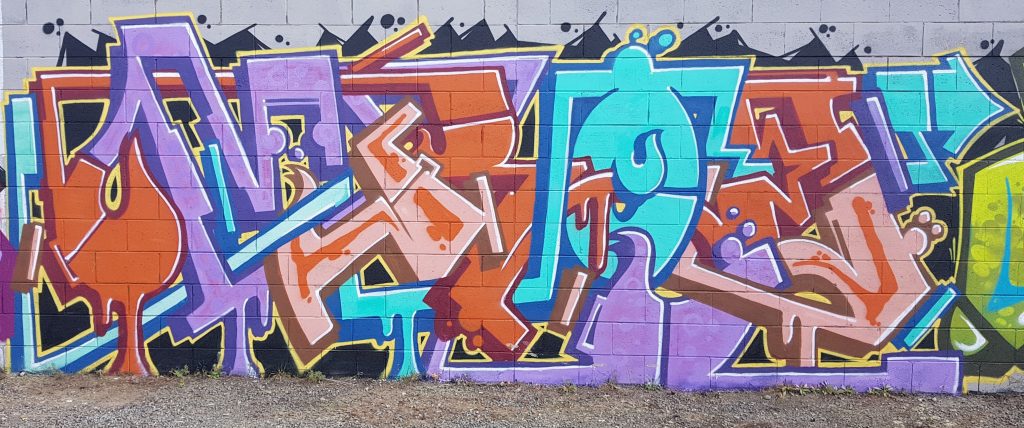
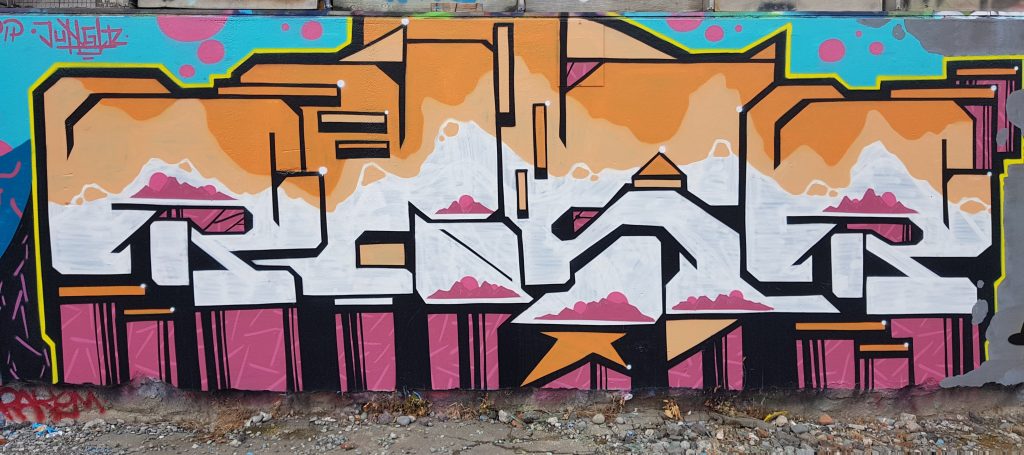
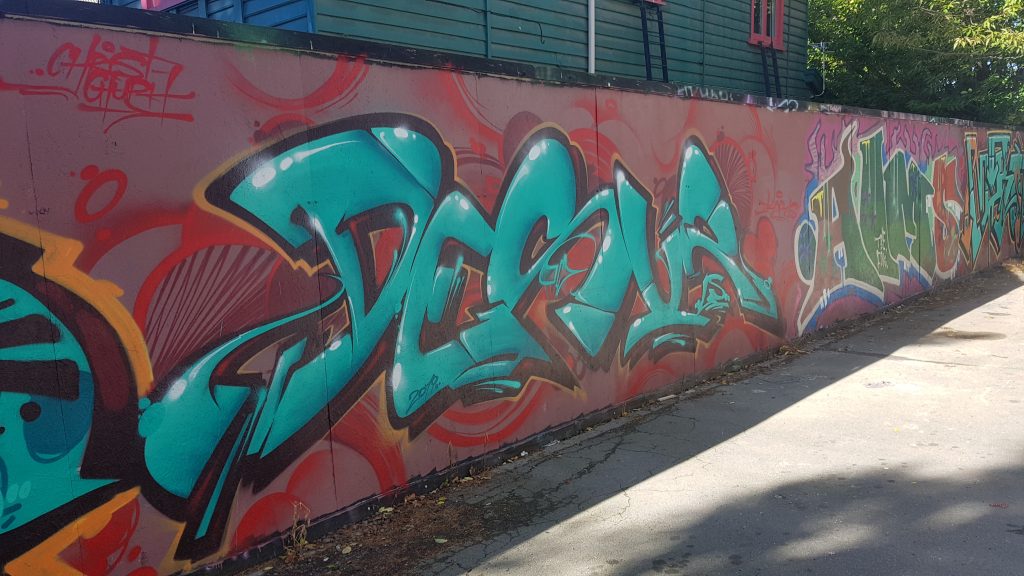
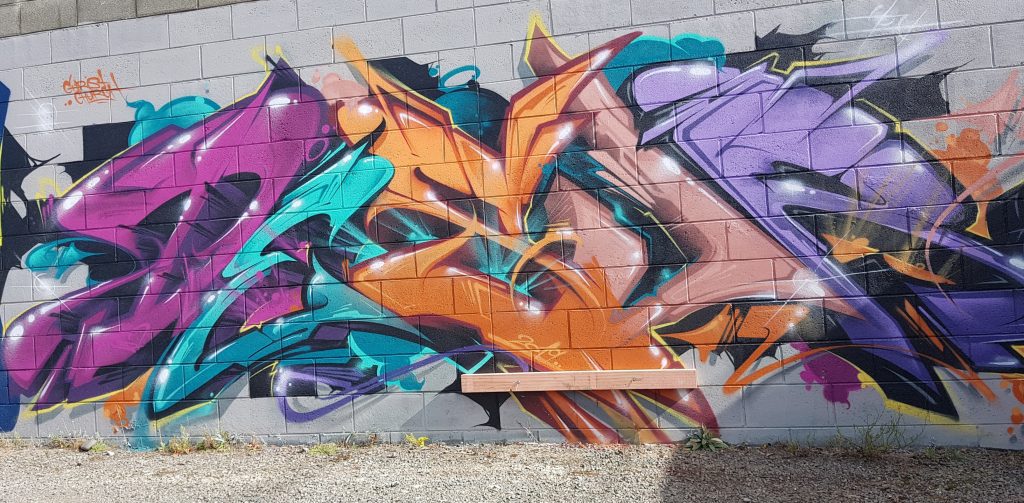
In the second part of our interview with Nick Lowry, we continue with a free-flowing dive into the physicality and urgency of painting, the influence of music, the process of collage and the need for creative diversity within tight-knit communities…
Talking about some of the formal elements, your letterforms seem to have become increasingly abstracted. The dissolution of letters into blocks or blobs or half circular forms, is that the result of thinking about letterforms, or moving away from letters?
I think when I paint graffiti, I’m using my arms a lot and I’m gesticulating a lot and I think my letter structure mirrors that…
They mirror the physicality?
Yeah, like a dance. I’m really wiping the wall, or I’m doing some crazy contemporary dance in my head and I’m articulating that with my hands. I try to be as fluid as possible. I hardly spend any time on my sketch, usually it’s just my fill colour. Why would I go back over my sketch and change up my letter structure if that’s my impulse? What I’ve just sketched is how I’m feeling obviously, so I’m just backtracking over my own emotional involvement by touching it up.
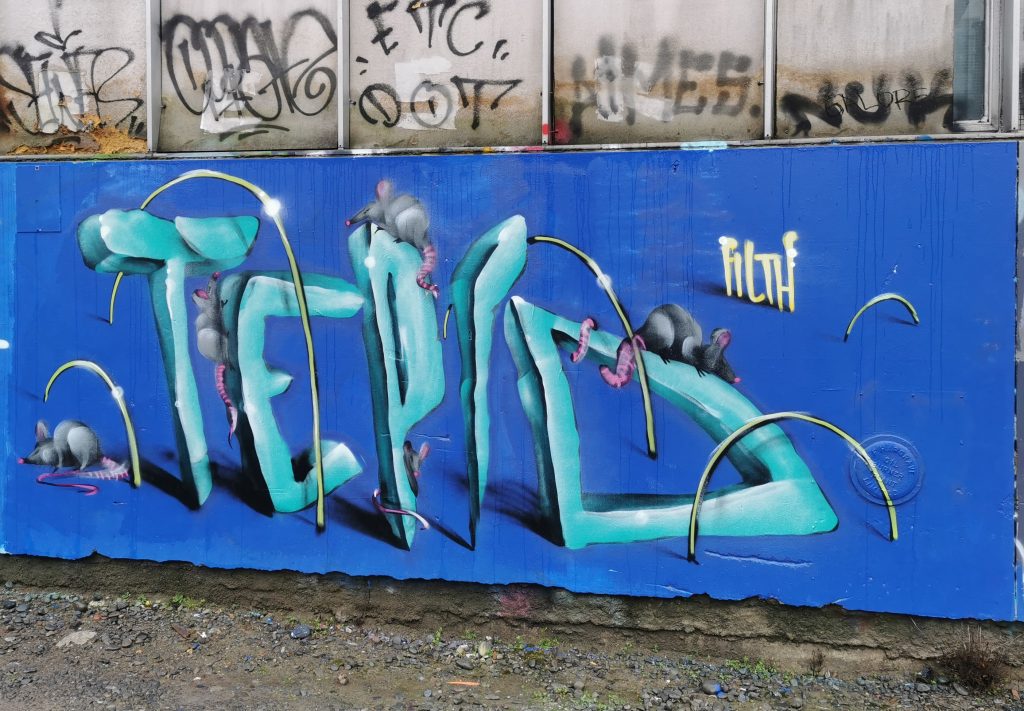
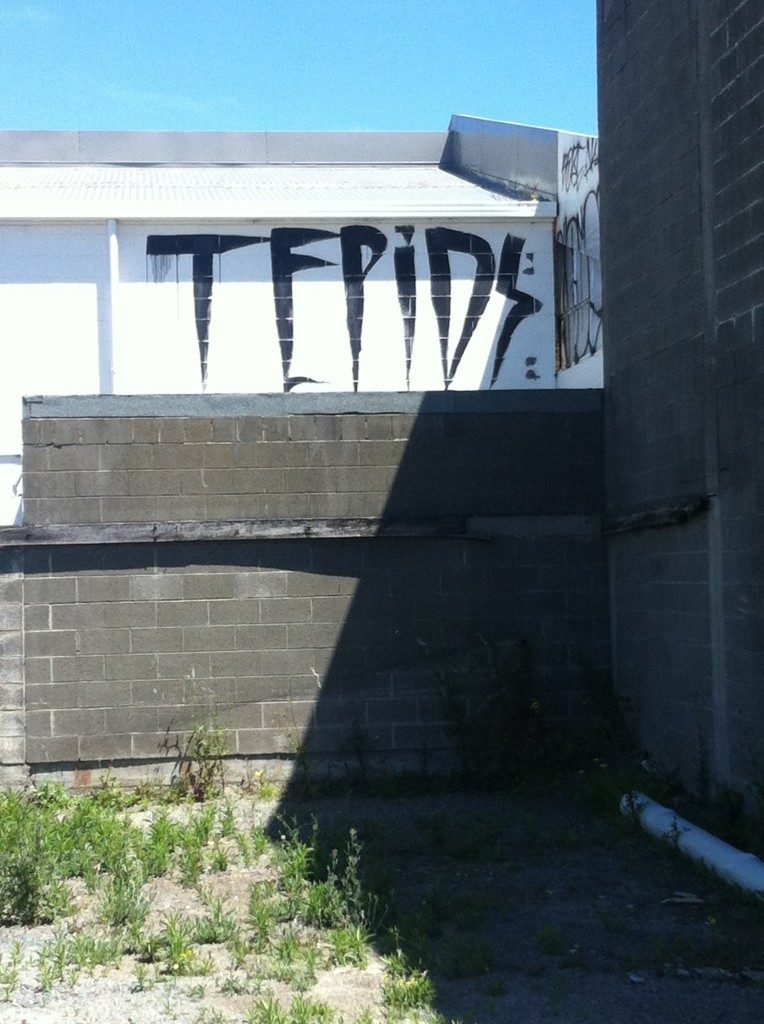
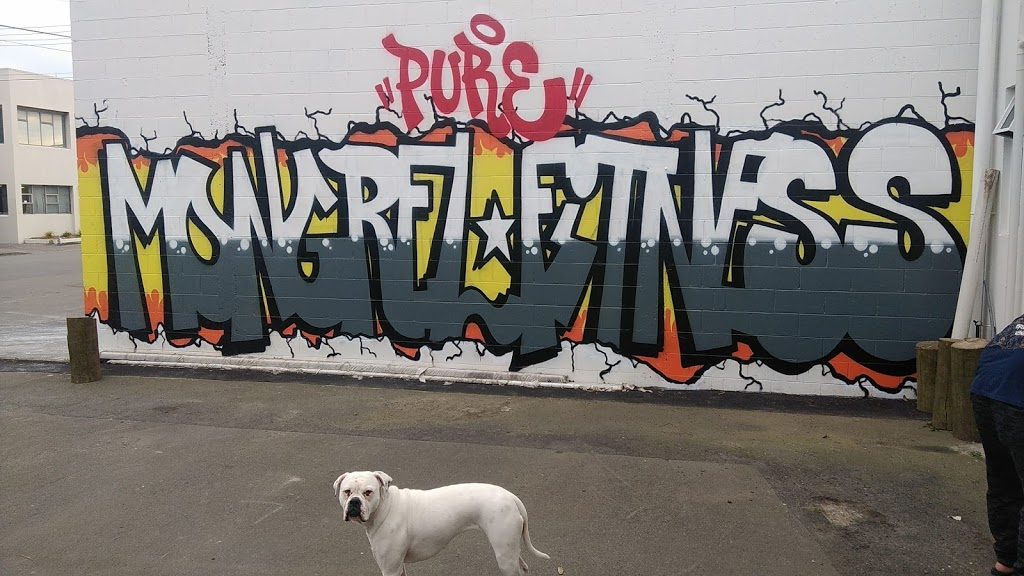
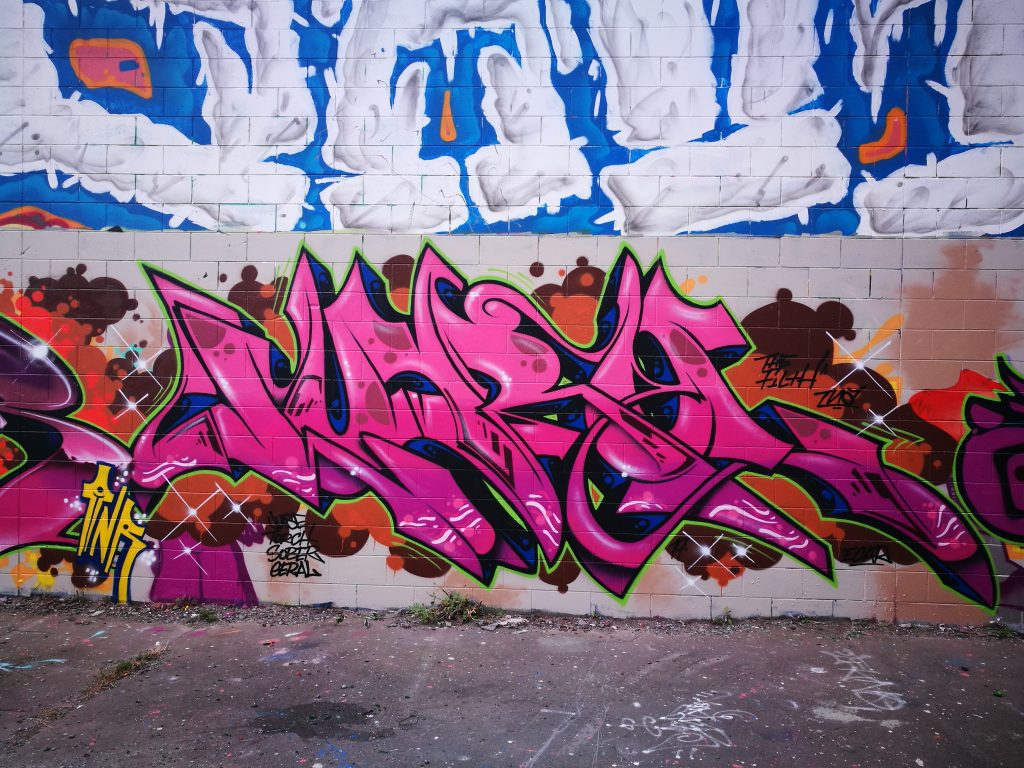
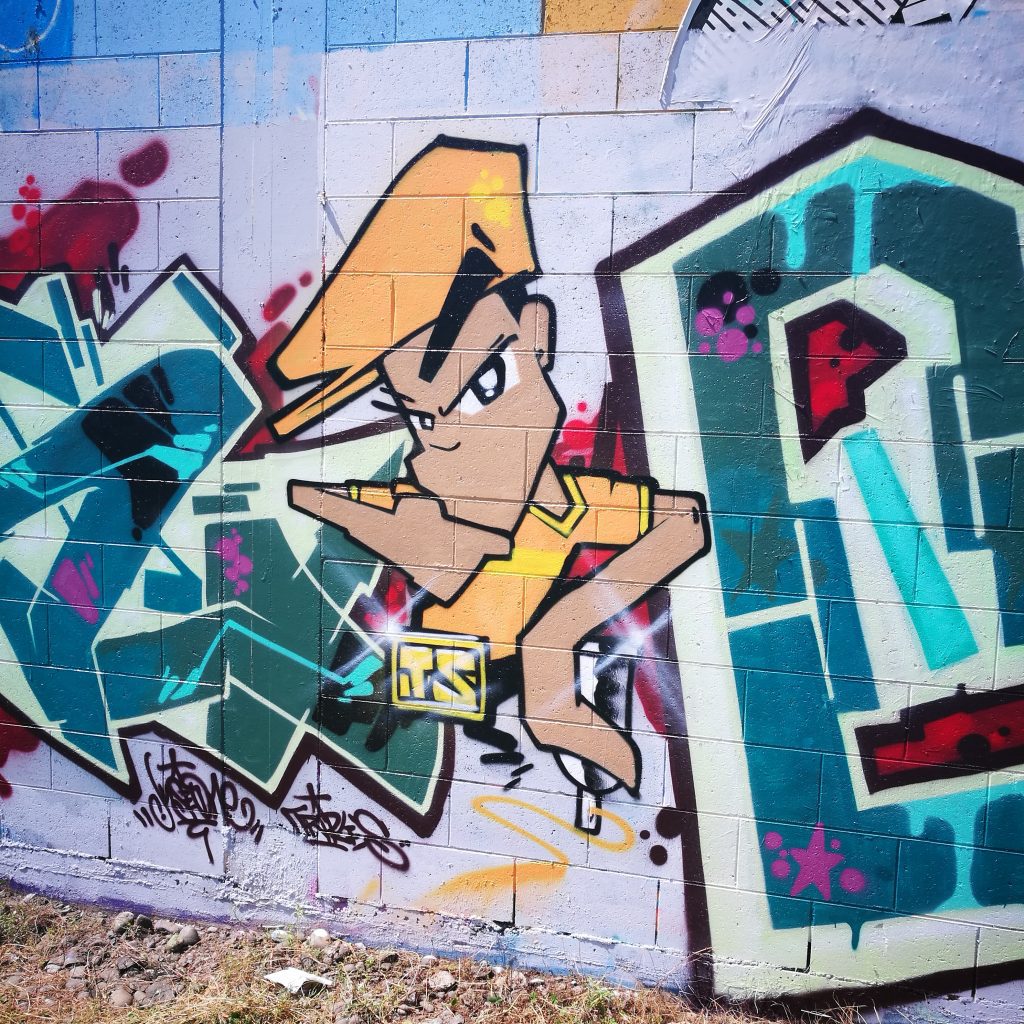
Tepid piece, central Christchurch, 2019
It comes back to that urgency and violence, and if you are redoing it, you are losing a lot of energy, right?
Yeah.
Having an idea beforehand and trying to replicate it is a very different approach to trying to make something that reflects a specific moment and emotion.
I don’t premeditate. I’ve chucked away all my sketch books, even from when I started. I chose to throw them away. I have photos on my computer of recent pieces, but I’ve lost hard drives of stuff from up until 2016. I feel like I want to get to a point where I don’t want to take any photos of the graffiti at all.
That would really make it about the singular experience of doing something in that moment, right? It’s no longer about a catalogue or a body of work…
I think that’s why I did it. Most people would cry if they lost their books, because they really love them, but for me, they are just collecting dust and getting eaten by rats. They are a ball and chain…
There’s a freedom in letting go?
Yeah absolutely.
In so much of your work there is a dynamic quality, a sense of action and movement, from the lines whipping across the plane, to this lovely flickering quality that your more recent works have, and even white highlights, which seem to be a recurring, enduring fixation.
That’s why I paint as fast as I can go, because I don’t want to lose that. I’m scared that it’s going to float away again.
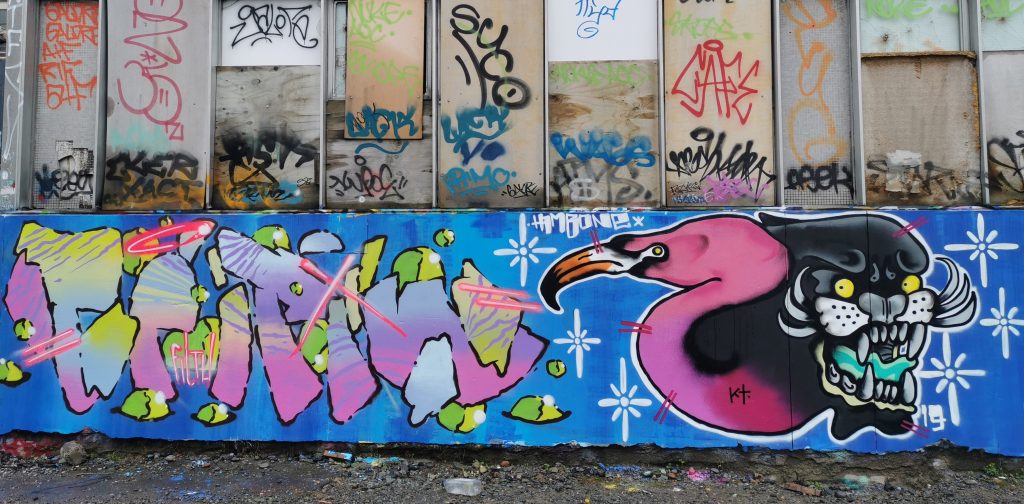
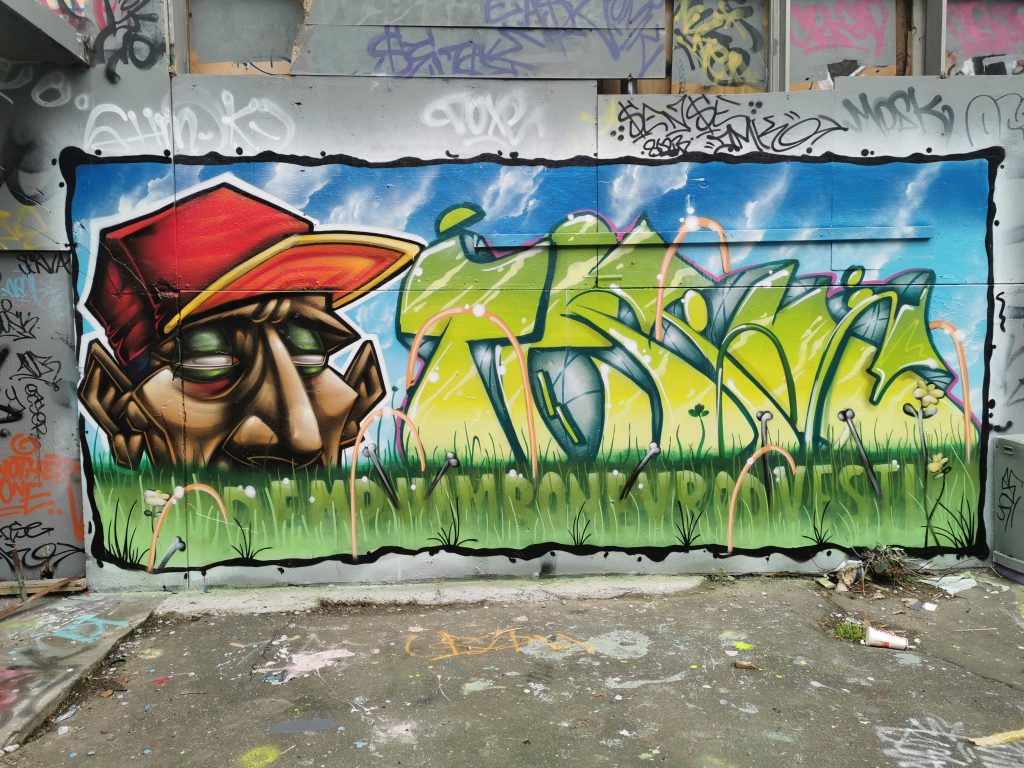
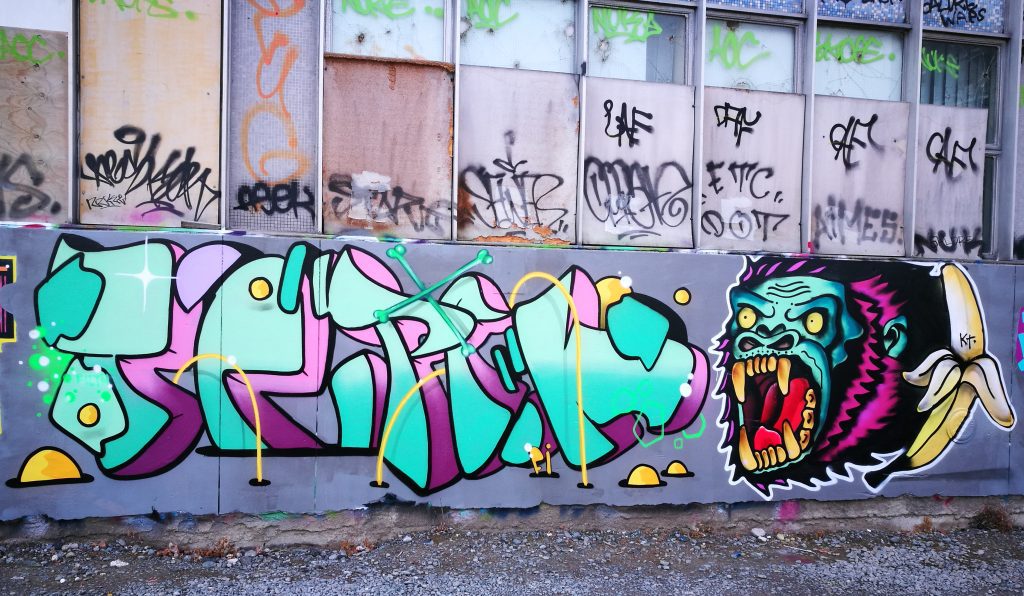
Tepid and Hambone colab, central Christchurch, 2019
Is it an interest in the use of shimmering light, of reflections and movement?
That’s a good word, shimmering. That’s precisely what I’m trying to create in my pieces, movement and the feeling that each piece is its own entity. I used to try and paint with traditional colour schemes, but now I’m looking at soft gradients, not even reflections, I’m just trying to create an emotional response through the colour palette, and I think by doing that I can try and put life in these pieces, and a sense of movement and electricity.
Those soft gradients have become definitive, or at least distinctive, and they often set your work apart from others around them, kind of dissolving the harshness and angularity of some other styles. There’s something about those soft gradients and transitions that ties to those wavering outlines and organic letter shapes as well, all of which make your work stand out…
Man, that makes me really want to paint again! (Laughs) Yeah, I guess those wavering lines are the gradients I’m trying to create, these beautiful soft gradients. I’m trying to be as clean as I can with the fill, as fast as I can, but as dusty as I can, and I think the wavering lines add to that sense of motion…
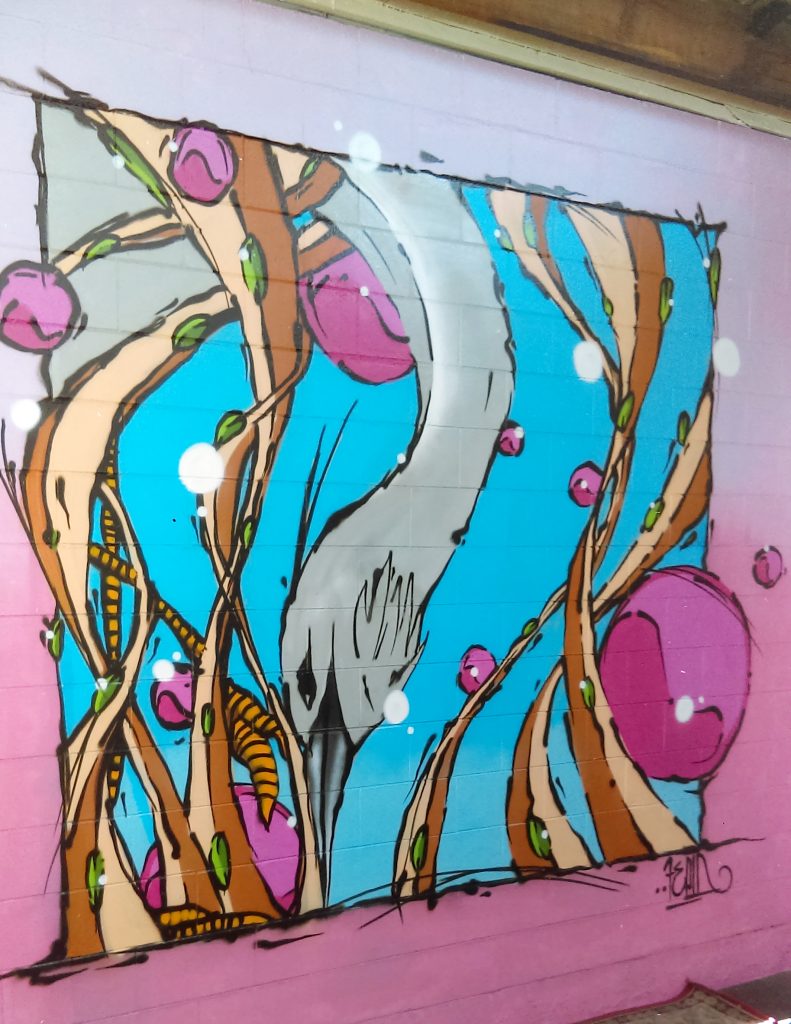
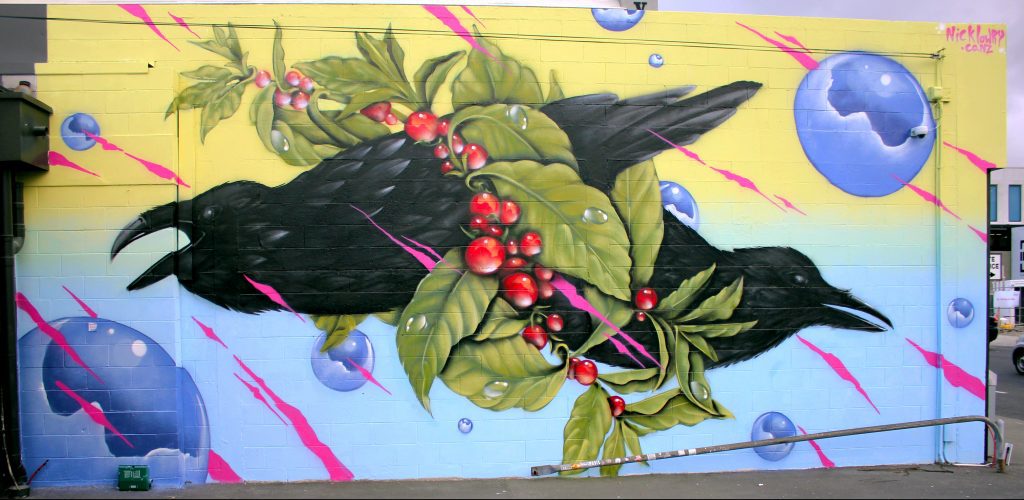
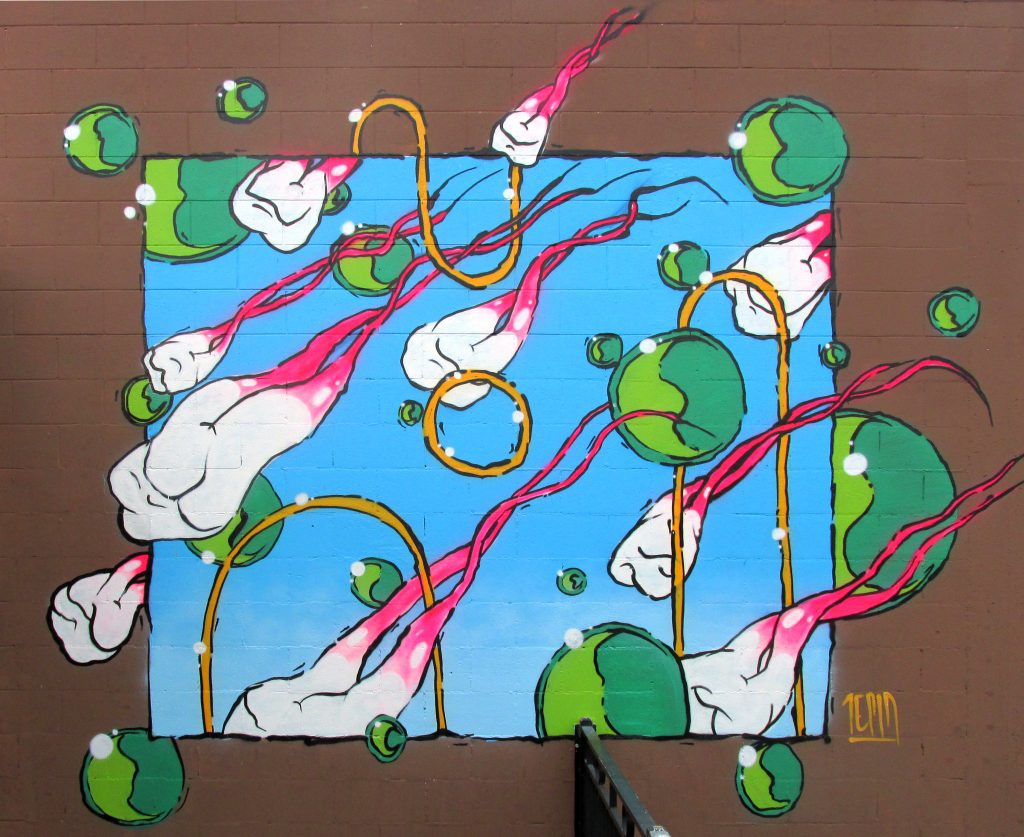
“Heron” mural, Christchurch, 2018
It seems to me that a lot of these qualities are related to the nature of aerosol, or the possibilities found in aerosol. There is a high level of can control obviously to get those effects, but there is also a freedom and that comes about through aerosol having certain characteristics, right? Is that something that interests you?
It did… I think it did, but now I feel like, especially with my outlines and details, my gradients, I need decent paint, because you can only achieve that with certain levels of paint, and colours that hold well to the wall. Although all the blacks and whites are generally acquired from wherever, just cheap brands that I’ve scabbed. Actually, a lot of my pieces are roller fills. I’ll do the base, you know, if it’s an orange with a softer yellow or lime green gradient over that, or whatever, and generally the heavier colour is a roll fill. And I find roller filling fun because it adds to the element of really smashing and grinding something down. I look at graffiti as sculpting as well. I think it is quite sculptural, you can start with a base shape and you just kind of chisel and shape it down with detail really.
Being that you have worked across so many fields, what experiences really stand out for you?
I guess with all the art forms that I engage with, there’s at least one or two things that stand out. When it comes to graffiti, a fond memory of mine is painting a piece in the open during the day illegally on the side of a dam in Margaret River and then hearing the alarm going off as I’m painting, finishing it, scrambling off, climbing out and then watching that thing wash down! With graffiti, I like the element of getting yourself into crazy situations, not that I focus on getting up or hitting the craziest spots, but the situations that I put myself into and walking around in really obscure places you wouldn’t usually go. It’s not so much to find a place to paint, it’s more the idea of exploring. You go out with the intention of painting because you have paint with you, but painting is only twenty percent of the time, the experience and everything else is what you are taking in visually and is filling the senses, filling that void of whatever I have! I don’t know what that is, but obviously I have one and I need to fill it! I think that’s eighty per cent of the reason why I do anything. With set design, I’ve had some pretty amazing jobs recently and looking back, I think it’s probably doing kids shows, anything for children. If you can deliver something to children that is going to stay in their minds forever and inspire them, I think that is so important. I still think about shows my parents used to take me to, shows at the Mill Theatre and all that, and I can still remember every detail. I do a lot of music videos as well, and I’ve had really good responses to the stuff I’ve been producing with some really good crews. I think the satisfaction of that and seeing yourself in another format is really satisfying and doing it all to music I like as well.
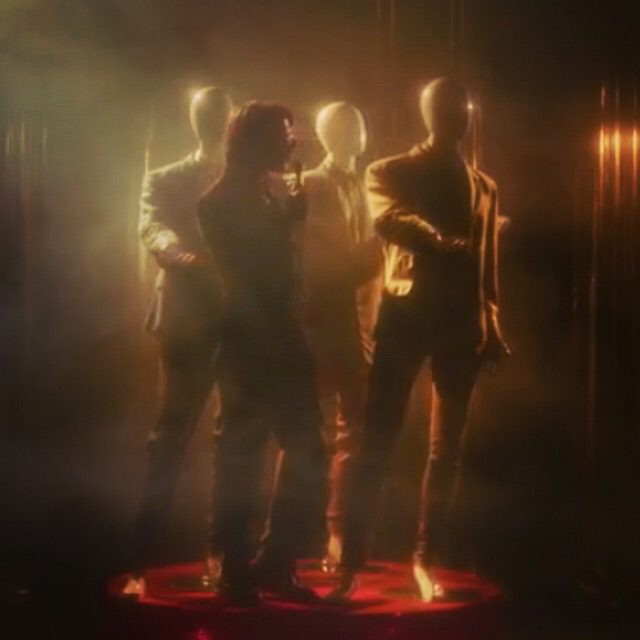
Still from the Aldous Harding music video for The Barrel, from her album Designer, art directed by Nick Lowry, 2018
When you are working on music videos, that relationship between the visual and the musical, does that make you reflect more on the influence of music on your visual arts practice? Music has been an enduring influence, right?
Forever, yeah…
You talked about the influence of punk and metal; can you define that influence visually?
I think it’s like when you are eating food and you kind of see with your nose. So, for me, with music, you can visualise certain energies in your mind. Music has always been this driving force for anything creative I’ve done, subliminally…
Is music always playing when you work?
Or not. Sometimes when I listen to music for days and days and days on end, just constantly, when it comes to making art, I try and tone down the amount of music or just don’t listen to it at all and just let that energy just come back out because I’ve done all the thinking and I just have to kind of let the process flow…
Which suggests reflection on the experience of listening. For some people listening to music becomes a background accompaniment, it fades into the background. It’s there and is driving action but not necessarily reflection. It sounds like for you it is actually a reflective thing as well…
Yeah, we are sponges, right? Whatever we expose ourselves to exists within us, and I think sometimes it’s nice to have that negative space and have nothingness around us and I think that’s when we can be in our most creative space.
That energy of the act of painting that we were just discussing, there’s obviously an echo with the energy of music, do you kind of see you paintings as musical in a sense, not overtly, like painting a song, but in terms of the rhythms and energies…
Absolutely, and I think for most people it’s the same, most people that paint or have some sort of visual expression, also love music and need music around them, and I think that is probably one of the driving forces of what I do.
Having talked about the why your interest in certain forms fluctuates, what has captured your energy currently? Are there any significant developments you see on the horizon?
Yeah, I mean I’m drawing a lot more now and I haven’t painted in a while. When I was in Perth five or six years ago, I used to paint a lot, and I was also painting graffiti, but I think I’ve kind of let painting go and now I’m trying to get back into it. I feel like I’m on the brink of dropping my guard on that again. Because I do put up boundaries, like I have with graffiti right now, I’m just like, I want to do something else. I think the painting one is about to come down, I’ve slowly started just playing around with stuff, heinous stuff, it’s not good, but it’s a start! (Laughs) I’ll just keep painting over and over until I feel like I’m juicing up again, you know?
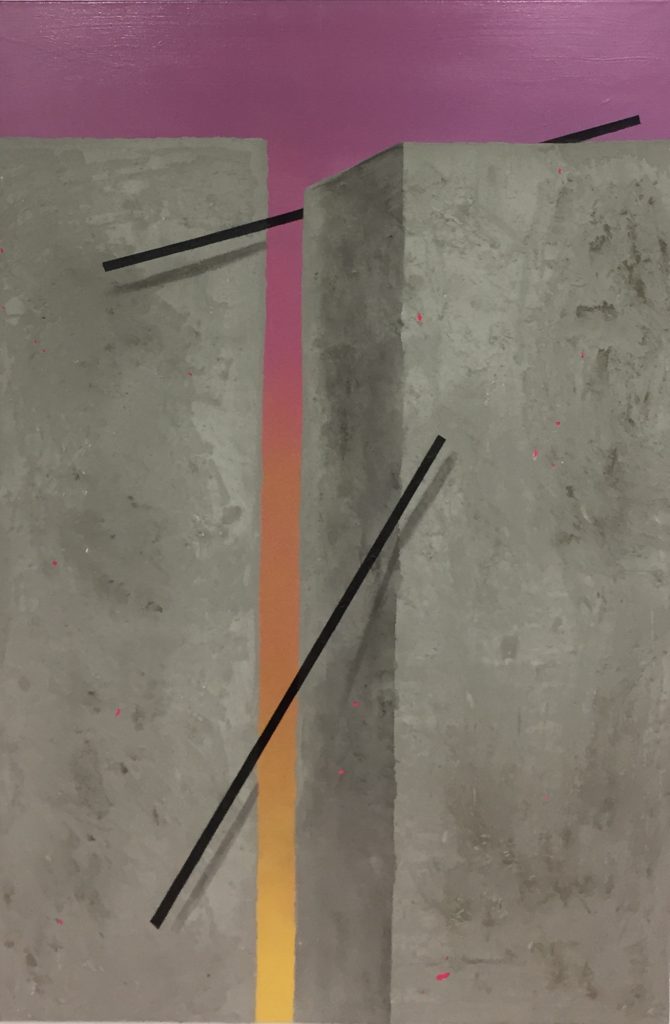
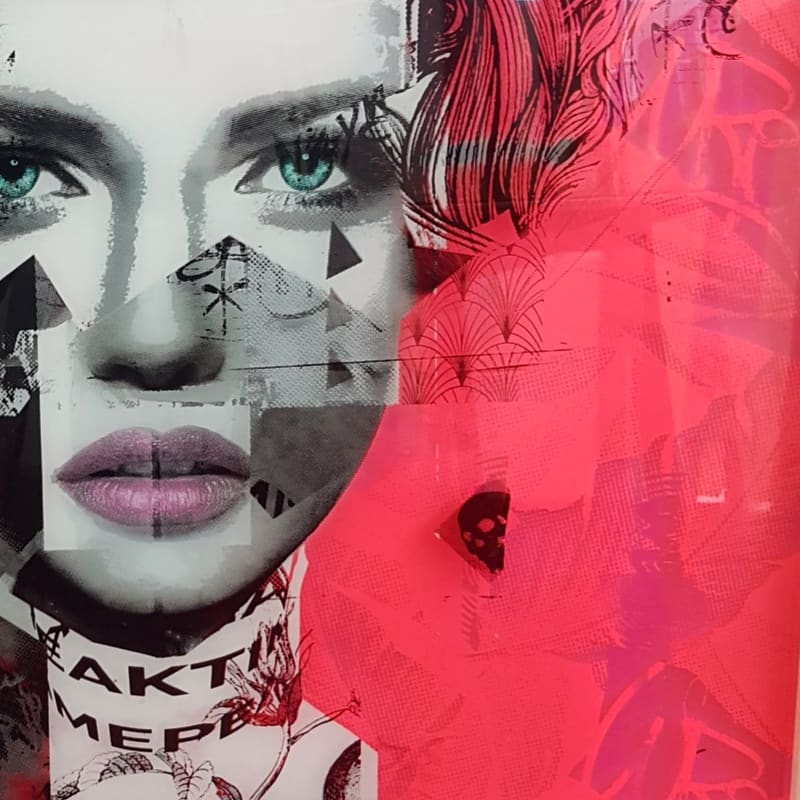
Untitled, mixed media on canvas, 2019
Are those elements of the gradients and colour schemes, the line work, are they still as strong?
Absolutely, I’m exploring the loose lines, and the very brushed fast geometry that doesn’t have to necessarily make sense but just exists, because if it did make sense, what’s the point of looking at it? It’s like watching a TV show that is not interesting, when it’s easy to watch and it has just been laid out for you.
You are not challenged…
But if you create something that doesn’t exist or shouldn’t exist or something that doesn’t even make sense, I think it’s more interesting because it’s up to the viewer to make sense of it…
What about your collage practice, do you see that as distinct to painting and more akin to your experience in film?
For me, collage is a very fast, quick way of expressing myself but also setting boundaries, you know? You are playing around with images that already exist.
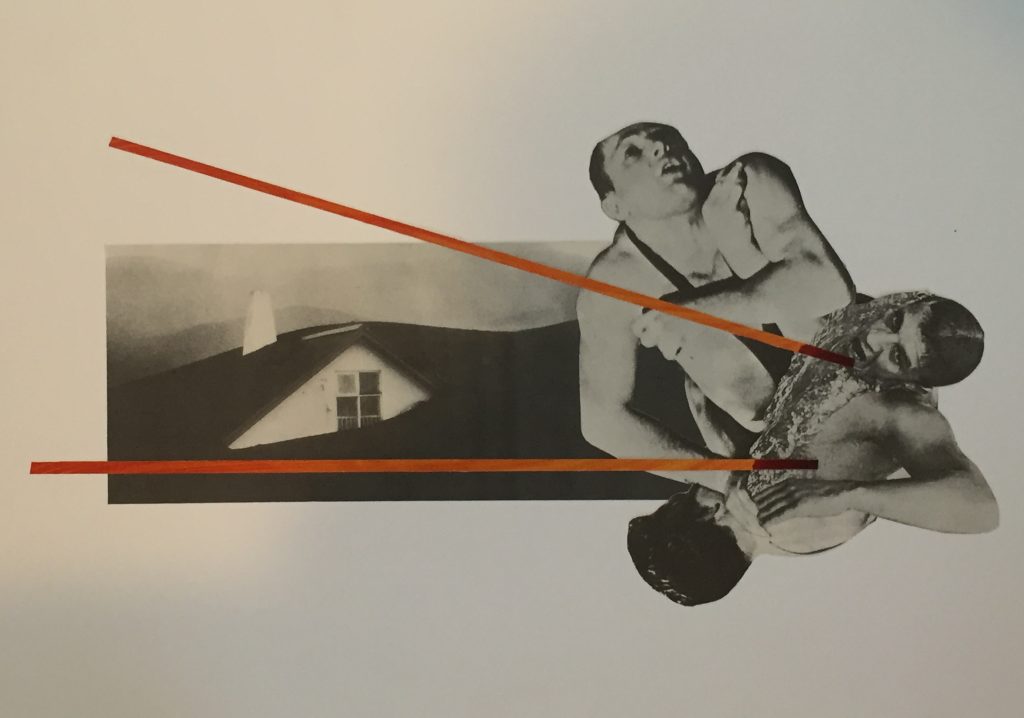
Untitled, collage on board, 2019
Do you apply the same element of urgency that we were talking about with your graffiti? Are you chucking them together quite quickly?
It’s all false perspective. I like the idea of having minimum images but creating the maximum depth possible. I think emotionally they are so fucking aggravating, and I really like that. They are really harsh to look at, they don’t look right, but… It’s hard to describe. Because I do them so fast and because I’m doing them with a blade, there is a physicality and I’m really having to scratch myself and grind into it and rip and tear, and there’s that element of violence that I really enjoy, that we all have in us, and it’s very human, it’s just how you get it out.
Like graffiti in a way, right? The need to get something out, and to do so in a certain way, it is lost on some people who shut themselves off from it, but it is an outlet for a very human need…
It’s very primitive.
Which is why I still find it strange that people are so emotional in their response to and vilification of graffiti…
I kind of like the idea that it is vilified, if it was loved by everyone, what would be the point?
True, and that’s often overlooked by people who don’t get that side of it, channelling it into positive directions is good in some cases, but it also means that it is not what it was. Is there anything you want to tell people about?
I have recently provided art direction for three music videos about to come out, so people should see them. But, mostly, I think I just want people to get off Instagram and see the art for themselves, to be in front of it and smell it and touch it. I just want to try and promote that, to promote that regaining of the sense of uncontrolled-ness, and how we should all be less homogenised. Socially we should be forming a greater sense of community, but creatively we should be pulling away from each other, if that makes sense…
We can be together and unified as communities, but creatively, the more diversity the better for those communities…
Yeah, and I think this is the time to do that in Christchurch as well. We’ve had to band together and now we have to create a split, to form new dynamics within our communities and cultures so we can then really start to get the ball rolling and become a creative powerhouse as a city. Also, I think, in Christchurch, get on your bike! Like literally, get on your bicycle and roam around and check it out, because there’s a broader part of Christchurch that people don’t explore or don’t know exists, or they do, but they are too scared to get out there…
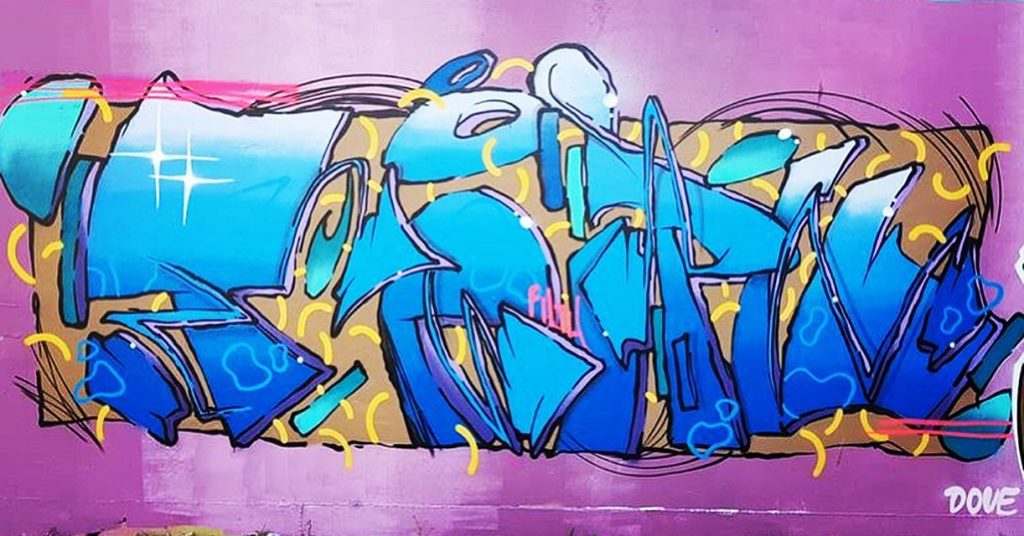
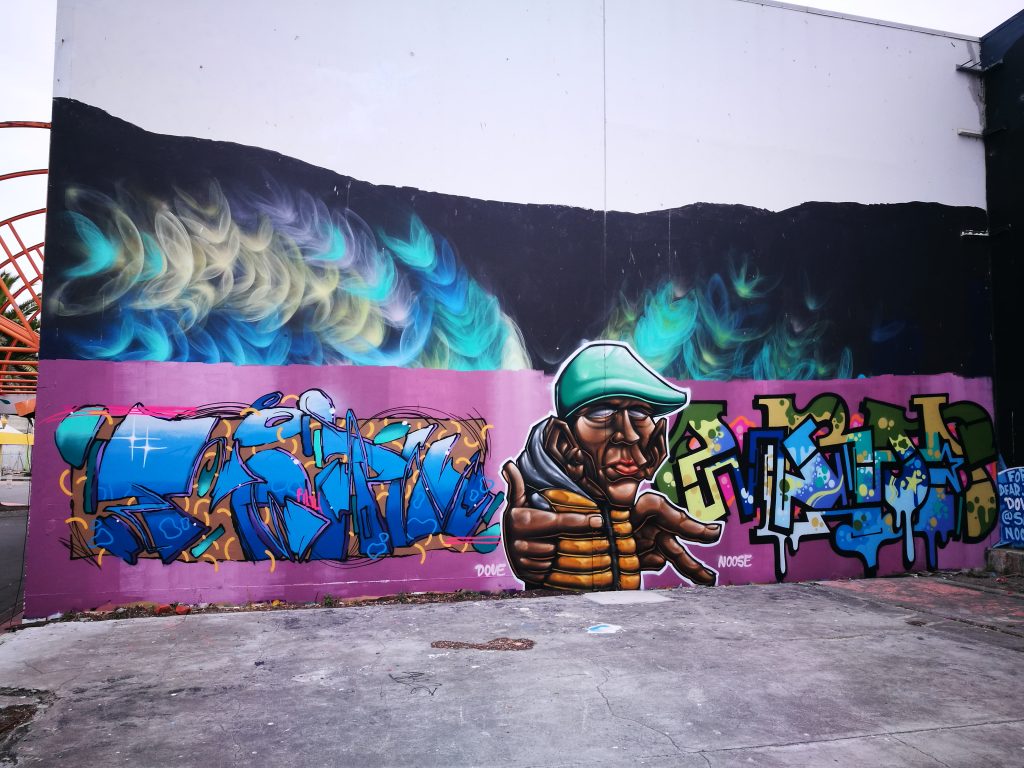
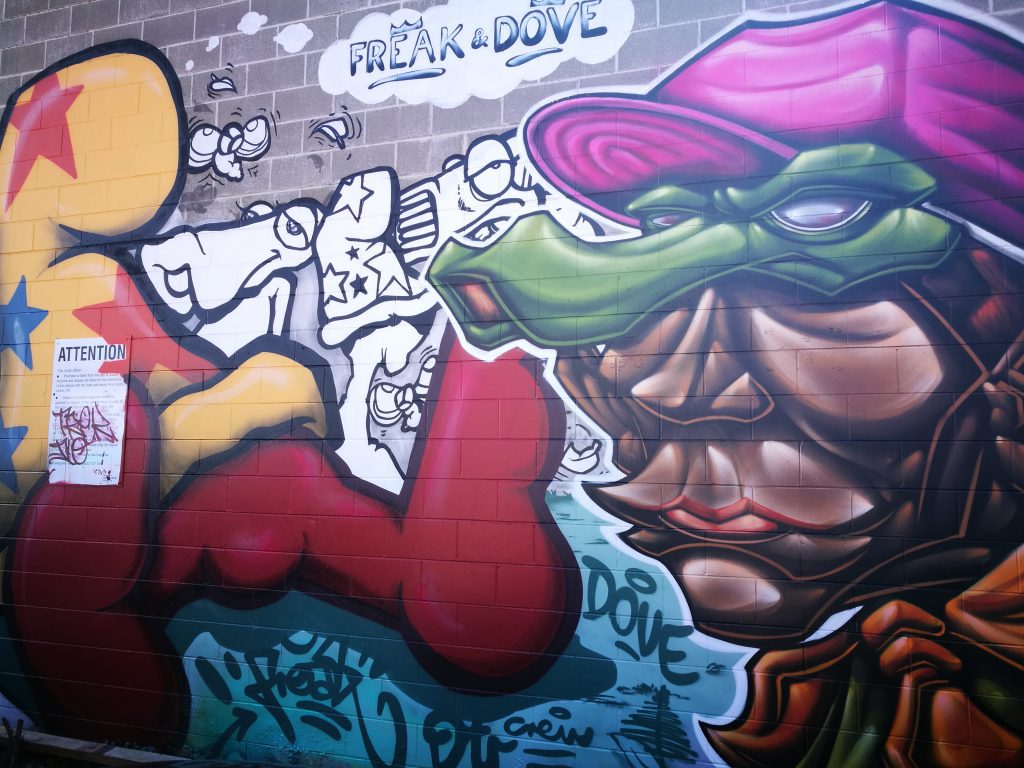
Tepid and Dove colab, central Christchurch, 2019
We often avoid getting outside of our comfort or routine, and that’s the beauty of walking or cycling, you can easily verge off down a side street, go down an alleyway, do things that will lead to experiences that are unexpected, but can be quite life affirming.
Definitely, and it’s a slow down as well, it slows you down to be able to accept everything that you come across. I love Christchurch, it’s sometimes hard to live here, but it does have these beautiful aspects about it that are undeniably so good!
When I arranged to sit down with Nick Lowry (at times known as Tepid), I wasn’t sure where the conversation might lead. This wasn’t a reflection of Nick’s temperament, he is a chill guy who is instantly likeable, instead, it was based on the reality that his work is spread in so many directions that there were almost infinite possibilities. When we started to chat, it became pretty obvious that we would sprawl across various topics, shifting back and forth, an apt reflection of Nick’s process as a maker and doer. As a graffiti artist, muralist, painter, collagist, set designer, art director, sticker maker and more, it was fascinating to see how he distinguished these practices, but also had a defined understanding of his creative impulses in a singular sense. It was quickly apparent that Nick’s compulsion to make things is driven by a deep urge, one that doesn’t necessarily require explanation or understanding, but instead is a very human condition that invokes all the contradictions of our nature. By the time we came up for air, an hour had flown by and we had discussed a raft of ideas around graffiti, surfing, music, scenic art, exploring cities, and overthinking things. It is no surprise then that this has become a two-part interview, and here in part one, we start with the diversity of his work, his introduction to graffiti and his thoughts on his hometown of Christchurch…
From graffiti, stickers and mural works, to set design and film art direction, diversity is kind of a hallmark of your work. What was the earliest creative impulse for you? Was graffiti a gateway into other creative practices, or was it more of a vehicle that harnessed your existing creative impulses?
I think it was more of a vehicle. It was probably intrigue that sparked it off. When I was twelve years old, I had a babysitter, he was probably sixteen, and he wouldn’t feed me until I smoked a joint and watched him paint freights in Belfast, which is pretty funny. So, for me it was almost this hatred of graffiti because I wasn’t getting fed unless I helped this guy out, you know? I hated it until I was about sixteen when I became mates with some guys who were painting, Fader, Astro, Raws, Venom, all those dudes. They were all mates from university. I was watching what they were doing, and I was like, this is actually a really intelligent form of art! Up until then I had always been drawing. I’d been drawing forever. I was really into, strangely enough at a young age, interior design. All through high school I was always building dioramas. So, at an early age I was exploring set design, scenic art and that sort of thing. One of my first jobs was a scenic artist in the Riccarton Players Club, at the Mill Theatre in Addington. Before that was destroyed. So, I think there is a real cross-over for me between graffiti and scenic art, in that there is a really blurry line. When I paint graffiti, I don’t paint for the ‘getting up’, I paint purely for the way colours work and for the names that I’ve chosen over the years. It’s simply a vehicle for style, like it is for a lot of graffiti writers, I guess. Like I said before, I’m just creating these little worlds and the diversity of my art just comes down to how I feel on any particular day. Some weeks I put a lot more effort into collaging or into graffiti, or into set design or muralism, or realism, or just hustling for work. I’ve never been fully immersed in anything. I don’t want to be typecast. I don’t want to be known for anything. I just do it for myself, and everything I do is simply an outlet.
There must be a consistent thread through it all though, something that unifies everything in some way, can you see the way they all interrelate?
Oh definitely…
Not only aesthetically or stylistically, but in the practice and process of each, is that something you think about?
Yeah, I guess I don’t really think that deeply into it. It’s almost like with a creative act, the more I think about it, the less I want to do it. For me being creative is a way of not thinking at all, and that’s why I probably don’t produce as much as I should. But I don’t want to have to think about producing a lot of things, because for me, that just creates pressure and I don’t like that! (Laughs)
Tepid roller tag, central Christchurch, c.2013
That freedom is important?
The freedom of it is really important. It is what it is, and if one week I make fifty collages and for the next three weeks I don’t do anything, it’s because I’ve transferred my energy into something else. I like to surf a lot, and that is one of my most creative outlets. If I’m not making art, I like to do that. I also like to run a lot, and that is strangely another creative outlet because a lot of thought processes go on during that time. I think having physical outlets is really important.
There is a physicality in wall painting and in set design as well, so there is inherently a connection between physical activity and the act of creation in those instances. Conversely, in the case of running there is a sense of freedom, physical but also by extension mental, while surfing offers a physical creative performance…
It’s a release of a certain type of energy. We get a taste and I think we always want to feel that energy again. I like having a diverse range of things that get me to feel differently. I don’t really think about achieving a consistent style, but sometimes, if I look around this room, if I blur my eyes a little bit, I can kind of see something. I don’t really know how to describe it. I don’t really think about what I do to the point where I can do that.
You talked about leaving things and letting them evolve subconsciously, before coming back to it when it has worked itself through…
Yeah, I just sort of nurture it in my mind and come back to it.
Do you see your work in a progressive sense? Can you look back over time and see a lineage, or are there various trajectories between different points because of that willingness to leave things? For instance, is muralism a progression from graffiti?
I think my muralism is quite immature and unrefined. it’s one of those things that is more of a hobby. Muralism is probably the hardest thing for me, because I am quite critical of what I do, and I prefer to do things for myself. With a mural, you have so much pressure to create something that’s for the viewer and I generally don’t care about the viewer! (Laughs) But at the same time I would like to produce more, and over time it is getting better and I am trying to refine the style. But I don’t visit muralism as much. Maybe I will in the future, but at the moment it isn’t a massive priority. Whereas I think set design is helping me to evolve that further because I have to work within a limited space, and I think that kind of helps set me up mentally.
Mural for Underground Coffee, Durham Street, Christchurch, 2019
You mean when you are designing a set you are working within a defined space and creating a defined world? Which to me, kind of echoes graffiti and muralism in that you are trying to create something within the space around you…
It’s too much. With muralism, there is almost too much you can do. You aren’t restricted by physics. I like being bound and restrained; you know? If I was given three colours or something and told to only use those colours, perhaps I could manage it. But I think with muralism, it is too easy to overthink it. With set design and art direction, you are given a space and an actor or dialogue, and you are confined to that, and that’s how I like to work.
Did you train in set design at all?
No, I studied graphic design, video post-production and editing.
How deeply do you think about the conceptual approach to set design? Are you constantly thinking practically, in a real-world sense, or do you explore an abstract concept beyond the visual and how an environment might be multi-layered?
Definitely, and I think that’s the beauty of it, you are creating a world through which someone is going to speak their dialogue and it doesn’t have to be literal. In fact, they want it to be as non-literal as possible, so the actor then has a space from which to bounce off, I guess.
You’ve got to achieve that balance between the nuances of each approach…
You also have to think about lighting and shadow, and the way those elements work, so there are a lot of things to consider.
This all leads me to back track a little bit. You mentioned that you didn’t come at graffiti through the traditional ways of Subway Art and Style Wars, or even hip-hop culture necessarily…
No, it was the direct influence of my peers, this supposed babysitter! (Laughs) Just being there when it was being done. My direct influences were my friends, watching things getting destroyed, skating and things like that…
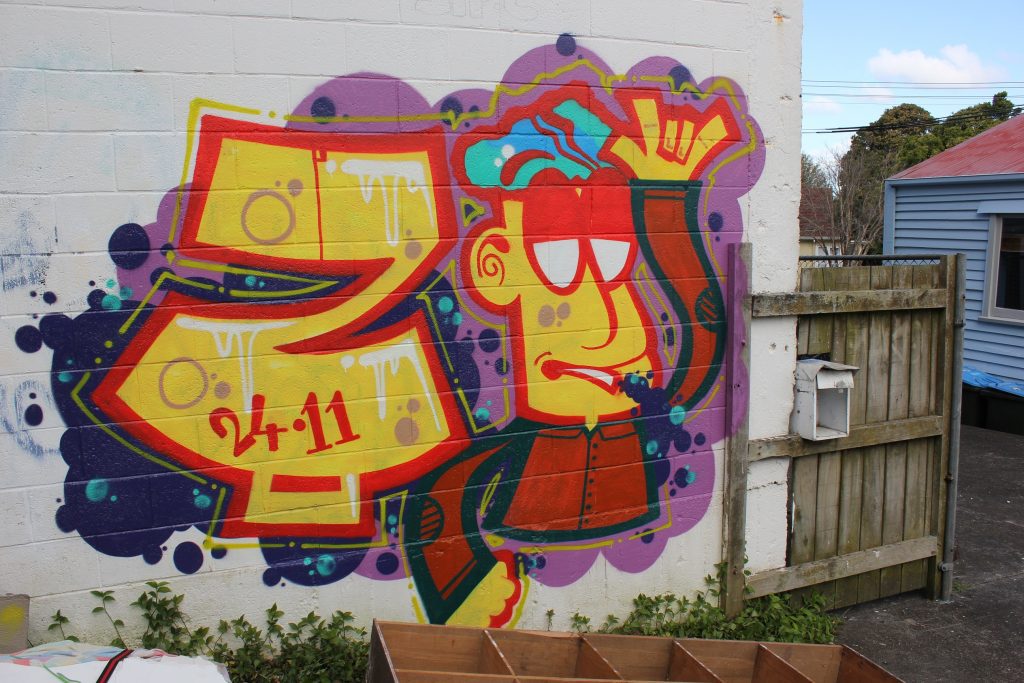
Tepid piece, Christchurch, 2019
Does that mean you had more or less of a recognition of the importance of graffiti as a sub-cultural and even historical phenomenon?
I soon learnt. Once I formed that obsession with tagging and throw ups and all the rest, I quickly picked up every book I could, watched every film I could, researched every writer throughout history and then formed obsessions with certain writers and created heroes and stuff like that. So, I soon schooled myself and became obsessed with graffiti and street art.
Were you conscious of the idea of graffiti as a political act and the themes of identity and contestation? Or was that aspect always secondary to the draw of being creative? Although creativity through destruction is political in a way…
I think the importance of graffiti and my understanding of it was about being in a moment in time and the way you deliver it, the aggression behind it and being with other writers. Not to sound like graffiti is a macho thing, but you are with the crew and you are outdoing each other. I liked the idea that there was this aggressive, ‘fuck you’ element to it. The punk influences behind graffiti for me were the main thing when I was younger…
You mentioned the punk influence earlier, which is often overshadowed by hip hop, but punk is a significant influence on graffiti and street art culture…
For me, Christchurch metal was a big influence, which I guess is like the punk ethos. I was a young metal head, but I had a broad spectrum of friends, a lot were really goth, but a lot were also really G, so there was a cross over. But we were all hanging out together. There were skaters and goths and G’s at parties, everyone was hanging out together. I didn’t want to box myself into any one circle. For me, graffiti was a thing that didn’t exist in any boxes, because my social circles didn’t fit into those boxes…
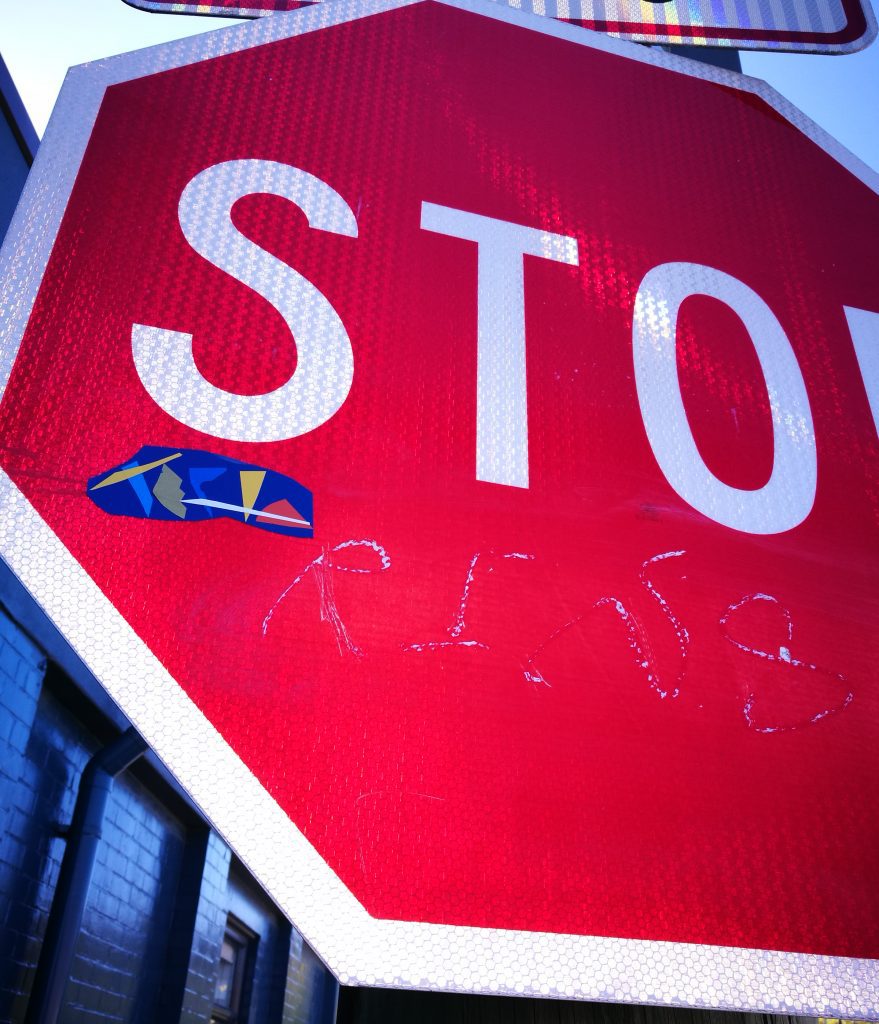
Handmade Tepid sticker, central Christchurch, 2018
Christchurch is a small city, so it is more likely that those scenes will intermingle, right? Speaking of Christchurch, what impact has the city itself had on you as an artist? How big an impact do you think the quakes have had on the city’s creative communities?
Well, I spent a lot of my twenties away from Christchurch, in Perth, in Margaret River and in Broome in Western Australia, exploring the desert. I also spent a lot of time in Indonesia and exploring the Philippines. So, when the February 2011 earthquake hit, I was here for two months, and I was like, I don’t have to be here. I had travelled enough to know there was more out there and I could access that with a $400 plane ticket, so I was out…
So, those experiences travelling, have they influenced the way you think about the post-quake city? Has painting pre-quake given you a certain take on the city now?
I enjoy Christchurch’s dark underbelly and industrial vibes. I think it has this very rigid, grey stone element that I quite like, but that a lot of people despise. The city is kind of a juxtaposition of these lovely blue skies and then this grey, sterile, and weathered architecture, which I don’t know, is just kind of a strange mix. And then we are surrounded by natural beauty, if you are willing to go find it. I think it is the most schizophrenic environment to be in, you know? (Laughs) We have this white and seemingly uncultured city, but then we have these explosions of music, like you were saying before, the amount of music that comes out of Christchurch is phenomenal, explosions of art and artists and everything else. There is something in the water in Christchurch, for sure, for a population of 400,000. Maybe it is that energy of where we are geographically?
Since coming back to Christchurch in 2015, have you found new directions have opened up for you as a creative?
It has opened so many doors. I think Christchurch has changed, it’s not as gritty and grimy as it used to be. But for a creative, someone who is on their own, trying to hustle for work, it’s amazing. You can create so many opportunities for yourself, whatever you can envision in your mind, you can achieve, it just depends on how far you are willing to push yourself.
Tepid and Hambone colab, central Christchurch, 2019
Does that surprise you, based on your experiences when you were younger?
I think those avenues probably existed then, but the situation didn’t allow us to have that train of thought. Whereas now when you come back and you are left with limited things to do, you really have to, in order to dig yourself out of a hole, you really have to dig, but you don’t have to dig too far to get what you want out of it. There are so many possibilities. There is not a lot that exists in Christchurch, so if you have an idea and you want to get it, you will get it.
It is almost a perfect storm because of the opportunities presented by the recovery, but also, I think, in our contemporary digital world, you can access and experience so many ideas that people are exploring all over the place and translate them to this environment if you want. The inspiration coupled with the opportunity is perhaps unlike any other time…
Definitely.
Although, I guess that can create a sense of homogeneity.
It can be a little bit homogenised sometimes.
I’m interested to talk about some of the more recent work you have been making, and particularly the features of fluorescent colours and wavering lines…
It’s kind of more painterly…
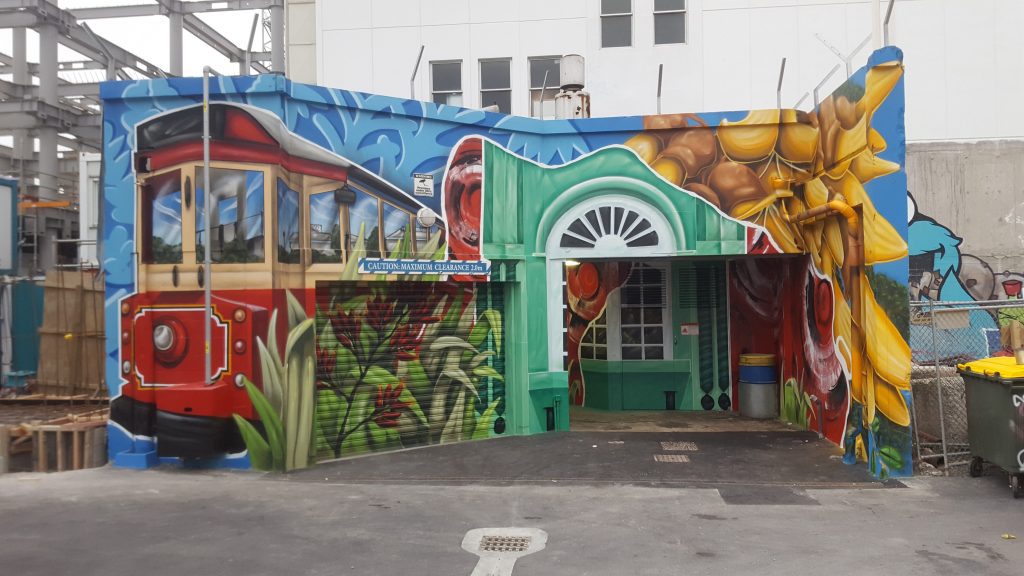
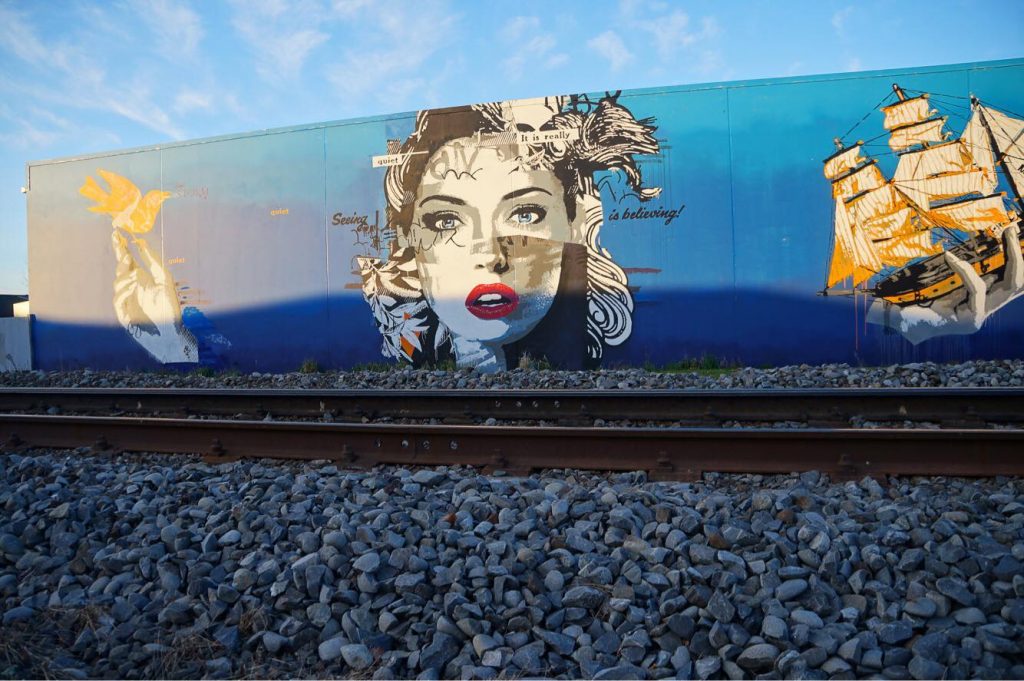
“Teeth” mural, Arcadia, central Christchurch, 2019
What is the inspiration for that?
Um I guess, physicality. If I’m making something, I don’t want it to look perfect, I don’t want it to look like it is clean cut or fresh. I was obsessed with painting like that in the past, but I found that as soon as I tried to paint more fluidly, I enjoyed it more. I think it’s more human to paint as rushed and as aggressively as possible. It’s like that classic car crash advertisement: ‘The faster you go the bigger the mess.’ The bigger the mess is awesome! So, much to the bane of all my mates who I paint with, I fucking rush my paintings. I always rush my graffiti, and it’s not because I want to get in and get out, it’s because I feel like I want to spew it out, I want to vomit my shit on the wall, you know? I don’t want to think about too much, because I think you can overthink things and you can overcook it. It’s not like graffiti is ‘get in, get out’, because I’m not doing anything illegal at the moment, sadly. I wish I could, but I’m just an old man! But when I do paint a piece on a wall, I just literally want to smash it…
Is it a need to replicate the energy you get when you do paint illegally? By painting with that speed, there’s an energy that echoes being somewhere you aren’t supposed to be, doing something you aren’t supposed to do, and the work will reflect that…
Definitely. I painted illegal graffiti when I was younger and I got caught enough to be like, fuck! But graffiti is graffiti and if you are not rushing it, why are you painting it? That’s the whole expression, to smash it out. It is a violent art form. As chill as you are, I think the point of graffiti for me is to make it look like it’s going to smash you in the face. I like things that look violent and have that emotional response, like you are going to get fucking sliced or whatever. But then I like to create these really funky colour schemes as well, with really soft gradients, which is my connection to nature, so maybe one day I want to die on the hills violently! I don’t know, maybe I want to get eaten by a shark? Maybe I try to create pieces that look like a violent beautiful death, or something…
August might not have had the greatest weather, but it still provided a number of highlights that served as doses of sunshine, from exhibitions to the New Zealand International Film Festival. For good measure, I even managed a trip out of town to Wellington (it rained, but I got breakfast at Sweet Mother’s Kitchen, so I didn’t care), where you can always find something interesting while exploring. So, if you can get over the disappointment of not having a guest columnist this month, here is my personal top five from August 2019…
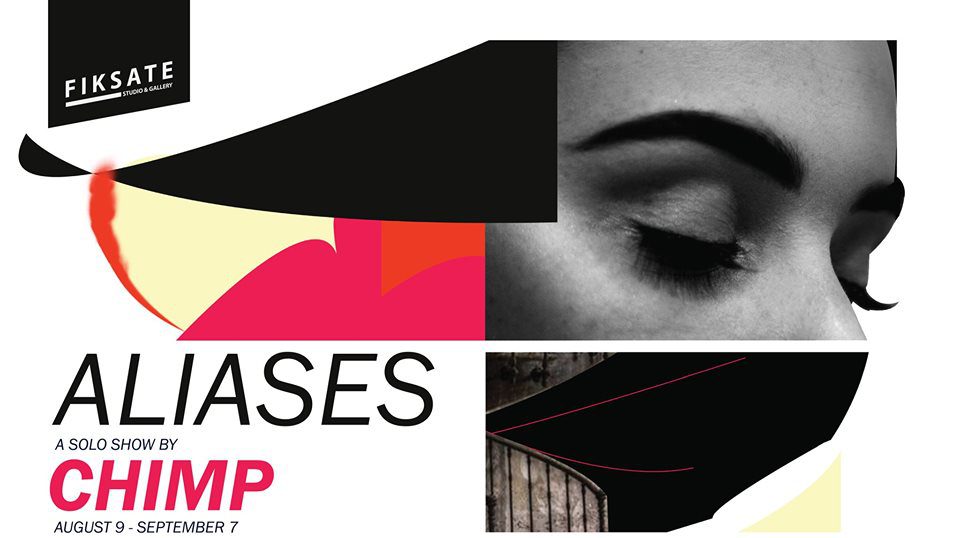
Chimp – Aliases
Wellington artist Chimp was already familiar to Christchurch through his fantastic Justice and Emergency Services Precinct mural Organic Matters, and in August the city got a deeper insight into his evolving practice – the technical flourishes and superb detail of his mural work were joined by abstract forms and urban references in the body of work that formed Aliases. Chimp spent the week building up to the show in town and hanging out with the Fiksate crew, doing radio interviews and filming promo material, not to mention the busy opening night…
A Weekend in Wellington
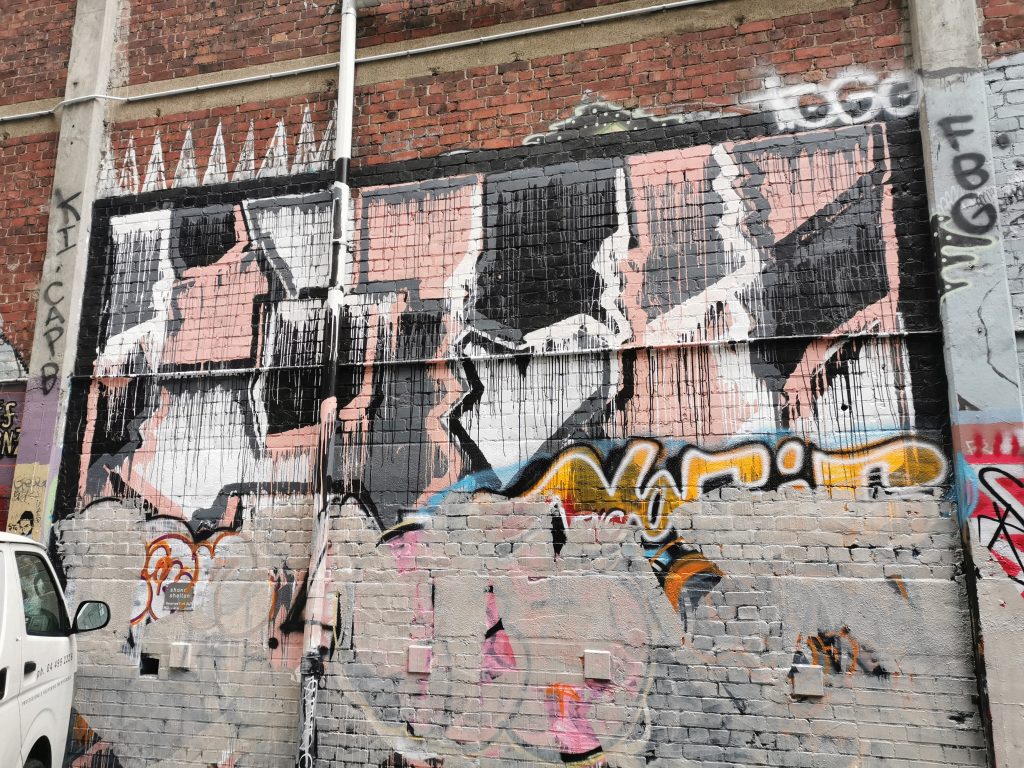
A Togo piece in central Wellington, August 2019
I heading up to the capital for a friend’s birthday party in early August, and it was a timely reminder of why a new environment can energise your appreciation of your own surrounding landscape. Following my nose and wandering down alleyways in central Wellington, punctuated with their amazing coffee and restaurants (thanks SMK, Burger Liquor and all!), I was refreshed and returned home determined to put in the footwork here with more regularity.
Martha: A Picture Movie
The NZIFF had some amazing films on offer, but personally I was no more excited than to see the first feature documentary by the amazing Selina Miles (herself no stranger to Christchurch, having been part of the Rise and Spectrum shows), Martha – A Picture Story. The film explores the life and times of the legendary Martha Cooper, an iconic photographer of graffiti and urban art (amongst other bodies of work), who into her 70s, is still keeping up with the likes of the chaotic 1UP Crew on train missions! As I settled into my seat at Lumiere on a Monday lunchtime, I realised the crowd were largely a similar age to Martha, so here’s hoping there were some inspired viewers!
Fiksate presents Glen
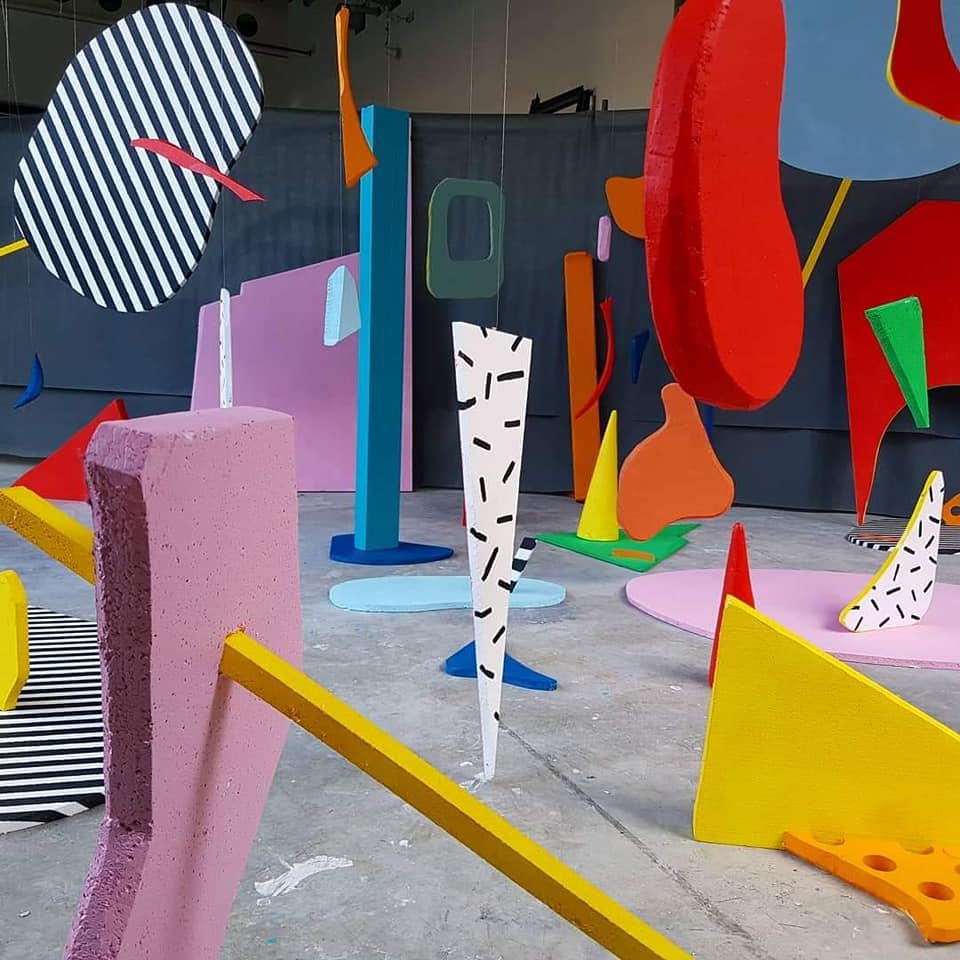
Fiksate’s Glen installation, part of the Winter Wander presented by Glitterbox Pursuits, The Terrace, August 2019
While it was completed in late July, Glen, an installation by the Fiksate crew in The Terrace for GlitterBox Pursuits’ Winter Wander project was officially on view through August, so it fits in this month’s list. An abstract painting come to life, the space was filled with cut outs and changing lighting. Rumour has it Glen may or may not have been inspired by a namesake encountered at a festival, you decide…
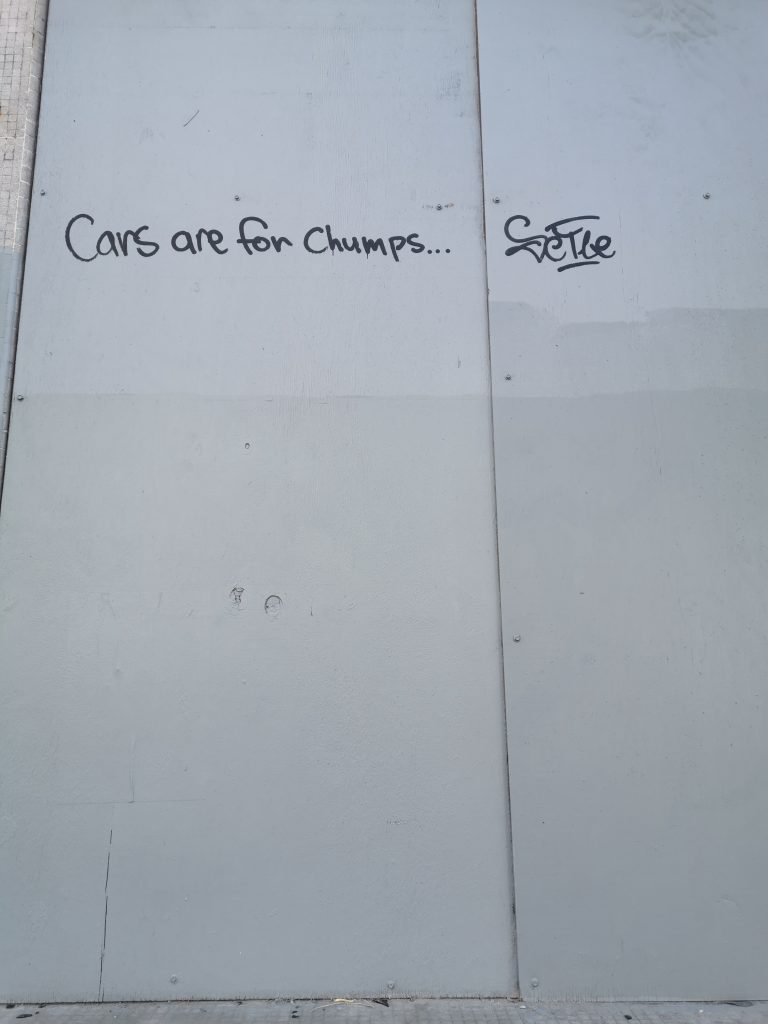
“Cars are for Chumps”
Cars are for Chumps, unknown writer, central Christchurch, August 2019
What would this list be without some cheeky urban inscription? This was a personal favourite in August, from the legible form, to the content of the message, the seemingly impossible height, and the ellipsis ending, what’s not to like? Shout out to the writer (Setle?) and shout out to the walkers, skaters and cyclists, and to the city’s cycle lanes, who seemingly upset so many people to a disproportionate level…
This month’s contributor to our And That Was… series is Christchurch artist Uncle Harold (also known as Josh Bradshaw). Known for his dripping constructions, including a recent body of nostalgic 90s cartoon characters, reimagined with melted and warped glitches, Uncle Harold took the opportunity to follow a slightly different path to our previous lists. Regularly crossing the city on foot or skateboard, Uncle Harold is a keen observer of the quirks of our cityscape. As a result, his June recap is less about events and examples of public art, and more about small details, things often overlooked by others, but that left some type of impression on his daily experiences. As he explains, these are not things “I intentionally set out to find”, these are things that “just happened to catch my eye on my daily walk to and from town, to work and the studio.” So, what caught Uncle Harold’s eye during the month of June?
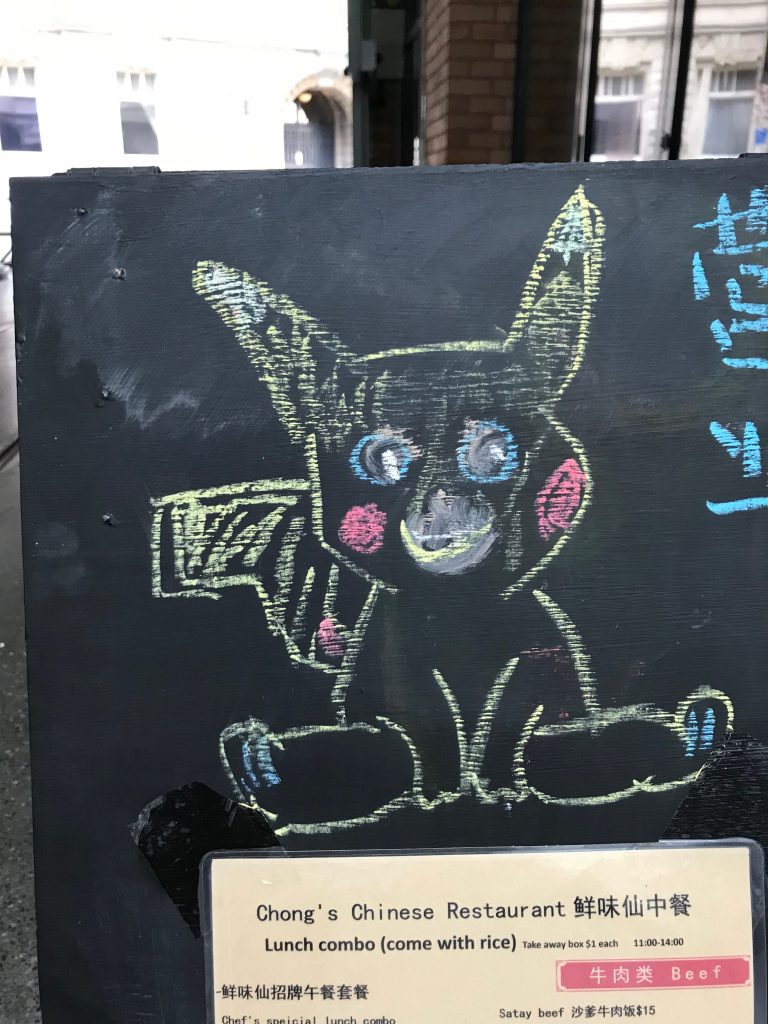
Pikachu
Do you ever accidentally keep making eye contact with someone for way too long? That was me and this chalk Pikachu drawing on a sign for a Cathedral Junction restaurant. I walked past this at least twice a day, every day. I have never walked through and not stared at him. Eye contact. Every. Single. Time.
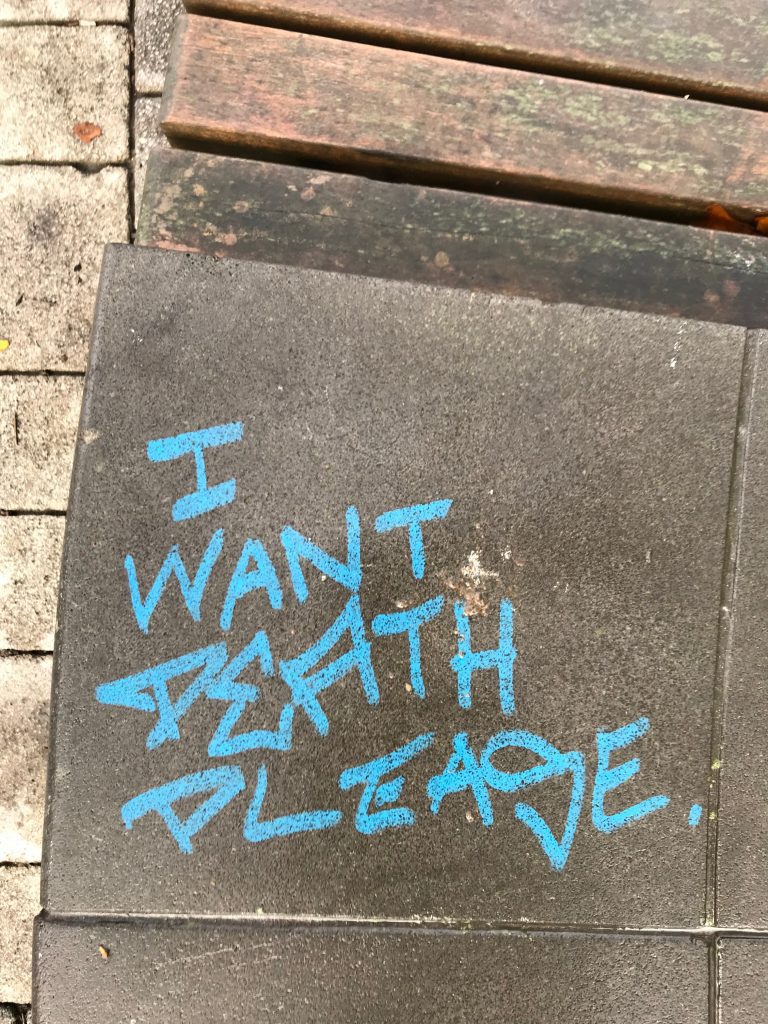
“I Want Death Please”
I’ve always liked this kind of graffiti. Half of the time it is not so much the tag itself, but the backstory I can instantly conjure up: the what, when, who and how that brought about its existence. It just so happens that in this case, I really do like the style as well, so it’s a win-win.
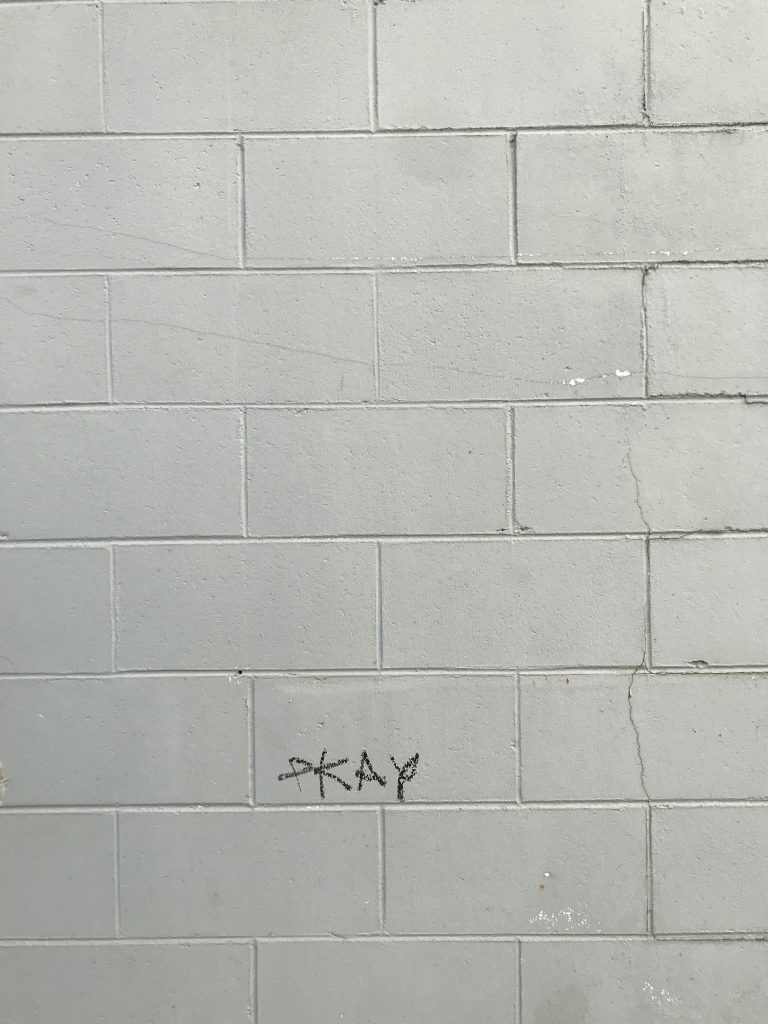
PKAY
Even if you aren’t familiar with this tag, I guarantee that you have seen it at least a million times without realising. I’m always on the lookout for new tags. I picked this one because I almost didn’t see it. On a fifty-metre long, plain grey wall, this little tag sits right in the middle. Having all the space in the world, this little guy hides perfectly in plain sight. Genius.
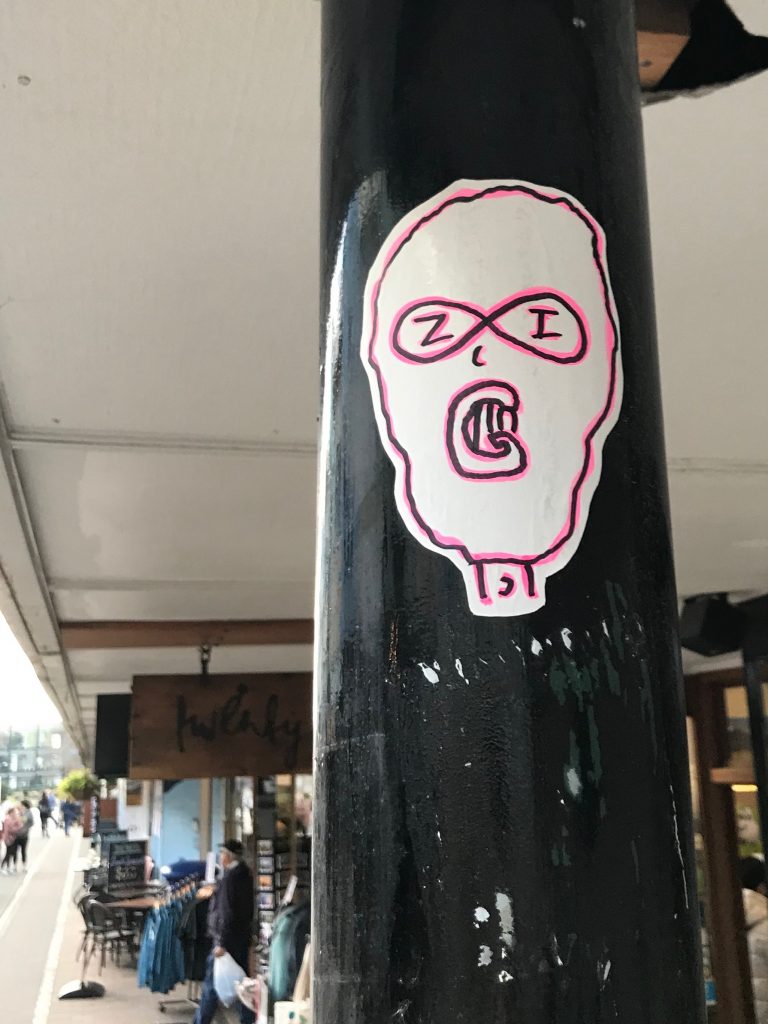
ZIG ‘Ski Mask’ sticker
I’ve always had a soft spot for stickers. From getting free stickers as a kid from skate shops, to now making my own, I often stop to check out sticker spots around town. I had just been given some stickers from ZIG the same day I spied this guy on my way home from work. Sketchy ski mask guy. How could you not love it? ZIG’s stickers are cool.
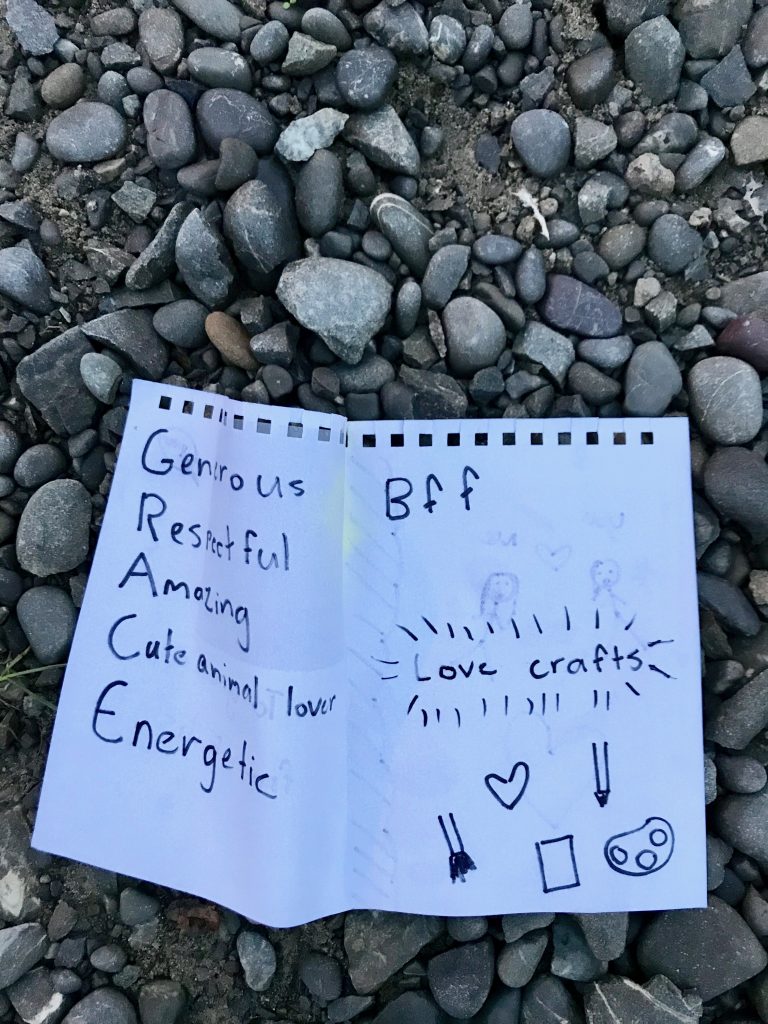
Grace
Again, I chose this one because of the complete lack of context and the imaginary backstory that it allows me to create. Who is Grace? Did this card ever reach her before it was lost? Does Grace know her friend loves that she is a “cute animal lover”? These questions, paired with the epic illustrations, ensured that I thought about his card way more than I should have. It was a no-brainer to go into my top 5.
This month, we are stoked to welcome a guest contributor to our And That Was… series: the man behind the Instagram feed Rubble City (@rubblecity), Gavin Fantastic. The idea of this series is to cover a wide selection of what’s happening in Christchurch’s urban art scenes, so it was natural to throw our net wider and make use of those people, like Gavin, with their fingers, and cameras, on the pulse. Rubble City is a go-to feed for fresh, and often highly temporary, pieces of art across Christchurch. So, what has been on Gavin’s radar in April? Read on to find out…
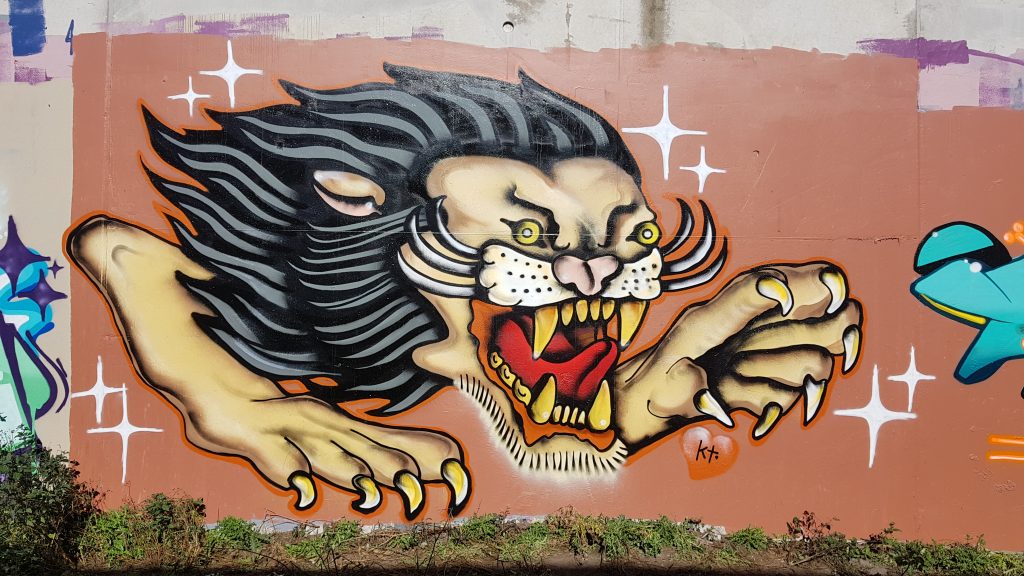
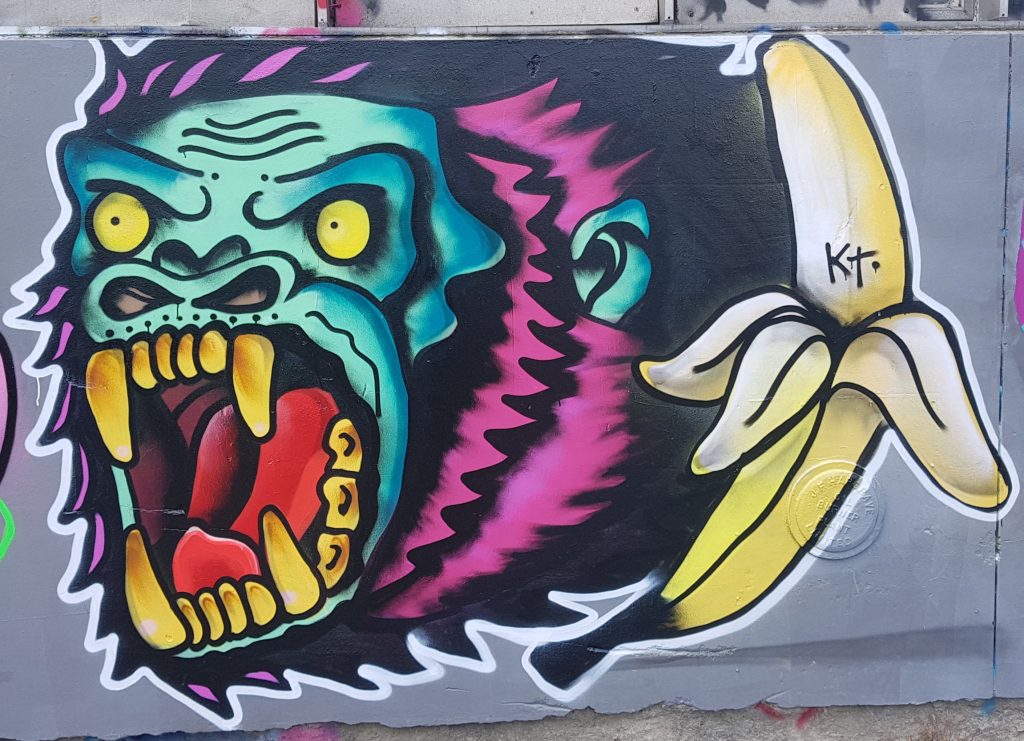
Hambone
Local artist Hambone is certainly setting the scene alight lately with his neo-trad style characters. From pumas with snakes to gorillas armed with bananas, the characters are certainly eye-catching.
As the nights get longer the ability to lurk in the shadows also increases for those smashing the scene.
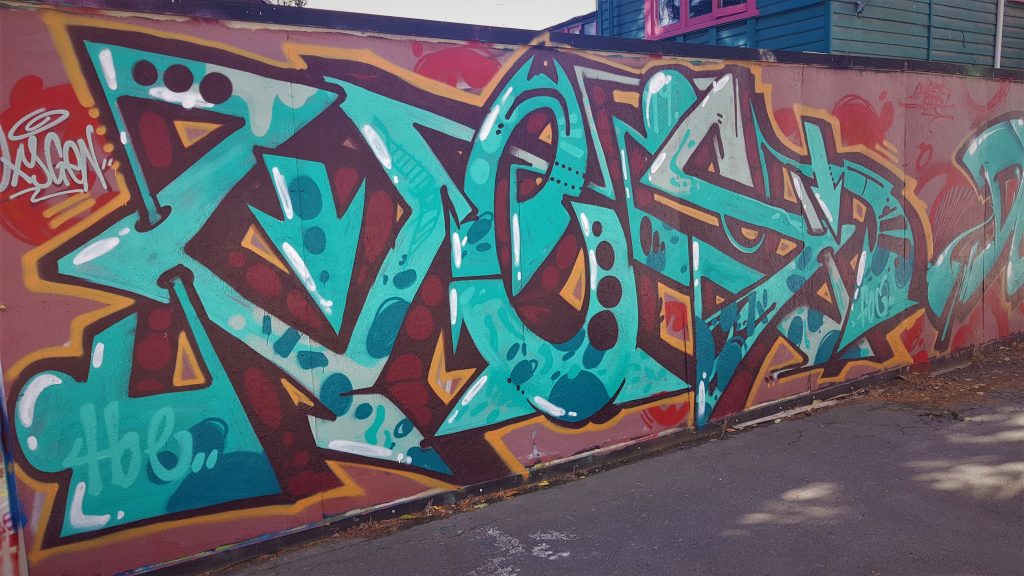
Two artists who have been dropping nasty steez are V-Rod and Vesyl. It has been interesting watching the style of these two artists evolve over the last couple of years from tags and rollers, to the next level pieces seen this April.
Our walls have been graced with additions by painters from afar this month. Showing how the other side of the world gets down were two of Europe’s finest. Resr47 was throwing down snow-capped letters from the Swiss Alps, while Desur managed to fit in a couple of Hamburg burners during his stint at local tattoo studio Otautahi Tattoo.
Situated next to World on High Street, Yikes’ pop-up shop hit my Insta feed (and my wallet!) this month. The man from DTR is selling both originals and prints in a space that is occupied for the next few months selling eclectic furniture. Check it out and support your local artist!
Jacob Yikes’ pop-up shop, High Street, central Christchurch, 2019 (photo credit: Gavin Fantastic)
RIP Jungle
As featured in the ‘And that was … March’ blog post, we saw the passing of local O.G. Jungle. Tributes have been popping up all over Christchurch City and around the world. I’ll sign off with a tribute piece from two other 03 O.Gs – Yikes & Ikarus.
When I started the ‘And that was…’ series, I didn’t expect this column to be as difficult as March proved. The month got off to a terrible start with the passing of a true graffiti king, the legendary Jungle. Then, on March 15th, the horrific terror attacks sent shock waves across the city, and indeed, the world. Even in these awful times, the art on the streets has played a role and performed acts of tribute, memorial and communication. And it has continued to do its own thing as well, providing distraction from difficult realities. So, although it is not really fitting to describe this list as a ‘best of’, here are five things that made March 2019 unforgettable…
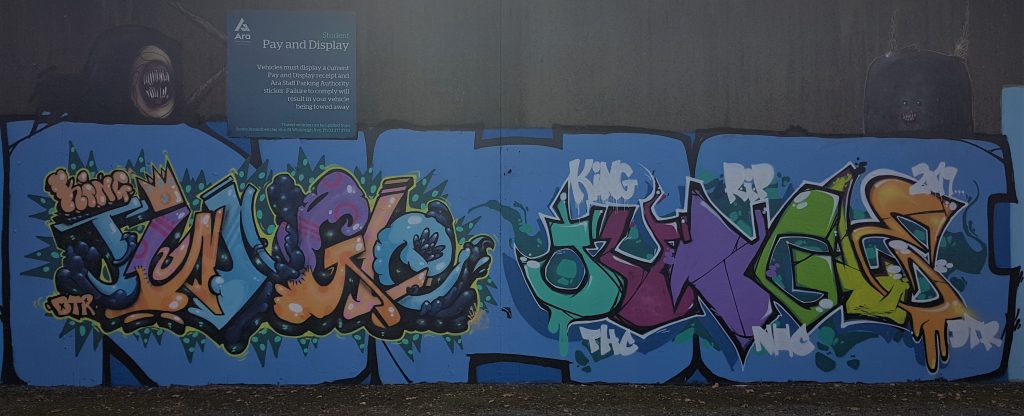
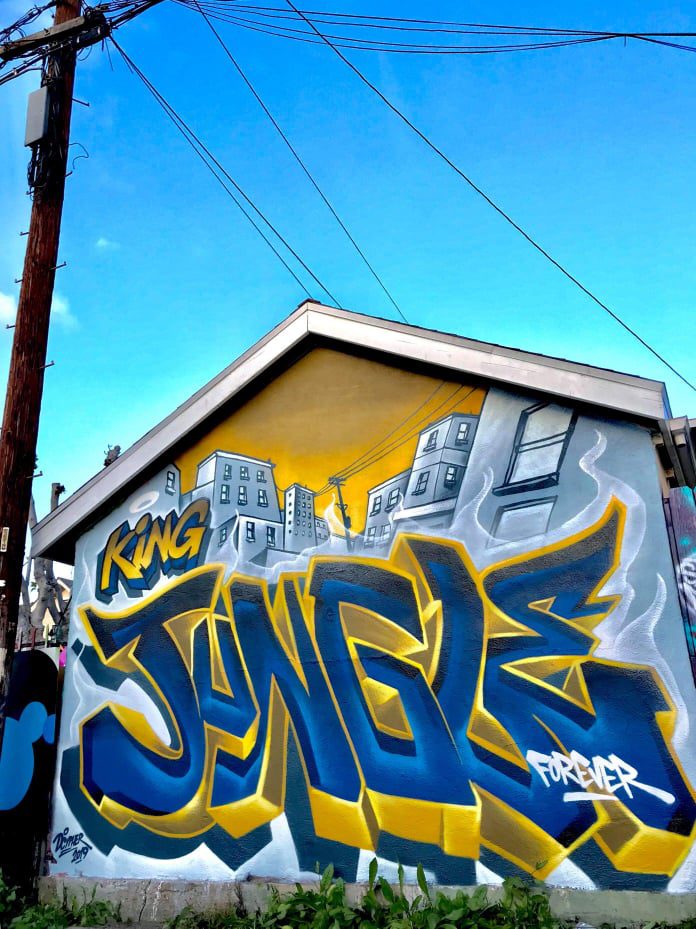
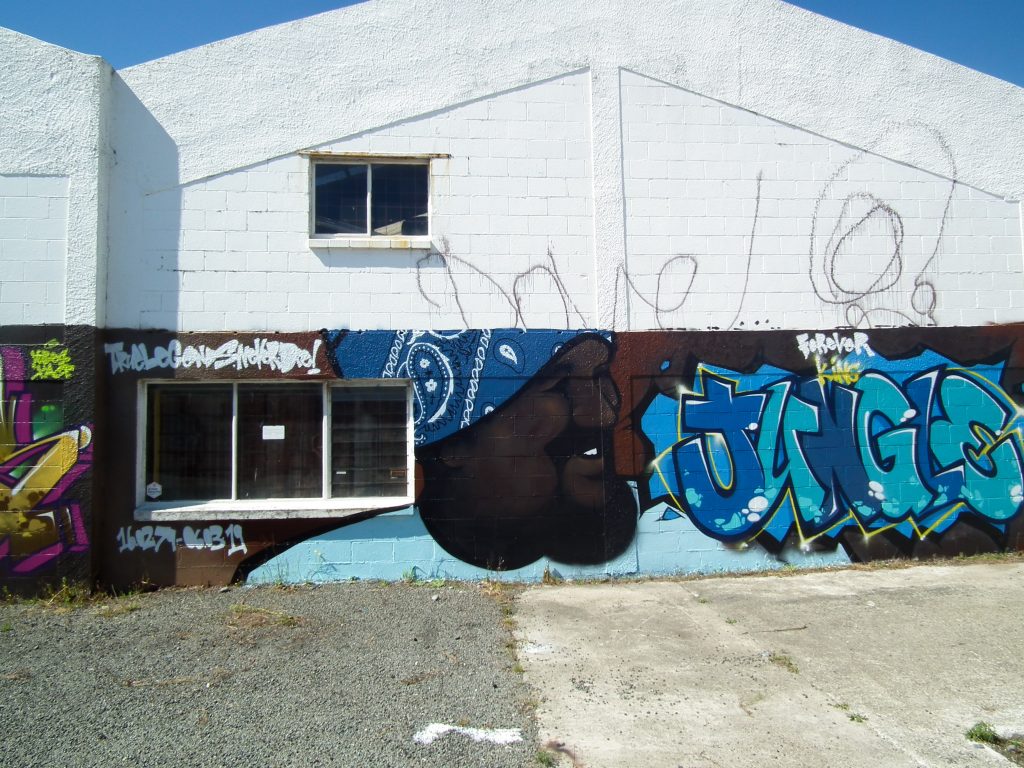
Jungle – RIP to the King
Leon Te Karu, also known as Jungle, was an absolute legend of Christchurch graffiti, and without his presence, the city’s culture would not be what it is today. As Ikarus confided in me, without him, there would be no Freak, no Dcypher, no Lurq, no Pest5, and no Ikarus. His influence is that important. L.A.-based Dcypher noted that he had never met anyone who embodied their graffiti more than Jungle, an important acknowledgement in a culture built on a visual form becoming a signifier of one’s presence. It is little surprise then that tributes to Jungle have appeared across the city, the country, and indeed, the globe, from Christchurch to Chile, paying respect and honouring a massive influence.
Dcypher, Jungle tribute, Los Angeles (photo credit: Dcypher)Ikarus and Wongi ‘Freak’ Wilson, Jungle Tribute, Sydenham (photo credit: Millie Garrett-Peate)
The Christchurch Terror Attacks
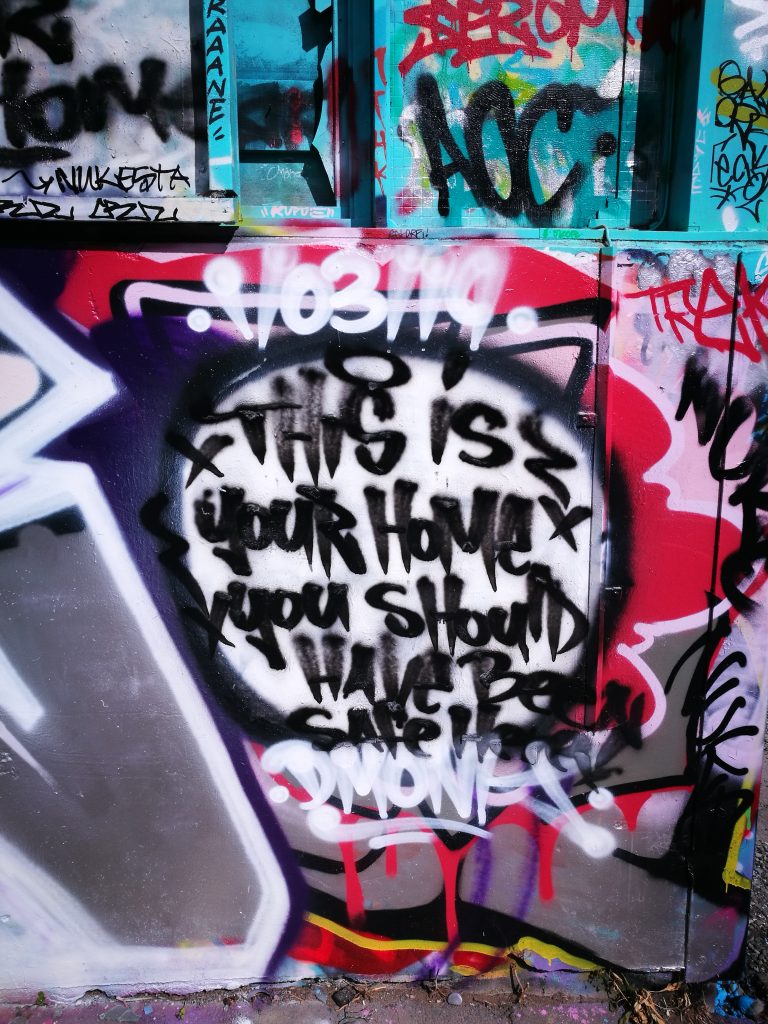
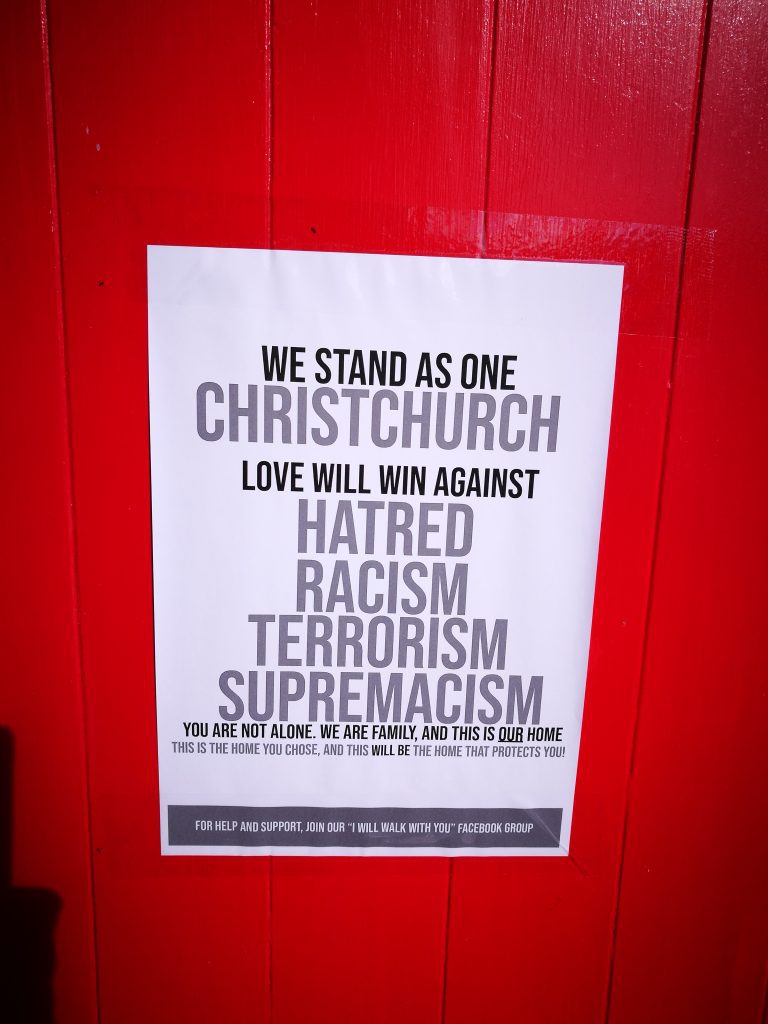
By the time of writing, the impact of the March 15th Terror Attacks had not manifested explicitly in the city’s urban art, but there were quickly messages of support, not just at memorial sites, but also as annotations of graffiti, highlighting the sense of solidarity the city was importantly trying to extend… The importance of public space as a site for communication was revealed once again. Will more responses appear as artists figure out the discussions these events have created? And importantly, what forms will they take?
Dmonk, This is Your Home…, Central CityWe Stand As One poster, central city, Christchurch
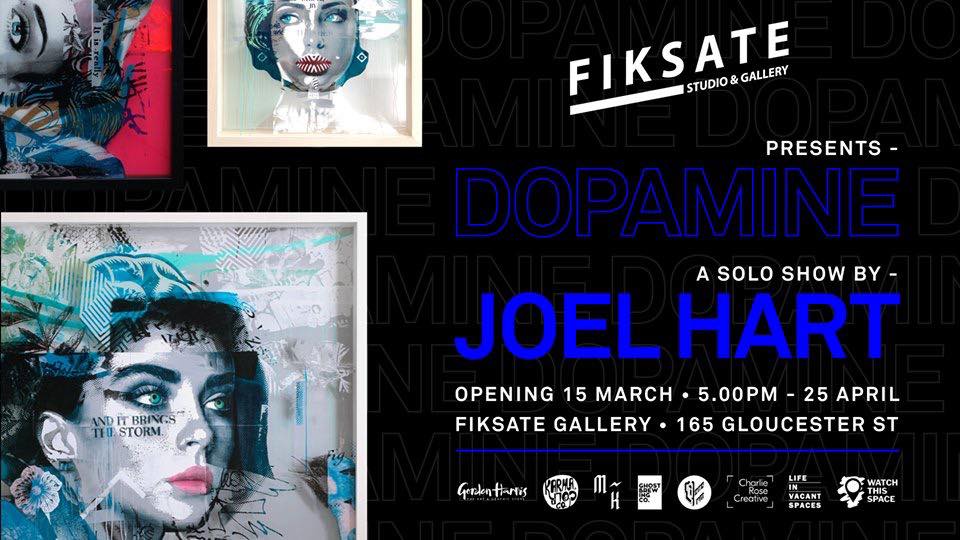
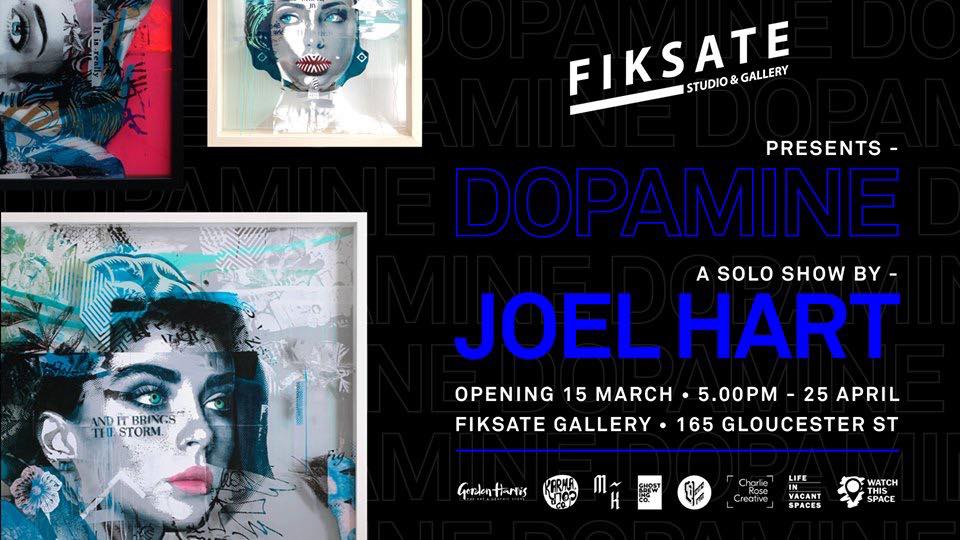
Joel Hart – Dopamine
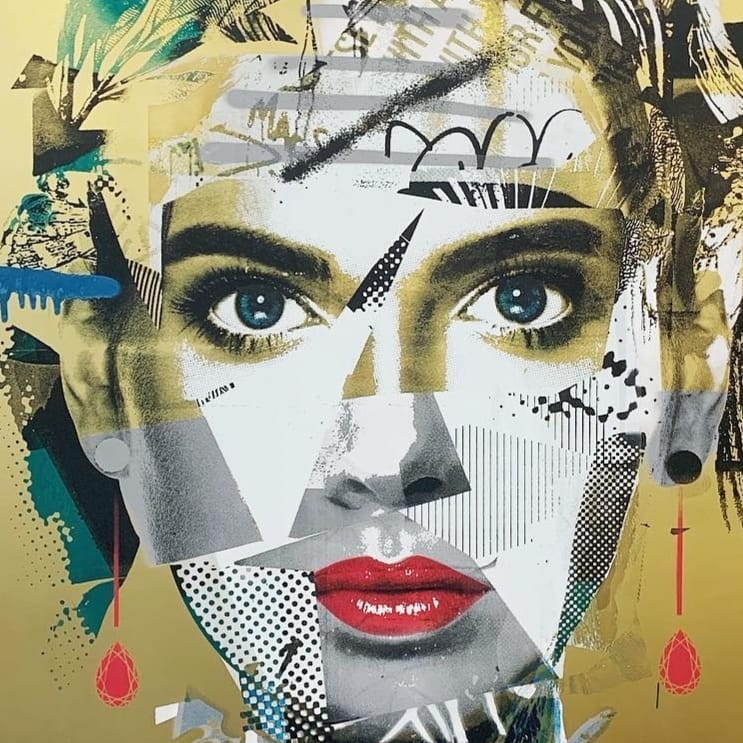
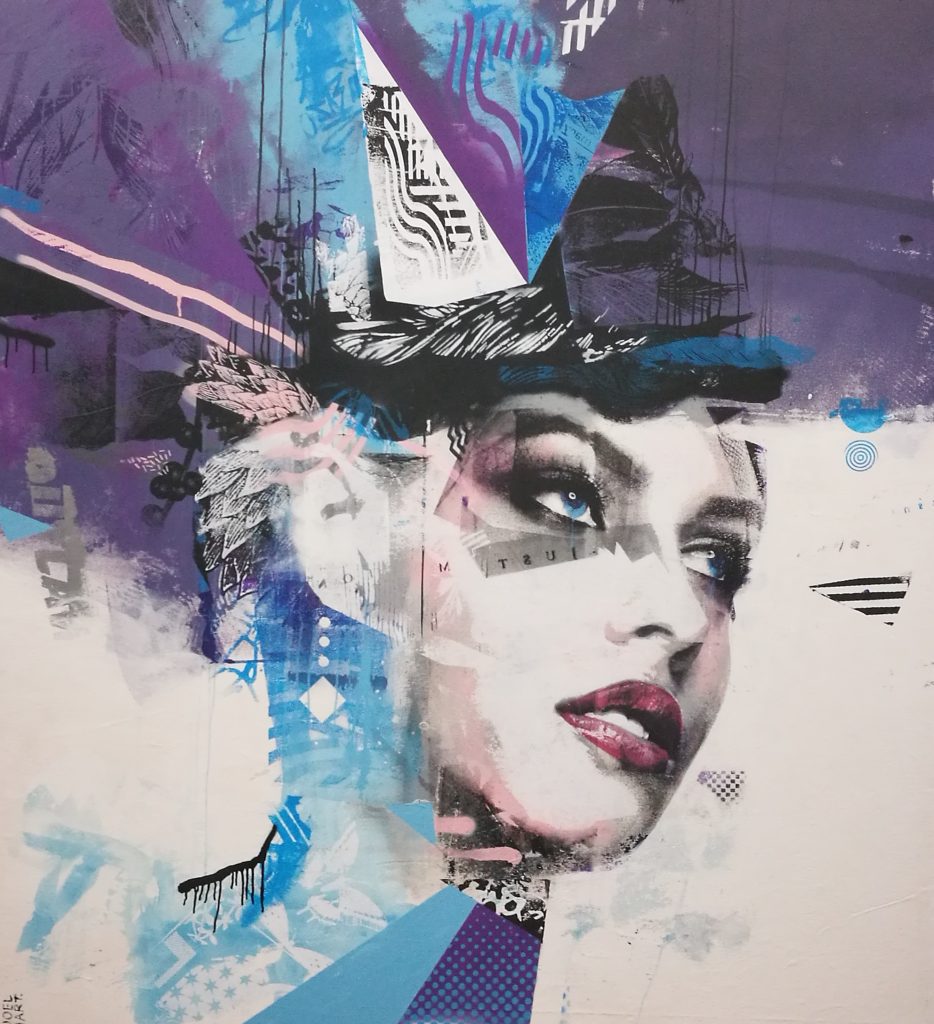
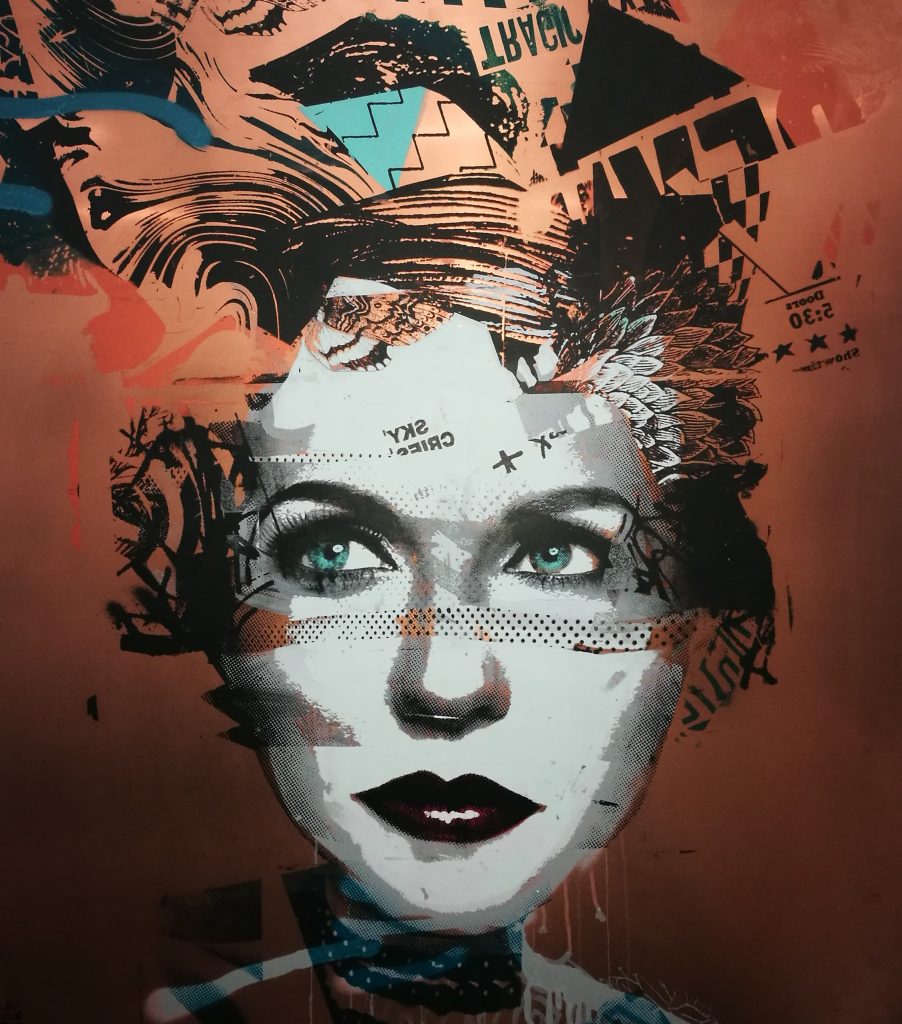
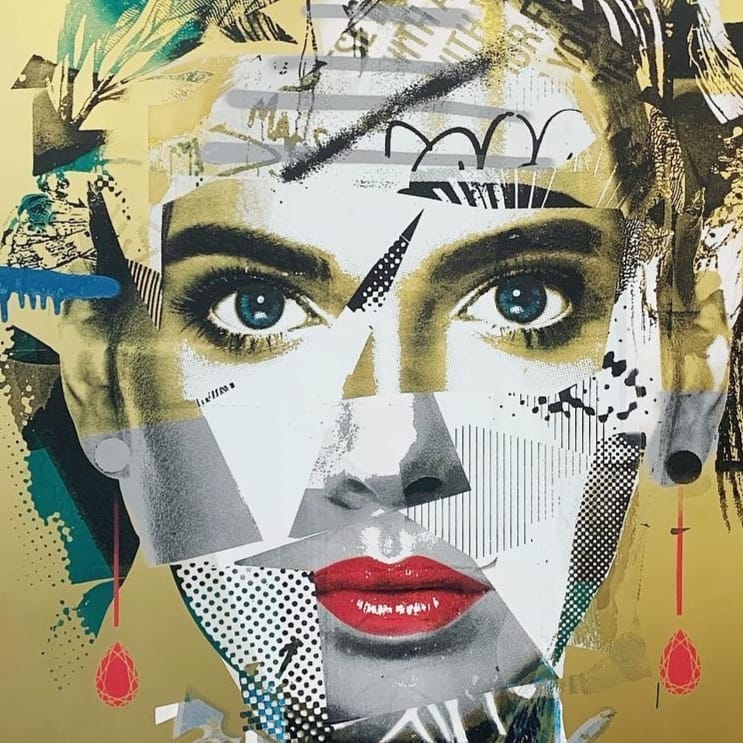
Another event impacted by the Terror Attacks, Joel Hart’s second ever solo show, Dopamine at Fiksate, was due to open that Friday. Understandably delayed, the show eventually opened a week later to a bumper crowd. Hart even ran a silent auction of a work on the night, with all proceeds going to a victim support charity. The show’s impressive collection of fascinating portraits and explorative use of materials such as copper and brass sheeting, mirror surfaces, light boxes and intricate hanging sculptural cut outs, as well as a diverse colour palette, have ensured its popularity, while also hinting at new directions for the artist.
Joel Hart, Hush, mixed media on brass panel, 2019
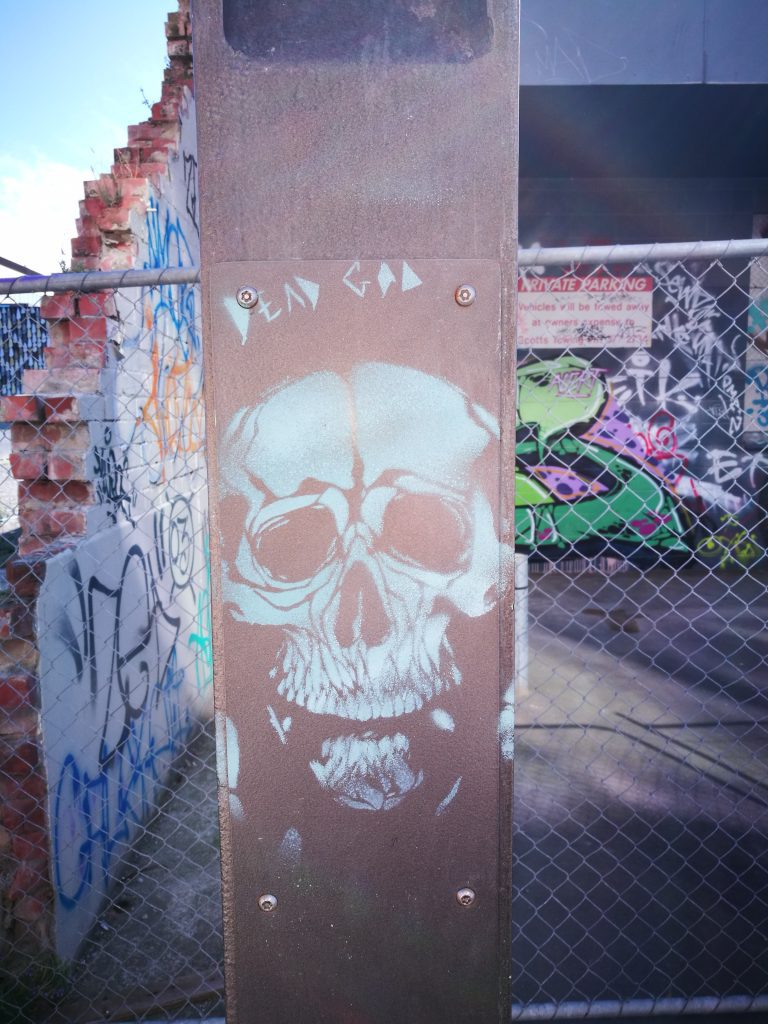
Dead God
Although lower in profile than some other entries, I have been enjoying these Dead God stencils around the city. The intricate cellular cut-outs and overriding punk vibe catch my eye whenever I stumble upon them, often in spaces I probably shouldn’t be hanging out. With little information about the artist, it’s time for some research…
Dead God stencil, central city, Christchurch
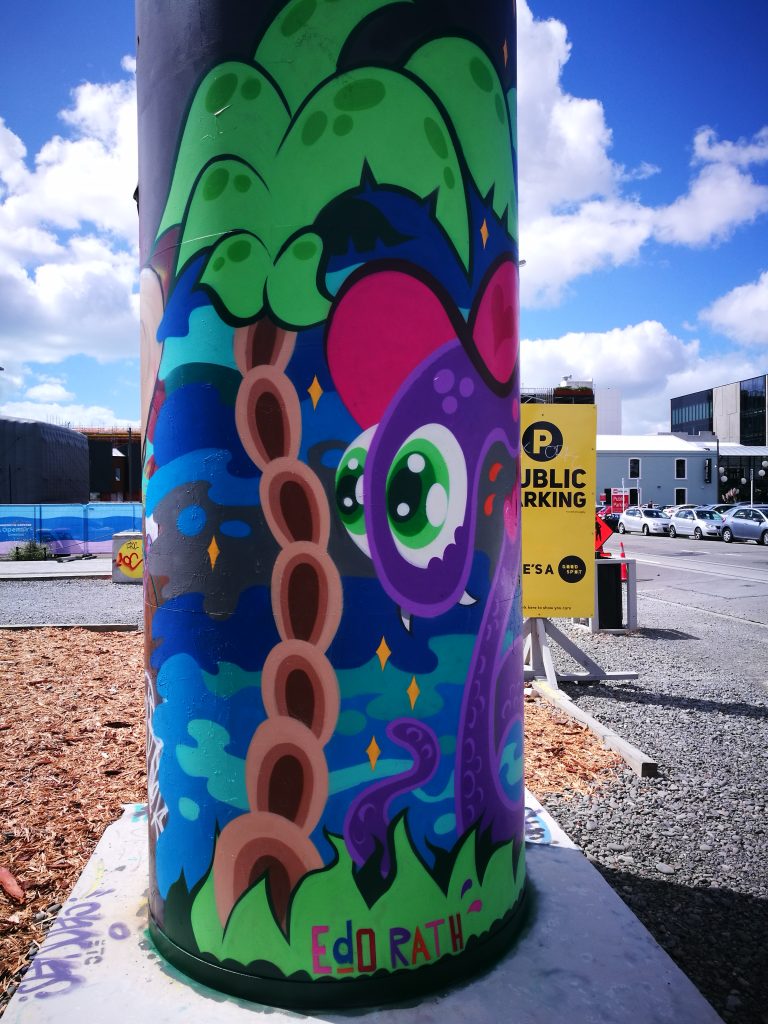
Edo Rath
So, technically it was the last couple of days of February, but it felt right to include visiting Dutch artist Edo Rath’s playful cartoon serpent on one of the Giant Cans amongst the darker tone of this month. The bright palette, sharp, crisp line work and fun use of patterns and shapes made this small addition stand out. Check out Edo on Instagram…
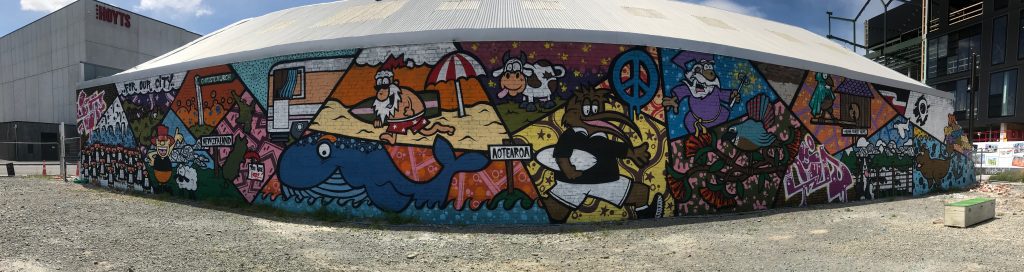
Caelan Walsh is a thoughtful guy. The often faceless and pseudonymous nature of graffiti writing leads to perception of graffiti writers as senseless destructive forces. Caelan is eloquent and intelligent, and importantly, well-versed in the complexities and contradictions of both the world of graffiti, but also of the public perceptions. He also represents the tensions graffiti writers feel when moving into the realm of commissioned work, and the dreaded sphere of the ‘street art muralist’ (dum-dum-dummm!). In the latter stages of last year, with support from Watch This Space, Gap Filler and the Enliven Places fund, Caelan produced a sprawling ‘kiwiana’ mural on Tuam Street. Walsh segmented the long wall into an angular geometric grid populated with icons of Aotearoa; from a gumboot wearing farmer, sheep, and a rugby-playing kiwi, to a horde of sunglass-wearing penguins, a tuatara, a pohutakawa tree, and the tino rangatiratanga flag. Laced with bright colours and patterns that differentiate each segment, the playful comic stylings are a perfect fit for the still in-progress area, with Gap Filler’s pump track sitting directly in front. After a long back and forth to actually sit down and chat (this seems to be a theme with my interviews!), when we did, Caelan deftly jumped between a range of topics, including graffiti history, the various ‘moods’ of the culture and how he navigates those divergences, and his experience on the pump track wall…
Let’s start by talking about the ‘kiwiana’ mural you completed along the Gap Filler ‘Roll with It’ pump track on Tuam Street. How did that project come about?
Thanks to you guys! (laughs) I kind of got thrown in the deep end on that one! It was the first properly commissioned wall I’ve painted, full stop, and on top of that, it was also the biggest wall I’ve ever painted, so it was obviously pretty intimidating. That’s why I came up with the idea of sectioning the wall up into smaller parts, each with different images and colours. Along with trying utilise all the space effectively to avoid it getting tagged through. I could look at it as twenty-two smaller pieces rather than one big wall, which would have been more intimidating…
I imagine that the idea of segmenting it up into pieces was necessary when you haven’t had a lot of experience working on commissioned murals of that size. Your background in graffiti means that even with bigger pieces, you are often collaborating, and as such you are using a smaller space rather than the entire wall, so is that must have been quite a big change…
Yeah, definitely. There were other challenges too. I’m horrible at working with colours. I just can’t put them together. So, a lot of the time when I’m painting, I’ll push other people to come up with a colour scheme, so it’s like: ‘Cool, whatever you said, we are doing that 100%’! But, working on my own and having to conceptualise that on a larger scale, it was definitely something that I couldn’t plan ahead. A lot of the colour choices were made by starting with just picking one colour up and going from there. Obviously, then in the section next to it I would use a different colour to create that contrast and develop it from there. Then I would step back from the wall and think, oh I haven’t got enough pink in that section, I’ll work with pink now…
Do you approach graffiti pieces with that openness to change as well? When you are working on a piece, do you have a strong idea of how you want it to look, or are you open to change as well?
With graffiti, I really have quite a strict idea in my head of how I want the process to work, and how I want it to sit on the wall. But I also don’t like to complete a sketch because I feel as though then it has become its own entity, and then you are just replicating something until it’s completed on the wall and there’s not really much fun in that. So, sometimes I’ve gone to walls with three different sketches and I might like different parts of each one and there will be other ideas in my head as well. So, I guess if you were to look at my sketches, they would look like big scribbles, but they will turn on different lights in my head…
So, when you are drawing or sketching for a piece, it’s not so much about creating a plan as it is exploring ideas that you can then explore further on a wall. But with a commissioned mural you often have to show a more developed idea and some kind plan, which means they are necessarily distinct processes for you…
Yeah, I think I was pushed a lot more with the mural work because obviously the owners and everyone involved wants a proper idea. With Graffiti, my basic style or structure is in my head, I can see it already on the wall, but when I’m explaining a mural to people, often I can tell that they don’t really get it until they physically see a drawing of it. So, that was a big challenge for me, because like I said, I don’t like finishing sketches, I like it to be more open, especially going from ballpoint pen to using a spray can, there are completely different effects involved. I am definitely more confident with a spray can than a brush or a pen. I can’t show that I’m going to shade here or have some drips going down here…
Collaboration with Tepid (left) and Dove (centre), New Brighton, 2019
Technology is making that transition easier though, at least in some respects, right? I was recently watching a video of someone using a Posca pen with a Crayola add-on airbrush piece, to create the effect of a tiny spray can painting a stencil. Obviously, there are problematic elements to the embrace of technology, but it must at least make some of that transition easier…
I think with some of the programmes they have on iPad’s and that sort of thing now, it is crazy the different ways you can digitally replicate how you would paint on a wall. It is not something I’ve had a chance to muck around with a lot, but in some of the work I’ve done with Dove especially, he’s used that technology to map out how something would sit on a wall, and that just makes a crazy difference when it comes to actually visualising a large-scale project…
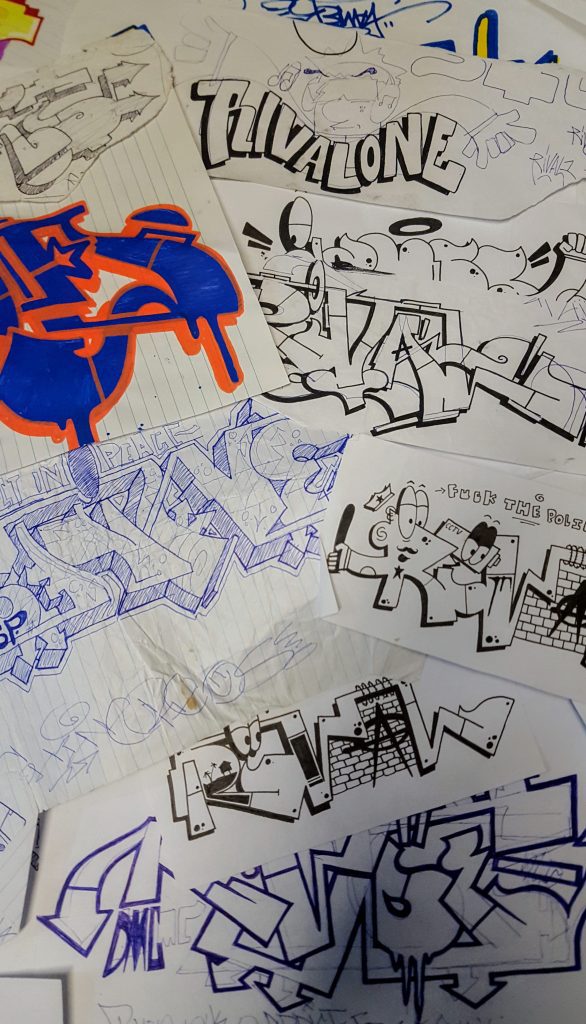
Collection of sketches, 2018/2019
Do you have a process to scale up from a sketch to a wall? Often artists have a specific approach that is slightly different depending on the individual…
For me, it’s the same with everything; graffiti, murals, I just start by taking steps. I step out the length of the wall. Say it is twenty steps and then for example, if it’s piecing, and you’ve got four people, sweet, you’ve each got five steps, and I just mark it out and work from there…
Even that simple approach, it essentially represents one of graffiti’s core attributes: the ability to solve problems. There’s always been that DIY nature, where you can do more with less by problem solving. You are constantly having to overcome problems when you are painting graffiti or making art in the streets in that manner, and that’s why I guess that transition to large-scale work is so achievable, because of the skillsets you pick up painting without permission, or painting without the support mechanisms of a studio space, or a commission…
In terms of proportions, even with my graffiti, my work is quite mathematical. I guess it ruins some of the natural flow when you explain it, but I’m literally looking at the first line I did on the wall and following it from there. I’ve got maths going in my head, like, that width between each line is twenty centimetres, so I should make it about that the whole way through. I’m stepping back and judging widths of the letters themselves and the space between them along with the thickness of each individual line itself. So, I’m actually thinking about how certain attributes that come later will affect the piece as well, especially adding shadows, it’s something a lot of people seem to struggle with, but there’s almost a mathematical formula to how a piece sits on the wall. I also use shadow to help add dimension to my pieces rather than one flat image sitting on a wall, so it is a series of intertwined connections overlapping and underlapping each other.
Game piece with Dove character, Christchurch, 2017 (Photo credit: Caelan Walsh)
With drop shadows and those types of effects, it is literally mathematical, right? It is about the angle created by the light source, the angle you are trying to project and those types of things. It’s also something where you can fall onto either side, though, right? You can be looser, more chance driven, and all about how it looks and feels, or you can be more precise and adhere to spatial relationships and certain effects that you are trying to achieve. Your graffiti letter style is kind of angular and quite strong in its line work, do you that comes out through that kind of mathematical approach?
Like you said, you can go either of two ways with it. I’ve probably wished I was more comfortable doing a more natural approach, but like I was saying earlier, my pieces are very controlled. To add even more mathematics and numbers, I’m also always trying to add my work into a certain slot of where I feel comfortable. Like, I want to do pieces at the moment, I need to do everything in my head that justifies it being a piece, to then fit into that slot where I can be like: ‘O.K., now I’ve done forty-seven pieces.’ If it’s missing certain elements to it, then I can’t class it as a piece.
So, there’s a classification process going on in how you are building your body of work?
Yeah, so, it’s something that I’m almost forcefully trying to do. I’m sort of restricting myself. I’m not going out as much and doing more creative stuff, stuff off the top of my head, because in my mind, that would fit into a different slot. Which is perfectly fine, it’s just my sense of control makes want to be able to categorise what I am doing…
Social piece, Auckland, 2010 (Photo credit: Caelan Walsh)
Is there an end goal in mind then when you are taking that approach?
Like you were saying, it is just building a body of work. Not so much to show other people, it’s more just self-confidence, knowing that I have got that body of work behind me. That will allow me to feel more comfortable going out and doing weirder, less-appropriate sort of things…
Does it give you a good sense of how far you have progressed already? Does it become obvious to you?
Yeah, with my letters at the moment, I do make some dramatic changes, but generally speaking, each piece I paint, I’m trying to develop one letter. So, there are four letters in the name I write, right now I’m working on developing the ‘O’, so if you look back at previous works, the other letters will be the same, but the ‘O’ will be different. The next piece, I might decide I’m happy with the ‘O’, so I will start developing the ‘D’, so then, like everything, you will actually see the natural progression of how it’s changing. Right now, I’m actually reverting back to a lot of my earlier work from the beginning of last year, stylistically, because I feel like I drifted off in the wrong direction and now I’m going back to that body of work and seeing where I was going with that. That’s why having that control of doing a piece is important I guess, I can see where I was going wrong, or what I need to do instead. Even with that amount of control, you still make mistakes. I’m not particularly happy with my style at the moment, I think it has sort of regressed a bit over the last few months and that’s why I’m looking at the older work and hopefully bringing it back…
Character piece, Auckland, 2016 (Photo credit: Caelan Walsh)
That’s a really mature, thoughtful approach. Was that compulsive element, repeating a tag or developing letters over time, was that always one of the attractions of graffiti for you? And how do you relate that sort of approach to commissioned projects? Do they require a slightly different approach?
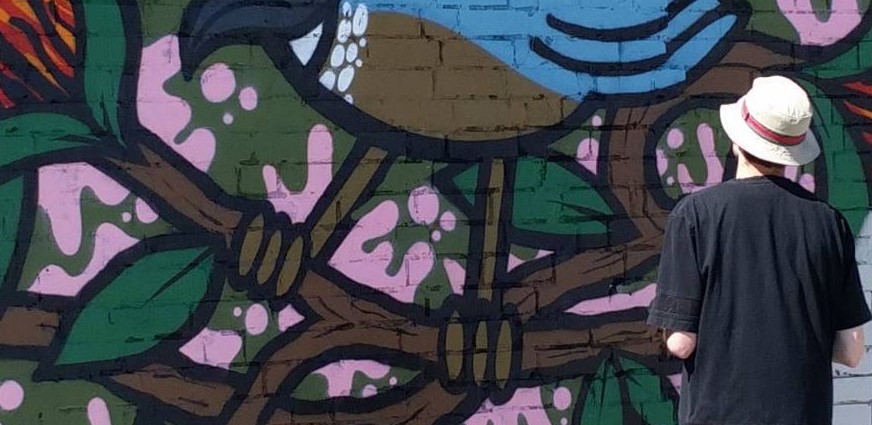
You could definitely say I am a bit obsessive compulsive and that definitely is evident in the way I paint. With the commissioned work, I think as long as you get the O.K., I’m a lot more open to switching things up. The pump track mural, I did control that a lot as well, specifically to ensure it had that more comic effect, with very bold colours. There were a lot of parts, especially the birds, where I would have liked to have thrown in more detail, but it would have taken away from the rest of the mural. Although I knew there was more that I could add, I had to control myself and let it be what it was. But now, after doing that, I’m definitely a lot more confident in being able to wing it a bit more, to chuck my own flavour in there. There are definitely challenges that come with painting concepts and ideas that I have never really attempted on paper, let alone a wall.
Commissioned work also generally allows more longevity. You can often physically revisit a work over a longer period. Does that affect your thinking as well? Which reminds me; we were just told that your mural will stay in place for longer than originally thought as well, the project has just been extended, which is good news! So, what is that shifting mindset like between a work that might only be there for a day and then disappear, and a work that is somewhat more protected? For someone who is so analytical and thoughtful, is it tricky constantly being reminded of a work, thinking I could’ve done this, I could’ve done that…
Yeah, absolutely, especially with that mural, because I was working between a lot of other commitments. There were a lot of hurdles I had to get over, so it ended up taking a month and half of on and off days. So, yeah there were a lot of sleepless nights thinking about something I really wanted to do before I forgot about it. I was borrowing my friend’s ladder, and near the end I just got him to pick it up so I couldn’t really do anymore work without having to organise more stuff. It was almost a case of someone having to just take the can out of my hand and be like, that’s enough, it’s’ done.
Collaboration with Dove, Hereford Street carpark, 2019 (Photo credit: Caelan Walsh)
I guess when you are having a jam, generally you are looking to finish within a shorter time frame, although there are other reasons you might finish when you finish, but with the longer time afforded a commissioned work, it is probably good to have some limit imposed on you…
Yeah, well, graffiti is incredibly speed-based, especially in New Zealand. It is almost frowned upon to spend any longer than a day on a piece, although, in my opinion, if your piece needs three days of work, then put three days in, make it the best possible.
Some of that comes down to the spot though, right?
It’s definitely tossing it up a little bit. But yeah, with my pieces, especially doing the fill and the initial outline, I am sweating trying to just get it done, to get the piece up on the wall. Then I will spend the same amount of time just tidying it up, stepping back and looking at it. My main goal is to try and finish it before everyone else, so I’ve got that five or ten-minute window of being able to step back and look at it. I took a similar approach to the mural as well, but with no experience or any time frame to go off it was really hard for me to tell what speed I was meant to go.
You mention the New Zealand scene as a whole, you are based here now because you are studying here in Christchurch, but you are from Auckland, right?
Yeah, born and raised.
So, growing up in Auckland, what influences were the strongest impact on you growing up? What got you involved? Auckland is so different from Christchurch, what were the biggest things you noticed coming down here?
Well, since coming down here, I’ve always looked at Christchurch as almost being in a time warp, almost ten or fifteen years behind. Not as far as skill goes, there’s some amazing artists down here, but the train tracks down here now look like how Auckland looked in the early 2000s, and that was the era that got me into graffiti, so I love the scene down here, it’s what we’ve now lost in Auckland because of the buff…
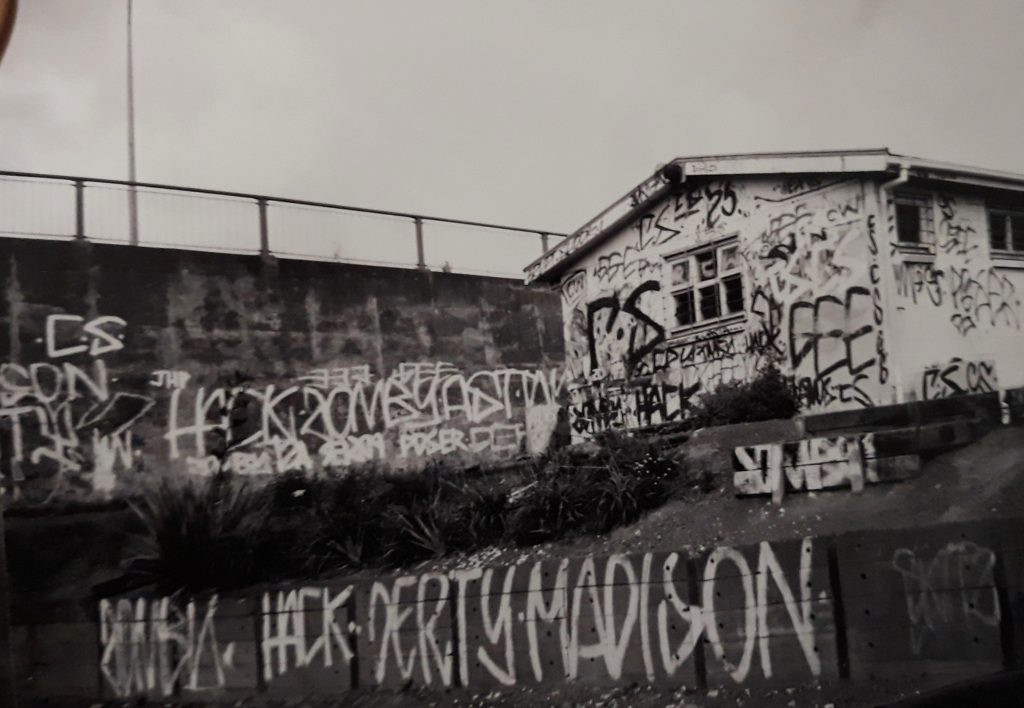
The Christchurch Rail Corridor, 2017 (Photo courtesy of Caelan Walsh)
It’s almost nostalgic for you… (laughs)
Yeah, and the creative energy, with so many blank walls, like in Auckland, every spot has been done to such a high level, that it is almost like: what’s the point? It’s already been ‘kinged’, someone’s already done something better, whether it’s a stomper, a tag, a piece, it’s already been done. Down here, even along the train tracks, you’ve got walls that have literally never been touched. Whatever you do on it, it’s going to be the best thing that’s ever been done on that wall…
There are two ways to look at both of those things as well, like you say, if somebody has already done something amazing, it’s either what’s the point, or there is a real drive to try and better it, or, when the are no precedents, you’ve got the freedom to do something without expectations, or you can get lazy and the level gets pulled down…
I guess from my point of view, being a bit older, I can really see opportunity down here. When I was younger in Auckland, I didn’t appreciate how lucky I was to be a part of that scene at that time, even in the early 2000s, I remember thinking, I wish I grew up in the 90s! Then when the buff hit in 2011 (when the Rugby World Cup was staged in New Zealand), it was like, oh crap, we were painting in the golden era of Auckland graffiti and we took it for granted! We should’ve been out doing pieces on all these spots instead of tags! But down here, it’s different for me, with that maturity that comes with age, and a desire to just do pieces, just being able to have that confidence in my style, I can quite confidently make a wall look better than it was…
Which again is a mature attitude, it is not what every writer is trying to do…
I do contradict myself quite a lot, and I still feel a lot of the different moods of graffiti. I think it’s important though, it can be very restrictive sticking to one set of views. But, generally speaking I like to paint for the act that I am making the wall look better than it was. It might not be publicly appreciated, or aesthetically pleasing to everyone, it’s still graffiti, but its better than the tagging that was on the wall before. This is also my general argument or, I guess, defence if I was to be approached by the public.
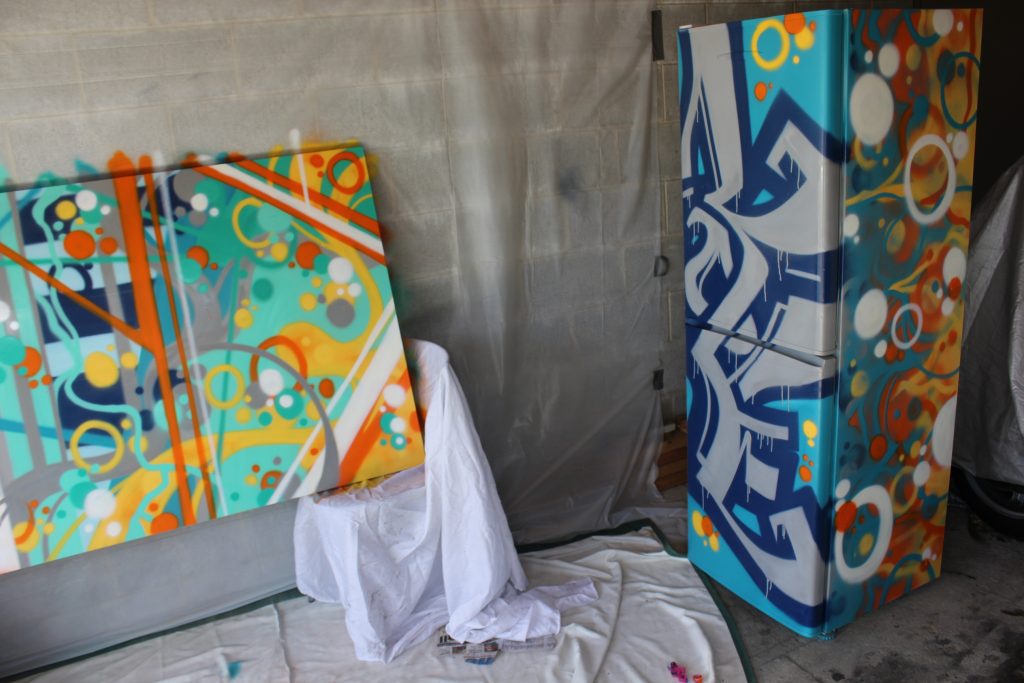
Studio works, including a benchtop and painted fridge, 2015 (Photo credit: Caelan Walsh)
For most people, it is the legal issue, the private property issue that is the most upsetting, and that is what leads them to say they don’t think graffiti is aesthetically pleasing, and that is sort highlighted by the way a buffed wall, with patches of mismatched paint, is clearly not an aesthetic improvement…
I find that very ironic, there are some very bad clean up jobs around that look worse than the tagging itself did. A particular example of this for me is when people tag using their fingers on a dirty wall or window, obviously it is still vandalism, but it is simply moving dirt around on a neglected surface that no one has taken the time to maintain. I would argue the wall was not aesthetically pleasing to begin with and the tagger simply pointed that out. With that said, I do hear the argument, even from writers, that they would be pissed off if their fence got tagged. But for me, I’m a pretty placid human being, if someone did paint my fence, I would go and paint it out and get on with my day, it’s not something that really stresses me out…
A fence is an object that defines territory, and as such it invites responses in some way, right? I’m not saying a fence deserves graffiti, but it does say: ‘this is my space, keep out!’ So, both because of that symbolic presence, as well as the physical form, something is likely to end up on them… it’s almost inevitable, even if it is not necessarily pleasing.
It comes back to that core emotion that people look for from graffiti, why people paint, we’re looking for that mental reaction. nothing beats being in the city at two or three in the morning, with no one else around, you’re walking down the middle of the street, and whatever you want to write on, whatever you want to climb, no one is stopping you, the city is yours, you own it…
[American graffiti historian] Roger Gastman has written that at its core, graffiti is about young people exploring the city, and as you say finding that freedom, those boundaries seem to vanish. On the flip side of that, how did you make the decision to take on commissioned opportunities? Were you influenced by what other people were doing? Did it germinate in Auckland, or was it more a case of the opportunities in post-quake Christchurch? Was it something you always thought you might do, or was it something you came around to?
Like I was saying before, I contradict myself a lot. I go between wanting to be a reclusive vandal and wanting to screw society up, to wanting to make society better, make it more beautiful, be a part of the wider community, go to events, talk with people. In Auckland, I guess, I got into the concept of tagging, not that I ever thought I would do it, but my older sister, who is in her late thirties now, a lot of her friends were ‘gangsta’ taggers, they don’t tag anymore, they have all moved on to actual serious crime, a lot of them are in jail now. But I was opened to that at a young age, and a lot of them were amazing graffiti artists, classic old school wildstyle painters. I can remember being eight years old, and trying to copy a drawing I had found, and I was just drawing heaps of arrows, and being like, how do you do this? That lasted maybe a couple of days, then you move on to the next little game or whatever. But then I revisited it as a teenager. One night I was staying at my mate’s place, and he was like alright, we’re going tagging. I was like, what’s that? I thought only people from the hood did that? Which is a racist view, really, that only poor neglected kids go out tagging. Why would a proper citizen, from a private school, who has the opportunity to be successful, start tagging? But ever since then, I caught the bug for it.
That’s what they have said about New York, that because hip hop was very Afrocentric, everyone assumed graffiti was the same, primarily the realm of poor black and Hispanic kids. But the reality was that graffiti was broader, it wasn’t as defined by your position in society as some of the other elements of hip hop…
It’s kind of funny, when you get more involved in the world, people still have that view, that it’s brown hood rats out tagging, when its just as likely to be middle-aged men with full-time jobs and families. Some of the most prolific taggers I knew in Auckland as kids are looking at owning their own home, or already own it, dealing with full-time job, a lot of them are sober of everything and they are still out every second night painting. I remember seeing an article years ago about Deus from Auckland, and the article was so racist, the actual headline was like: ‘Taggers are not just brown, poor and from South Auckland’, or something like that, and then it had a picture of Deus, an older white guy with missing teeth, quite an eccentric guy, dressed like he’s a bit homeless, and he’s one of New Zealand’s best artists, the complete opposite of the stereotype of what people think of graffiti, and he is at the pinnacle, especially of character work in New Zealand…
What are your next goals? You have talked about this cataloguing approach to pieces, and this increasing commissioned work, is that just a case of balancing the two, or does one become a focus?
I think that the commissioned work motivates me to do other things, because I don’t want to be known as a muralist. I enjoy painting murals, but as soon as I allow myself to be known as a muralist, or a ‘street artist’, that’s what really opens up my work to getting destroyed by younger taggers. So, there’s that certain aspect of keeping up my rep, whatever rep or street presence that may be. I’d like to let people know it’s cool, if you want to do it, take the opportunity if you can…
Some people decide it’s one or the other and go for it whole-heartedly, so actually deciding to do both and how you go about contending with both worlds is quite challenging…
I was having a discussion with Juse from Wellington, and we were saying it takes maybe like ten or fifteen years into your career before you can really know your work, which to some people sounds like a hell of a long time, but in art and graffiti, it’s really just the tip of the iceberg. If you look at people like Askew, he has been doing it since the early nineties, but its only just in the last like five years you can see that he has really found his purpose and found comfort in doing what he wants to do, and that’s more than twenty years of work that’s got him to that point…
The penny doesn’t necessarily drop quickly, right?
Yeah, like I remember starting out and being like, I’ve done graffiti for like two years, I’ll be good soon! My first piece was around the beginning of 2006, so I’ve been doing it for over ten years…
It’s a constant journey of self-discovery, right? You admitted earlier how there are always elements of your work you are unhappy with, and that is kind of what makes it such a long journey. It’s about your own standards, developing ideas, there is no end goal…
It’s bloody hard, you know? For anyone thinking of taking this up, it’s a big commitment, and you are never going to be satisfied. There’s always another spot, another piece, a different colour scheme, there’s always something. There are so many people in this scene, even since I got into graf, the scene is crazy big, and every country has a heap of cities and every city has suburbs. There are some amazing artists from all walks of life doing it, constantly pushing boundaries. I don’t think anyone could have imagined where graffiti would go…
It’s crazy, when you think about the roots in Philadelphia and New York, and now everywhere has its own scenes and micro-scenes; the hip hop tradition, punk, skateboarding, trash, anti-style, and then within all of those, you’ve got people doing different things, and with so many people…
It’s like all art, everything is influenced by your surroundings. We have the internet now, there’s obviously a lot of hate for it, in some ways it’s not as natural, but at the end of the day, it has just opened the doors of where you can take influence from, we’re no longer taking influence from our scene or street, we’re seeing every single suburb in the whole world…
The key thing is that if you are taking influence from somewhere, you need to know why something looks the way it does. If there is a cultural influence, there is a responsibility to understand that influence, and you also need to understand the relationship to space and place of where you are, and how it relates to what you want to do. There are a lot of things to acknowledge…
That’s exactly right, New Zealand has a great example of that; the tagging style ‘straights’, which is actually a very, very refined, rigid typography which takes a lot of discipline. It developed in the early nineties, from an old FDKNS member’s trip to Los Angeles I believe, and he came back with a lot of photographs and that developed this style and it’s since become a completely unique New Zealand style. Like you said, without understanding it, you could copy it and it would look like straights, but it’s not straights, it hasn’t got that discipline, and you need to understand why the letters look like that. Even now in Auckland, there is a West Auckland style of straights, an East Auckland style of straights, and you can’t just mix the two together, which I noticed in Wellington or Christchurch, where people just kind of copy the idea of straights, and there’s something missing from it or added to it. It makes it unique I guess, like Christchurch has its own form of straights, Wellington does too…
But they are not strictly the form that developed in Auckland, which brings its own specific influences…
Even just growing up in Auckland, if you showed me a set of straights, I’d be able to tell you what era it was done, because every year it is changing, or there was a particular style or letter that was pushed, and that was another thing, I guess, biting, copying was sort of expected with straights, if you were pushing it, you were expected to know what went before…
Perfecting it rather than pushing it because it is a specific visual language you are aiming to replicate. Shifting focus, tell me more about your field of study, because there is an interesting connection…
I’m doing a Batchelor of Criminal Justice, which is a Criminology degree essentially…
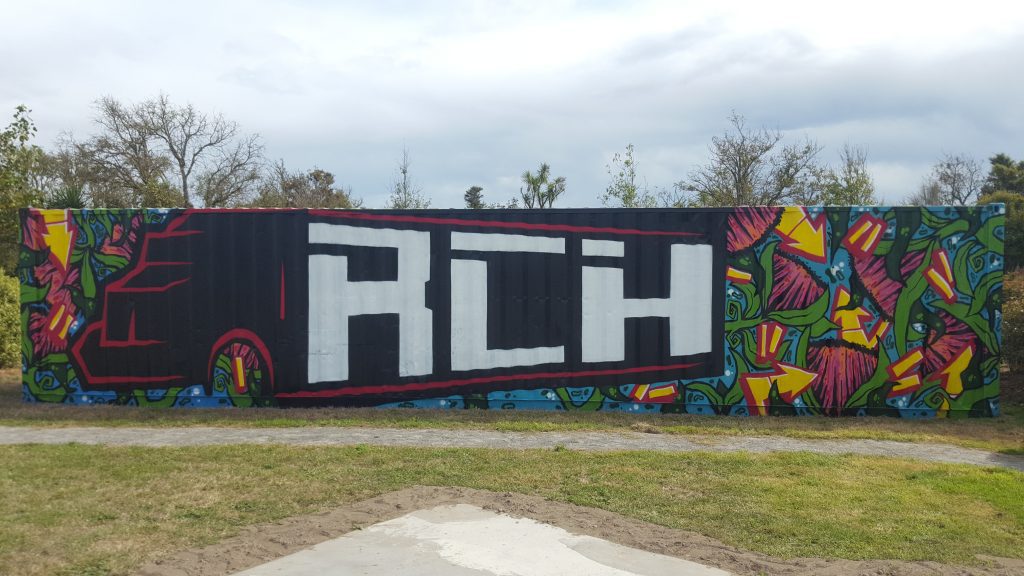
RCH container mural, March 2019 (Photo credit: Caelan Walsh)
Did your graffiti writing background influence your decision to go in that direction?
Yeah, not so much in the sense of actually writing graffiti, but the consequences of it. I’m not embarrassed to say I do have a criminal record, I’m very strong in my morals, if I think it is right, I’ll do it, even though it might be against the law. I think I’m pushing eight or nine times just on wilful damage charges. Just dealing with the court system, I’ve seen a lot of people who have been abused by the system, just because they have a lack of knowledge of how to deal with it. I’ve been lied to, I’ve been taken up the garden path, and told we won’t charge you, and then you admit to something and it’s like sweet, you’re under arrest. I don’t know about other countries, but in New Zealand they don’t teach your rights enough in school. I think every school should have some class about knowing your rights, because Police and anyone with authority can abuse their power…
I’ve always believed that any education programme should have some moral or ethical philosophy component. If we had more people who understood, not only their rights and how the justice system works, but who also have the ability to make up their mind about what is morally and ethically right, it would go a long way. So, when you finish, will you try and connect those worlds?
Obviously, I do have issues with a criminal record, which does impact where I can go for now, it will take time, but I will get where I want to go. I definitely want to end up doing some sort of social work. I’m already putting myself out there as someone willing to talk to people. I’ve gone to a lot of my friends’ court cases as support, because it’s a scary, intimidating thing going to court, even if it is just for drinking in public and its just a $200 fine, it’s still really intimidating. So, just having someone there, telling you it’s all good, that the worst that can happen is you might get home detention. They are thinking they might go to jail for two years, so it’s important to have someone who can say it is alright, don’t stress out and be confident with what you are doing. I’ve always found the worst punishment is not knowing, once you get charged, you got a couple of hundred hours of community service, O.K., I will knock that out, and move on. But that few months of: Am I going to get charged? Could I go to jail? Just getting stuck in the system is an incredibly scary thing…
Thanks man, it’s been really interesting, I look forward to seeing what comes next for you… Do you have any shout outs?
Yeah, shout out to Watch This Space obviously and Gap filler, also my boy Dove, the FOK and AOC crews and anyone in Christchurch that is doing their thing at the moment. And thanks to Cent for documenting the scene and helping out with some photos!
So, after kicking off this recap series last month, it became apparent how fast each iteration would come around! Luckily there has been plenty to keep us going, with good weather, a number of spots and new initiatives, February 2019 saw Christchurch’s urban art scene keep up appearances, from the return of a big name, to the return of an important event, it was a good month…
Jenna Lyn Brown with Porta and Dr Suits – Viva New Brighton
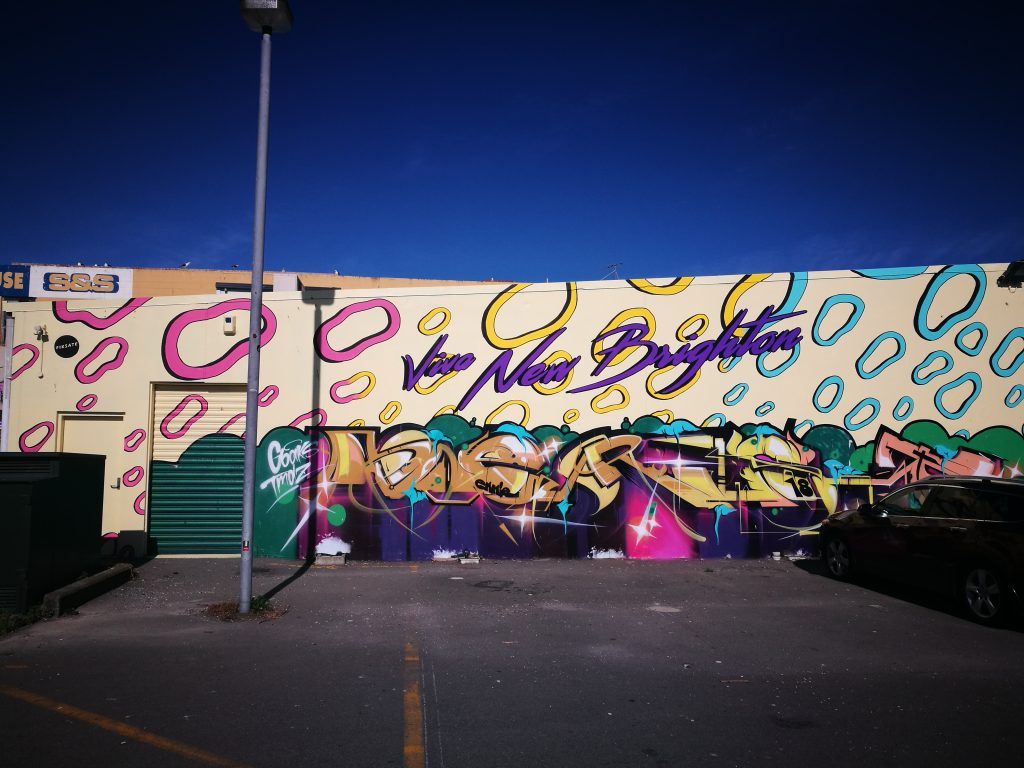
Jenna Lynn Brown with Porta and Dr Suits, Viva New Brighton, Hawke Street carpark, New Brighton
A fun addition to the seaside village (along with a spattering of new paintings throughout the mall) the text-based painting on the old Couplands building deftly co-exists with Auckland artist Berst’s dynamic piece, with shared echoes of colour, albeit in contrasting styles. The declaration ‘Viva New Brighton’ becomes a proud celebration of the community’s rebellious spirit…
Style Walls 2019
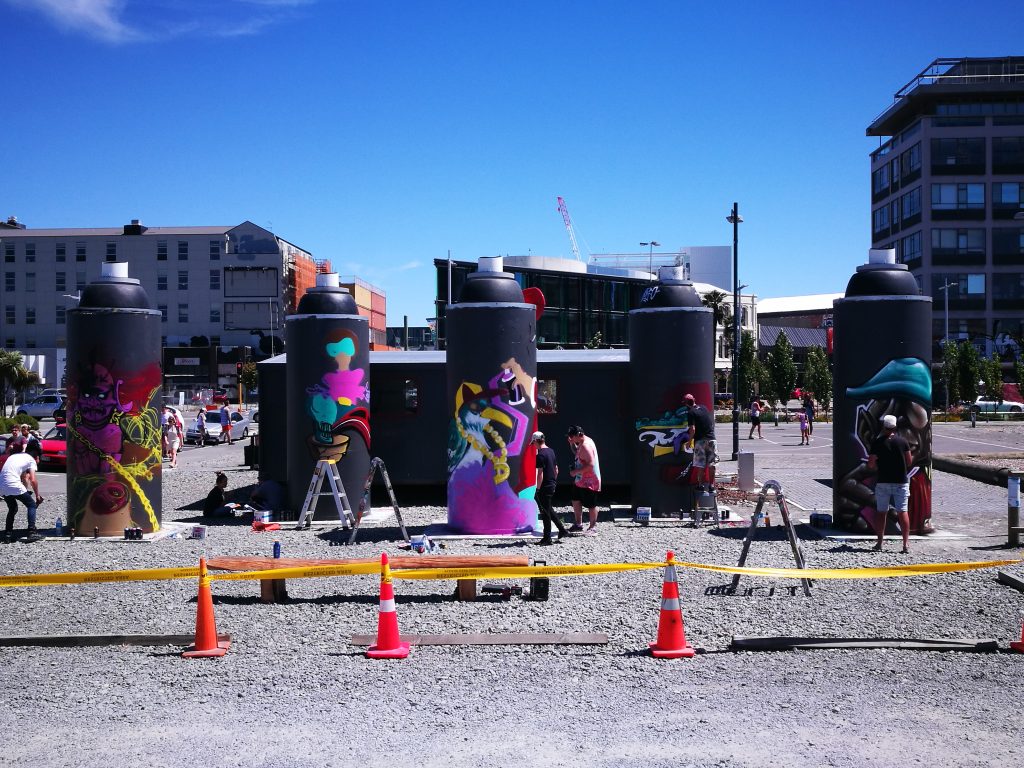
Competitors in the middle of battle for Style Walls 2019, Lichfield Street.
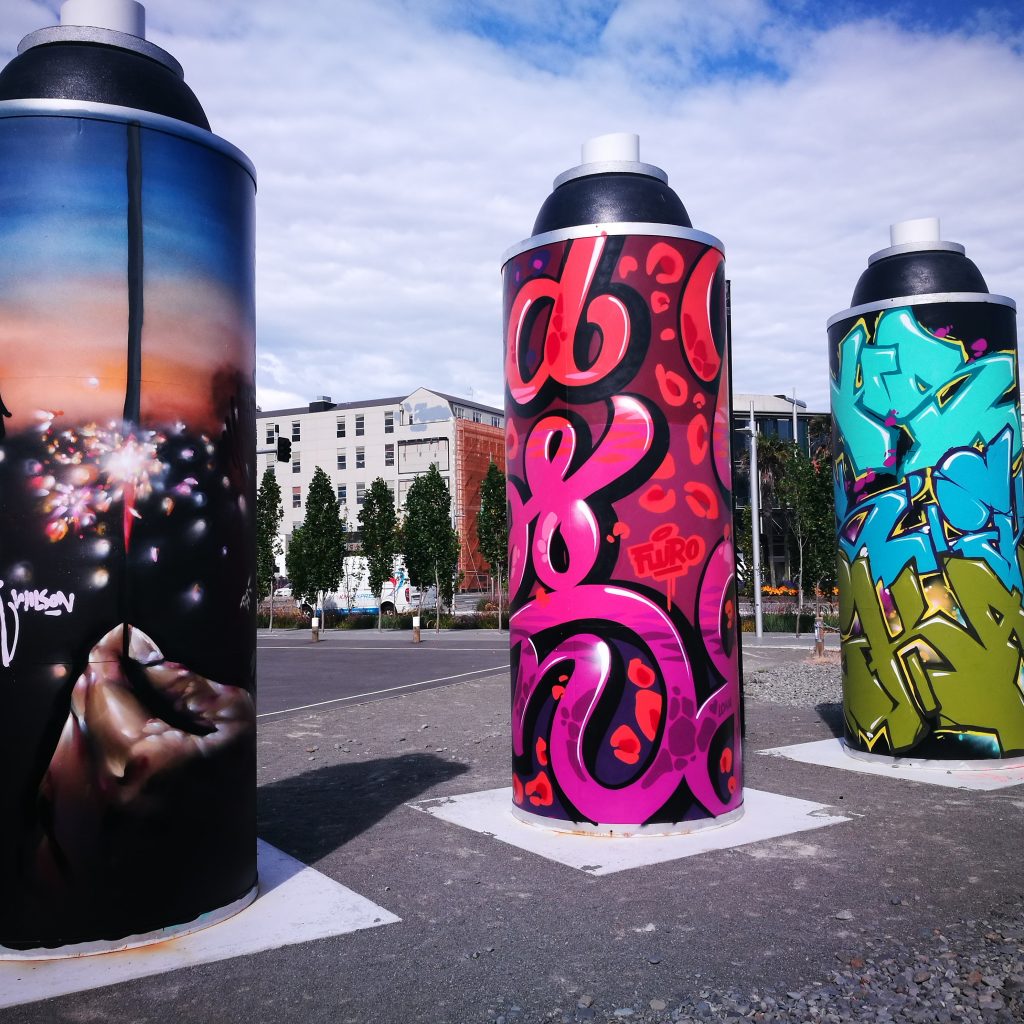
In early February, the local institution Style Walls returned, once again pitting an array of talented artists against each other in a battle format. Utilising the giant cans as the canvasses, Style Walls 2019 focussed on characters rather than letters, and the hand-picked line-up were allocated four hours to impress the judges. Ysek7 came out on top, beating out Kieos, Dove, Daken and Sewer. Stay tuned for an interview with the champion, and some further insight into Style Walls with co-founder Ikarus…
Black Book sessions
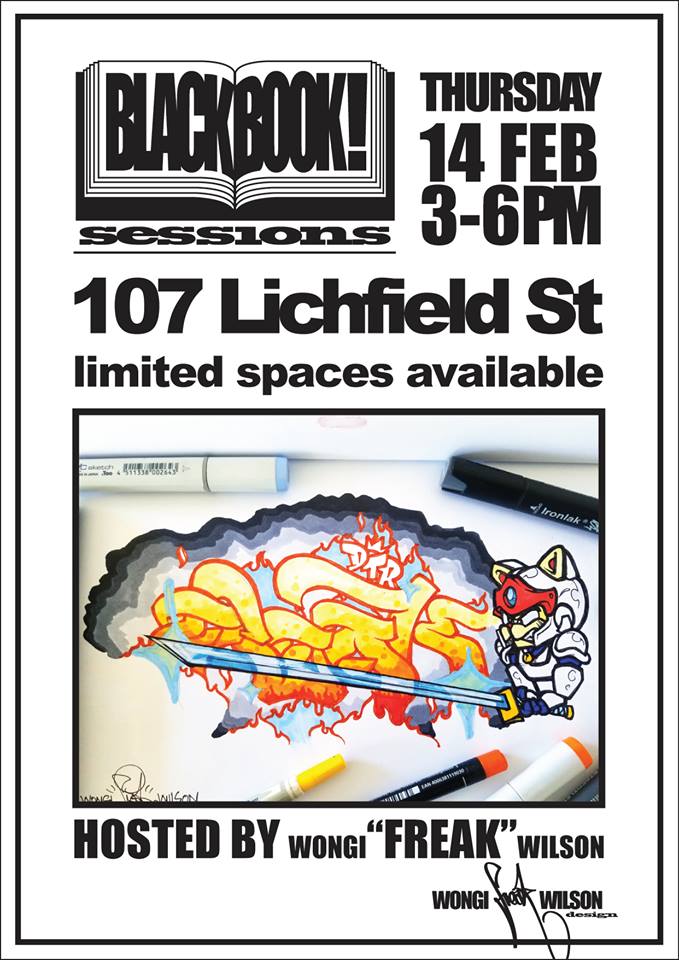
While not strictly a February event, we just had to shout out the Black Book sessions that have been running for several months now, encouraging graffiti artists of all ages and levels to commune and create. Established by Wongi ‘Freak’ Wilson, Emma Wilson and Ikarus, the sessions are held weekly on Thursday afternoon/evening at the Youth Space on Manchester and Lichfield corner. See their Facebook page for more details…
Who is that Lurq-ing?
Lurq, Hereford Street
It is always good when local legends leave their mark, so seeing a number of pieces around the city by Lurq deserves a mention for the month of February, that recognisable style featured in a number of productions in different spots…
Dove and Wongi – Bode tribute
Wongi ‘Freak’ Wilson and Dove, Bode colab, Hereford Street
Definitely a personal favourite, the tribute colab by Dove and Wongi ‘Freak’ Wilson in Hereford Street combines the stylistic flair of each artist while celebrating a seminal influence on graffiti culture. The underground comic artist has been a massive inspiration on a number of graffiti writers, and his iconic Bode Lizards and Cheech Wizards have been included alongside pieces and in productions across the globe.
In basketball they talk about being a triple threat: a player who can score baskets, defend, and provide assists for others. This concept is fitting when it comes to Christchurch artist and designer Joel Hart, not just because he has his own history in the sport of hoops, but because he is also a true all-rounder. A talented and popular artist, whose captivating work is found on walls both in the streets and in galleries, he is, to top it off, a heck of a nice guy, unassuming and relatable. It has been a goal to sit down with Joel to discuss his work and career for a while, and the opening of his new show Dopamine at Fiksate provided a perfect opportunity. For an artist whose work embraces a number of processes and materials, and as a figure who perhaps represents an alternative entry into the worlds of muralism and urban contemporary practice, there was no shortage of conversation…
What was the inspiration for the title of this show, Dopamine?
Where did it come from? I can’t actually remember…
I did a bit of research, and from what I have read, bearing in mind my limited scientific knowledge, dopamine refers to chemical neurotransmitters in the brain and they impact a range of emotions and capabilities, including the ability to see and obtain rewards, which was interesting to me, is that what you had in mind when you came up with the title?
Yeah, it is that idea of the visual experience, when you see something cool, and it releases that dopamine feeling, and I guess that’s how I like to explain my work, it’s very much about a visual experience…
You see your work as a very visual, visceral experience, and the immediate response triggering an emotional response?
Yeah, I think so, so that’s where Dopamine came from.
Just Motion, mixed media on canvas, 2019
The show opens March 15th at Fiksate, and having talked to you for a while about a solo show, it feels like a long time coming, do you feel that way?
Yeah, it has been over three years since I had my last solo show, so all these ideas that I’ve been pulling together, it has been a long, long time coming. But it also feels like it has snuck up really quickly as well…
That long gap must mean there has been a fair amount of progression in your work, which must be more satisfying than successive shows of the same stuff, but at the same time, it must mean that there is a lot to try and condense into one coherent show that explains that progression. The ability to have a solo show in a dedicated urban contemporary space, like Fiksate, must be satisfying too. Did you feel a different responsibility than you feel painting a mural, having work in a group show, or even a booth in an art fair, a responsibility to have a more coherent, cohesive body of work and presentation?
Yeah definitely, you want to be tying it all together as a consistent body of work, which is really hard to do, because I’m constantly working with a lot of different materials, I’m pushing towards sculptural elements, there are layered works, and there are works on metal as well. I’ve tried to work around the female portraits, which is mainly what I do anyway, so that consistency ties it all together, the themes are similar…
The female face has long been a central icon of your work, what is the allure? Is there an inherent commentary?
I was thinking about that the other day, and it sort of stems from my journey as a graphic designer building into the art works. I’ve worked for magazines, I’ve done a bit with photographers and fashion magazines, I worked for a student magazine as well, which was more of a grungy, underground culture, and then I’ve worked in screen printing as well, so it all plays a part, and the images I work with have come from various elements of all of those worlds and experiences…
Tragically Hip, mixed media on copper panel, 2019
Does the imagery work in relationship with the formal material approaches? The use of layers, the reflective surfaces, the fragmented effects, do they intentionally combine with the beautiful faces, and the other references to make a statement?
Yeah, a little bit, the faces come from a way to build on my stencil stuff. The face really builds the emotional quality of the works, and that’s why I started to build around those images. That probably doesn’t answer your question!
Are the faces you depict drawn from media, like magazines or advertising?
Yeah, a little bit, I suppose that is my background, commercial art, design…
Have you ever considered photographing subjects yourself?
It has always been on the list of things to do. At the moment I just destroy magazines and images and signs and that sort of stuff and fuse it all together. But maybe being able to focus on a specific angle I want, or a look that I want, and being able to build around that from the start will be a lot easier to make a more consistent look, rather than pulling a lot of stuff from everywhere. Sometimes it is hard to build a narrative around a piece when you’ve got all this stuff floating around. I could pretty much build an image from this room, I will see it in my head, all the objects and signs and textures around us, I will pull it all together, but I guess I have always tied my compositions together by building them around faces.
I recently saw a newer work of yours that depicted a male figure, is that a first? Is there a reason the female face has been a more prominent motif?
I’ve done probably half a dozen male figures, but probably most of my work features female figures. I guess I kind of feel like you get more emotion from female eyes, especially in high fashion photography, the lips are more interesting, I don’t know, I guess that is what I’m more interested in working with. Some of the recent stuff I’m playing with allows me to see my work as a snapshot of a larger story, some of the works in this show have a broader narrative, and the faces I see as just something more to explore the formal elements I’m working with…
Those other elements include text, skulls, animals, patterns, natural elements like flowers and foliage, so what is the relationship between all of those aspects, especially the text, it often seems that a piece of text will have an apparently evocative connotation, but at the same time they can be quite ambiguous in relationship to the other pictorial elements, there is a duality between meaningful and meaningless…
Yeah, I quite like to do that, I will have this idea for the visual side, and then I might hear a line in a song, or see something written in a book, just something small, a couple of lines or something, and I will cut it out, and then the text takes quite a prominent role in the piece.
Hush, mixed media on brass panel, 2019 (Photo credit: Joel Hart)
Often the text forms the title of your work, right?
Yeah.
With the typography of the text, are you playing around with that, or using the found visual? Is the text both a signifier as language and as a visual form?
I have always had a big interest in typography, especially in my commercial design work, but the text I use in my work is more often found than a decision to use a trendy, disposable typeface, or even one that is timeless, they are often a bit low-res…
That process of collation, putting all your ideas and images together; scanning, compiling, composing, is there an equal balance between that process and actually producing the work from that sketch?
Oh yeah, there is lots of preparation and planning, so probably sixty percent is that preparation, and forty percent is the application. But in saying that, a lot of the new processes I’m working with, the structures and layers, they are making it more like fifty/fifty…
Within the structures and layers of your compositions there is also a gestural and apparently free-form mark-making, which almost seems at odds with your design background, how open are you towards the end goal when you are making work? Do your sketches reveal how something will look, or can they change over the process?
The scanned image will pretty much be the final product, but in saying that, once I start, I might cut bits out. It is a pretty loose process but the actual appearance of the face, I’ve got the scale right, I’ve got the stencil size right, so that element will generally look like the sketch. Going into my street works, it is really helpful to be able to show a client how a piece will look. So, I guess my smaller works are similar to my larger works in terms of process.
I always remember Porta saying how he respects your ability to solve problems, that you handle things on the fly and find solutions. Is that something you take pride in? Having watched you paint, particularly outdoors, you are use a raft of techniques, from stencils to screen printing directly onto the wall, and in your studio, I imagine it’s even more diverse, because of the extra freedom that kind of space provides. Is a challenge a necessary part of the art-making process for you?
I was saying to someone the other day, I need a challenge, I’m always trying to push the boundaries. It is kind of why I got out of design, because I found I was just doing the same thing over and over. But at the same time, I guess the problem-solving element comes from my design background, where you are solving a problem for a client essentially; they have no collateral or visual presence and you are solving that for them. So, I suppose it comes from that. I guess I like to always explore ideas, and on a wall, you know you will learn something new every time. In my studio works as well, I will be like: ‘Next time I will be able to do that, because I can see where I want to be heading…’
Supreme Supreme mural, Welles Street, 2017
You can see a larger tapestry?
Yeah, like heading into some sculptural work is a massive learning curve for me, working with steel, with timber, engineering stuff…
Is that something you are leaning into yourself? Or do you have people helping you? A lot of artists will work with fabricators and technicians these days, but I feel like you are more hands on, that you would want to be on the tools…
I’m very hands on, but I have very limited knowledge in that area. So, I’m just learning different things, like welding, not that I’ve done much, or steel fabrication, getting ideas and asking questions to see if it is possible to do stuff. The work that comes from it will still be my style, I still want to work in layers, but I am interested in making things that can occupy public space…
Is there any work in Dopamine that represents that direction, or is it a longer-term goal?
It’s probably more of a longer-term goal, but I’ve got a couple of things I’m trying to pull together, so hopefully I can pull it off, but it’s only a couple of weeks away!
Escaping Reality, perspex, 2019
You have been working with layered plastic and copper sheets, what other materials have you been working with? What are you seeking from these different materials, especially as they become more and more important parts of your work?
Yeah, I’ve been playing around with iridescent lighting effects, with film, and mirrors, and just playing with how light can sit in a room. That’s something that has always interested me, spreading the layers out so I can work with shadows, exploring the angles of shadows and light, and how light reflects off surfaces. I’ve always been interested in repurposing things, ever since I was a kid, I loved finding stuff and making something. It’s experimental, playing with different things…
When you decide to use a copper surface or a mirror surface, how do you decide what type of image to use, and how do you develop the relationship between those two elements?
It sort of just comes naturally, because it just starts as a rough sketch and develops from there. I’ve got all this material in my studio that I think will work with something later, so if I know I’ve got a piece of mirror that’s six hundred by six hundred, I can sort of build my composition into that mirror. Often, I will just put something aside, like a rusty bit of steel, and once I start on piece, it will be like, oh that will be perfect for that…
Obviously, you enjoy the ability to experiment with these materials in the studio, but do you prefer that environment to working on a mural? Do they feed into each other, or is there a preference?
At the moment, I’ve been stuck in the studio, so I can’t wait to get outside on a wall. But then when you have been on a wall for a week, you can’t wait to get back to the studio! It’s quite nice to have that balance. And it’s good to have the design, not that I do much at the moment, but it is sometimes quite nice to do some of that, to have a more structured brief.
In terms of public, or street works, you aren’t from a street art background as such, but your work definitely has the urban contemporary aesthetic and obviously stencils form a massive part of your work. Have you ever had a desire to do smaller, intervention-style stuff? More post-graffiti street art, rather than the larger muralism?
I’ve always been interested in it, and being a stencil artist, you would have thought I would have had that background, but I don’t know, I was always inspired by graffiti, but I never really liked the idea of painting someone’s wall, I don’t know! But I love the history and I guess I just have always taken it more as a studio practice…
Untitled, New Brighton, 2017 (Photo credit: Joel Hart)
What was your introduction to stencilling? I always ask that, and there always seems to be a common entrance point, like making a stencil of some type of pop culture icon, and then progressing from there. What was your early influence? Was there a particular artist who influenced you? Which stencil artists do you look at now and respect?
I think I saw Rone’s early stencil stuff, it might have been in Wellington? At that stage I was studying graphic design, so I had the tools to make a stencil, and then all my work started to look like that, I used that aesthetic on every project. Then I started cutting and I always just used fashion magazines, because I had them around, and my Nana always had them, as a kid I remember she had stacks of them, so I would cut pictures out, female models in black and white, and I always liked that look for stencil stuff. Logan Hicks was a massive inspiration for me, the massive scale stuff and the process of learning how to break it down…
To break down an image and build it back up? That always fascinated me as well. Did you have those moments where the penny drops with your process and the whole image changes, it unlocks the potential of what you can do with a stencil?
Yeah, it’s amazing right? I got up to twelve-layer stencils at one stage, but I realised I only needed three or four, sometimes only two, I don’t need all those layers to get across what I’m trying to do. Logan Hicks used to do massive thirty-layer stencils, but he basically said you don’t need to do that…
I admire the approach of artists like Flox, Alice Pasquini or C215, where there are only one or two stencil layers, which serve as just like a defining marker over the top, while the gestural painting plays underneath to build the composition…
That’s sort of how I do my larger stuff. I have one stencil essentially and cut the black lines and the grey and white lines, all as one, so its all lines and then you are pretty much colouring in once you take the stencil away…
This all makes me think that your stencil work could be a really nice surprise if it was made on a smaller scale in the streets. The transition between street and studio shows that your work can scale up and down, so it is a real possibility…
It has always been in the back of my mind, I’ve just always been so busy with commissioned works and stuff, it’s just taken off, so I’ve been pushing that…
Untitled, Colombo Street, Sydenham, 2015
Your use of screen printing, has that been influenced by stencilling, or has it influenced your stencil technique? Do you delineate between the two? Because they form big parts of both your public and studio work…
A screen print is just a stencil essentially, just a different application, pushing the ink through instead of spraying it. But I worked as a graphic designer for a screen print company for a while, so I got the basics of splitting my image, then breaking down that image further for t-shirts and stuff. I didn’t really think about using it in my art work until later on, when my wrist was killing me from cutting stencils, so it just came from a negative really. It has become a main feature of my work, the main detail is in the screen print and I will then stencil behind it, if that makes sense. I also use kind of a grungy approach to make a screen, I wouldn’t use it commercially, like some bits wash out when you are trying to hold it, it’s quite a back-yard process…
As a stencil artist, do you have that feeling of inadequacy around can control?
I’ve always used stencils and relied on stencils, so I’ve tried a little bit but I’m not very good with a spray can. You watch people do it, like Wongi and Yikes, and it’s like, how they can do that! In my past I would do pencil or charcoal drawings, so I’ve got that drawing background, but it’s just another thing, even with a stencil sometimes, it’s hard to get the effect you want…
With your use of digital approaches, how much do you find that you draw in the ‘old-fashioned’ way now? Do you try and keep that habit up or have you found it less necessary?
I used to do it lots, just because that’s where it started for me. But even with my sketches, you can hardly tell what they are now, they are just quick scribbles. I would like to bring it in more, it would be like going in a circle, because the roots of what I do come from drawing, I used to do pictures of people’s dogs and kids, they would commission me to do that, and that’s where it started. I worked for an architect as well, way back, drawing renders of houses and stuff, so it has all come from that…
It has always been there?
Yeah, but I’ve found other ways to do it, I don’t know, I guess it comes from that experimental approach of every time I do something, I try something new, and it has been replaced. I always have my tablet, and I always draw, but it is straight onto the screen, I guess it’s the way it is going….
How did the show at Fiksate come about?
It is exciting for Fiksate to be in town now. It is really cool to see where it started and where it is heading, it feels like a big step up. It’s a really cool space and I really like what all the guys are doing there. They are also really nice people to deal with, and I guess that’s the main reason. It fits my work perfectly too, as an urban contemporary space.
As a specialised space, it must be helpful to not have to compromise, or to have to put extra work into finding and transforming a space. How does the experience with Fiksate relate to previous experiences?
My original thought for this show was to have a big warehouse, and to run it all by myself, but working with Fiksate, I can focus on the art and not the space and the marketing, they are taking care of that. I think Yikes said the same, it’s nice to focus on the art for a change, because there is a lot more that you don’t think about behind the scenes…
All the little stuff, right? A lot of urban artists are using alternative spaces, like DSide and Extincted, where he made a fake gallery, or the Underbelly Project in the subway tunnels of New York, or Hanksy’s (now known as Adam Lucas) take-over of an empty Los Angeles mansion, was that your thinking around a warehouse space?
Yeah, absolutely, you always want to push your work and display it places that blur that line between inside and outside worlds…
Popular by Demand, mixed media on perspex and board, 2019 (Photo credit: Joel Hart)
Blurring that distinction between gallery and urban spaces?
Yeah, for me, I really want to show how I can tie together all the elements of my work, the outside works, the studio works, the sculptural elements that I am really interested in. Like, how Vhils makes the image out of the wall, that really interests me…
The idea of urban excavation…
Using what is there and building on that…
The last few years have been pretty crazy for you, right? Your work was included in the Australian Stencil Art Prize touring exhibition, and despite not being at all comfortable, you were featured on a reality television show, what has been the most unexpected thing to happen over the last few years?
Being on The Block! I hated it, aye! I was so nervous! I hate the idea of it, but I like pushing myself outside of my comfort zone because if I don’t, I don’t feel like I’m going anywhere. So, it was a good way to meet people and push my brand out there…
It is important to help grow your profile, but a show like Dopamine will ultimately be more important in terms of your artistic development, a cohesive body of work is a more important proposition than just putting your name out there, right?
I suppose so, yeah. Like we were saying before, pulling together all these ideas I have and trying to show them in one body of work, and, as opposed to sending bits out, or working on this project for this show, it’s different. It has consumed me for a few months, it is all I have been doing…
I assume you can see the light at the end of the tunnel now, and for someone like you, are you straight into the next thing, or do you take a step back and relax?
Nah, I’m onto the next thing. I’m always thinking of what I’m going to do next. I’ve got a couple of murals to do and commissions to work on, and of course I will be trying to develop the sculptural stuff…
What sort of experience have you had working outside of Christchurch? Do you see that as an inevitable and exciting pathway?
I haven’t done that many street works outside of Christchurch and I would like to, just to get out and see more of New Zealand. I would like to do that more, so it’s been a goal of mine to make contacts over the last six months. I am also looking at maybe Australia, and approaching a few galleries there to do some stuff…
Untitled, Kaiapoi, 2018 (Photo credit: Joel Hart)
Have you looked at the festival circuits? There seems to be a new event every month, and in increasingly surprising places, so it seems like it could become a more viable option, right? With the likes of Street Prints, Sea Walls, and various other independent events, you could potentially be all over the country…
I haven’t been a part of them, but I would like to, I just haven’t had the opportunity yet. I haven’t really pushed it though, so if it comes it comes about, I will just say yes to everything, although that’s how I ended up on The Block!
I guess it could’ve been worse, it could have been Married at First Sight, right?
That’s addictive bro!
I can’t say I’ve exposed myself to that addiction yet! I’m fascinated by the different backgrounds of people, and part of your story is your time as a basketball player. Do you see any overlap between playing high level sport and making art? I know a lot of people might not see that connection, in fact they are often set up against each other, but I’ve always had a relationship with sport as well, and I’ve always thought about the aesthetics of sport. Basketball in particular has that mixture, with the branding and the visual identity, but then as well, the physical performative element of sport and the repeated perfection you search for, searching for your stroke when shooting, your handles of the ball, did you ever think about the connection between the two? I know you kind of moved between the two rather than occupying both, but do you see that connection?
Yeah, I definitely do, I always think about how I got to where I am as an artist, and my former career as a basketball player. I have always had an addictive personality, and if I do something, I want to do it as best I can. I did that with my basketball, and you end up training three times a day, it consumed me. I loved it, it was all I did. But then I don’t know, I stopped, I had kids. Whenever I was on basketball trips I was always drawing. I never had a style, but I was always drawing cartoons and typography, and then as soon as my basketball stopped, my art career took off. I always had my design background, or trade I suppose, and then I put all that hard work, that training mentality I took from basketball and I applied it to my art making, and I just didn’t stop doing it. I wanted to learn new techniques and master them, just like you perfect your skills in sport. Like you said, the aesthetic side all links together as well, the branding and design work and the aesthetic side of sport all work together.
Speaking of that visual branding in basketball, do you a team that you really like their branding and visual culture?
I like the Golden State Warriors and how the logos went from being eighties-styled to being really colourful, back to being really simplistic. As a kid I used to draw all the logos and laminate them and stick them on my wall…
I did that as well!
I suppose that’s the process, the aesthetic side of it. I like the singlets as well, the design of singlets, how they have gone back to really simple concepts, with bold colours…
To finish, what can people expect from Dopamine?
I can’t compare it to my last show, but I kind of see this show as a big progression from that show. My finishes are different, it’s just a lot different really. It’s more experimental I suppose, I see it as a stepping stone for me to show some of the stuff I want to be doing. There are quite big pieces that I have been working on, and a few more prints. I’ve only done one print before, so there will be a few more prints…
Prints are accessible, which is why urban artists have embraced them. Have you worked with a printer to get the standard you want? I imagine it is really important to get the right image quality and replication, especially since you have such an interest in surface textures and finishes. Was it easier because of the digital rendering process?
I kind of mix them together a little bit. The prints are a bit of digital and screen print, so there is that tactile feel. That’s something that interests me as well, from that design perspective, the combination of the digital and the real. So, it should be quite interesting, no one print will be the same…
I’m sure they will be popular! Thanks Joel, good luck for the show!
Cheers!
Dopamine opens 5:00pm on Friday, March 15th, at Fiksate Gallery, 165 Gloucester Street, running until April 25th.
Well, January flew by, right? We thought that since life is so hectic, and the worlds of urban art are often so fleeting and ephemeral, it would be helpful to recap each month with a kind of top five list, you know, like in the Nick Hornby book High Fidelity (or the John Cusack movie adaptation, where Jack Black steals the show, take your pick), or a truncated Letterman Top Ten. We will list five things that we loved during the previous month – from new works, big or small, to events and exhibitions, or even just general talking points. And of course, we would love to hear what you think, so jump in and comment, or send us a suggestion for our upcoming lists…
So, without further delay, here, in no particular order, is the inaugural ‘And that was…’ list for January 2019 (drum roll please…):
Face Value @ Fiksate Gallery
The team at Fiksate followed up the Jacob Yikes exhibition, Bad Company, with another impressive showing – the second incarnation of the Face Value: an exploration of portraiture, figuration, faces and characters through the lens of urban art. The show featured a range of talent, from emerging and established locals, to big names from wider Aotearoa and further abroad, such as Anthony Lister, Elliot O’Donnell (AskewOne) and Tom Gerrard (Aeon). Highlights included O’Donnell’s monochromatic apparition Chloe (Beta), the collective strength found in the juxtaposition of local artist Meep (Kophie Hulsbosch)’s bold self-portrait and the works of Auckland’s Erica Pearce, the elegant chaos of Lister’s Ballet Dancer, and Koe One’s typography-laced black and white portrait of urban youth.
The Giant Cans get a makeover…
The Giant Cans got a make-over with new work by (L-R) Wongi ‘Freak’ Wilson, Fluro (Holly Ross) and Ikarus.
While five cans remain a constant open platform, the three cans that stand aside are designated as semi-permanent. Initially painted by Wongi ‘Freak’ Wilson, Ikarus and Jacob Yikes, in mid-January, the three metal sentinels were re-painted by Ikarus, Wongi and Fluro (Holly Ross), giving them some fresh evening wear for 2019. With Ikarus’ slick letterforms, Fluro’s elegant typography, and Wilson’s photorealism (with some nostalgic cartoon fun thrown in as well), the cans represent a variety of approaches and styles.
Macadam Monkey chills in North Beach
Macadam Monkey’s North Beach and Chill wall, Marine Parade, North Beach.
French artist Macadam Monkey spent several weeks in the city in late December and January, and he made the most of his time here. Hitting a few spots with his almost Art Deco-styled, elegant females as well as more traditional lettering, our favourite was probably his appropriately titled ‘North Beach and Chill’ wall beachside in North New Brighton. The refined (and recurring) colour palette of black \, grey, yellow and white added to the chilled vibe and the work itself seems to have the potential to be something of a small-scale landmark for the area (although time will tell of course…).
Juse1, VRod and Torch in New Brighton
Juse1’s B-Boy chilling in New Brighton.
It was something of a meeting of generations and locations when Wellington legend Juse1 visited Christchurch. He spent time painting with local writers VRod (who hails from Auckland but is based in Christchurch) and Torch, and while the Hereford Street spot was a blink and you’ll miss it deal (in fact there have been a number of pieces there that could have made this list, shout out to Tepid, Lurq, Ikarus, Dove and more), their sprawling production in New Brighton has shown more legs. The pieces add to a vibrant setting, and Juse’s iconic B-Boy character adds a perfect nod to hip hop culture, as if it is straight off a New York subway train circa 1982, albeit still fresh to death…
Jonny Waters, Dizney Dreamz @ Anchorage
Jonathan Waters, Goofy, from Dizney Dreamz, mixed media on plywood cut-out, 2018
Dunedin-based artist Jonny Waters goes by a few names, but one thing is always consistent: his playful, twisted aesthetic, which was on full display in Dizney Dreamz at The Anchorage on Walker Street. Presented by Kin Art, the show featured a new series of Waters’ cut-out characters, this time iconic (and several overlooked) players from the world of Disney cartoons (his previous works have taken on Looney Tunes, Rugrats, Sonic the Hedgehog and The Simpsons). While the silhouettes are familiar and intend to invoke a feeling of nostalgia, the details take the viewer on an unexpected trip; eyes where they shouldn’t be, limbs and heads protruding from fresh wounds. All these features are accompanied by a fine technical detail, with layered sections, perfectly imperfect lines and a use of various media.