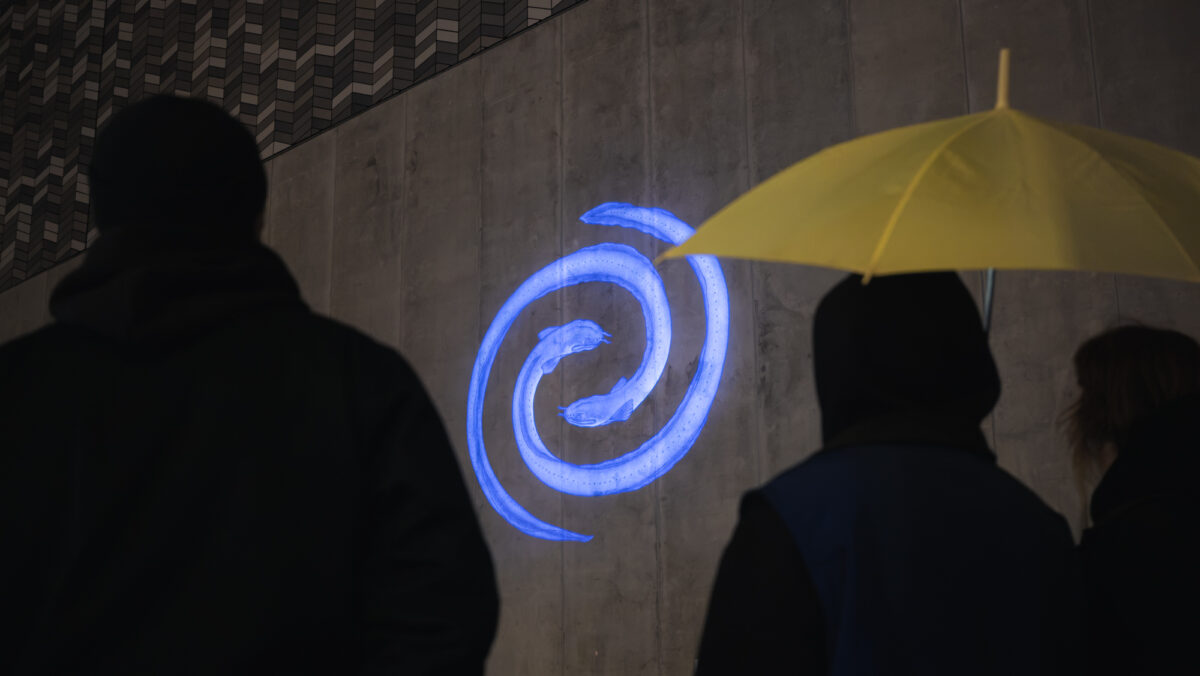
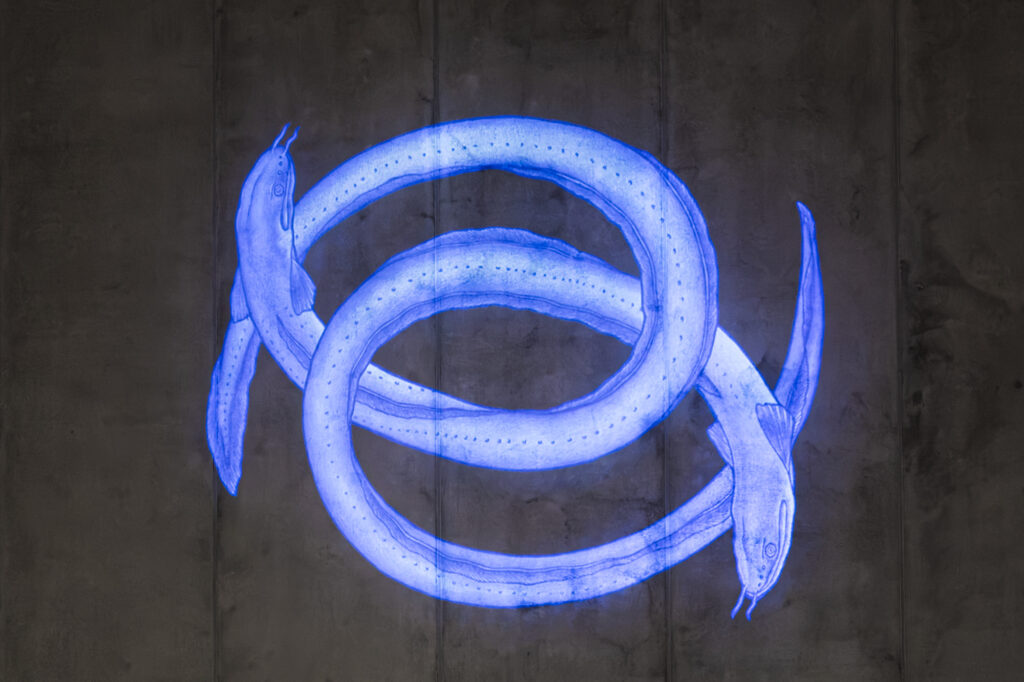
Ōtautahi artist Joy Auckram (Ngāti Maniapoto, Ngāti Parewhata) is the latest contributor to the Spotlight Urban Art Projections series. Their work E Rua ngā Kaitiaki, depicting two twirling, intertwining tuna, was created as part of the Tātai Whetū, Tātai Tangata Matariki festival that lit up parts of the central city in early July. Illuminated in glowing blue, the tuna serve as cosmic kaitiaki, at once personal and universal, inviting contemplation and reflection. To celebrate E Rua ngā Kaitiaki, we sat down with the artist to discuss the work’s animation by digital artist Nicholas Keyse, Auckram’s creative roots and the navigation of the pathways of ngā toi Māori and tattoo.
Kia ora, Joy! Would you like to introduce yourself?
Tēnā koe, Reuben. Ko Ngāti Maniapoto tōku iwi, ko Ngāti Parewhata tōku hāpu. Ko Joy tōku ingoa, ko they/them/ia ōku tūkapi. My name’s Joy, my pronouns are they/them. I grew up in Ōtepoti and moved to Ōtautahi five years ago .
What would you say are your creative roots that have got you to where you are now?
I’d say my siblings and I have inherited our creativity from our parents. My mum makes jewellery out of recycled copper wire and things from op shops. My Dad makes rings from old spoons and coins, some of which he forages using a metal detector. I think just growing up and always making stuff, it kind of just came naturally to me when I started focusing on art as a teenager.
How big a role has Toi Māori and your relationship with your Māoritanga played in your creative path? Were they always embedded, or is that something you have come to slightly later?
I think they’ve always been there. My grandad would often say to us “remember, you are Māori”, but never really elaborated. He was Catholic and he used to carve things related to his faith, for example, he carved The Last Supper out of kauri, which I keep on my wall at home. In my mind, that is his Māoritanga coming out. For me, Māoritanga came to the forefront while I was studying at the Dunedin School of Art. My teachers and classmates really helped me embrace my whakapapa and to be conscious of humanity’s impact on the whenua, which has influenced my creative process. I went on to study raranga at Te Wānanga o Aotearoa, which is where I really took a step into Te Ao Māori and I feel at home there. In the years following, I studied both visual arts and rongoā, all of which continue to inform my mahi today.
How much has that grounding in Māori tradition underpinned your approach to tattooing more generally?
As a tattoo artist, I use Māori concepts to guide my everyday practice. The tattoo experience can be intense for both the client and the artist, I mean, you’re opening up someone’s skin! I’ve found creating a space that is tapu helps keep us both safe across all domains.
In a visual sense, I suppose that the tattoos I design are quite heavily inspired by the environment. My environment is te taiao (the natural world), but also, like, pop culture too. After all, I live in the city and interact with that system too. I feel like these two sides are a part of me, I work in a tattoo studio in town, and I’ve been learning about traditional tā moko with Christine Harvey. I think there is a part of me that wants to embrace who I am, as both Māori, and a person living in the modern world. I’m so grateful for the knowledge, and opportunities that have been presented to me.
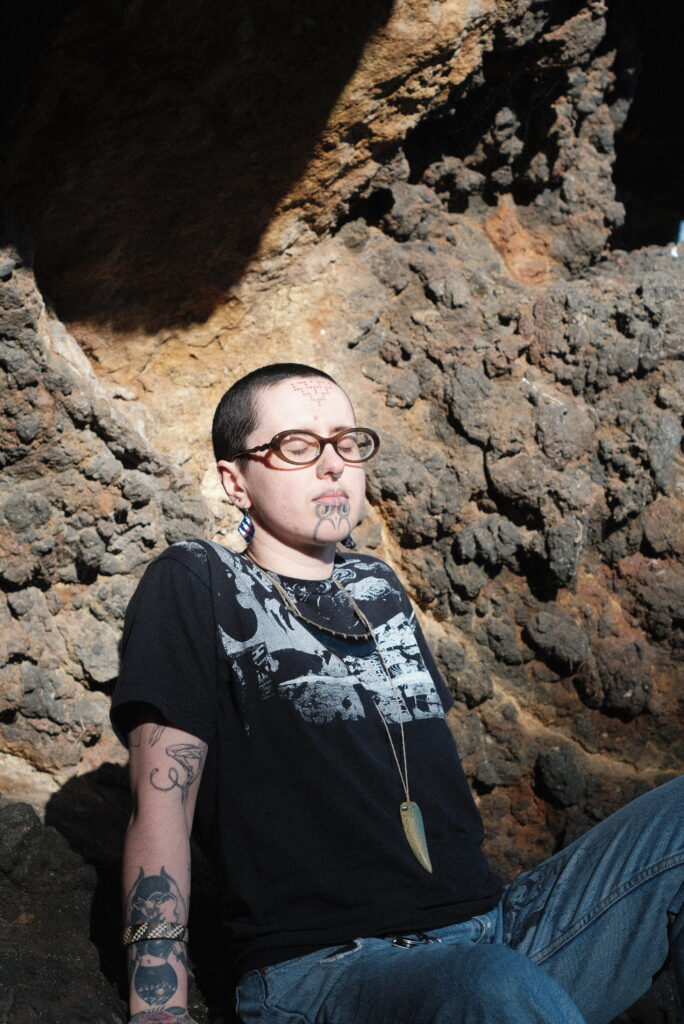
I think one of the really interesting questions for new generations of Māori artists is how to immerse oneself in tradition and the necessary knowledge and tikanga, while exploring how to engage with those traditions in the contemporary world. Tattooing seems like a very rich practice, I guess, for that. Because there’s a lot of important thinking around the significance of, as you say, opening someone’s skin and, you know, the process and the interpersonal relationship that you necessarily undertake, but it also is ultimately something where you also have to relate with that individual and their ideas and thoughts as well.
Over the years, I’ve met so many wonderful people who have taught me that art doesn’t have to be an individual endeavour. Making art in the community, sitting, weaving, drawing and having kōrero is a really powerful thing. The collaborative aspect is what drew me to tattooing.
On the topic of tikanga, it’s important for me that I’m acting in a way that encourages others to exist as their own unique selves. A fair amount of what I know about tikanga will be from Te Wānanga. I feel like that knowledge has given me a pretty solid foundation, and from there I’ve been figuring out what my own tikanga looks like. I mean, I want people to feel safe, seen, and included. When people are being tattooed by me, I want them to feel comfortable to be themselves and for the work they receive to celebrate their uniqueness. I like to use karakia in our sessions, and that’s for everyone, not just Māori. People I engage with respond well to that; it puts us both at ease and helps bring our intentions together.
It comes back to being built upon relationships, right? Art should foster relationships, it should be born of relationships, where we can share with each other, learn from each other. It’s a transmission of ideas and that becomes much more powerful, I think, when it’s collaborative, when it’s community centred, because its reach is broader and, in many ways, more powerful. For you, what are the key skills when it comes to tattooing? Obviously, you need incredible discipline and confidence because of the nature of what you’re actually doing…
It mostly comes down to drawing, that’s the main thing. Spending hours, and even whole days drawing was how I built up the portfolio of work to get an apprenticeship. When I say it like that, it sounds really simple but in truth, it was really difficult to stay disciplined for so long. That changed so much once I started working in a studio. Having people to hold me accountable is really helpful. Like, I’ve got deadlines when I’m booking work, so I’ve got to get a drawing done by then, otherwise we can’t really do it. I think that outside pressure has really helped me be productive, it’s so much easier when there’s a tangible outcome involved.
Other than drawing, the thing that I really wanted to get right was health and safety, this is part of tikanga, and not getting anyone infected or unintentionally scarred from my work. Like, obviously tattoos hurt, but it’s controlled and the healing should be easy. Healing can be a beautiful part of the process when you get a tattoo or tā moko. You learn how to take care of your body and be present throughout the process of healing.
Thinking about the body as, I’m loathe to say canvas, but, you know, as the surface that receives your art, and literally seeing your iPad right next to us, do you see a difference between that practice of drawing on the digital screen as opposed to paper, which must have a greater sense of tactility?
I still prefer to draw on paper, and probably always will. I bought a tablet somewhat reluctantly, but it is an incredibly useful tool. Like, I’ll draw an image on paper, take a photo and then increase the contrast or change the size or something like that. I do some designs on my tablet, but mostly on paper. There are far less distractions in the offline world.
We spend so much time on screens already, right? One of the reasons I ask that question is that the reality of putting ink into skin is that you are dealing with this very organic and ergonomic surface. That contrast between the flat and the three dimensional must be one of the biggest challenges. In terms of how you translate that, how you navigate that, is there something that you draw from in terms of the tikanga around that shift from a design onto skin?
Yeah, I think all of the work that goes in before the session. There can be more work at this stage than the actual tattoo itself. Sometimes I’ll draw an image, print it out onto paper and physically position it onto my own body. It’s a good way to check how the image looks once it’s wrapped around a wrist or leg. It’s really about embracing the flow of the human body and the wairua of that person. A lot of tā moko is drawn directly onto the body. So, you’re just skipping the pre-drawing process. On the one hand, drawing freehand opens up a whole dimension of difficulty, but it also allows the artist to really connect with the person receiving the work in that moment, it’s just the most amazing process.
A lot of people getting pre-drawn designs want to see exactly how it’s going to look before getting the tattoo, but I don’t always need to see, like, the shading or whatever because I know how I’m going to do it, so, there’s a bit of trust there. With that said, I have built up a bit of a portfolio now and am able to give my clients an idea of what the result will look like without having to spend unnecessary hours on the pre-drawing.
I’m interested to hear about your relationship with the tattoos you complete. A street artist puts something into the world knowing that it could disappear quickly. Your work is very permanent, it’s not ephemeral as such, but it does get up and walk out. Do you get a desire to check in, or do you just have to be able to go, okay, it’s gone? Your relationship with the piece of art you produced must be necessarily different on that personal level because you do have to allow it to move away.
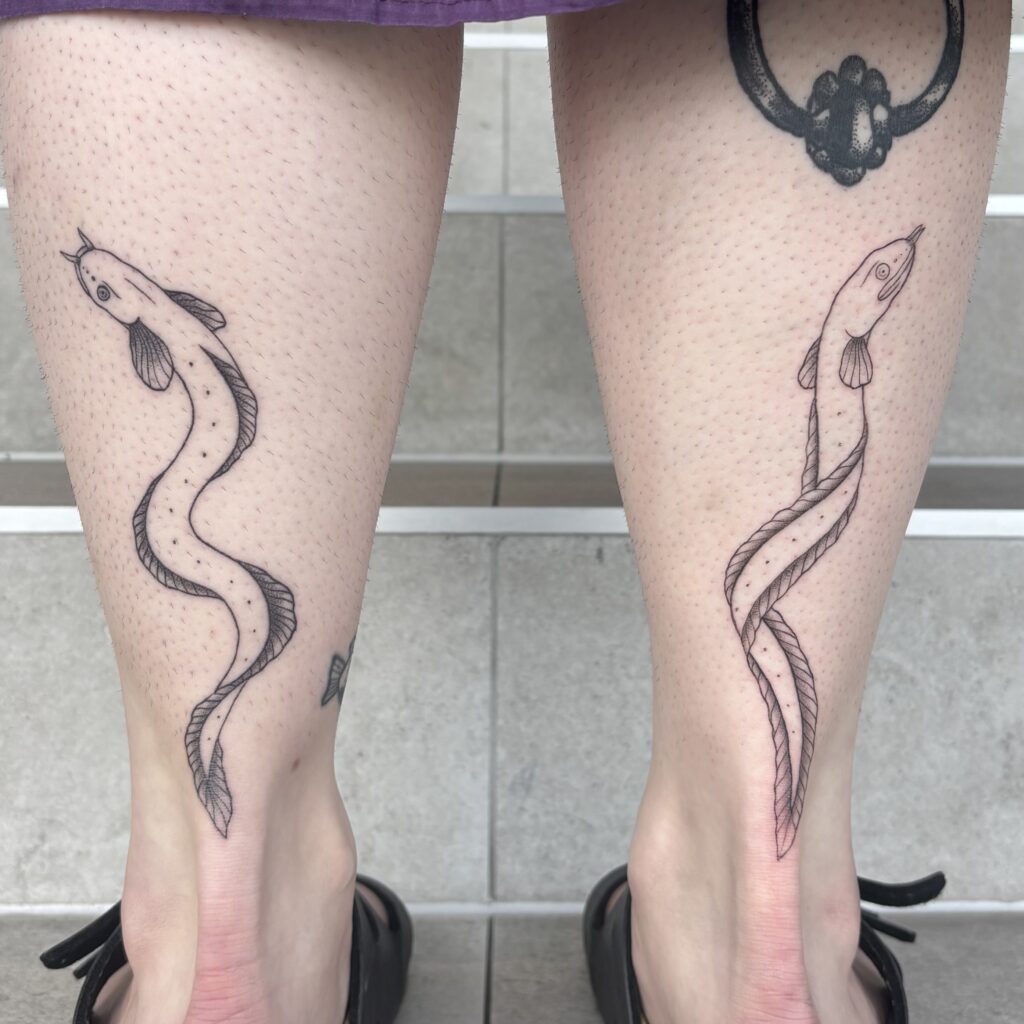
At the end of the day, it’s not my tattoo. Like, I’ve made it of course, but once it’s on somebody, it’s theirs. Sometimes I see tattoos that I’ve done and I think, oh, I can make that a little bit better if they want to come in and get it touched up. As long as they’re happy, that’s the main thing. My clients have all been so beautiful to work with. I’ve got some people that are like walking billboards for me, like, my friend Ash. She’s always showing off the tuna that I tattooed on her legs and has sent heaps of people my way. Like we were talking about at the beginning, it’s all about relationships.
You mention tuna, which of course, are the subject of the work you created for the Spotlight Project and Tātai Whetū Tātai Tangata, the Matariki Festival. Your image of two swirling tuna, what was it originally produced for?
That image was created in one of those long day sessions I mentioned earlier when I was creating content for my portfolio. It might have been the last one I did for that. I remember realising then that the next step was to walk out the door and ask people for advice on getting an apprenticeship. I had a lot of lovely people who sat down with me, flicked through my portfolio and offered me feedback and direction. One of these people was Naith at Absolution, who I’m now working alongside. I still use tuna a lot in my design now, but it’s nice to reflect on the piece that’s being projected, it’s part of my story, and it’s so special to be able to share that with everyone.
How challenging is that step, asking for that feedback?
That was so scary, but you know, tūwhitia te hopo (feel the fear and do it anyway).
Was your apprenticeship that traditional old school approach or a mixture of old and new?
I didn’t finish my apprenticeship, partly because of this culture where apprentices are considered lesser than other artists, and required to do a lot of free work. I know that it’s pretty common, but it just didn’t sit right with my mauri, and my clients weren’t always comfortable in that space. Despite that experience, I did have a great mentor who saw me as an equal and just wanted to support me. We still have a good relationship for which I am so grateful. Another reason for leaving the tattoo shop where I was apprenticing was the opportunity of mentorship by Christine Harvey who has done my moko kanohi. I work with Christine as her kaiāwhina some days, and work at Absolution part time. I’m in an environment where everyone’s supporting me, like, this morning I tattooed my co-worker Mieke. Mieke was teaching me as we went, trying to hone the technique of blacking out an area, which is a lot harder than you’d think. That was really sweet.
Returning to the projection work, when we first talked, you said that this drawing had immediately come to mind as one that you’d like to use. What was it about the image that made it such a powerful and poignant one to use for this project?
I’ve drawn tuna and printed tuna from lino cuts in this particular shape for a few years now. I think I started drawing the tuna during the Toi Ataata visual art course at Te Wānanga. We were learning about the raperape shape that’s used within the pe’a or puhoro, the designs that go on the legs and the buttocks. I think I just drew the shape one day and then decided it would be two tuna swirling around, in balance, forever.
Does the raperape shape have symbolic meaning? I imagine it is fitting for the shape of that part of the body…
Yeah. Tā moko always flows with the muscles in the body, so it fits the space really well. That’s why laying out designs freehand continues to be a key part of the practice. The design can have many different meanings, but I use it to symbolise the ebb and flow of life. There’s an element of symbiosis, the flow of things in te taiao. For me, Matariki is about connecting with the environment and the natural order of things. Since we’ve entered the Māori new year, I’ve been feeling a strong urge to slow down.
I think I’m recovering a little bit from burn-out and this is a time where I need to rest, and reflect. I like to imagine that people might see the tuna projected on the wall and stop for a second, or a minute to watch the tuna swirling around each other. Although small, it’s still a moment of rest for that person, a break from whatever they were doing or thinking.
The work definitely has a restful, reflective quality. Its placement within an urban environment, which is one of purposeful movement, is part of that: anything that encourages someone to stop, pause and breathe is important. Then, when you tie that idea into Matariki and the idea of the new year, that’s one of the most beautiful aspects of the work, because it does have this lovely poise. Part of that is the movement, which is something that was developed between you and Nick Keyse, who helped animate the artwork. How did you originally envisage the idea of movement?
I couldn’t quite visualize how they would move, other than the whole image kind of rotating, but Nick really brought it to life…he even made the fins move! I had thought the tuna would just kind of spin around but now they go under each other, coming in and out of that original shape I drew. I think it’s pretty incredible what Nick was able to do, and he was so good to work alongside.
It’s an interesting process, because he is animating a still drawing, and there are limitations in that, but he has been able to add the subtleties of the fins softly rippling and moving. The other thing that’s really beautiful is the way the image retains the drawn aspect. You can still see the dotted shading, which I’m assuming would be an important thing to keep for you?
I wasn’t too worried about keeping the details. I’ve actually gotten used to reworking my drawings to fit what a tattoo client wants and I often simplify my work because ink spreads as we age and details can be lost. I was unsure how the animation would look at such a large scale, but it’s impressive how much detail the projection has held.
The other change was that originally the drawing was graphite grayscale on a white background, but you chose to shift the colour into a sort of a blue tone. What was the impulse for that decision?
I wanted these tuna to possess a holographic, or even cosmic kind of energy. For me, they exist on a spiritual level. They’re embodied by the tuna you’ll see in the awa, but they’re different. These tuna symbolise the unseen protection, guardianship, and kaitiakitanga from the spirit realm.
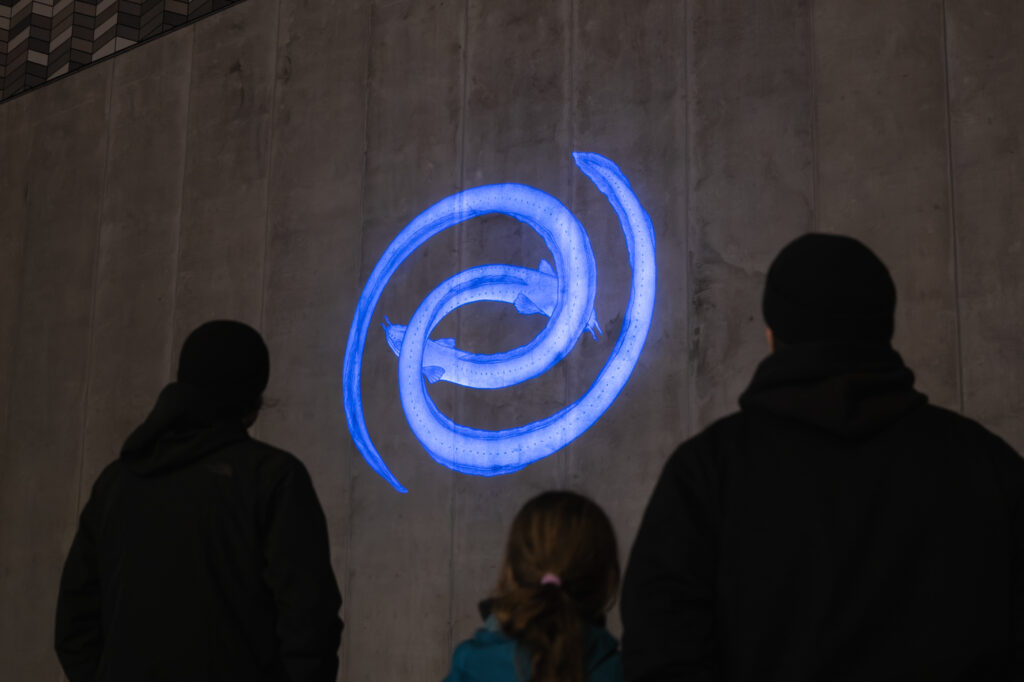
It is notable that they are elevated, not in the sky, but they’re projected in a way you have to look upwards. They also are only visible at night. They are literally made of light, they are kind of non-material, or non-tangible. Those qualities add to that idea of not being earthbound, I guess, of being something slightly different. What was it like seeing the work projected? I’m assuming this is possibly the largest size you have seen your work? Obviously, there are limitations in terms of the scale that you can tattoo…
I’m blown away, this is definitely the largest my art has been. It hasn’t really settled with me yet, but I’m feeling stoked about it. It’s refreshing to work in a medium that has different boundaries compared to tattooing.
This approach is different from painting a large mural, where you put paint to a wall and are very aware of the size throughout the process, but here, you see it at that size with quite fresh eyes, it’s a transformation of your work in a way…
Thinking about the public status, how do you process the idea of how the public will receive and respond to the work?
It’s a bit like when I tattoo someone, and then they walk out the door and that art is essentially on public display. People tend to get compliments for how the tattoos look and it’s up to them whether they say who did it. Although that’s not the point, the significance lies in why they got the tattoo and the meaning for them. Either way, as an artist the meaning for me is in the creation, when my work is made public it takes on a life of its own, I may not always be credited and it may not appeal to everyone, it’s just how it is, and that’s ok. This work was, in a way, quite personal, but I know it will connect with a lot of people too. I’ve done so many tuna tattoos, and people have all sorts of reasons why they’re drawn to the tuna, we see them in the Ōtākaro and Ōpāwaho awa running through the city.
The signage onsite features the poem you wrote about the work. Did you want to share that?
E Rua ngā Kaitiaki
Here are two kaitiaki.
They flow with te Ao
with the rhythm of the cosmos.
They visit me as I sleep
and guide me in my waking dreams.
They are tūpuna.
They are mokopuna.
They are Te Harikoa.
They are Te Huamo.
They are Tauiwi.
They are Māori.
They are both me,
they are divine.
Did you write that once you knew that they were going to be projected? Are they a rumination on the work as a projection and all the qualities that presents, as opposed to necessarily the original drawing? Or is it a symbiosis of both?
I guess it’s both. The original drawing was the foundation of the projected work, but the words also respond to elements that were added during the animation process, for example, the colour and overlapping motion. To me, the tuna felt like two kaitiaki swirling inside my puku. Two lines from the poem: They are Te Harikoa; and They are Te Huamo, can be translated to mean ‘They are The Joy. They are The Sorrow’. These polar opposite elements remind me of the Chinese Yin and Yang symbol, and the balance between dark and light.
Which again relates to the work’s physical manifestation…They illuminate when it’s dark and are invisible during the daytime. So, there is that idea of being present when needed. Having seen this work come to life, has it added a new interest in exploring projects away from tattooing?
I have always had an interest in many forms of art. It’s just that I only have so much capacity outside of my mahi. My partner David and I are involved with a community carving space Tūhono Taonga, Tūhono Tangata based at Climate Action Campus. We facilitate workshops predominantly teaching people to carve toki, Jon Jeet is the driving force of that space. Working on this spotlight project has got me excited about some upcoming group exhibitions in the pipeline, perhaps I will work on some pounamu carving or a mixture of carving and ceramics.
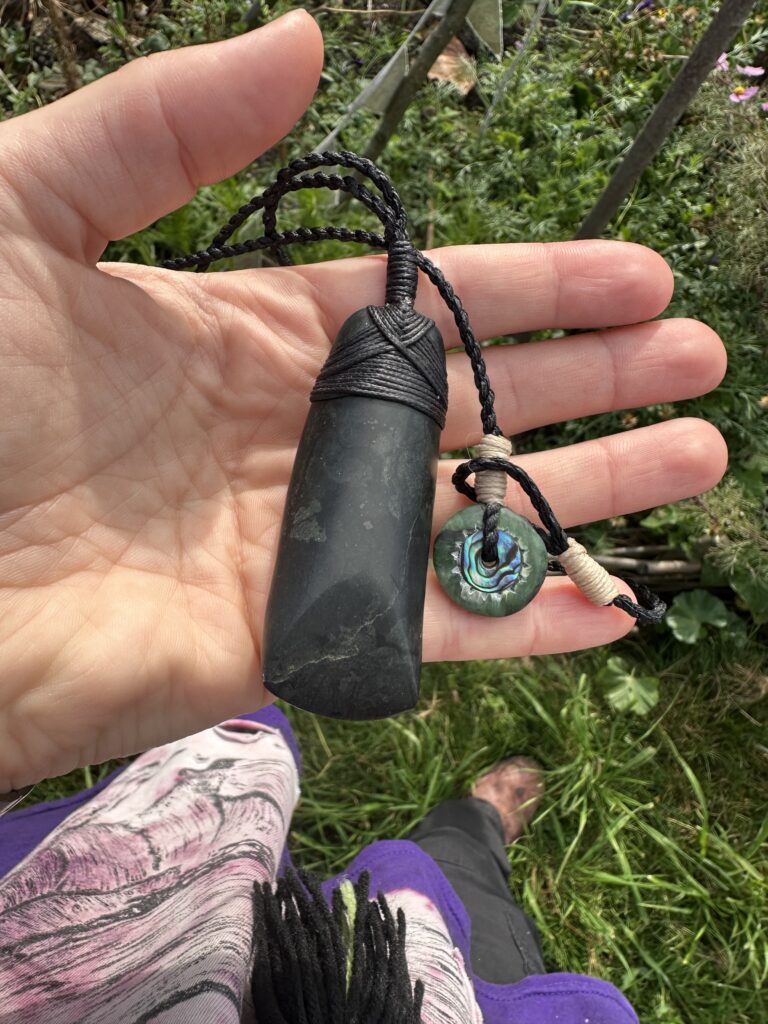
The tactility of carving and ceramics is so attractive, I think. Do you see these as mediums that can synthesise with your other creative mahi, or as something you want to keep separate, as a kind of release?
I would like to further explore carving tā moko designs and other tattoo style drawings into uku (clay) forms. It sounds like a good way to try things, especially without the pressure of inking somebody’s skin. The uku that I work with, I don’t necessarily need to fire it, I can just put it back into the whenua. Something to play with that can help satiate my creative brain. Carving pounamu has a more longlasting effect; I know the stone will outlive me and so it is always an honor to work with something that is already millions of years old. It can feel like a release to explore other forms of art but at the end of day, we can’t forget what we already know, so there’s always going to be crossover and influence between creative practices.
That sounds like a great direction. Kia ora Joy.
Follow Joy on Instagram (@huamo.harikoa)