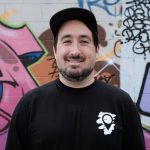
From the small Scottish town of Paisley, just west of Glasgow, via Melbourne’s iconic Everfresh Studio, Shaun Devenney travelled a long way to find himself painting in Ōtautahi. Establishing a strong reputation for his thoughtful, painterly ruminations on life, a kind of acerbic social realism informed by his Scottish sense of humour and an observational world view, Devenney’s deft brushwork and compositions are undeniably unique. His work is a reminder of the diverse potential of urban painting, eschewing conventions and traditions in favour of an aesthetic that is equally informed by the studio as the streets. With the assistance of Life in Vacant Spaces, we were lucky enough to help Shaun secure a wall to leave a legacy of his trip to Ōtautahi, and in doing so, we were able to spend some time with the artist. In between painting sessions, we sat down with Shaun for a chat about his travels, his trajectory as an artist, the distinctions between the streets and the studio, and the increasingly confusing world we face…
WTS: Let’s start with the obvious question, how does Shaun Devenney from Paisley, Scotland end up on the other side of the world in Ōtautahi Christchurch?
Shaun Devenney: My best mate from school that I grew up with, he moved here just after the earthquakes. He just got his residency, so it must have been 11 years ago that he moved here. In 2022 I came over to see him, but I was only here for Christchurch for a few days. He was staying in Queenstown, but we came up here and I’d seen all the murals and all that kind of stuff. But he’s moved here now and because I was over in Australia, I was like, I’ll come over for a few weeks to see him.
What were you doing in Melbourne?
I was sort of back and forth over a while. But originally, I had gone for the Frankston Street Art Festival. I had that lined up, so I was like, I’ll just go over, try to get a wee bit of work when I’m there and just catch up with my mates. On my way to Australia I had been to Hanoi, to meet my wee cousin, and then went to Indonesia. I met up with a crew in Jogjakarta, and then from there I went to Melbourne.
Melbourne obviously has a thriving scene, who did you connect with there?
I spent a lot of time with the crew at Everfresh Studio, Makatron was the main one that got me into the studio, and I used Urshtray’s space that he shared with George Rose for a bit as well. They are quite a tight crew at Everfresh. It’s social, people just chat and hang out in the communal area, so I knew most of them.
Did you have that anything like that back in Scotland?
No, not at all. Back in Scotland, I’ve got my studio at the bottom of the garden. When I went back [after my first trip to Australia], I got more involved with the Glasgow art scene, which was good. There’s a lot of artists there. A lot of good artists. But I just didn’t really know any of them growing up. My mates weren’t into that kind of stuff. So, over the past few years, I’ve definitely made more connections in the Glasgow scene. But compared to Melbourne, there’s nothing like Everfresh, a big hub where you can hang like that…
Spaces like that really help forge creative community. Tell me about your background in terms of your artistic development. When did you start painting?
Well, basically I was always painting. I remember painting for school and all that kind of stuff. And then I remember, I was like, once I finish school, I’m gonna be an artist. But I was told, no, go get a trade. Eventually I did get a trade, but I hated it, and I was shit at it, really, but I got through it. And then I was like, right, I’ve done that now, that was my time. I started traveling, and I went to Southeast Asia, Japan, I went to Australia, and I was just painting from then and it just kind of snowballed. I was doing commissions and doing walls and all kinds of stuff, and it just kept going in Melbourne as well. When I went back home to Scotland, I was like, I’ll just do what I’ve been doing. But it was like nay, I got like two jobs. I was like, fuck I’m going to have to get a real job again!
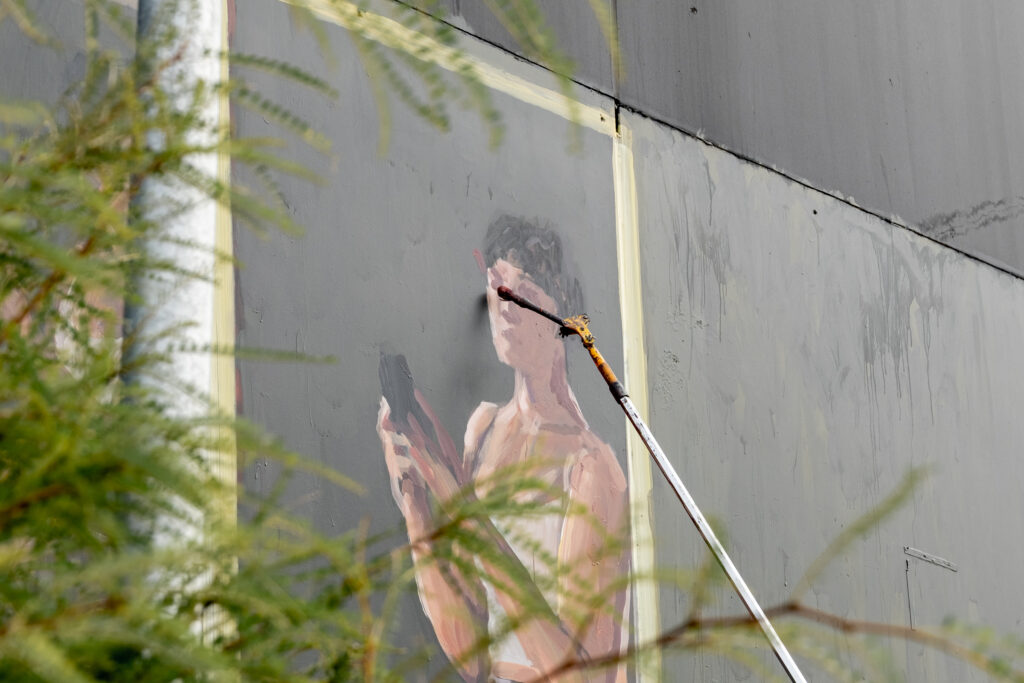
How did you get into mural work, do you have a background in graffiti?
Not really. I was doing more canvas kind of stuff. I done a wee bit of tagging and that, but nothing mental, more just painting. But then another artist, Mark Worst, he painted a mural in my hometown, and I was like, how do you do that? I want to do that! So, I just messaged him, and luckily he took me out, gave me some cans, and then that was it. I was more focused on doing walls after that.
There has long been this expectation that cans are the way to go for murals, when did you start to realise that brushes were the better tool for you on walls?
Yeah, at the start it was just cans. I remember taking buff paint one time and I was using water and that and I liked that. I think maybe I was also inspired by seeing other artists online, like Axel Void. Luckily, I did a week-long residency with him and some other artists in Spain and it just kind of appealed to me more, using the brush and rollers and that kind of stuff.
There’s such a big tradition of that painterly approach, especially in Europe, whether it is Aryz, Seb Velasco, Connor Harrington…
Like there’s something in the water. That whole region, down the Mediterranean, there are so many amazing painters, it’s mad.
Street art kind of got wrapped up in an expectation of how it should look, and seeing people breaking with that expectation, more literally taking art to the streets, not being defined necessarily by the sort of traditions of street art, is always really refreshing. It shows you can use whatever tool gives you the best or the most meaningful effect that you’re after.
When I was using cans, not saying I was great, but, like, for me, it was just a bit too, like, polished. It’s a different kind of look. I prefer being a bit more messy and rough. It appealed to me more like that. It feels like you’re painting, but just bigger, like a big, massive canvas.
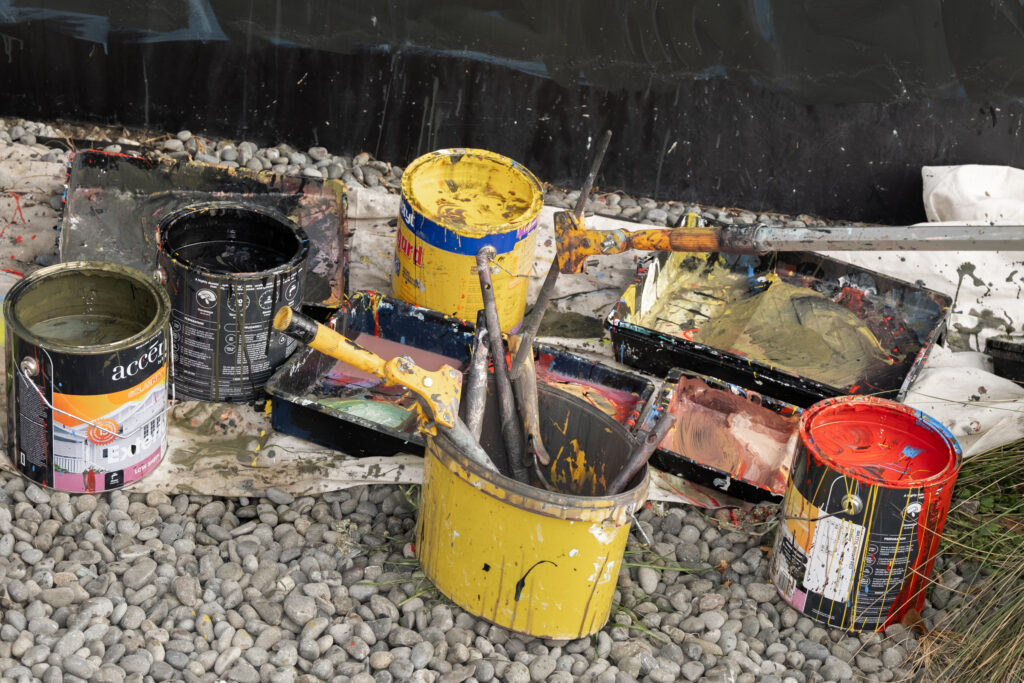
I was going to say that it feels like the transition from studio to street would be more obvious when you’re able to apply a lot of the same ideas, right?
I’m amazed when I see, like, Smug, it’s amazing that he can paint the way he does with spray paint, but I’ve seen his paintings in Glasgow on canvas, and they’re like, same, he can use the brush as well, which is cool to see.
Do you put a term to your thematic approach? I’d suggest it is a kind of social realism with a sense of humour…
I would say it’s just stuff I think about, stuff that I’m interested in. So, it is a kind of social commentary on things that are going on that I’m seeing. And then I add a little bit of humour because I don’t want it to be too heavy. I like to have a sort of humorous twist because people would normally say that’s what I’m like as well…
Do you think that is informed by growing up in Scotland and the Scottish sense of humour?
A good saying in Scotland is ‘If you don’t laugh, you’ll cry’, so I suppose that’s probably been worn into me. I think Scottish people do have a good sense of humour. We like to laugh a lot and have a carry on. So even within something that’s meant to be serious, as art traditionally is, it’s good to sometimes poke a bit of fun at something or like have a joke at something. So yeah, probably the Scottishness would impact that.
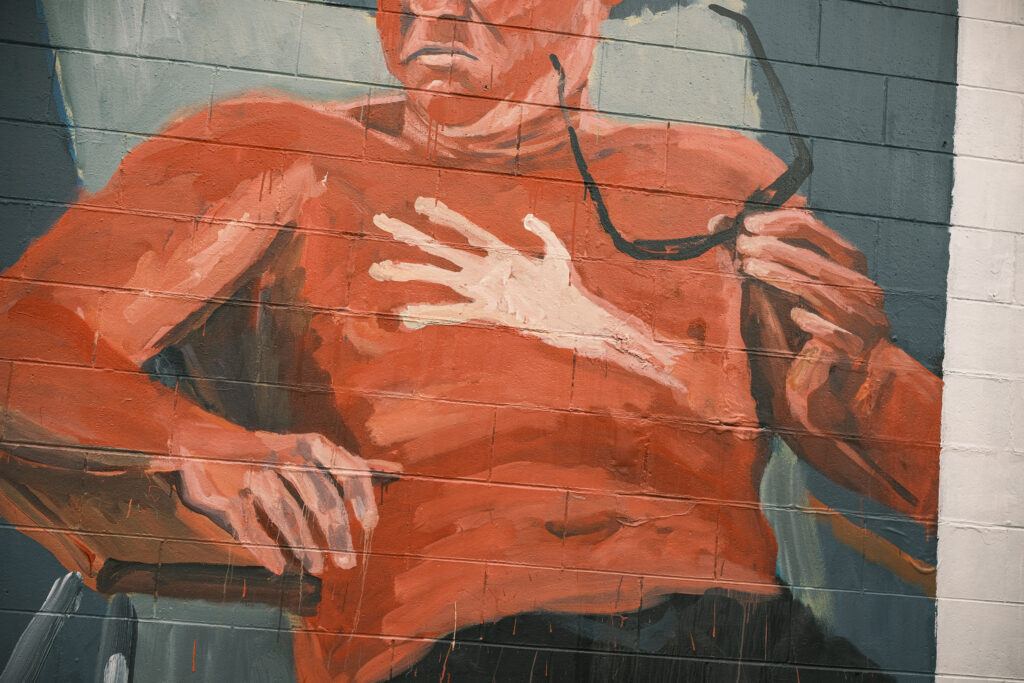
I feel like your painterly style also informs the narratives. There’s imperfection, there’s drips, the brushwork is obvious. It adds a kind of lens to the world.
I guess it informs the kind of grittiness or something. I definitely want it to feel like I’m painting, like it’s a painting. I’m moving more away from the need for it to be like any reference or whatever. I’m trying to break away from that a bit and just let myself do it more freely. I definitely prefer having the happy accidents or wee mistakes in it.
How do you explore and develop that practical approach?
I would say I always try to get better, to, like, look more like the idea I’m expressing, but I’m definitely not there yet. I’m trying to be more confident and actually step back more and just leave it before overworking it.
The craft itself is how economical you can be, like, how you can render detail through a stroke that still has an urgency and a gestural quality, right? It’s about the shorthand that you can create rather than how well depicted the reference might be. There’s something more powerful in the expressionism.
It’s just got a bit more flavour if it’s like a wee bit too saturated or a wee bit off, like, I don’t know. I just feel like it’s a bit more unique. I mean, it came from that moment of me painting and that day is how that turned out. If I paint that again tomorrow, it would probably look different.
That is one of realities of painting outdoors as well, right? There are always environmental aspects that impact how a work is created – I imagine it was quite different painting in Indonesia as opposed to painting in Scotland.
In Indonesia, it was just hot. But in Scotland, the big thing is just the rain, man. Like, it’s going to be wet. I painted just before I left in November, and after a few days, everything I painted, it just ran down from the rain.
You’re working with wet pigment, so that’s a real challenge for your specific approach.
Right, that can be annoying back home just for that. But it can also be a good thing, say I was like, oh, I kind of like that. I’ll cut that bit back in a wee bit. But I like that when it’s done there.
Muralism seems to constantly be going bigger and bigger. You’re using brushes with the clip-on extenders on roller poles and stuff like that, so you can reach larger heights, but your process and the painterliness kind of feels like, not that there’s a limit, but that it’s best served at a certain scale. Is that part of your thinking, to rein it in and make use of spaces in a more intimate way?
Yeah. I enjoy painting the smaller stuff, like just one day and just smash it. I like to use that as a constraint. Whatever will be, will be and I make decisions that way. I’ve also done bigger work, and it’s not got that same feeling to it. I’ve been speaking to my mates about it, and I’m trying to work out what it is. I don’t know if it’s bigger brushes or like, to just paint it. I usually do like a wee study, like a wee watercolour study, but it’s not really the same feel. It’s more like just working it out. So maybe I need to paint it in acrylic or maybe oil first, actually paint the painting. But, then it’s like painting a reference again.
In a time when there is so much importance placed on branding, how do navigate permissions for murals, especially when your work has that gritty edge?
See, the thing is, when I went home, I was working full time. I was working Monday to Thursday, so a four-day, week, and then I had three days off. So, my money was sound. I didn’t need to paint commissions. I didn’t have to paint stuff I didn’t want to paint. I just used those three days to paint what I wanted. So it was in that time that I really dug in and went, right, what am I? What do I want to do? And that’s when I really kind of dug into doing the social commentary with a bit of humour. I done a solo show in Glasgow and it was like, right, fuck, just stay with this now. Just keep going with this. Then when I was in Melbourne, there was a few bits and bobs, but a lot of the stuff I was painting was just self-permissioned. So, I’ve just been doing what I wanted anyway. When it comes to commissions, I’m like, who’s gonna want to pay me to do what I really want to do? It’s kind of funny, but I think I’d rather just have like a three or four day a week job and just paint the rest of my time.
Which means your painting can be more honest to yourself. Does that attitude also mean your studio practice becomes more important as well?
One hundred per cent. When I go home, I’m just going to batter the studio. I’ve got some ideas and stuff I want to try out. It’s like a symbiotic thing in that the studio stuff will feed the mural stuff. I feel like I’ve done my first Scotland run in the studio, done a few walls and then I’ve done a travel run with that as well, now I’m going back to the studio, where I can work out some new stuff, some new ideas, and then later in the year come back and do another run.
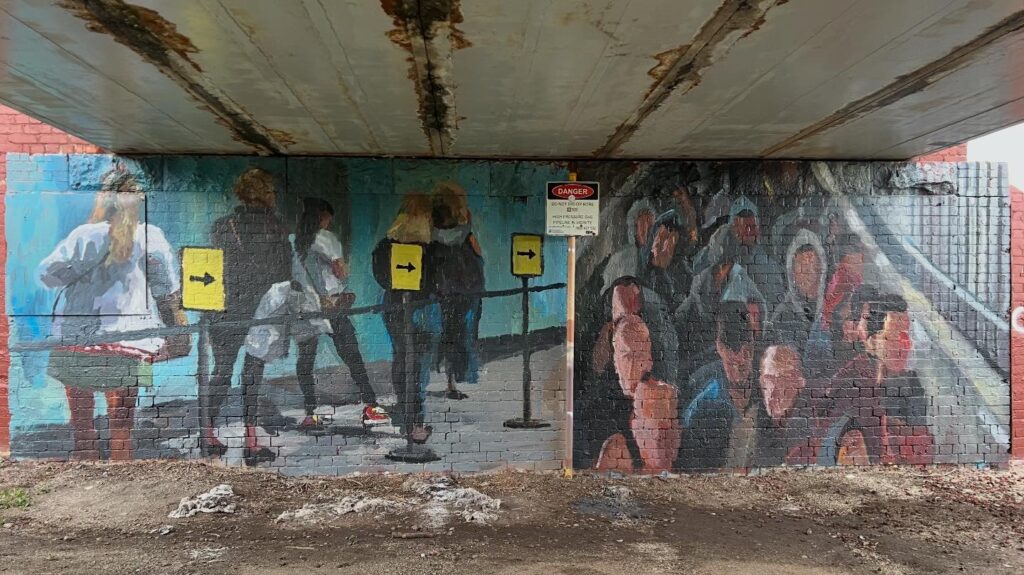
When it comes to your studio output, how do you position yourself in relation to the two worlds of the galleries and the streets?
I’m kind of conscious of that. I spoke to people that have said that sometimes with the mural work, it can kill the studio stuff. Well, not kill it, but there’ll be a limit to it. I guess there’s a ceiling, like where it’s, oh, you’re kind of commercial or something. But I don’t know enough of the two worlds really. I would just like to paint inside and outside.
There’s also this rise of galleries that want to position an artist as part of that urban art world for the attention that it brings, but then that also creates a kind of tether to that world that can be hard to break from…
Yeah, I’ve heard that. The show I had in Glasgow, it wasn’t a pure like high-brow gallery, but it was my first solo show, so it was the first step into that kind of side of things. I don’t want to be Damien Hirst or anything, but yeah, I definitely would like to have more studio practice, have more time and have more shows lined up, maybe spend two thirds of my time in the studio and one third on murals or something. I don’t know.
Ideally a scenario where you can take your pick at any one time of what you feel like doing at that time?
See what the weather’s doing!
Shifting to your experience here in New Zealand and Christchurch, one of the things you said when we first caught up was how much it felt like home.
I feel like, yeah, it’s really close to home, I’d say it’s like Scotland but on steroids. Everything feels a bit bigger. I’ve been on a few road trips and that, and it’s stunning here, all the rolling hills and lakes. Scotland is similar, like the further north you go, it just gets so picturesque.
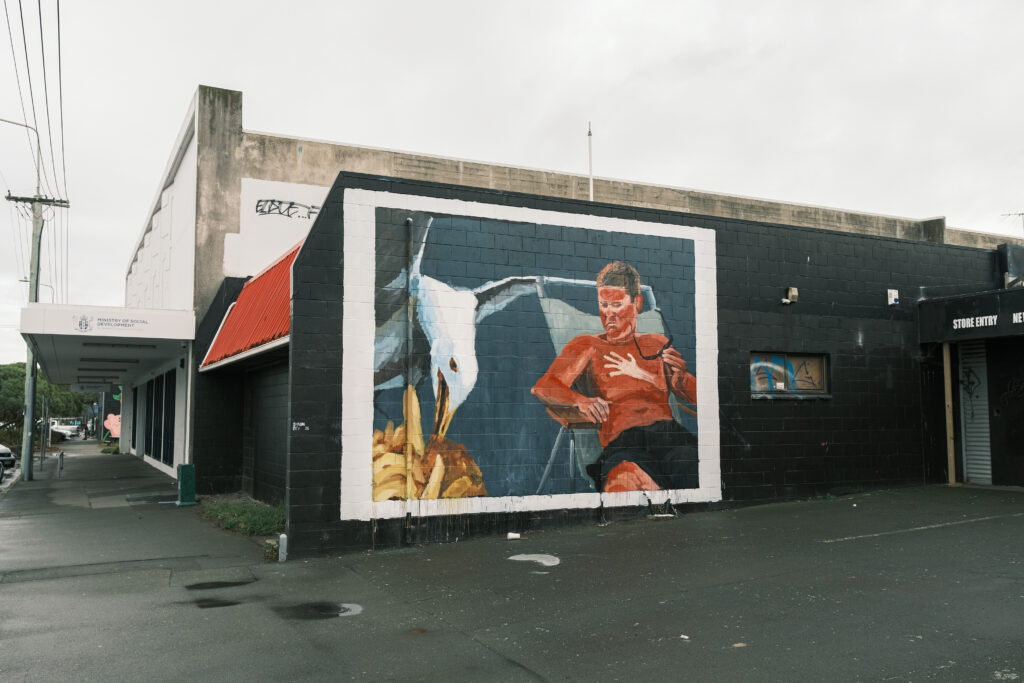
You have been staying in New Brighton and you’ve explored the central city, so you’ve seen places in the city where there’s a lot of art around. Having come from Melbourne, what’s been your take on the art in the streets here?
When my mate picked me up from the airport, it was clear there were a lot of decent sized murals here. I’ve been exploring a lot more, and just the amount of like big murals and surfaces, that was pretty striking. It’s different to Melbourne. It’s probably more like Darwin, where there’s like loads of murals within a kind of smaller area. But here, it’s constantly like turn the corner and find something. I’ve not seen that like this anywhere else.
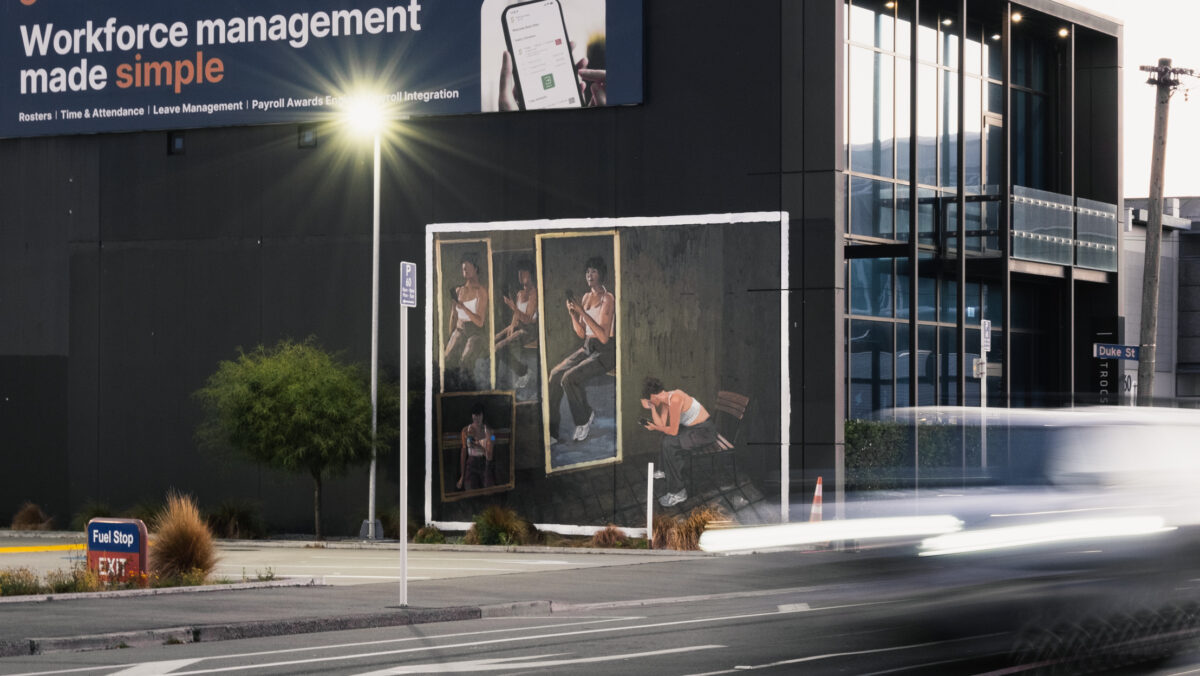
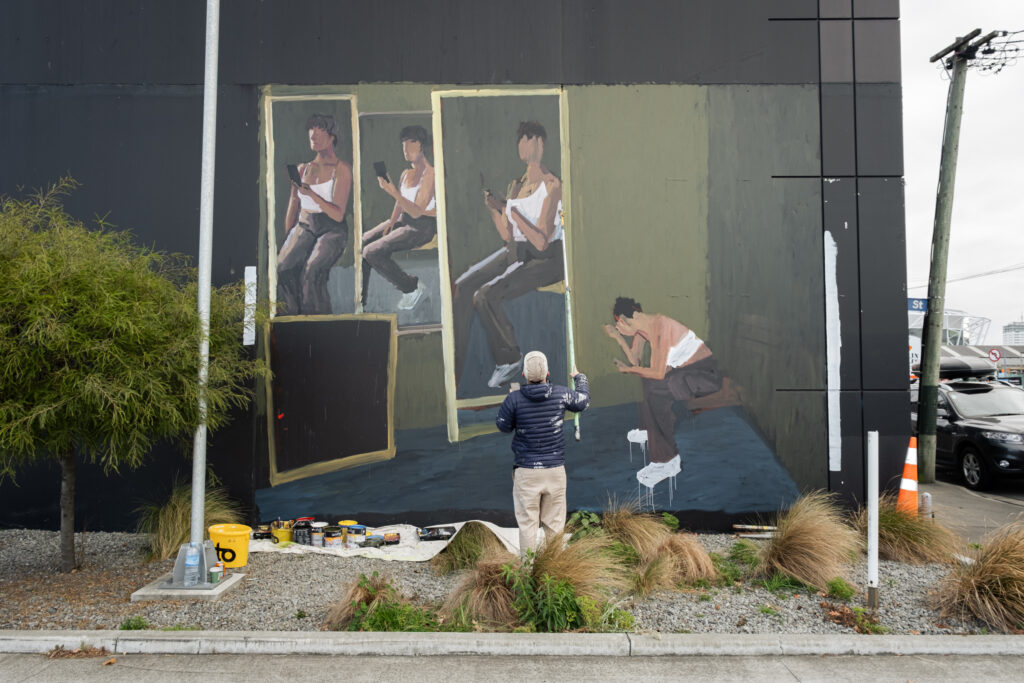
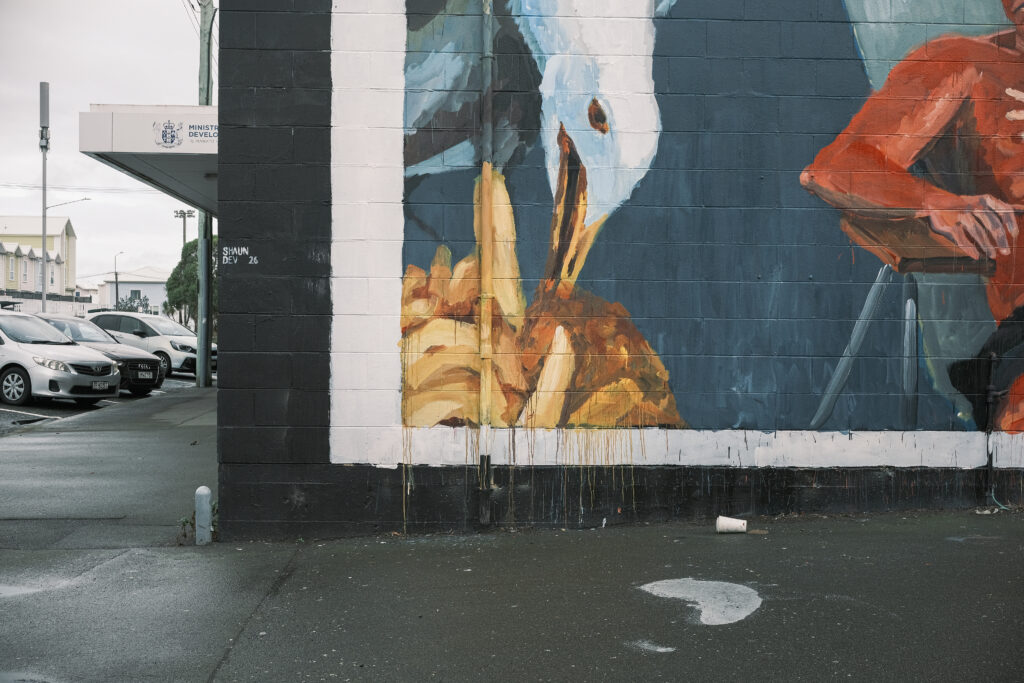
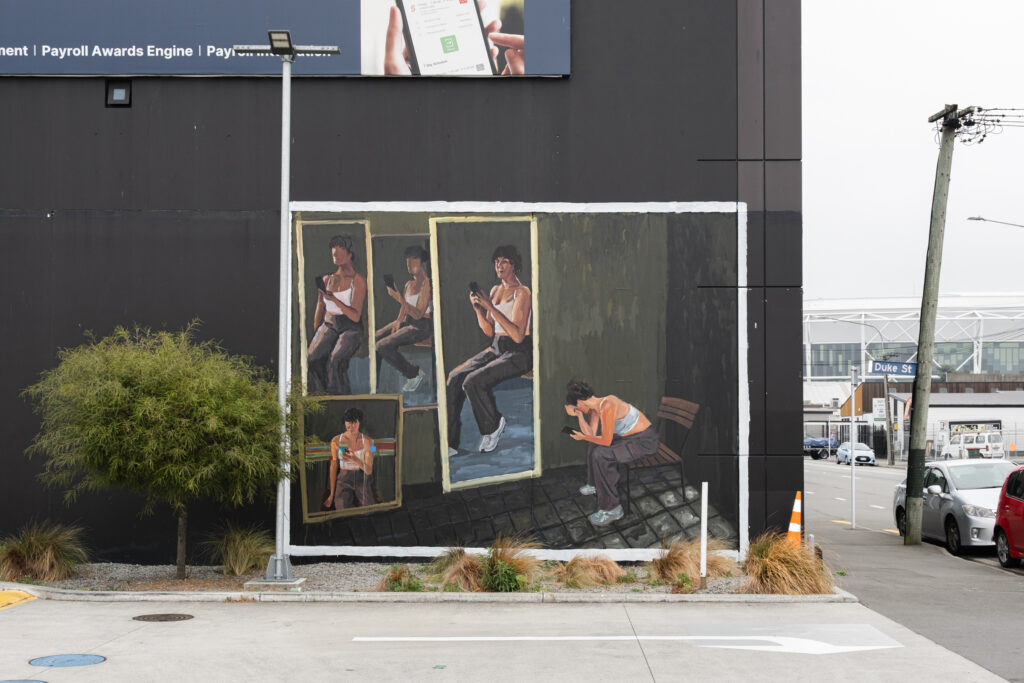
You have been able to paint a work yourself while you were here, on Fitzgerald Avenue. You have described it as reflecting the way that not so long ago your dad would show you photos from the internet and you’d be like, that’s not real, and you would kind of have to point out to him why it wasn’t real. But now all of us are struggling with that challenge, right? The painting uses the reflection of mirrors and the distortion of reality that cause us to doubt ourselves and the world around us, did you want to explain that concept a little bit more?
Yeah. It’s like seeing things on Instagram, as I say, before it was like, oh, that’s obviously fake. But now I’m like, I need to click the comments and see that it’s not [fake]. Which is mental, because it wasn’t even that long ago that it was so obvious. This progression has been crazy. But then also hearing people talking about things where you’re like, that’s not true. That didn’t happen. It didn’t happen that way. But they’ve seen it online, so they believe it. Do you know what I mean? I don’t know. I just feel like we’re going in a weird, dangerous direction with that kind of stuff. We don’t know what truth is.
I think what’s really beautiful about the work is that it reflects that idea through a mundane scene. It could have been more sensationalist, but instead, you show a figure sitting quietly, surrounded by mirrors creating this fragmented reality. It’s not this sort of incredulous narrative. It’s subtle, it’s almost isolated, which is sort of what we’re talking about, right? This distortion of what is real has become so prevalent that we almost question every single thing, including ourselves.
I wanted to be not just purely about AI. Like, it could also be about other things, you know, like you can read it in other ways. Like how people’s truths can be different. How there are many sides to the one story as well.
We see that so much online, this kind of selective truth.
Whatever you want to believe, you’ll find that. Which is like, where are we going with that? There’s just so much fog of where the line is.
Ultimately the Internet was intended to democratize the flow of information, but it also opened up how people make and disseminate information.
Yeah, it used to be like, my dad would say, haven’t you seen the TV? As if that meant it had to be true. So much has changed in only 20 years. That’s not even that long.
The speed over the last six to twelve months that we’ve seen the potential of AI to generate imagery and video that looks real is crazy. It’s scary to think about what that might mean for the future.
We don’t know, that’s the thing. But I think it’s something to be wary of, though. I don’t want to feel completely pessimistic about it, but like, the people that are in charge, I wouldn’t trust them as far as I could throw them. Why would we think they’re going to have our best interests? Remember Pokémon Go? You’ve seen what that’s become? It’s like they’ve basically mapped the entire world. I remember hearing people say that this isn’t good, the Pokémon Go thing, basically, it was gaining all this information while the people playing did all the work. I don’t know what you do, how do you stop it?
The online realm is so complex. It’s super accessible, no matter where you are now, you can get online and contribute to a global conversation with greater ease than ever before. But it’s also a space that can be really influential, in a problematic way, and also out of our control in a sense. We were talking the other day about this idea of how can graffiti, as a visual contestation, a visual subversion, exist in the digital space? It’s kind of a different concept to traditional hacking, I think…
I can’t imagine, like, just tearing up Facebook or Instagram. That would be iconic. It’s kind of like having the buff online, how long it can go? The online world is free as long as you’re doing this, this, this, this, and this.
You leave in the next couple of days, and head back to Scotland. We talked a little bit about your plans when you get back, but what about longer term? Is travel going to continue to be a part of the way that you operate as an artist?
I reckon so. When I go home, I’m gonna just try and get into the studio as much as I can. I need to get back to work. I’ve got a couple of murals, more commission kind of stuff, that I’m teeing up. But travel is definitely on the cards. I’m gonna go back to Australia in November for a project and then I’m thinking of coming back to New Zealand as well. But it all just depends on the beans, so we’ll see.
Well, we hope we see back soon!