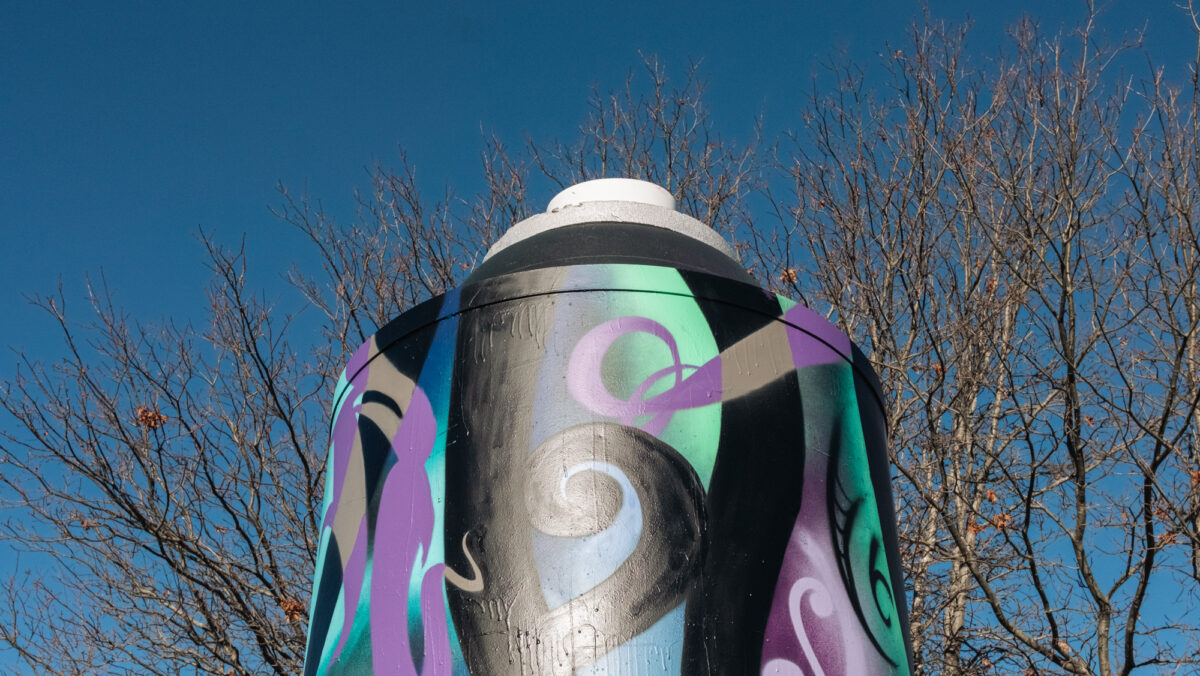
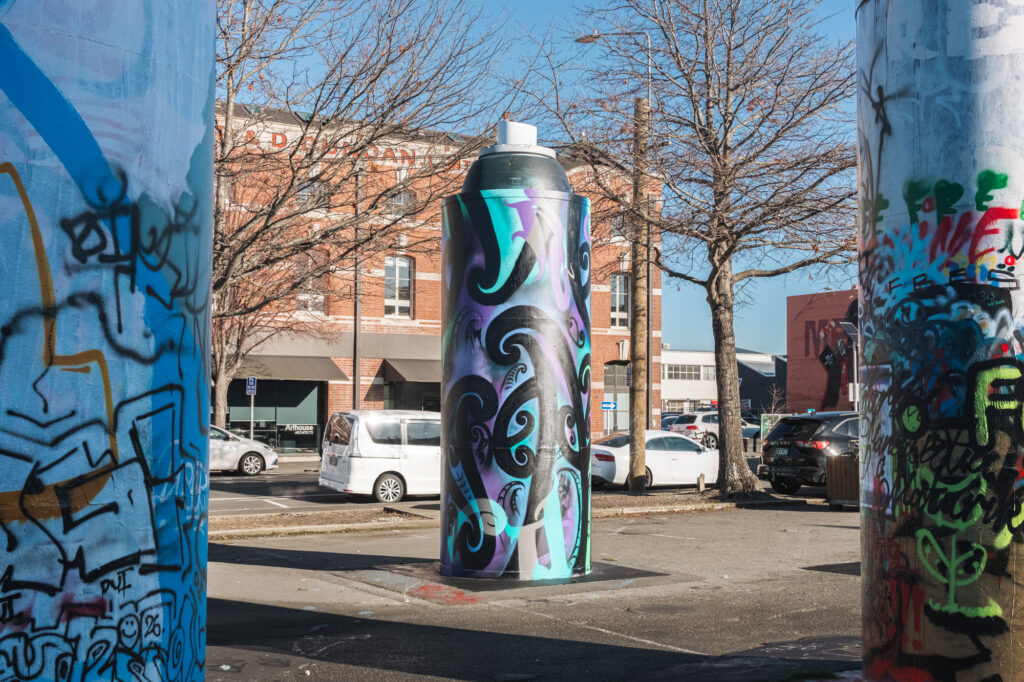
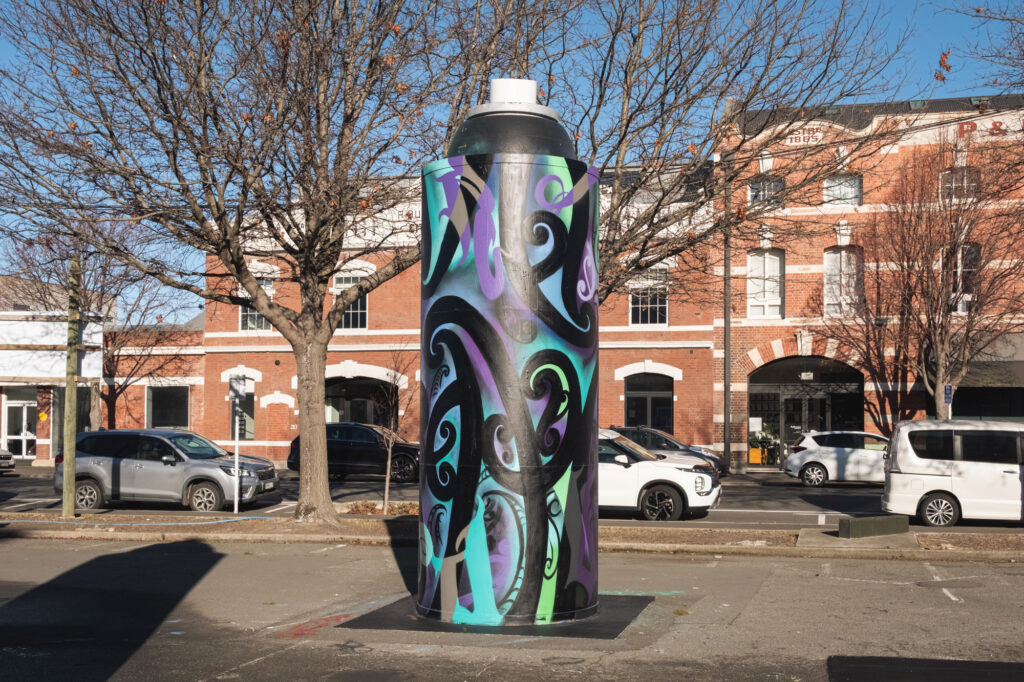
The Giant Cans on St Asaph have served as a free legal space for people to create and leave their mark – whether a simple name or message, or something more adventurous and stylised. But alongside the free wall status, one of the cylinders stands as a ‘commission can’ with artists invited to produce a cohesive take over – providing inspiration and pushing new ideas. For the most recent commission, Ōtautahi artist Ruka has explored the merging of graffiti and Toi Māori, an expression of his own creative trajectory. The circular canvas has been adorned with a sprawling, interlocking map of koru and letterforms, with shifting transparencies and an evocation of the iridescence of a paua shell. We sat down with Ruka to discuss the relationship between Toi Māori and graffiti, his exploration of his Māoritanga through art and where his art might go next.
You have just finished painting the commission can with a piece that incorporates aspects of Toi Māori and graffiti, and it looks amazing! I wanted start by talking about your exploration of and relationship with Toi Māori.
Ruka: Exploring Toi Māori is definitely like me trying to reclaim my identity and Māoritanga, learning more about myself and the culture.
Were you immersed in it growing up, or is it something that you’ve come to later?
Ruka: Yeah, more in my adult life. I didn’t really grow up around it. It was really just in school that I experienced it.
You also have a background in graffiti art, how do you see that form of expression in connection to Toi Māori?
Ruka: It’s quite easy to find an overlap between them. I mean, I feel like historically, being Māori, it was about being rebellious, you know, challenging government and governance, challenging colonialism. I think it’s the same in graffiti, like, there’s definitely a rebellion to street art and graffiti. So, I think Toi Māori and graffiti are sort of in contact with each other.
I guess in both spaces, there is also tradition that you have to understand before you necessarily break with it, right? How do you navigate the foundations and the histories of Toi Māori with the way you can express yourself in a contemporary manner?
Ruka: Yeah. It was about learning the fundamentals, the traditional side first, then trying to explore the contemporary side of it.
Do you see aerosol as a way to bring a new lens to those traditional Toi Māori approaches?
Ruka: Yeah. Obviously, spray paint is different from like, whakairo, and I guess, that’s where I see painting the can was a good experiment to do explore how it could work in that way. I was trying to merge graffiti and kōwhaiwhai and Toi together.
At the heart of graffiti is the subversion of letterforms: masking or changing letters, making them look a certain way or a different way. And in doing so, that’s partly the rebellion we were talking about earlier, because it’s taking something that’s established and accepted and subverting it, so only a smaller number of people can interpret it in this new way. When it comes to Toi Māori, what room is there for subversion in that way?
Ruka: It presents more challenges, because you are working within certain frameworks, the rebellion part is more in attitude, I guess.
Your work on the can is such a striking design, I love the way it seems to incorporate the iridescent colours of a paua shell.
Ruka: Yeah. That’s where I got the colour palette from.
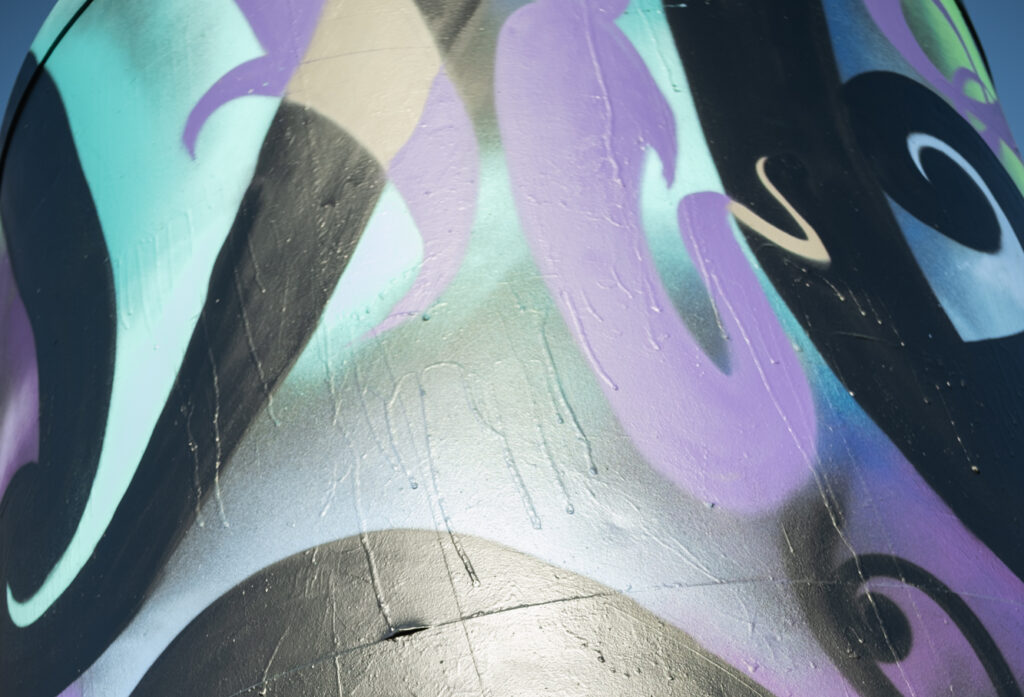
It also feels kind of cosmic, which is fitting with Mānawatia a Matariki coming up. The way the koru fill space and overlap, with letters revealed in parts as well, your eye is led around the can – was the composition intuitive or pre-determined?
Ruka: A bit of both. I had an idea, but I also let it kind of lead me. I wrote down a whakataukī that was sort of fitting because a lot of it was intuitive and it felt right: Ki te wātea te hinengaro, me te kaha rere o te wairua, ka tāea ngā mea katoa. It translates to: When the mind is free and the spirit is willing, anything is possible. I guess it was about just trying to challenge myself into having less restrictions and being more free with my process.
There are still a lot of challenges when it comes to mural artworks and artistic freedom, and, unfortunately, there is also still some resistance to more purely Toi Māori designs as well, at least from commercial commission type works, when it comes to finding opportunities to further explore your expressions, what pathways are there?
Ruka: Yeah, I’m still navigating that, but it is hard.
Aotearoa’s graffiti and street art history has embraced the presence of Toi Māori, but it feels like there is still space for growth there as well, partly because there hasn’t necessarily been as much opportunity to explore the potential, at least until more recently. Is that the space you want to explore?
Ruka: Yeah, I do.
Even though there are some limitations with the form, the giant cans ultimately provide a space for experimentation, do you think there is a need for more spaces like that?
Ruka: Yeah, definitely. Those sorts of spaces are still a bit overlooked.
What other material approaches have you explored?
Ruka: I’ve dabbled in like, whakairo, I’ve done raranga, that sort of thing.
Have you explored the overlap of those forms with your graffiti background?
Ruka: Yeah, I’ve looked at carving letter forms and things like that.
What Toi Māori mentors have you been able to connect with?
Ruka: I studied at Te Wānanga o Aotearoa, where Ra Horne was a mentor for me. I also would visit the carver Raphael Stowers every couple of weeks and spend time with him as well.
How important is that ability to have those types of relationships? Because I guess, again, tying it back into graffiti, you know, there’s mentorship, and I’m sure you’ve got older graffiti writers who have been influential on you…
Ruka: Oh, 100%.
But it feels like a different sort of kind of relationship when it comes to Toi Māori.
Ruka: Yeah, I feel like it’s more intimate. There’s, like, definitely more of a strong connection.
Do you see yourself fulfilling that role in the future?
Ruka: Yeah. I think so.
Aside from mentors, which artists inspire you?
Ruka: Graham Hoete, Mr. G., who has definitely been pivotal in the sort of Toi Māori and graffiti space. Techs, definitely. Charles and Janine are amazing.
How do you learn from those figures? Is it just from seeing their work?
Ruka: I guess it is learning Māori and then trying to explore ways to communicate it in my own way, just to being able to uphold like Tīkanga and learning about our history and then translating it into whatever it may be.
Thanks again for creating a beautiful work for the giant can – I look forward to seeing more!
The Giant Cans Commission was supported by The Christchurch City Council