Dr Suits goes to Akaroa…

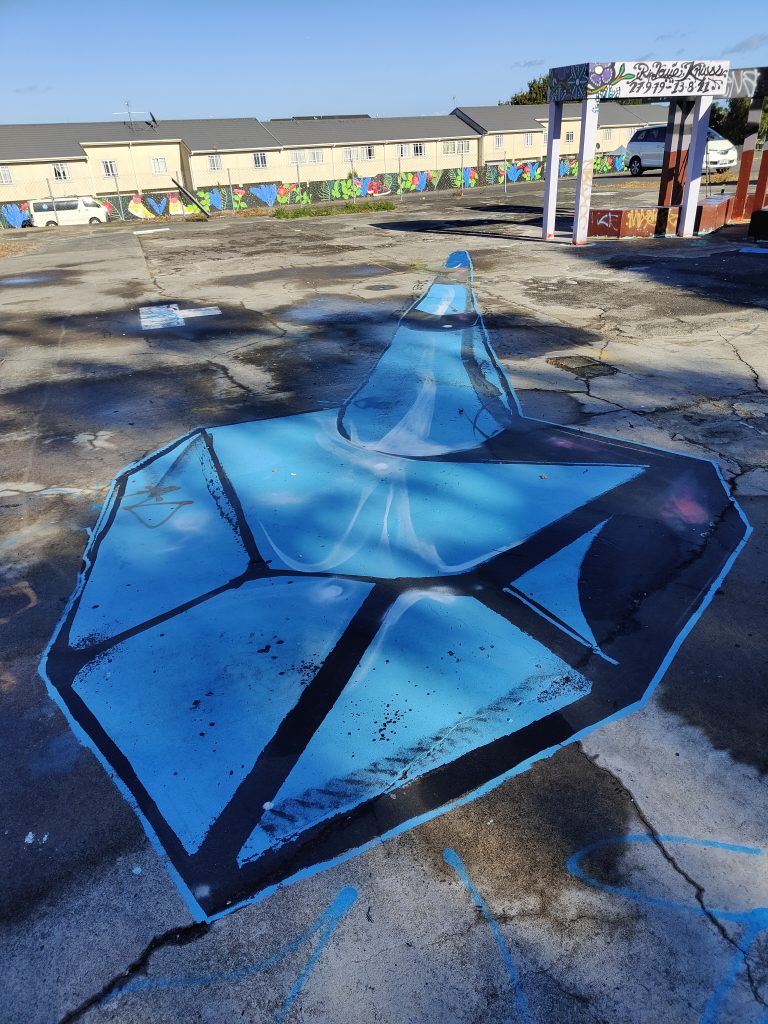
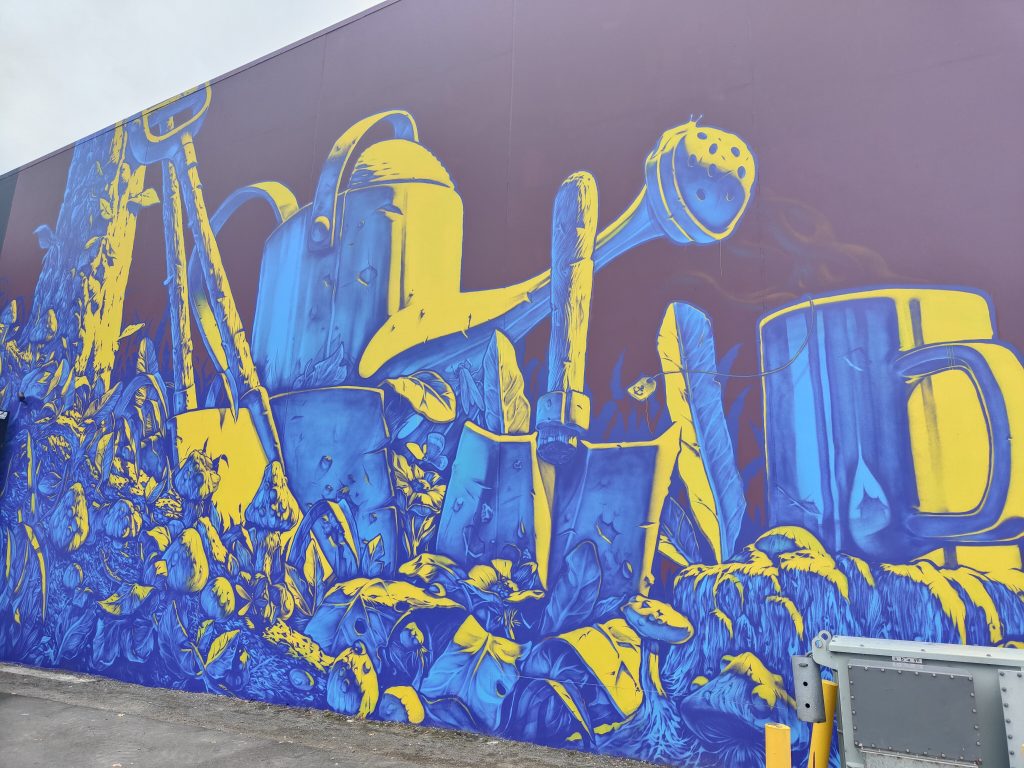
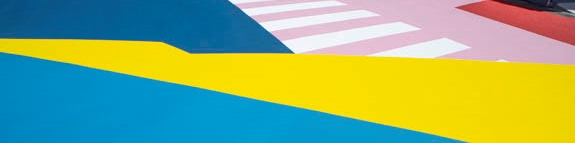
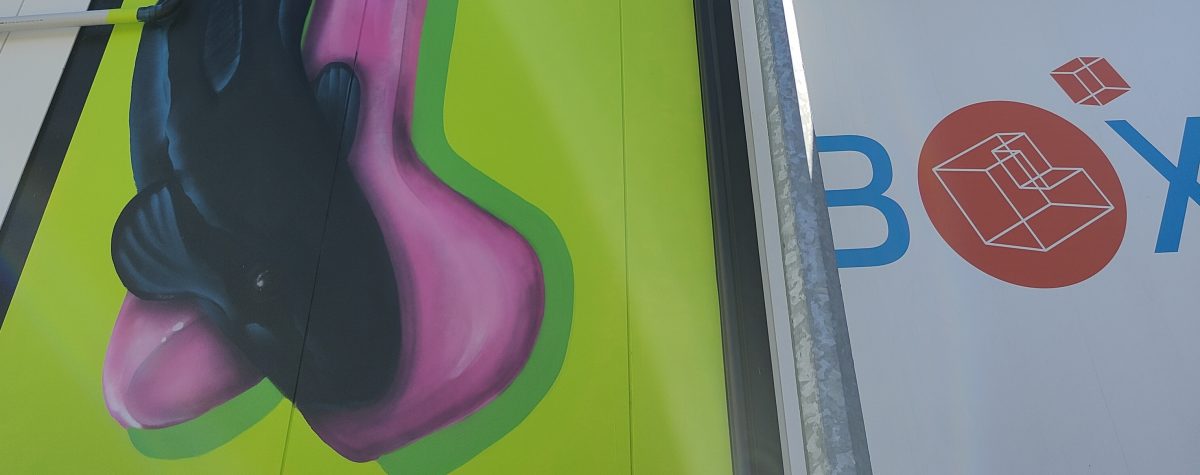
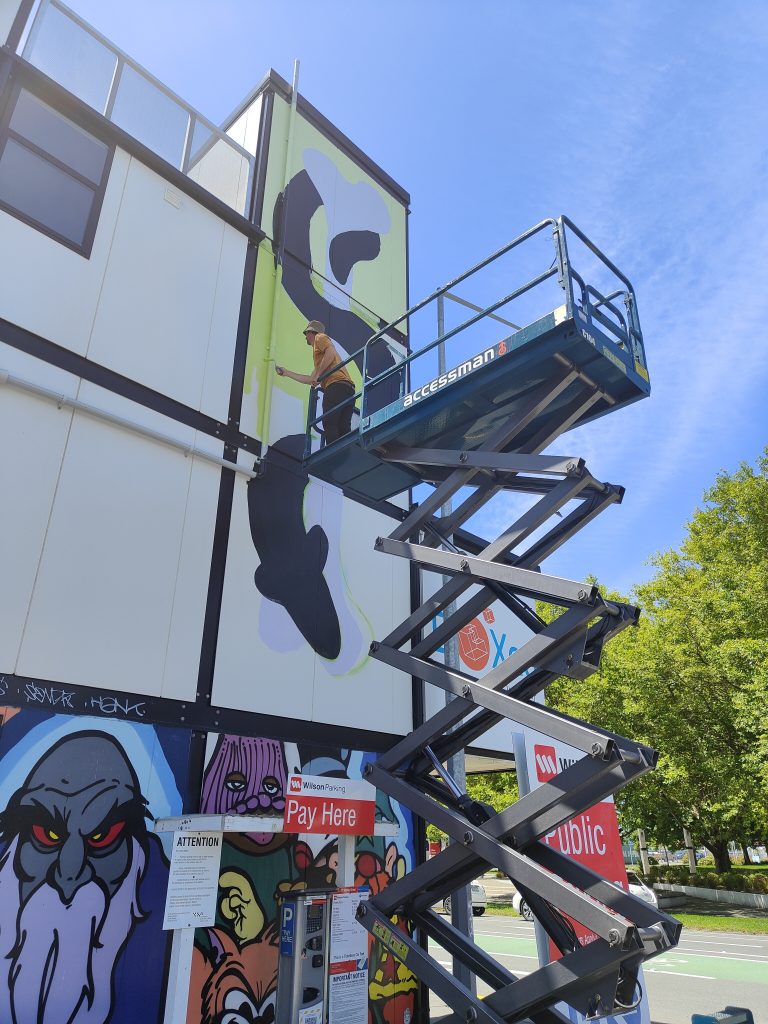
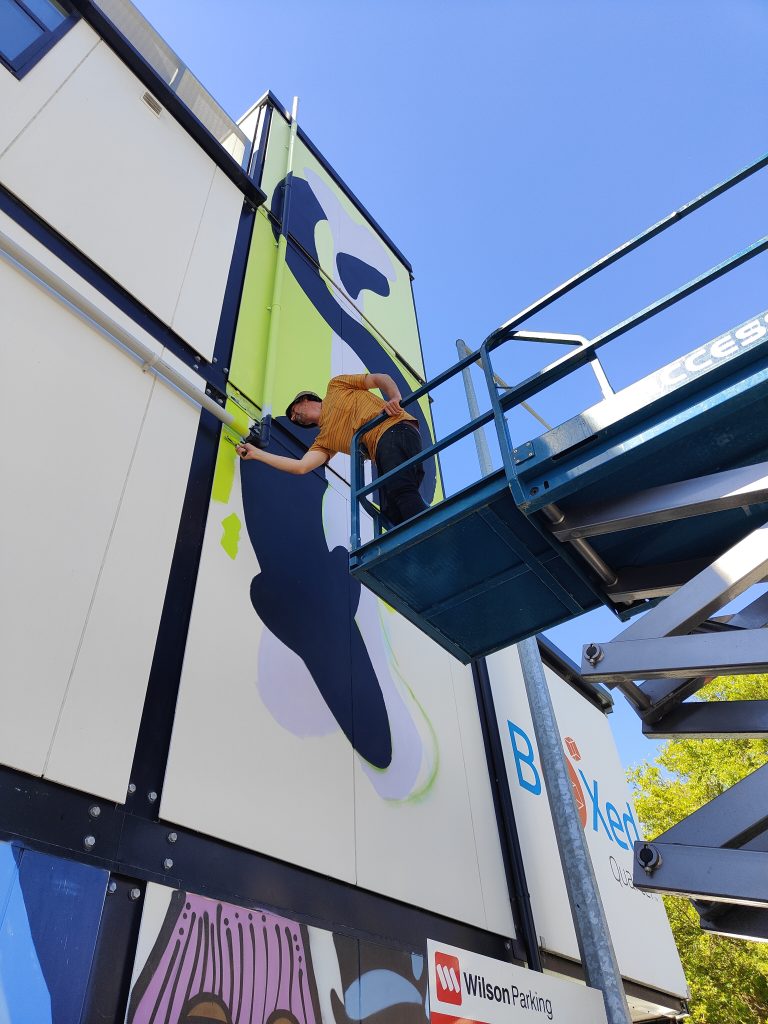
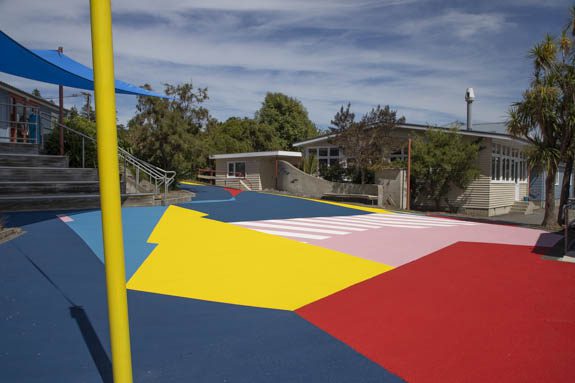
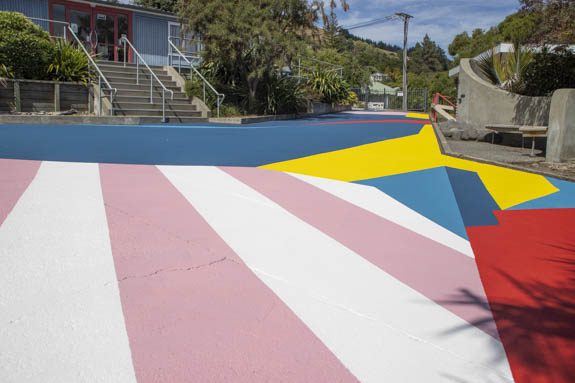
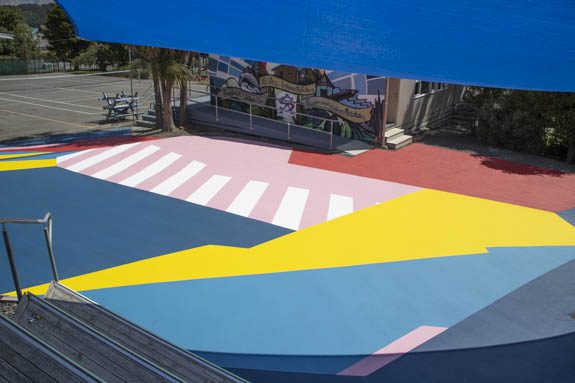
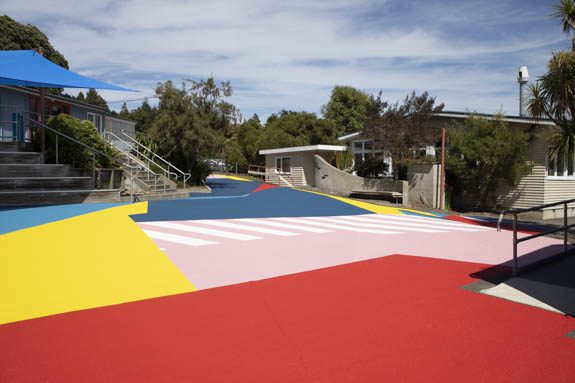
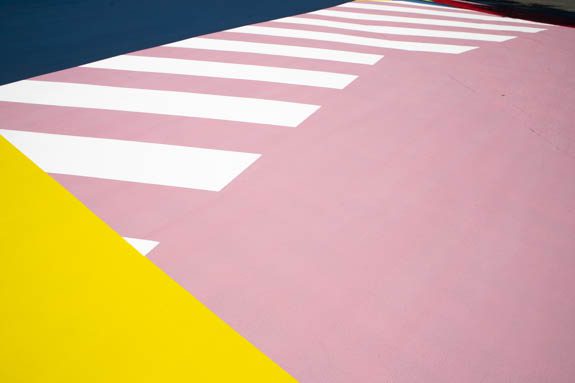
Back in November, we caught up with our good friend Dr Suits to chat about his experience at Taupo’s Graffiato festival, Aotearoa’s longest running street art festival, what he didn’t let us know at that time was he was in talks about a massive mural on the grounds of Akaroa Area School. Akaroa, the picturesque waterside township south east of Christchurch on Banks Peninsula, is not an expected location for such a project – but word of Dr Suits’ ability to produce bold, striking mural works had obviously spread. In January 2022, Dr Suits and Porta loaded up and headed to Akaroa to spend a week transforming the junior school with colour and the result, Polymorph, is stunning. When he got back we sat down to talk about the project and the technical process…

____________________________________________

How on earth did you find yourself painting such a massive ground mural in Akaroa?

It’s funny, the last thing I talked to you about was Graffiato (the street art festival in Taupo). As soon as I got off the plane in Rotorua after leaving Taupo, I checked my emails, and I had a message from Ross, the principal of Akaroa Area School asking if I would be interested in painting the junior area of their school. He didn’t really give away too much in terms of what he wanted, but it was quite exciting, especially having just painted at Graffiato

You must have felt like you were on a roll! How did you get on their radar?

One of the teachers showed Ross an article about Crossings, the red zone work we painted last year, and he must have thought, that looks good, this artist can paint a ground! I have a ground that needs some paint, so it’s perfect…
Did Crossings inspire the concept or were they already sold on the idea of painting the ground?

They wanted to paint the junior ground and after a conversation with them, they had some really clear ideas about what they wanted. When they asked me to quote the area, I was like, far out, how have this school got the money for this? To go through the design process with a school, I’d imagine it would be quite a long process…

I imagine there are a lot of stakeholders that must be consulted…

Yes. Their ideas were directed at traditional games and instructing children to play in a certain way and interact with the space in a very traditional way, like we probably would have interacted with spaces when we were kids…

You mean like hopscotch, that sort of thing?

Yeah, like Four Square, roads to follow, those types of things. I knew I wasn’t going to have a lot of creative freedom, so I just quoted the job. Anyway, Ross got back to me and said we can’t afford that, which I was expecting, so I called him back and I said, what is your priority? Is it to have those traditional elements, or is it to get a whole lot of color on the ground? He said if we can get that area covered, that’s the priority. So, I got talking to him about how we could make that happen, just using a more mathematical approach to working out surface areas and ordering smartly, basically designing according to how much material would be used…
So, you figured out a formula to achieve that? 

It was quite challenging. I hadn’t really approached the design process in that way before, I usually approach it more artistically. I’ve done it in fashion design, where you’re really conscious about material and how to maximize the design based on materials, so I kind of used that thinking. Basically, I tried to keep the design quite simple and geometric, because curves would slow me down, details would slow me down. I did a few concepts and gave them to my friend Roberto who put them into CAD, and he worked out their surface area, and then I calculated how much product I would need, and I tweaked it from there. I also had to consider the surface of the ground, because if it’s rougher, it’s going take more product, yellows and pinks will need more layers. So, I reduced the yellows and pinks and added more blues, because they cover the ground really well. It was all about efficiency, really.

You’re known for your color palette, particularly in your outdoor mural works and those pinks and yellows are pretty prominent. Was that a challenge to minimise those colors?

Yeah, it wasn’t a challenge as such, but I had to have some in there!

Did you use the paint product that you used for the basketball court in New Brighton?

A similar product.
Which is different to the standard paint that you used in the red zone. So, how did you go about sourcing the paint?

There were a few contenders, but it came down to durability and workability. I’d seen another company that used the same product, and I could see what it looked like in a similar context. I also had conversations with the sales rep. There are a few products within their range that are similar; some are acrylic, some are water-based, which is great, there were others that were chemical-based, which I wanted to avoid. I wanted to avoid playing around with solvents, which are unpleasant to work with and to clean up…

Particularly when you are doing such a massive job as well, that would have required a whole heap more gear just to get the job done…

Yeah. The paint company rep was great, he was really helpful. He probably got sick of me asking questions!

So, this product will be your go to from now on?

Absolutely, I got my head around how to use the product, putting the hardener in, laying it out. I had to get scales, a paint mixer and a few more things. The scales were a bit more expensive than I bargained for, but they came in extremely handy. I mean I couldn’t have done the job without either of those tools. There are different options for the application, the rep even recommended spraying it…
With a pressurized sprayer? Were you tempted? 

Spraying would be OK if you had a sprayer, but you’ve got to take into consideration masking, the wind, clean up and waste, and I wanted to reduce waste. Basically, once this product is mixed together, you have to use it within 40 minutes.

Was it a case of the old ‘measure twice, cut once’, or was there still a little bit of figuring out as you went?

I used a grid system, which meant I could get pretty accurate with the layout and composition, which kept me to plan, but when we were putting down the first coats, if there was half a bucket of product left, I’d improvise and chuck it in somewhere to break it up a bit…

How close was the original design to the finished piece?

I’d say 85 per cent. There are a few add-ons here and there…

That’s always good for the creative process, right?

When I was designing it, I was working on such a small scale and when I actually got into the space, it was so much bigger than the piece of paper or the screen that I was working on. It definitely changes the perception of it. I think one of the coolest parts about the project was being immersed in that color as you’re working on it, really experiencing how colors change when you put them next to each other.
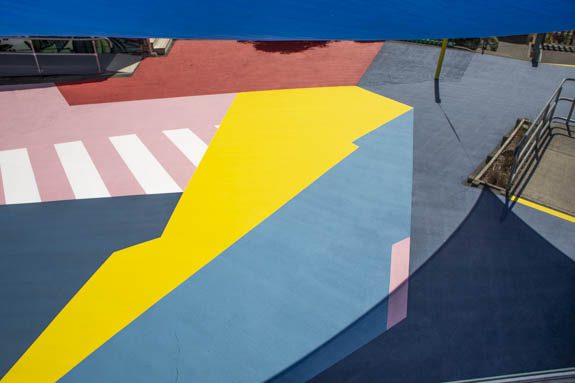
What was the area in square metres?

360 square meters.

Did you look at any comparable mural works in Christchurch? Do you know of any other similarly scaled works?

I didn’t even think about that. I was just focused on the task at hand. But, just to give you an idea of what that looks like, the longest straight line on it was 28 meters.

Wow! On that first day when you started painting or even just gridding it out, did you have to stop and ask yourself: am I going to be able to do this?

No, I’d done all that after I took the job on and designed it and been paid the deposit, that’s when I was like, shit! Am I actually going to be able to do this? It wasn’t until I went out there and had a good look around that I was like, OK, it’s not as big as I’ve built it up in my head.

Did it help as well that you had your trusty compadre, Porta, there with you?

Oh yeah! I’ve said it before and I’ll say it again, Porta’s the man!
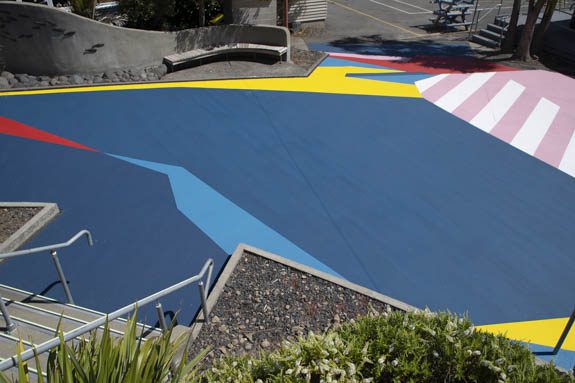
There were certain restrictions based on the colour palette, and you had to encourage them to move away from including those ‘instructed play’ elements, but was the final design based on any particular concept or idea other than dynamic shapes and space for play?

That’s it, just dynamic shapes and spaces. I used my trusty collage technique. I cut out some shapes and piece them together, and just subconsciously come up with something.

Have you been able to get feedback yet?

I sent Ross a message on the first day back at school to ask about the big reveal on the first morning of school, his reply was: ‘Awesome!! Thumbs up’. So, I figured, it must have been a big day…
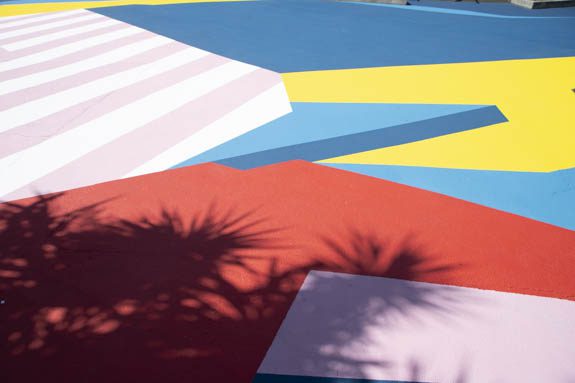
Was it disappointing that you didn’t get to see that first response of the kids yourself?

Yeah, I was a little bit, but as we were working on it, people would walk past daily and even when we had one or two blocks of color down, people were pretty excited. It really started coming together towards the end, I knew as soon as we got the yellow down it would really start to come to life, and then when we put the final blue down at the end, that just tied it all together.

You also added a little touch where you painted a pole bright yellow?

That pole’s funny because I’ve always wanted to do a sculpture exactly like that, with a just off axis yellow line…
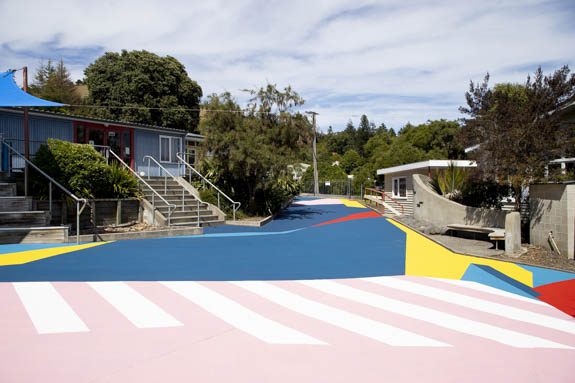
You finally got to do it! I was going to say that one of the great aspects of projects like this, and we talked about this with your court in New Brighton, is the way they encourage movement of bodies through and across these spaces (which allows people to engage with and respond to abstract art, even unwittingly). It would be really cool to have a drone video that shows the students moving across the mural.

Ross got some drone footage, with his kids walking on it, not playing unfortunately, but it will be really cool to see. With the COVID situation, schools have been really encouraged to get kids outside, and this work will really help with that…

An unforeseen practicality! Doing something in a place the size of Akaroa, I guess the work would reach the whole township. You said some people came past and saw it, did you get a sense that people were hearing about it and the word was spreading?

I think so. I did have that realization that we could have quite an impactful reach. Basically, if you are a family in that town with kids, they go to that school, and if you grew up in that town, you went to that school. So, hopefully people will be really excited about what we added to the school. The school is a really amazing environment, it’s nestled next to a hillside, there are a lot of native trees and birds, it was really beautiful to just hang out there painting…
Now that you’ve done something to this scale, it sets the precedent. How do you go about finding some new places to paint?

The school got funding from the Ministry of Education for the project and a couple of other projects around the campus, so my next task is to put it all together in a nice little package and reach out to more schools, find out what the funding was and how to go about getting it. Then just push them to apply for the funding to get something like this…

You will be taking more notice of school grounds now I imagine!

There were a lot of restrictions around this project, which made it good for the first one of this scale. Those restrictions really helped make it achievable and set boundaries, so I couldn’t really go too crazy with the design and get in over my head, which could have easily happened. I was learning a new product, I was out of town, if I ran out of something it wasn’t like I could just nip down to buy something. The product had to be ordered in from Auckland. So, if I get another job, closer to home, I’ll be able to push it a bit further and explore the color palette…

Follow Dr Suits on Instagram to what he has in store next!

All images supplied by Dr Suits
The Paste-Up Project – with Bloom n Grow Gal

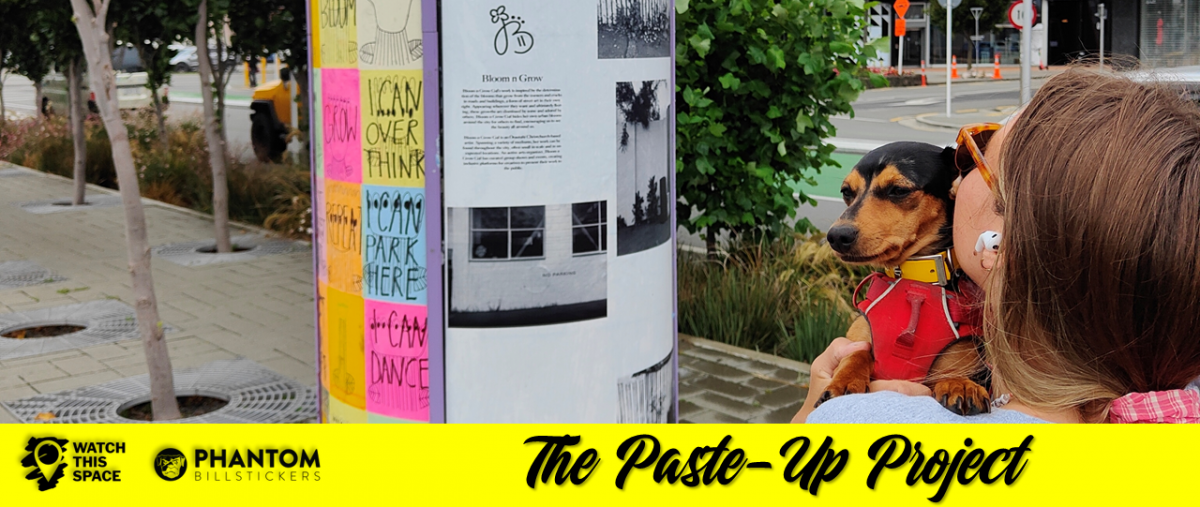
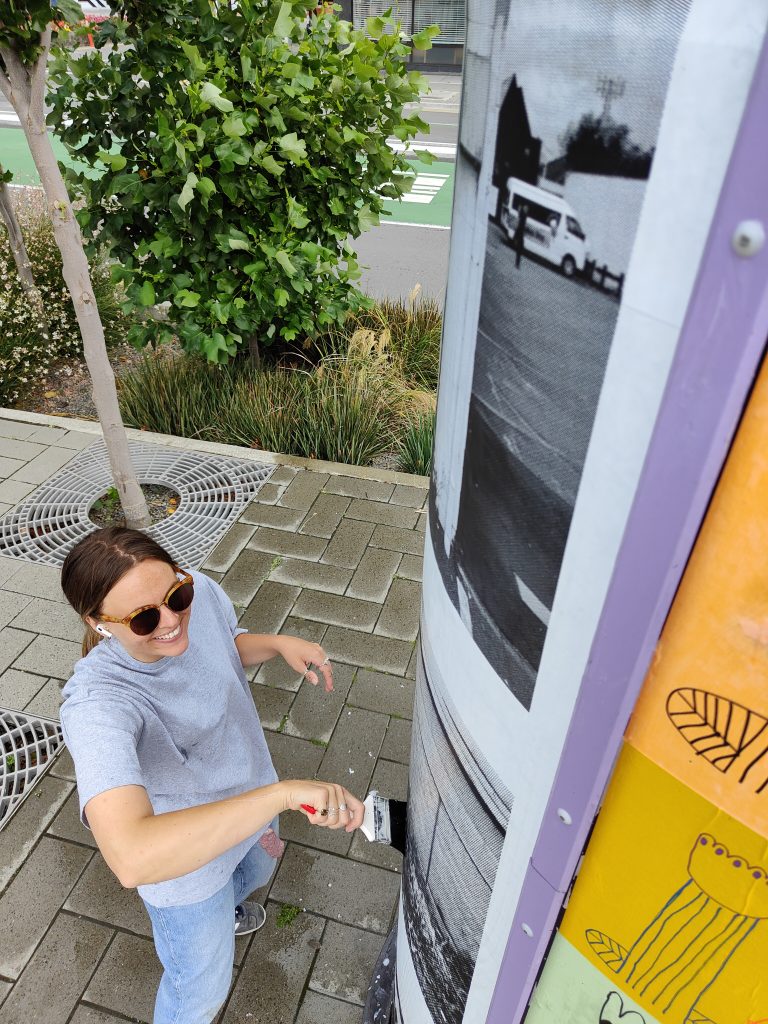
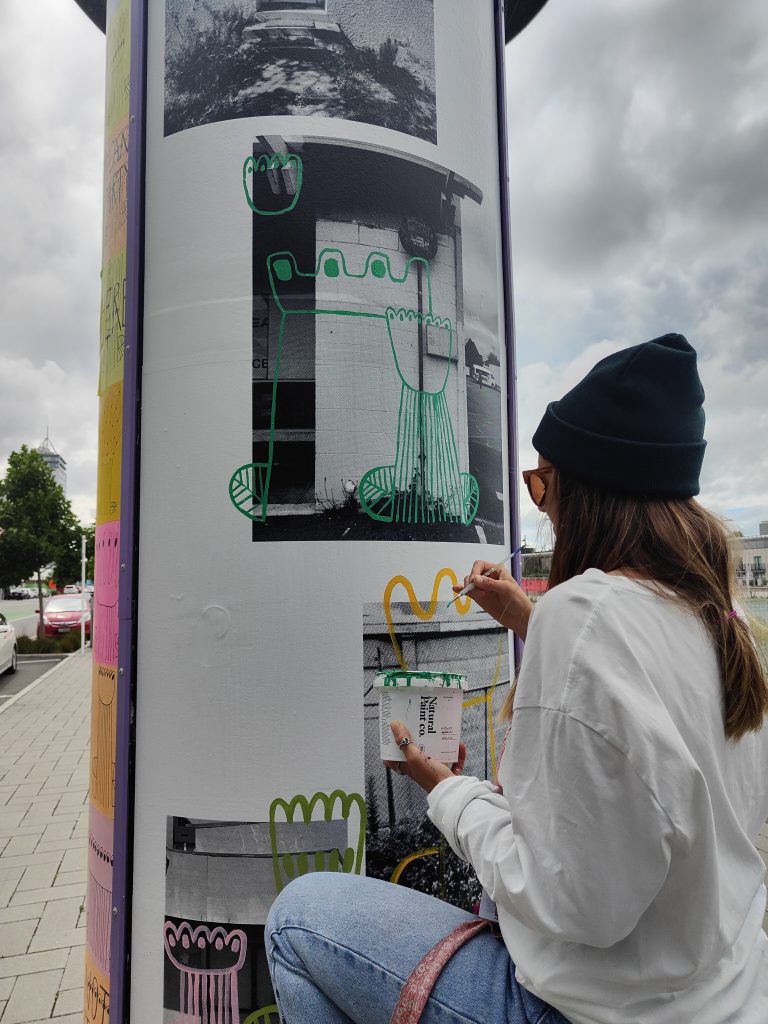
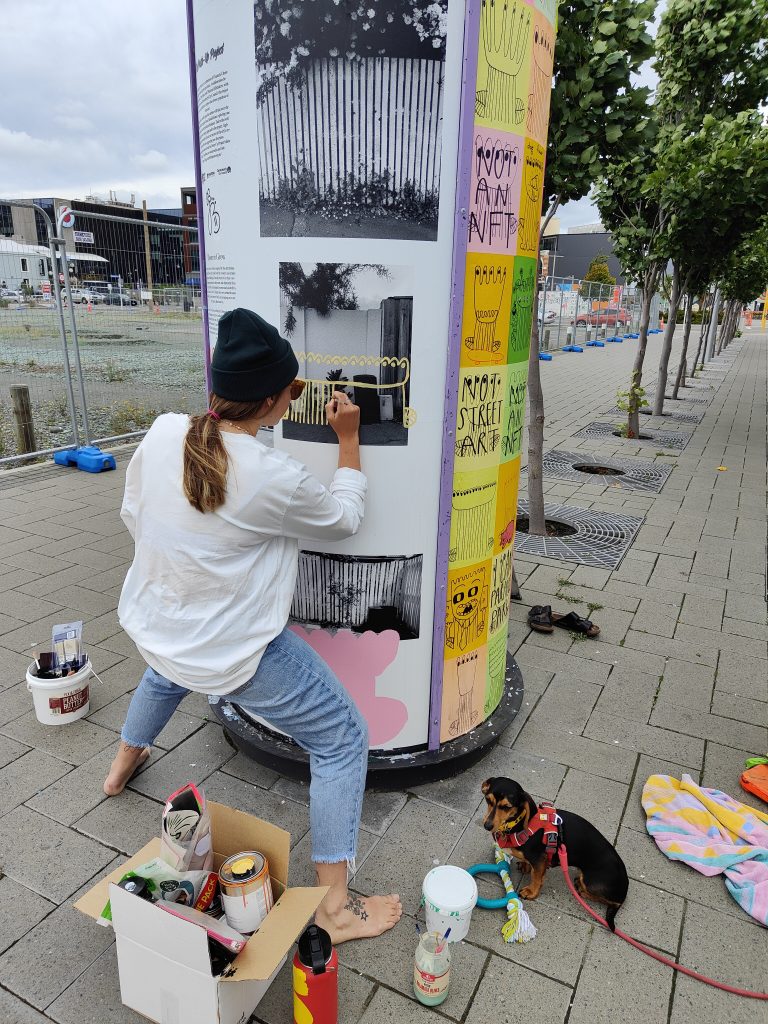
The second artist presented with the opportunity to take over the Paste-Up Project bollard, our collaboration with Phantom Billstickers, is Bloom n Grow Gal – our favourite urban gardener! With teethlikescrewdrivers‘ layered pencils cleared off the bollard, it was time for Bloom to add her touch. Unfortunately, the weather decided not to play along, with rain delaying the installation for a few days. But once presented with a dry spell to get pasting, Bloom ensured the Paste-Up Project had a new lease of life.

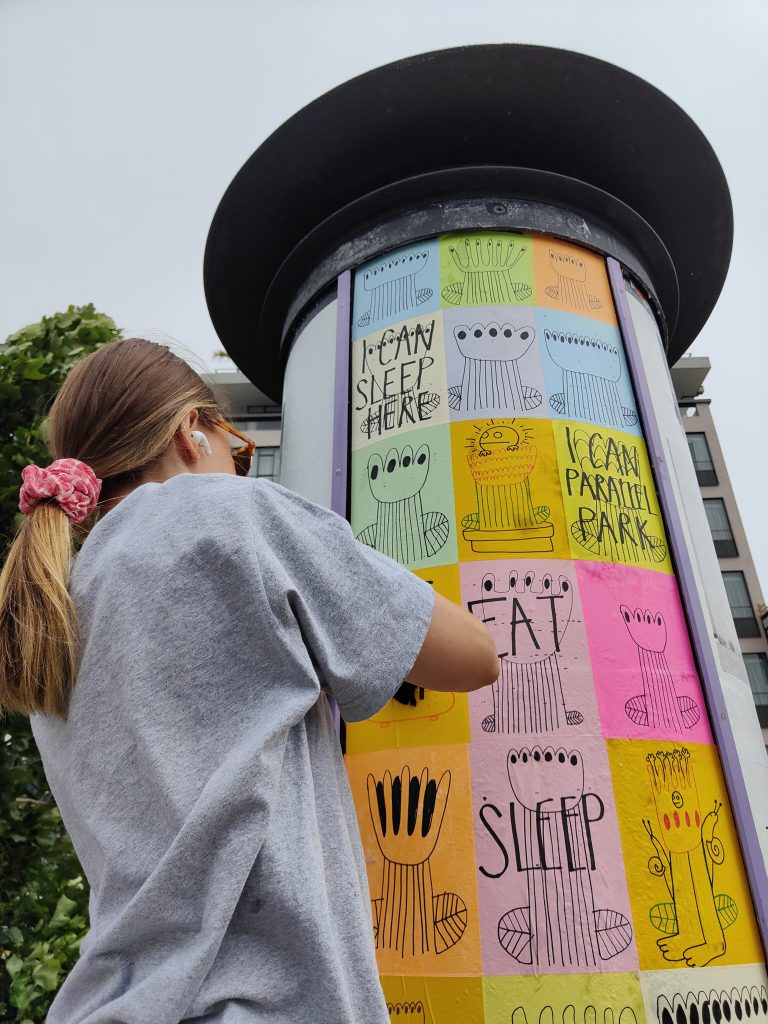
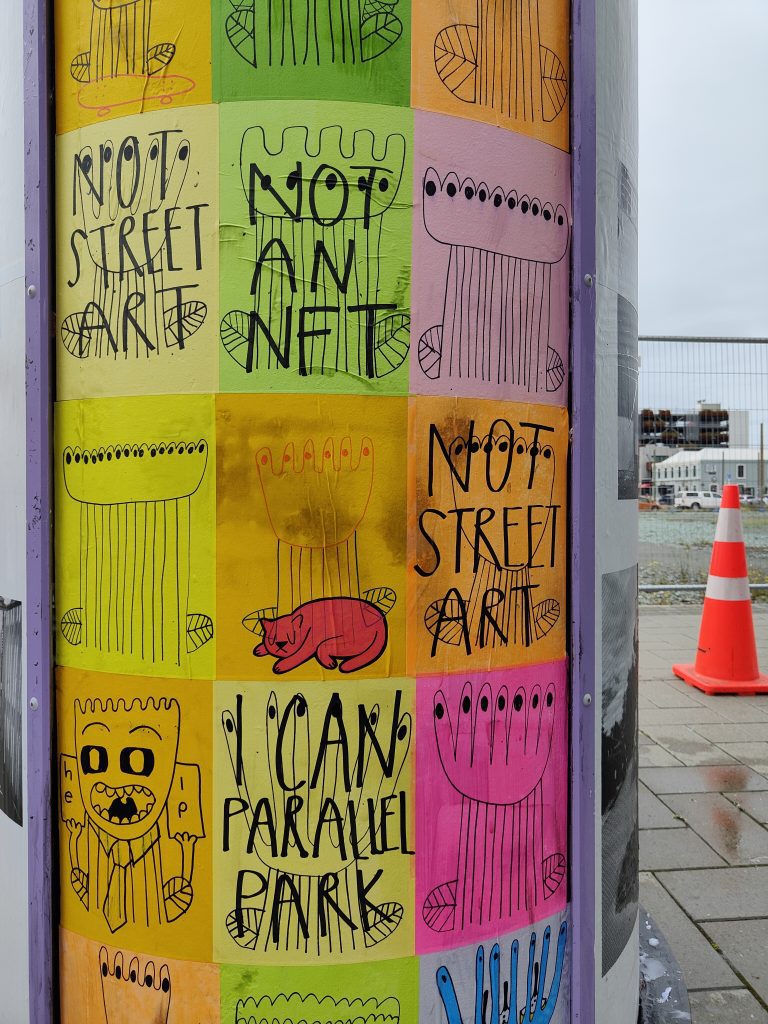
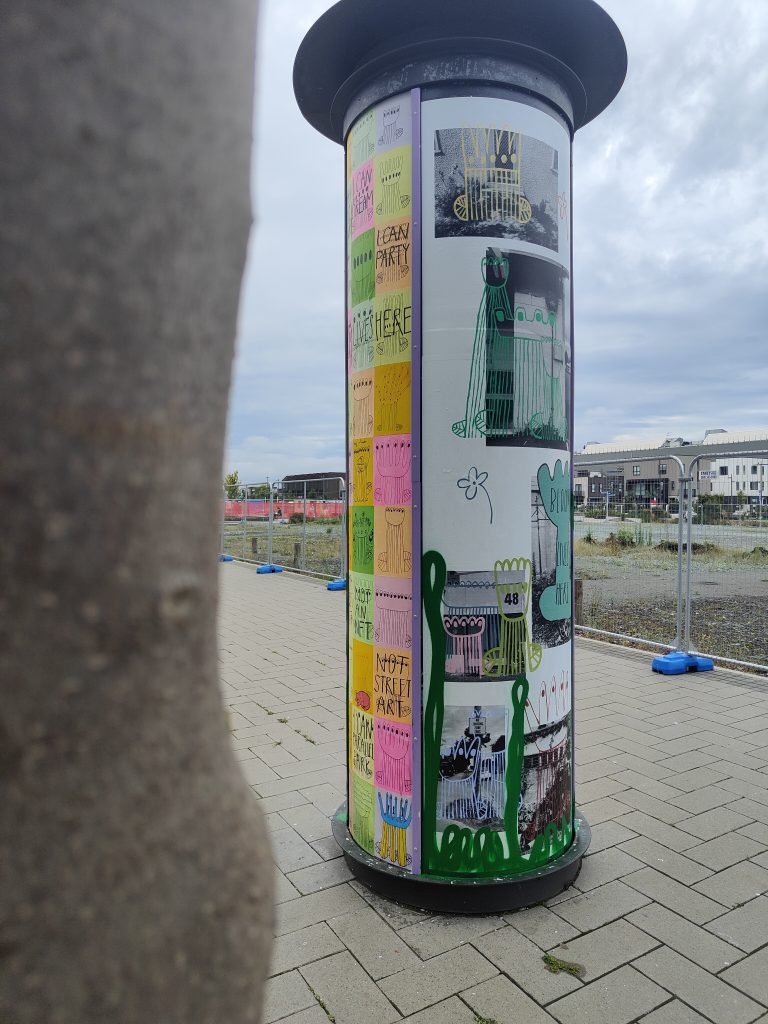
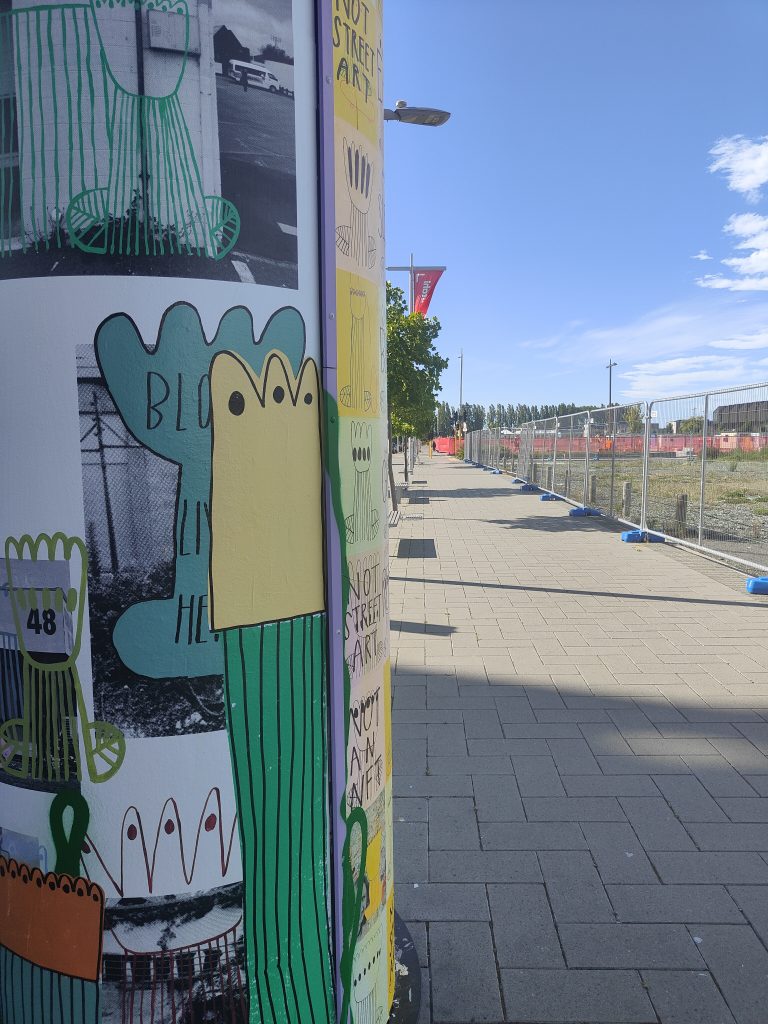
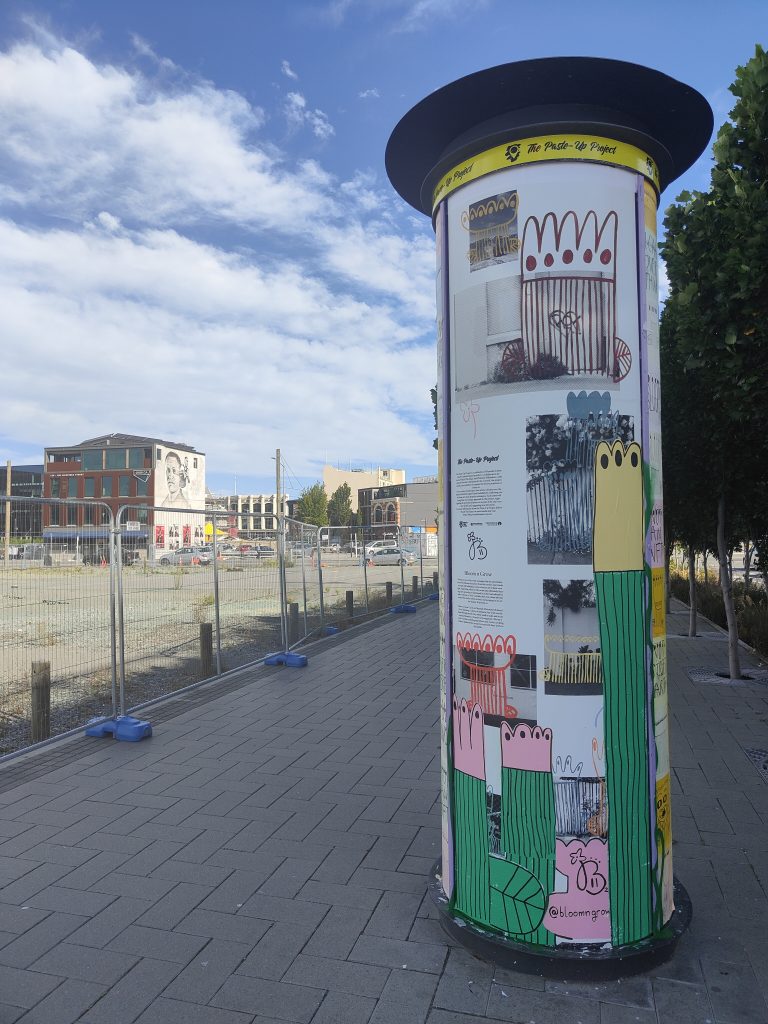
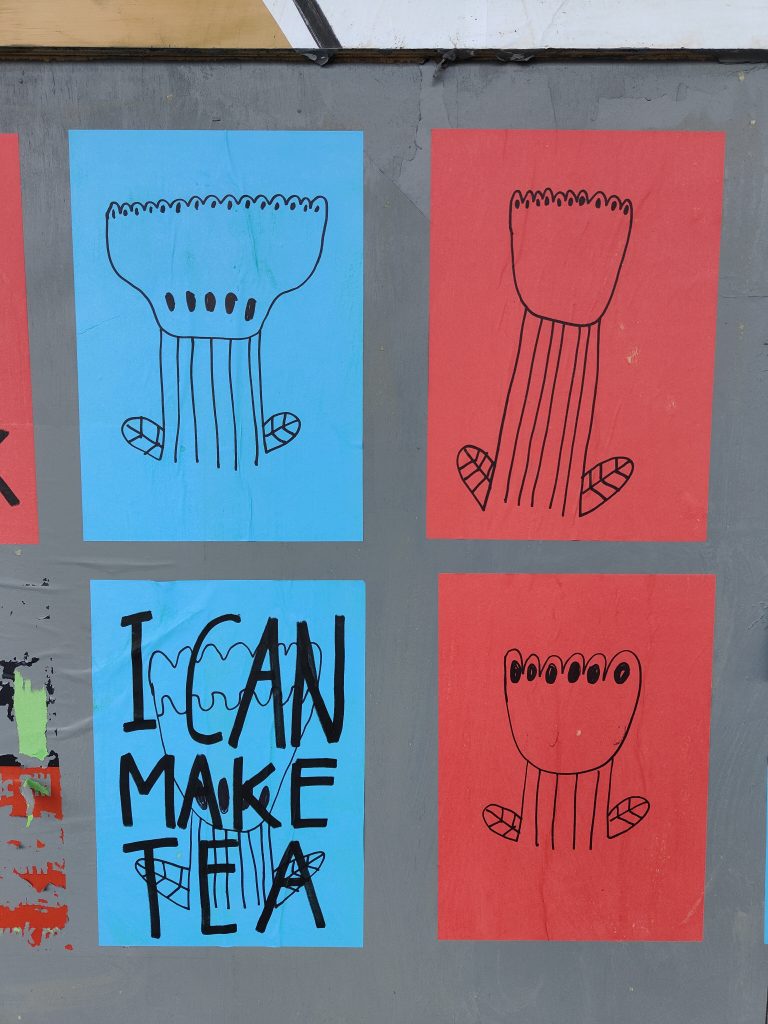
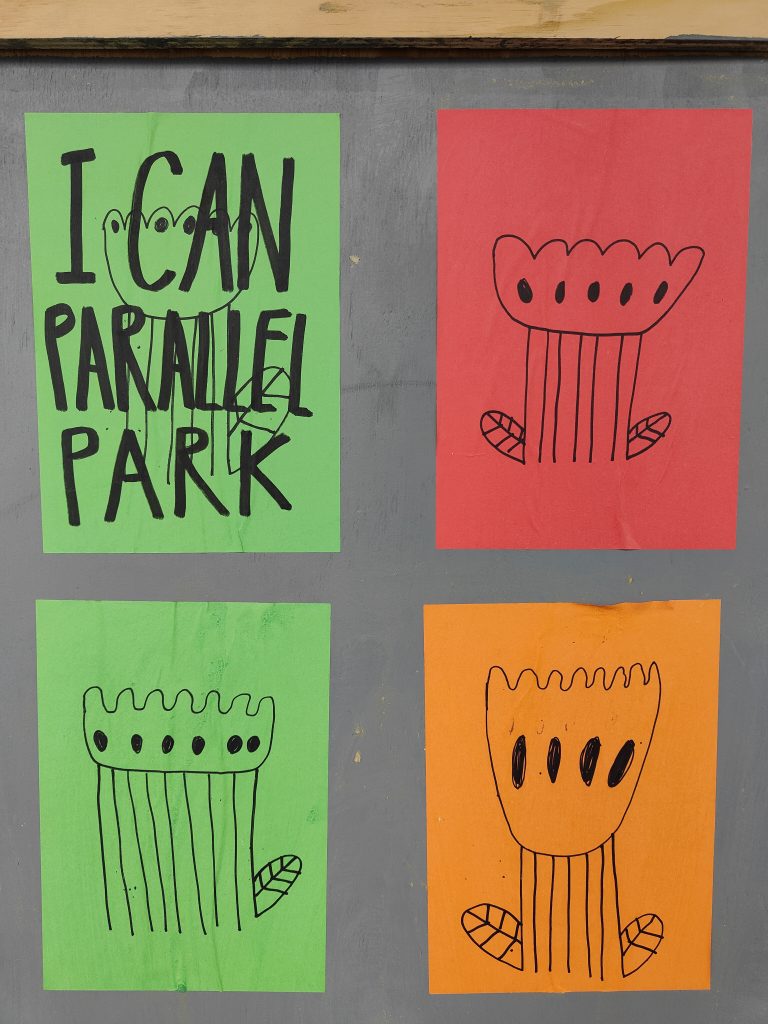
Utilising the four sections of the bollard, Bloom’s installation plays with two distinct concepts. On alternating sides, a colourful patchwork of her signature A4 flyposter paste-ups declare ‘Not Street Art’, ‘Not An NFT’ or ‘I Can Parallel Park’ across a series of singular blooms, a nod to her works across the city. Interspersed among the blooms are collaborations with Slap City artists, but here, the alterations to the blooms are perhaps more subtle, the flowers maintain the central importance. The A4 posters are a mixture of fluorescent colours, hearkening to the lineage of posters as an effective media for messages, whether advertising for your band’s first gig, searching for a lost pet or making a political statement.

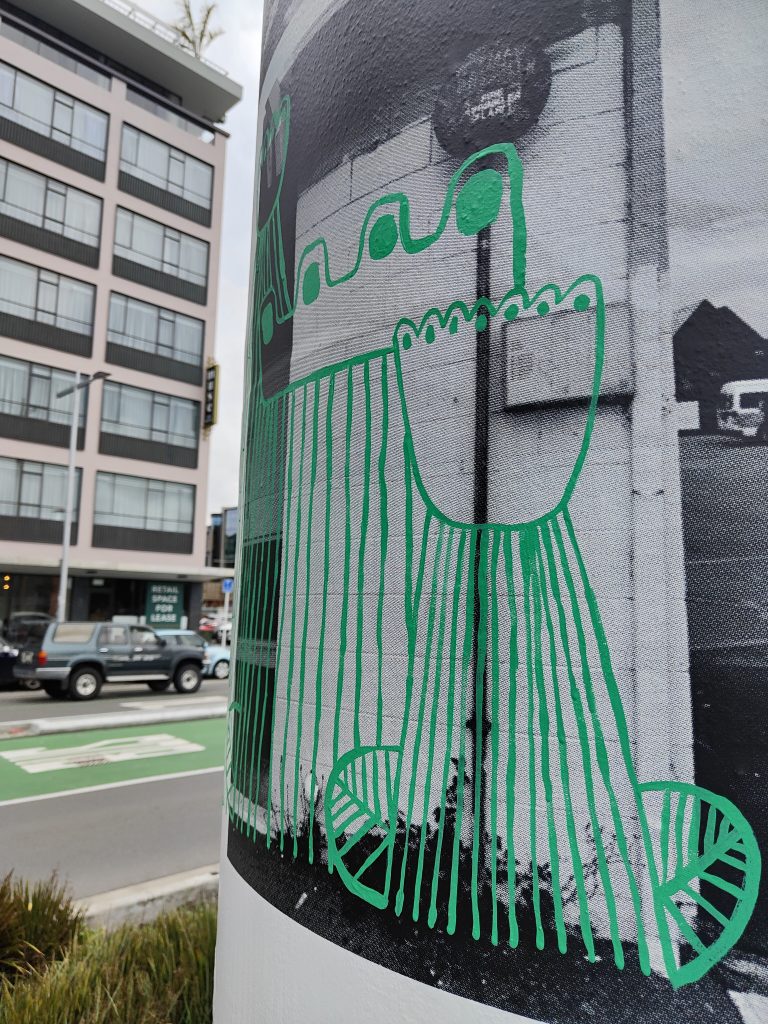
The other two sections are based on large scale white posters containing grainy photographs of dilapidated urban locations, with the white background providing plenty of space (this is important!). Over the top, Bloom has cultivated a range of flowers in bright colours, painted in her stylised line work. Larger than the buildings, they are an invasion – with the appearance of an unexpected addition to the ‘legitimate’ (but ultimately lifeless) posters, once more drawing on the urban theatre for inspiration.

A key part of Bloom’s concept was the ability to revisit the bollard throughout the installation, adding new blooms and allowing evolution. This theory was to come to the fore early when an expected addition of green spray paint was discovered just a day after completion. Not a typical tag or scrawling, it appeared to understand the concept but still threw a curveball for the artist. But, reconciling this occurrence with her intention made it easier and as such, the work is already a unique incarnation of the Paste-Up Project, embracing the potential for change as part of its inherent make-up.
We sat down to chat with Bloom once the paste was dry and talked about her idea, the process and how she has explored new ideas with this work…

____________________________________________

Finding your blooms around town over the last year has been one of my favourite discoveries, so it was an easy decision to get you on board as the second artist in the Paste-Up Project! What was your initial reaction to the invitation?

Wow! I was so privileged! I couldn’t believe that I’d been chosen to do this project, and when I found out people like teeth like screwdrivers and Cape of Storms were also getting on board, to put myself up against those guys, I was like, are you serious?! Yeah, it was kind of amazing!

What did you make of teeth’s installation? Did you take any inspiration from it, or did you already have an idea of what you wanted to do?

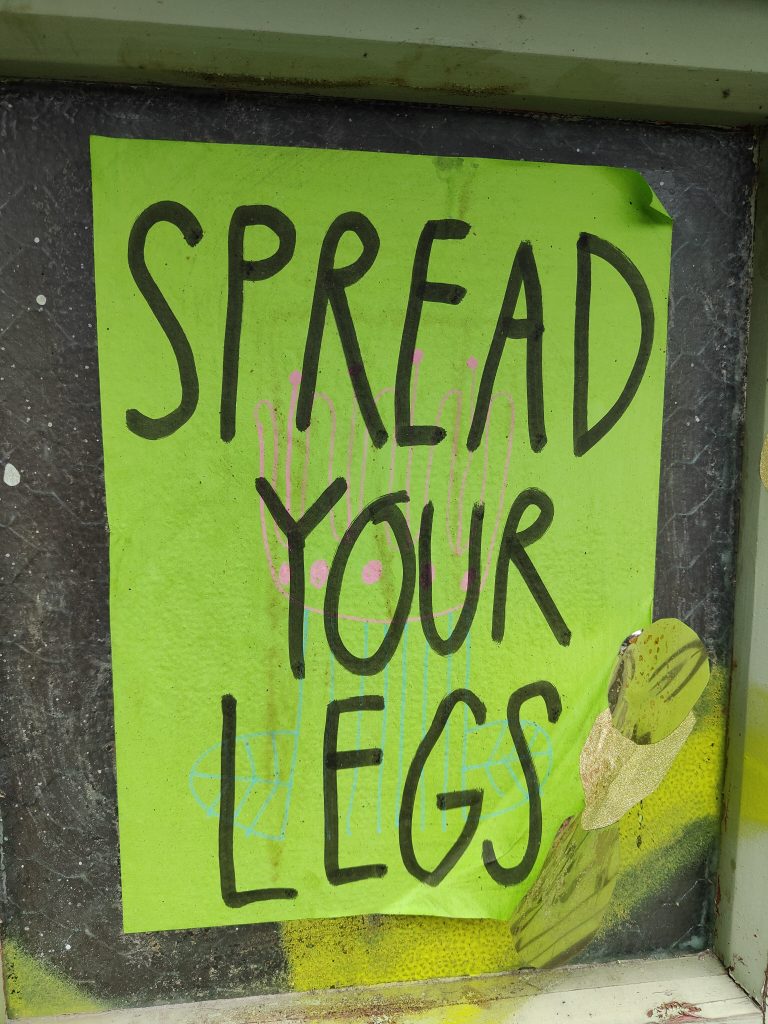
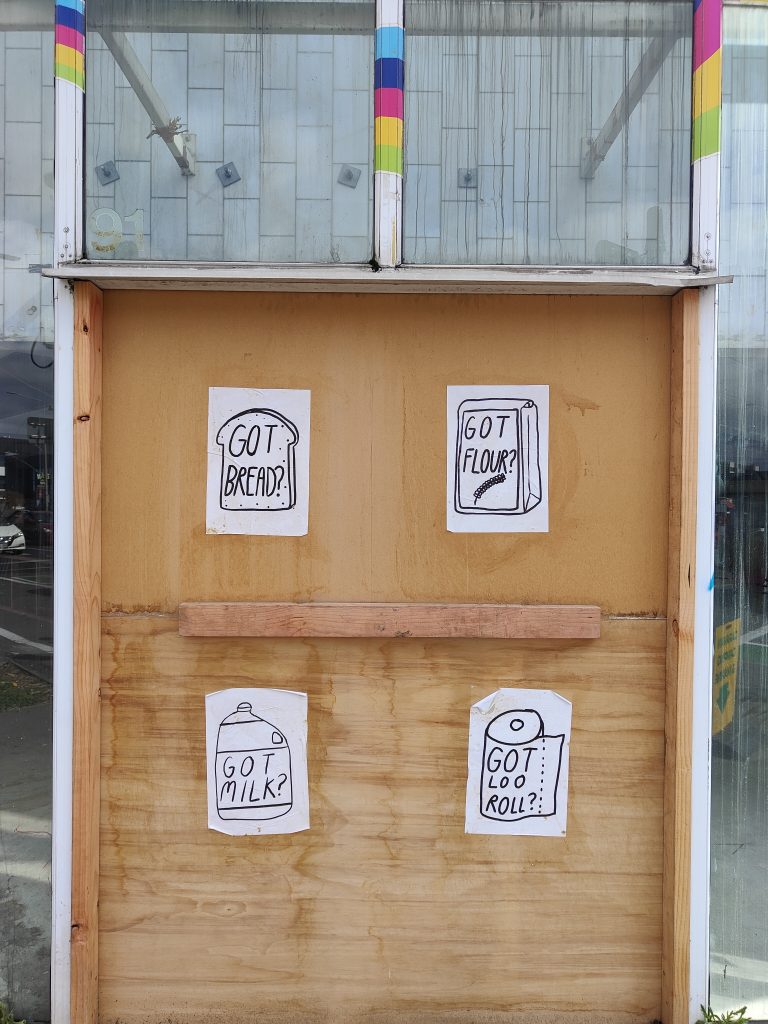
Even now I’m still getting all these ideas of what I could have done or what I should have done. My first idea was to do a grocery shop with flowers coming out of it, I mean it could still be an idea, but I remember when teeth’s work went up, I was like, OK, he’s done all these collabs with people, and I felt the pressure that I had to make mine look the same. But then I re-read the brief and realised that that’s not necessarily my kind of style. Reaching out to people, collaborating with people isn’t really what I do. That is very much a teeth like screwdrivers thing, so I focused on myself. My original design didn’t really match the brief and that’s why I took it back to the blocks with the individual blooms and the statements. They are something that I really enjoy and even today I get people sending me these photos of ones from lock down saying: ‘Spread Your Legs’, ‘I Can Dance’, ‘I Can Party’, even ones that have been slightly adjusted with random words written underneath like ‘Daddy’ – I just love that! So, to me it was important to include those after reading the brief. The photos were something that came from people sending me pictures of blooms from all over the world, saying they reminded them of my art, but also, just keeping an eye out for beautiful things in unexpected places.

You do have some Slap City collabs in there too, Cape of Storms, Lost Boy, teeth like screwdrivers and others have added their touch to some of the blooms, so that influence is still there a little bit…

Yeah, I’m quite a solo person, so when I realized that people wanted to join in with my blooms, it was really nice because I never thought it would be something that could be possible. How could you do anything with these? They are what they are. It was nice to find out that they were adaptable for people. The Slap City collabs were a last-minute thing and they actually worked! It was really warming.

I really liked your idea of an urban bloom just appearing in these unexpected places, something that some people might overlook and walk past, but that other people will see as a beautiful little bit of nature that has found a way to exist in an environment that tries not to let things like that exist. I think the contrast of the black and white photographs with the colored blooms painted over the top really brings that out. I really love that contrast of the color against the black and white, it’s a reminder that the world can be quite boring without letting nature have those little moments of revelation. The other thing I like is the nice lineage in all those A4 pieces, the slogan pieces with the individual blooms, that make me think of fly-postering, whether that is independent gig posters or political messages, there’s something nice about that repeated block. In the same vein, the larger posters almost seem like an interplay between what you’d expect to find on the bollards and an unexpected addition. There is a feeling they are supposed to be on the bollard, and then the flowers are kind of like this addition, this subversion. Are those references to the urban environment something that you were intending?
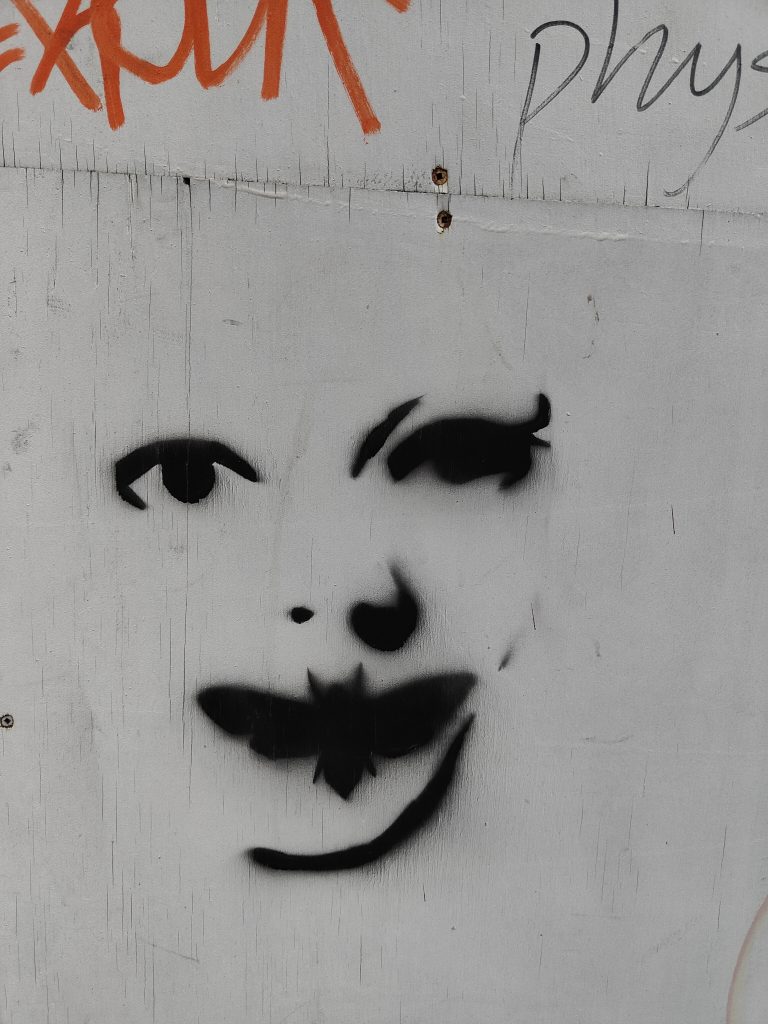
Yeah, for me, this graffiti part of my life is something I’m learning about myself over the last couple of years. It was never something I pictured myself doing. For me, graffiti was like this aggressive writing all over the walls around Derry [the town where Bloom grew up in Northern Ireland], but then I discovered that graffiti could be literally whatever you want it to be. I started looking at these plants and flowers growing out of buildings and seeing them as graffiti as well in a way; they’re not really supposed to be there, but they are there because they want to be there and nature gave them everything that they needed to grow there, which is what I really love. It gave me the confidence to start doing my own little blooms on buildings. I’ve always really been into design and color, I’m always wearing lots of little pops of color; I’ll wear an orange jumper and a pink pair of pants, blue shoes and a green coat or something. I love blocks of colour, so it’s important for them to be in my art, which is where the A4 posters come in. I guess the big black and white posters that Phantom helped with, that was me trying to bring my love of photography to the installation. I would never say I’m a photographer, but I just love taking photos of flowers growing out of places they’re not supposed to, because it’s beautiful. I love capturing the negative space around these flowers growing out of buildings, which is what the white spaces represent.

Are your blooms a reference to weeds? Weeds are kind of vilified, but they can still be so beautiful and intricate, aspects that are overlooked because of the way we are told to get rid of weeds…

I’m starting to not use the word weeds, I hate that word! It’s a word that I just can’t get out now because I’m like, they are not weeds! They are flowers! They are beautiful, I don’t want to pull them out!

I love their durability and persistence, they can thrive in places where they are being set up to fail, they are still able to find the space to exist. The other thing I love about the photos with the flowers over the top is the way that scale is flipped, rather than a tiny growth or bloom at the bottom of the wall, they are bigger than the buildings, and there’s something really powerful about that. It reminds me of those science fiction movies where people go to some strange new world, where flowers and plants are the size of cars and buildings, it makes us aware that we aren’t above nature.

I’m really enjoying that there’s no limitations when you’re doing something like this. I can just get into this dream world, and I can go as big as I want with a flower or as tiny as I want with a flower at the side of the road.

What about the process? The bollard is a big proposition, and a lot of your blooms in the streets are relatively small, so how did you find the challenge of filling the bollard?

It took longer than I thought it would, that’s for sure! I’m so used to doing a lot of prep work at the house, sat drawing my flowers over and over again, but I don’t usually spend as much time at a wall pasting up. It is so important for me to individually draw every single flower, I don’t have it in me to photocopy multiples of the same flower because that would take away the point of what it is…

Because that doesn’t happen in nature, right? No flower is the same…

Yeah, you can’t just photocopy a flower, it’s got to be different, that’s something that I’ve really stuck by. So, there’s the prep work of doing all those flowers, which is fine, because I can do them sat on my sofa, but when I was out there doing the bollard to took much longer. It was nice, because it felt like I had a bit of importance, with the road cones, and just sat there just pottering away, so it didn’t feel like there was that pressure that you get when you’re out wheat pasting at night, looking over your shoulder. The bollard was an awesome experience and I enjoyed taking my time, but I think getting out there on the streets, doing it as quick as you can and then running away and doing another wall, I love that!

It is a very different process and energy to working on the streets without permission…

I think that’s why I got a little bit upset when someone spray painted on the bollard, because it wasn’t just street art, it was actually me being an artist. When I came back a couple of days later after I had spent the time painting onto the bollard and it had been sprayed over, it was like somebody had gone into an art gallery and sprayed over my work. It’s a reality when you’re doing it without permission and something that you just have to accept, but when you are putting that extra time into something that you are doing in a different way, it’s a bit more disheartening.

It is interesting because that addition wasn’t what you would normally expect. It was almost like someone came and added grass, they haven’t gone over the top of certain elements, it’s strangely respectful…

It took a took a moment for me to understand it, but then, looking back at my idea and why I did those two boards with the photos and the white negative space around them, it was because something was supposed to grow in those places. Something grew so much faster than I thought it would though! It must have been all the rain! But yeah, I think I just have to be accepting that it happened…

Your work in the streets has always been quite adventurous in terms of materials, you are willing to pick up new materials, from works on wood to little ceramic tiles to various paste up styles and stickers, you aren’t afraid to experiment. In this case, you will be revisiting the site throughout the time of the installation, which means it becomes a fun experiment where you have the space to evolve ideas, which could open new doors…

I have literally grown and bloomed during this process and that is the whole point of my art and my journey. This shit happened, what can I do about it? How is it going to grow and bloom into something else? Because it is forever changing, just like the blooms outside are forever changing. It’s nice, just because you thought something was finished doesn’t mean it is finished. Not that I’m encouraging it, but it would be interesting to see if anything else happens to it that’s not me…

Which means figuring out how you can embrace it and make it part of your own work. So lastly, who do you want to thank?

You for pretty much stripping the bollard! I turned up when there wasn’t that much left to do, but still whinged a lot! Phantom (especially Mike from Phantom for helping paste those big posters up, what a sweetie!) and the Christchurch City Council. The guy who didn’t give me a parking ticket! Ben for bringing me a cup of coffee and Jamie for bringing me some sugar. My dog Milk for keeping me company…

She was very good!

Watch This Space, and the sun for finally coming out so I could finish it!

Thank you for coming on board and adding your lovely blooms to the Paste-Up Project, we look forward to seeing how it’s going to evolve over the next couple of months! Is there anything else you want to say?

I‘m away to plant some seeds to grow some blooms so I can add them to them bollard!

____________________________________________

Follow Bloom n Grow Gal to see what she gets up to next, and keep your eyes and ears peeled for more about The Paste-Up Project on our channels!

Oh, and get down to the site on Manchester Street to see this amazing installation in the flesh!

A Nice Trip to the Beach…

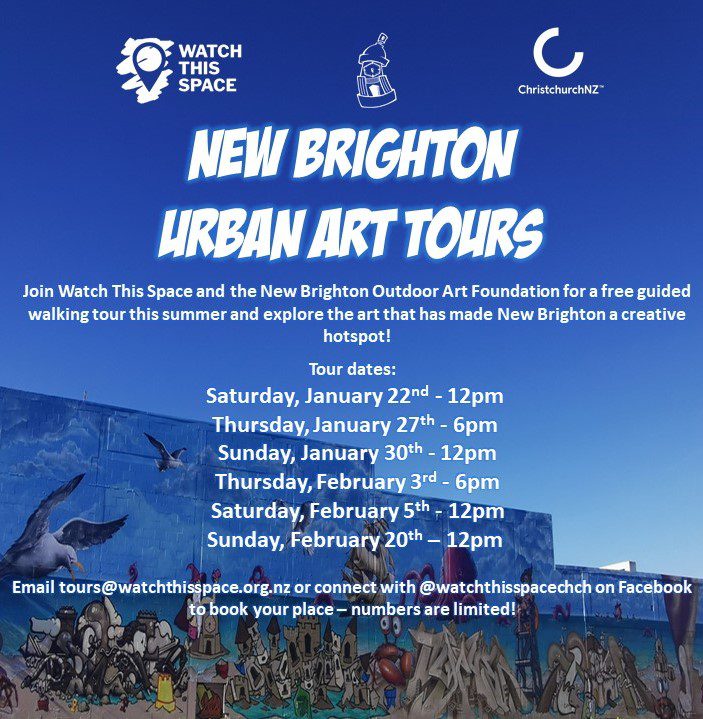
We are excited to announce a summer series of New Brighton guided street art tours! Watch This Space has already established central Christchurch street art tours, with hundreds of guests joining us to explore the art within the four avenues since 2019. Now, in conjunction with the New Brighton Outdoor Art Foundation, our tours will journey out to one of the city’s most vibrant suburban settings, the beautiful seaside village of New Brighton.

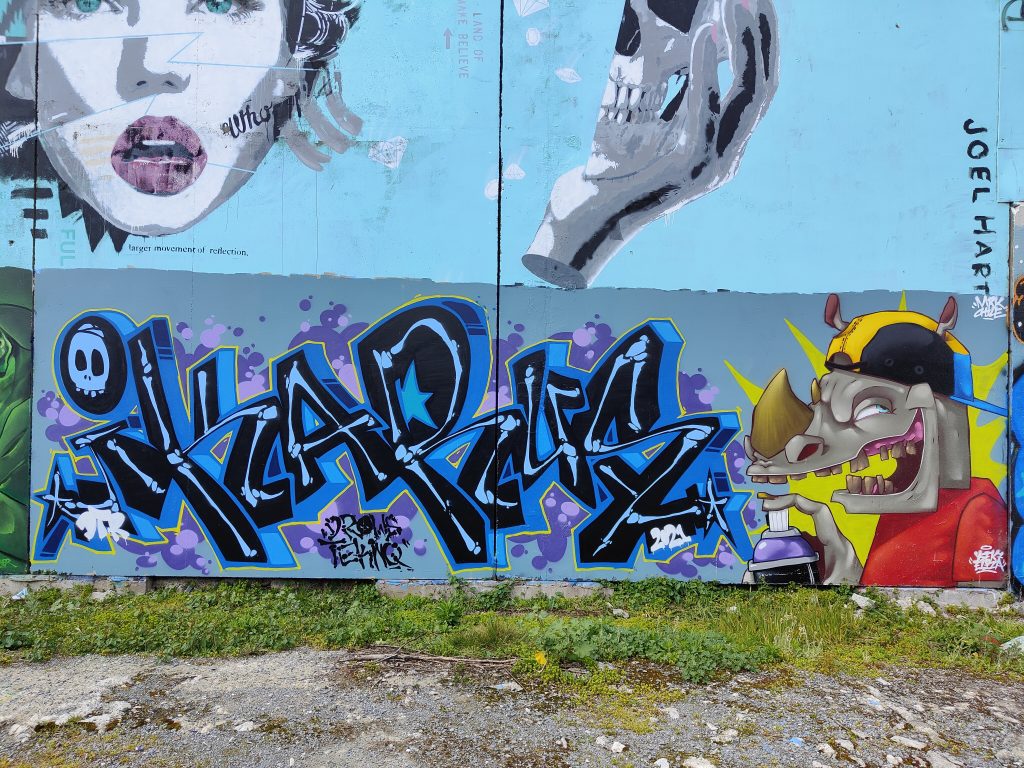
Ikarus and Ysek below Joel Hart

Although New Brighton has faced a litany of challenges over the years, from the economic downturn with the arrival of mega malls, to the damage of the Christchurch earthquakes, art has been an undeniable presence – brightening walls with evolving works that have often reflected the indomitable community spirit of the area! While today, the beautiful Pier is accompanied by the bustling children’s playground and the popular He Puna Taimoana hot pools (and a brand new surf life saving club to boot), since 2012, the dilapidated walls and empty spaces have been filled with art.  From the 2012 event Mural Madness to the 2020 New Brighton Outdoor Art Festival – art has been at the heart of so many aspects of the village’s revitalisation. The art found in New Brighton is not as pristine and curated as the central city, where there is an increasing sense of input from power brokers, instead it is more organic and experimental, and at times challenging, with traditional graffiti a prominent part of the artistic profile with legal walls and collaborative productions. But that makes it all the more interesting and authentic – it is the art of action!

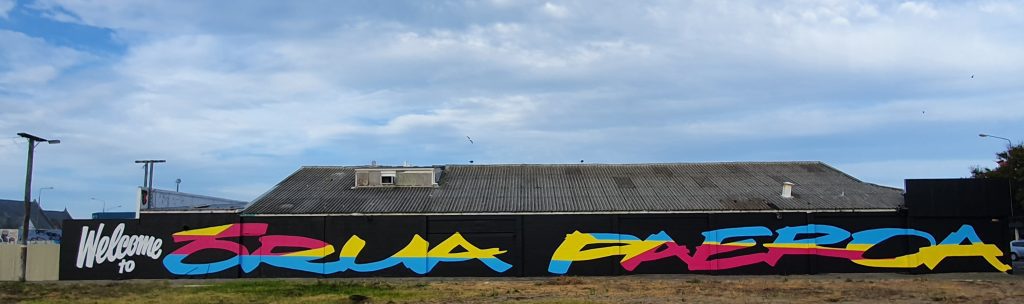
Welcome to Orua Paeroa, by the Fiksate crew and the New Brighton Community

With free tours spread across January and February, now is the time to book in and explore New Brighton! Perfect for locals who want to celebrate their neighbourhood or for visitors who will find a ‘new’ New Brighton, our tours are available for all ages!

Email [email protected] for booking options and we will see you at the beach!   

Tour dates:

12pm, Saturday, January 22nd (almost fill, less than 3 places available!)

6pm, Thursday, January 27th

12pm, Sunday, January 30th

6pm, Thursday, February 3rd

12pm, Saturday, February 5th

12pm, Sunday, February 20th

The New Brighton street art tours are an initiative between Watch This Space, the New Brighton Outdoor Art Foundation and ChristchurchNZ.

Nick Lowry, teethlikescrewdrivers, Bloom n Grow Gal and Bols @ the BOXed Quarter

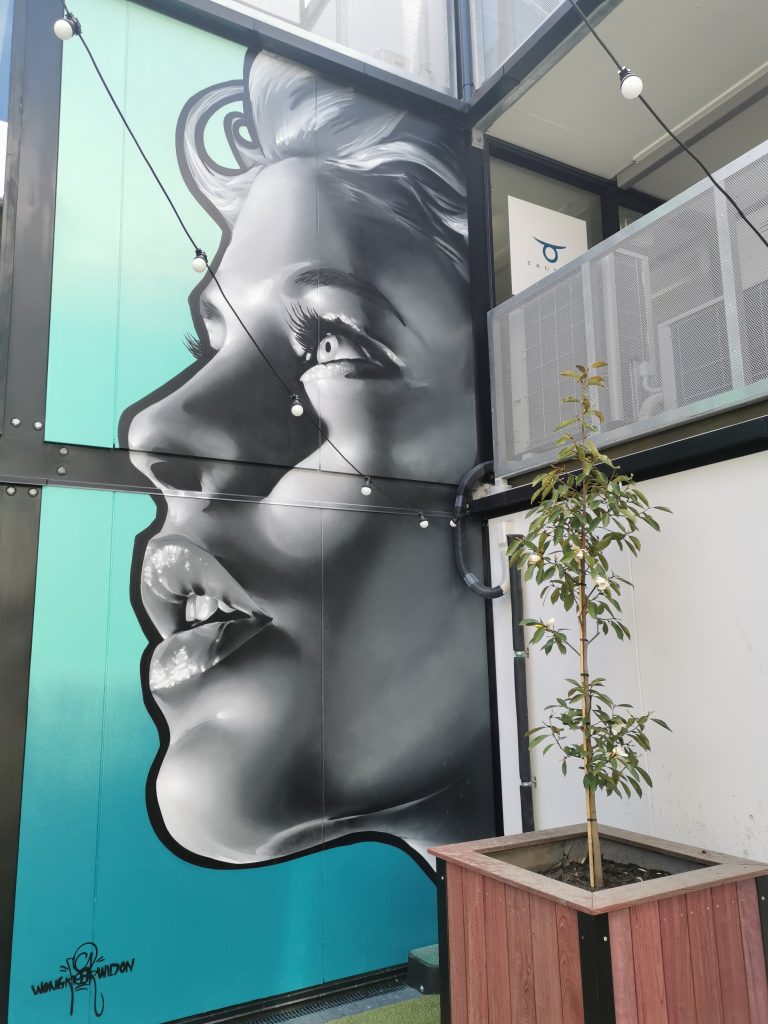
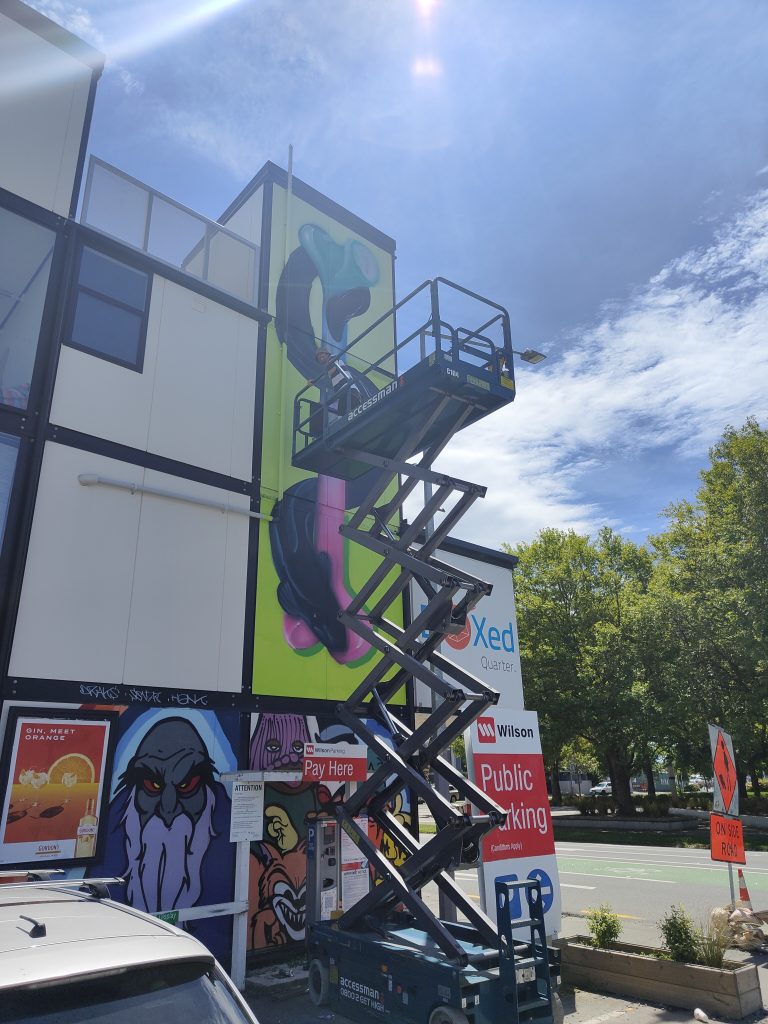
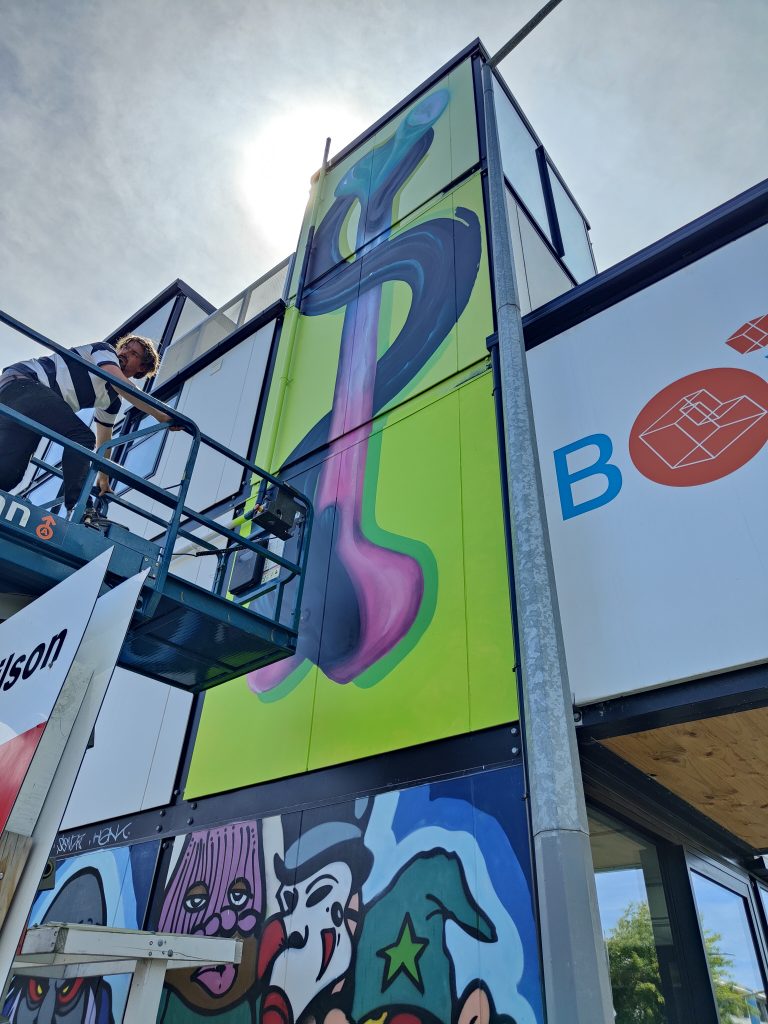
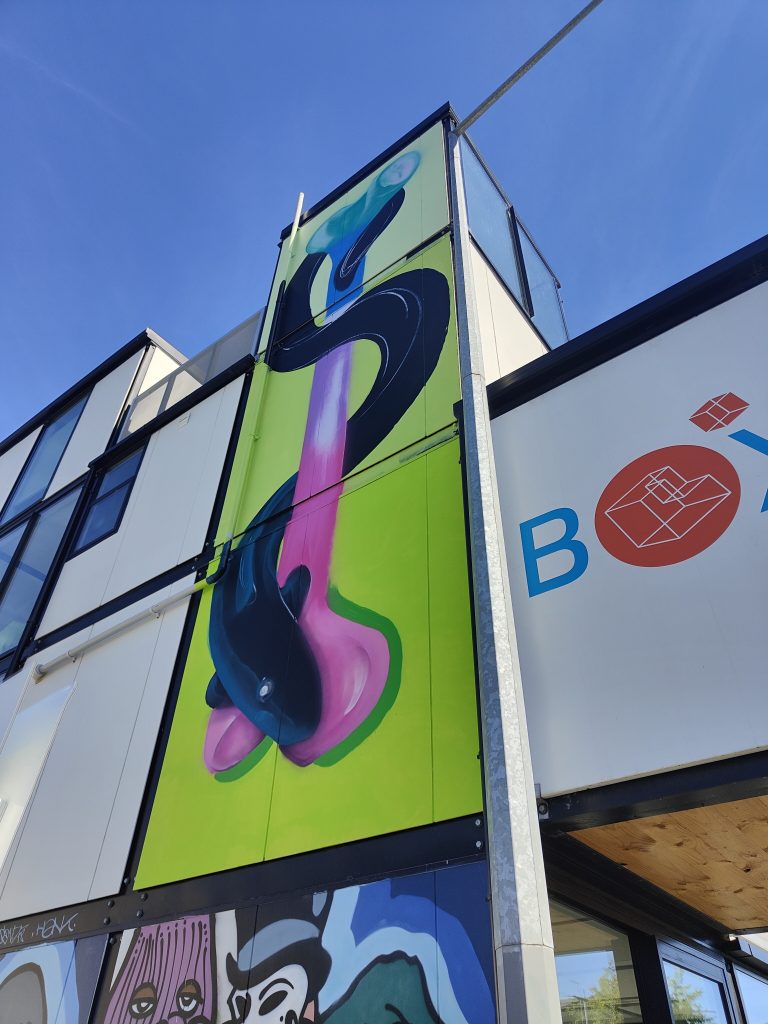
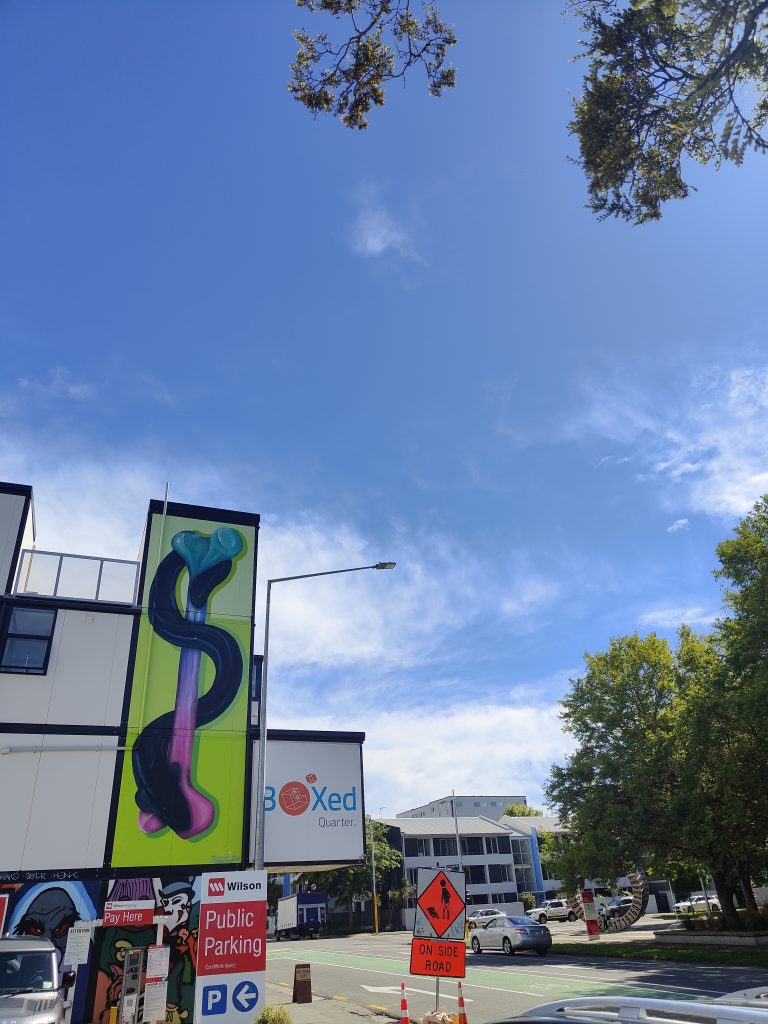
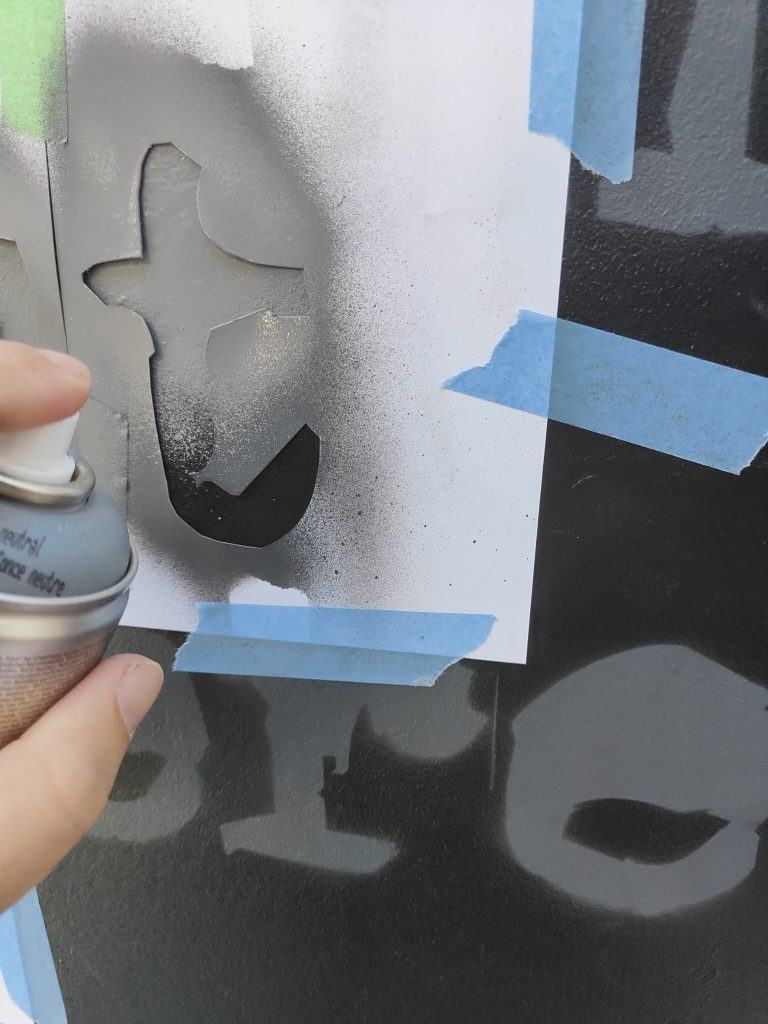
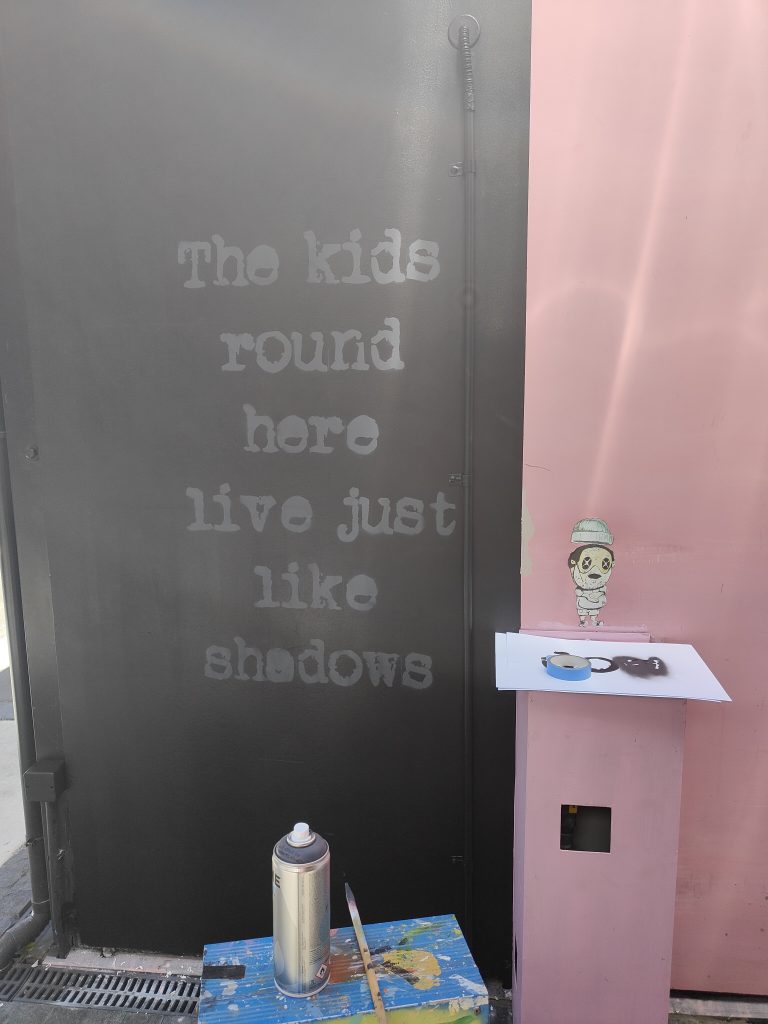
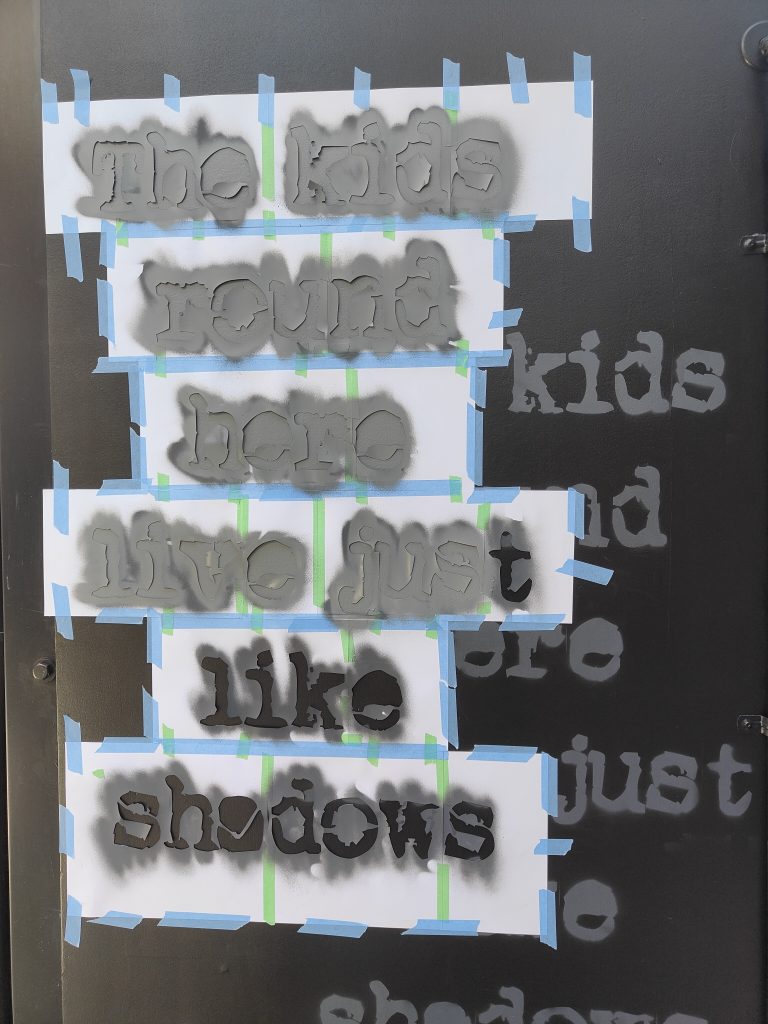
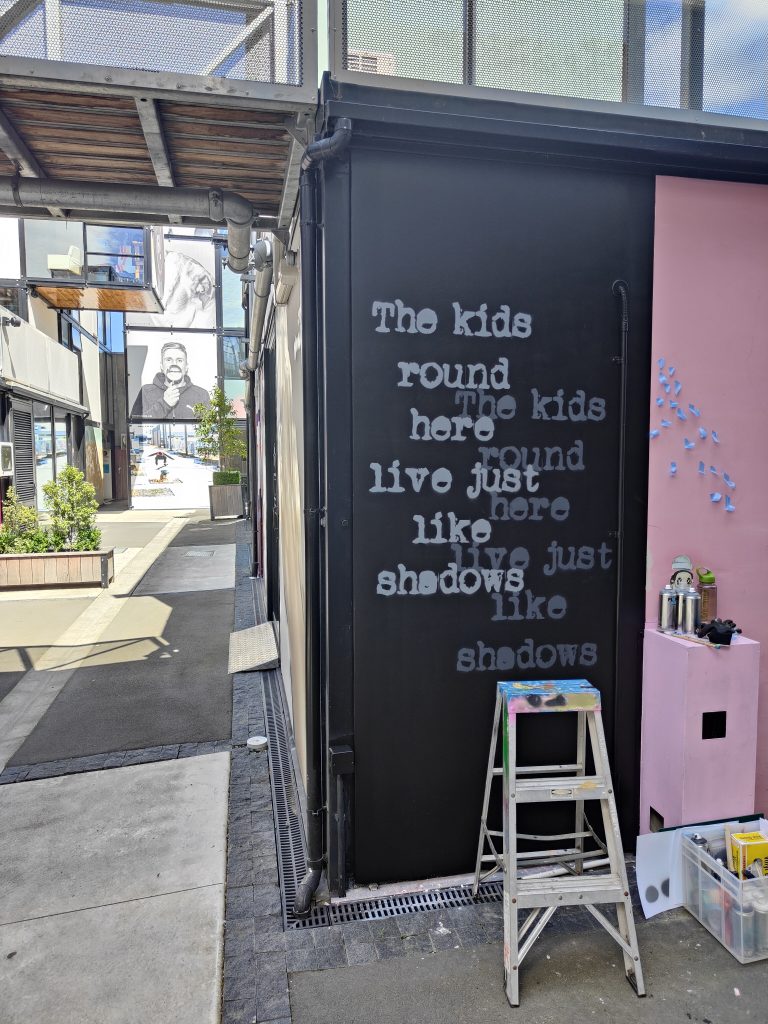
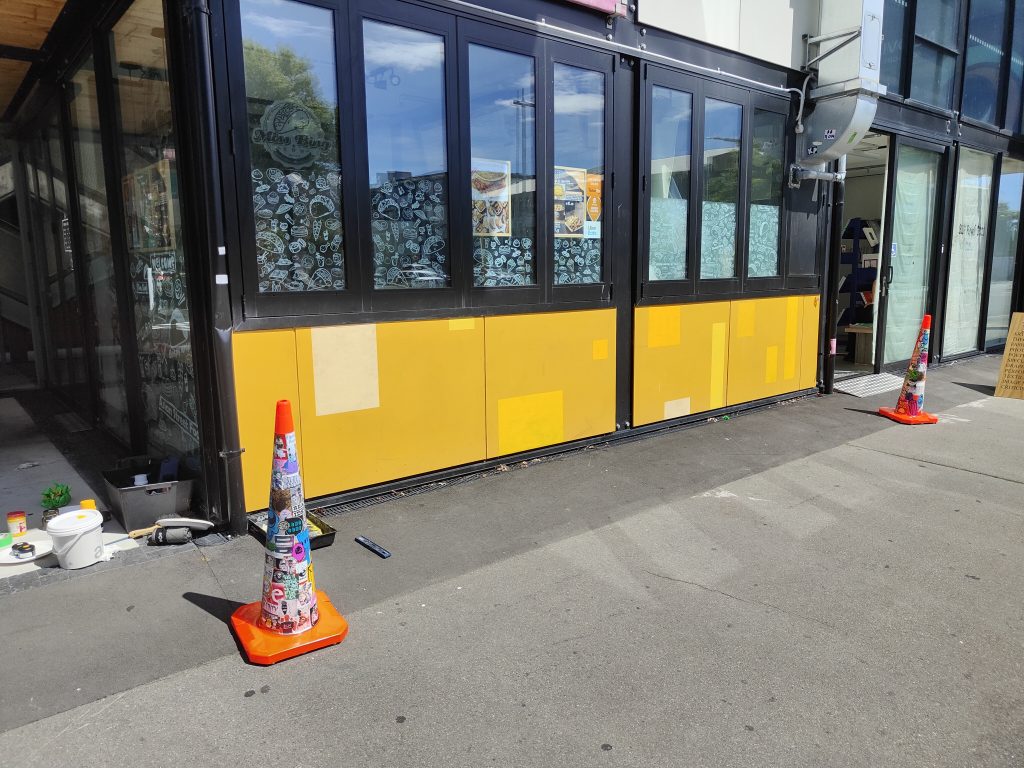
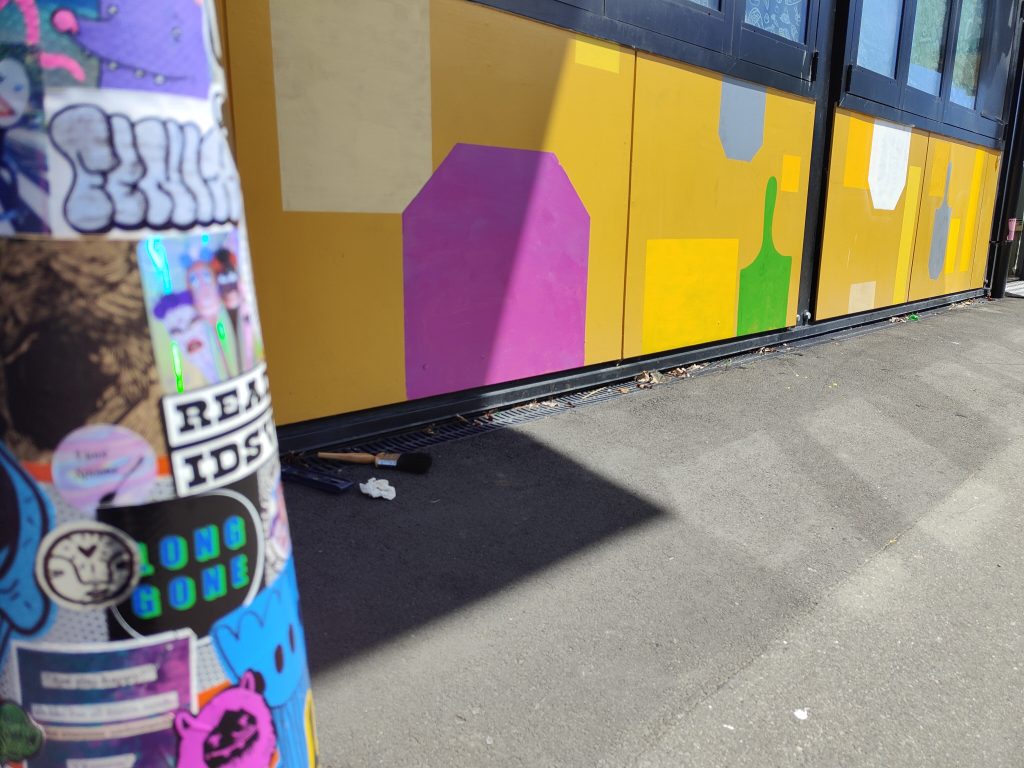
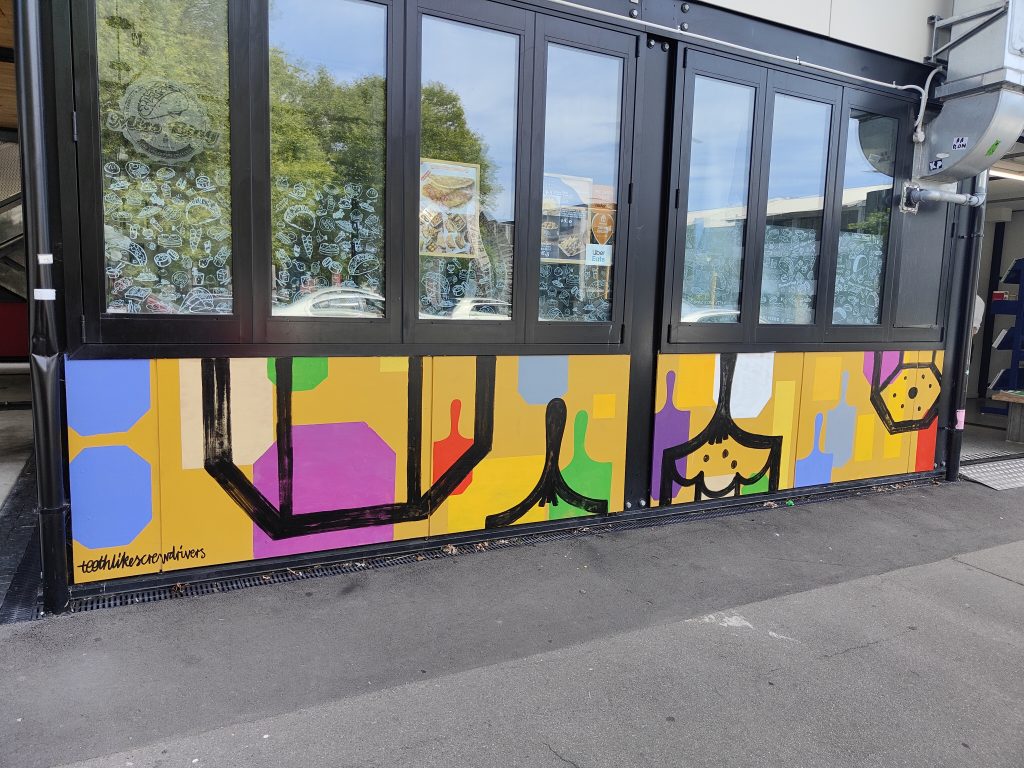
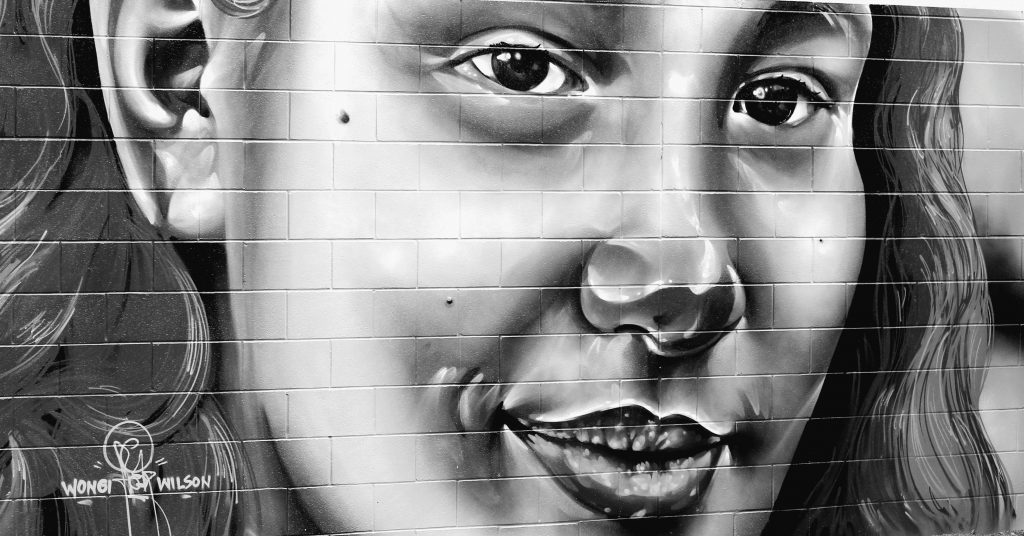
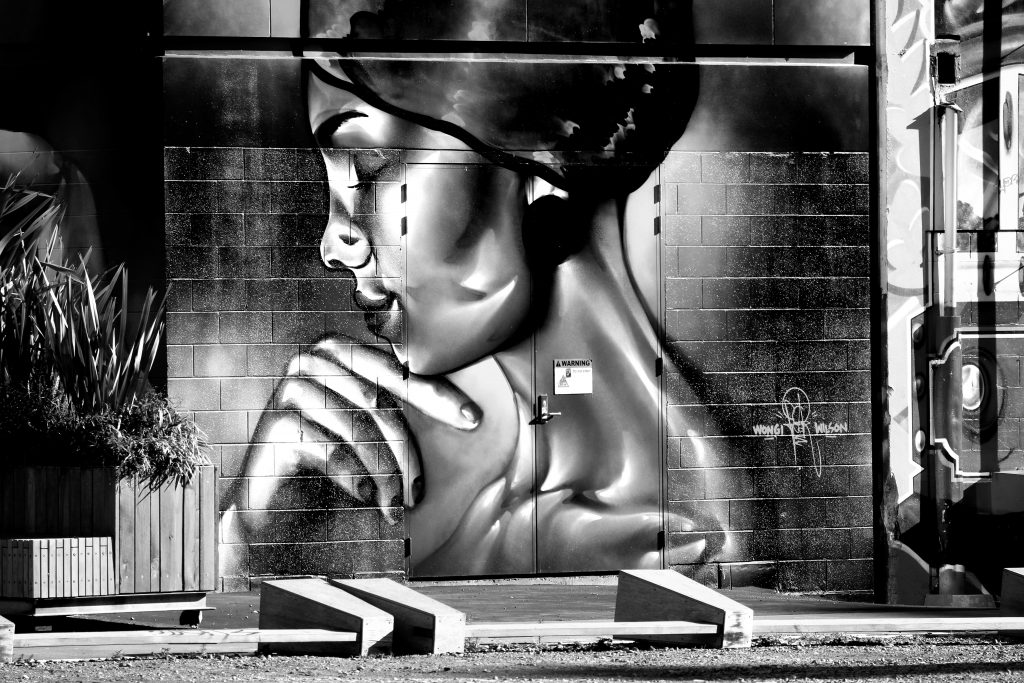
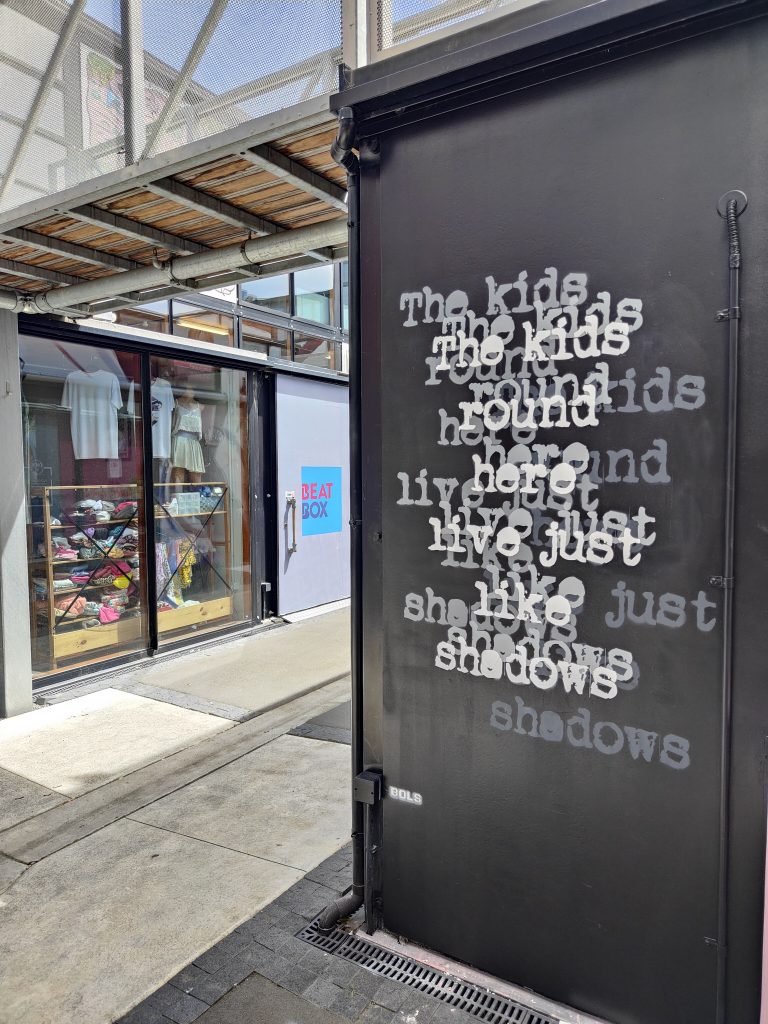
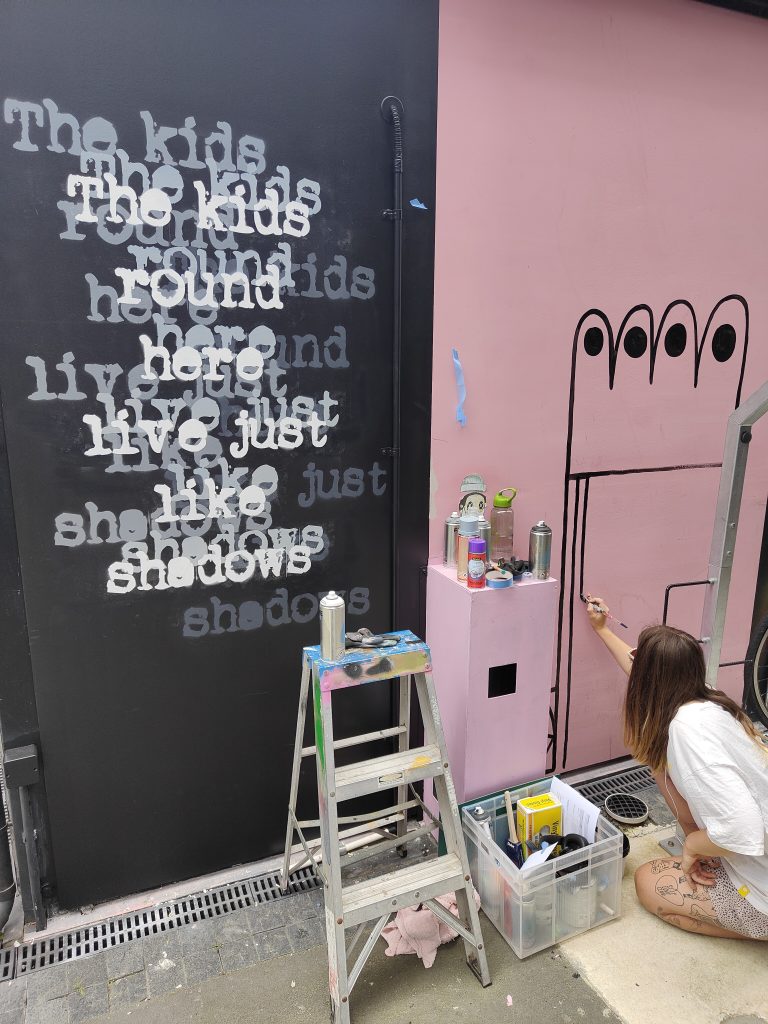
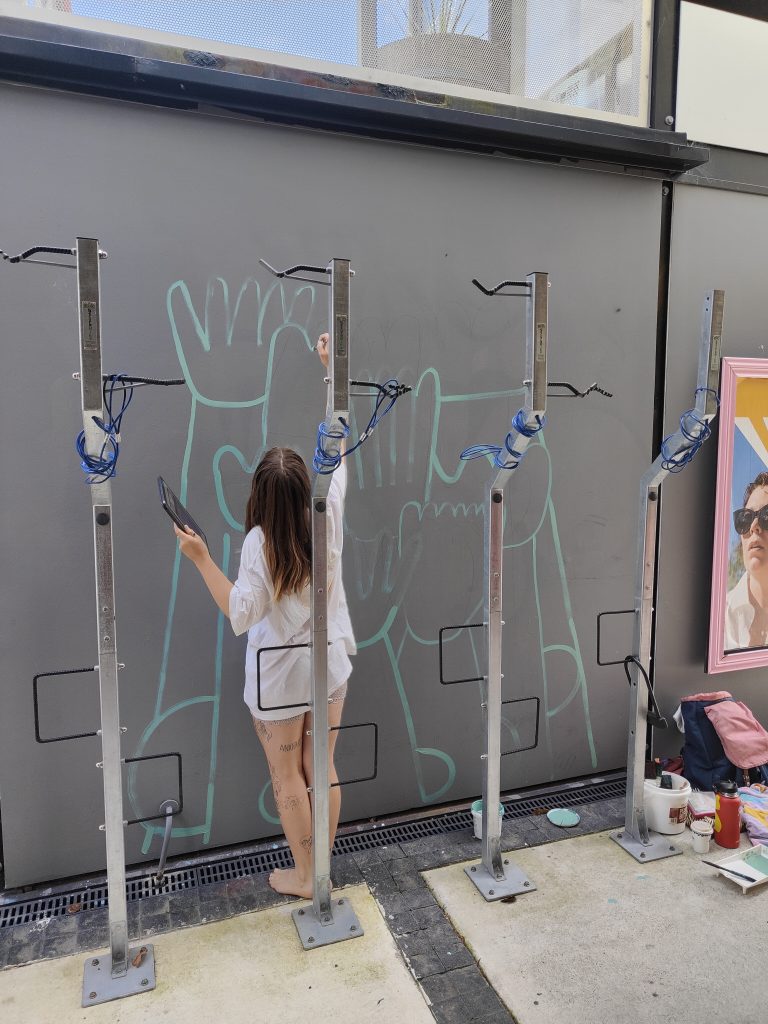
After a week of rain fall and grey skies, the sun returned just in time for a group of local artists to add to the already impressive collection of art on the many panels of the BOXed Quarter on St Asaph Street. Nick Lowry, teethlikescrewdrivers, Bloom n Grow Gal and Bols each brought their own styles to various panels throughout the complex, joining works by Wongi ‘Freak’ Wilson, Joel Hart, Meep, Chile One, Newen, YSEK, Mark Catley and more. Inside, Bols stencilled a multi-layered grey-scale text piece, reading ‘The kids round here live just like shadows’, a line taken from Bruce Springsteen’s epic Jungleland, while Bloom n Grow Gal’s flowers took root on nearby panels, boldly outlined and oversized. On Madras Street, teethlikescrewdrivers played off the existing buff patches to create a colourful swatch of squares and line-work pencils, bright colours buzzing against the rich ochre background. Around the corner, Nick Lowry went big, with a three-panel high piece featuring the evocative image of an eel wrapped around a bone, the background a shift of green tones. Reaching the top of the building, Lowry’s work is visible from far down Madras Street, a new beacon of the BOXed Quarter’s vibrant walls.

Let us know about your favourite new works around Otautahi by commenting on our social media, or send us an email at [email protected]!


Black and White – A Photo Essay by Graeme Russell

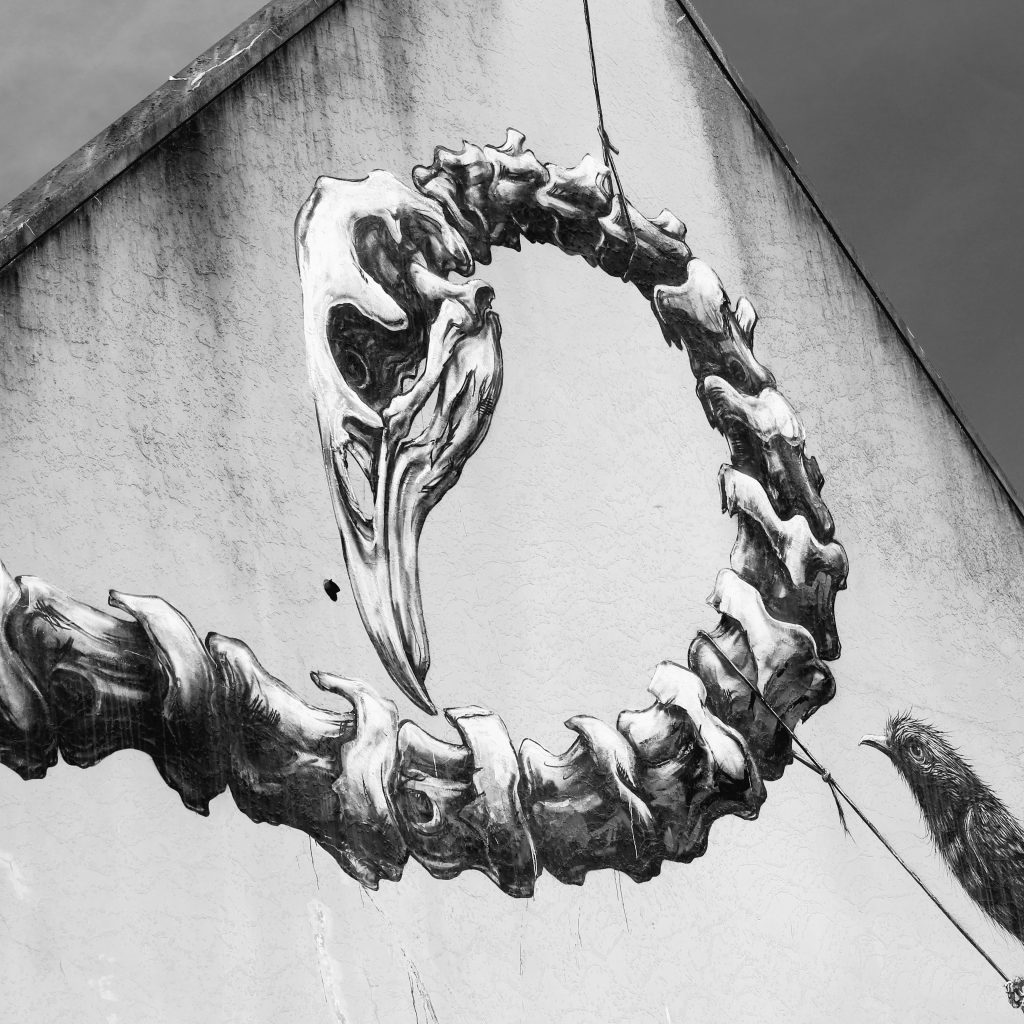
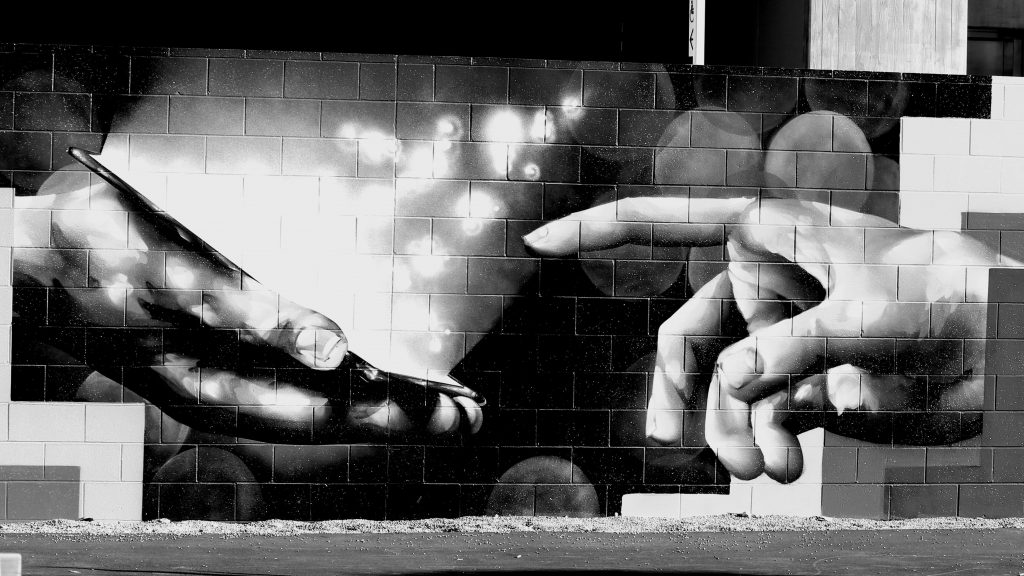
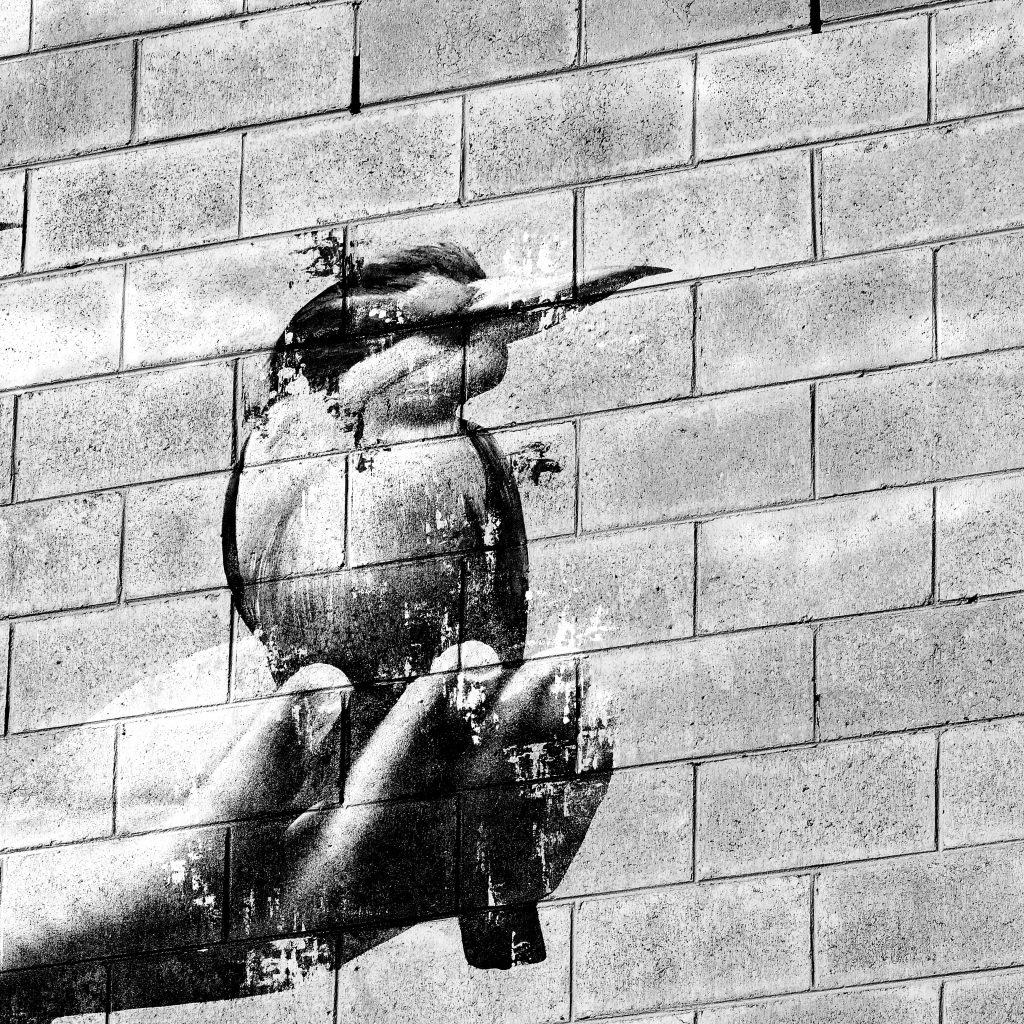
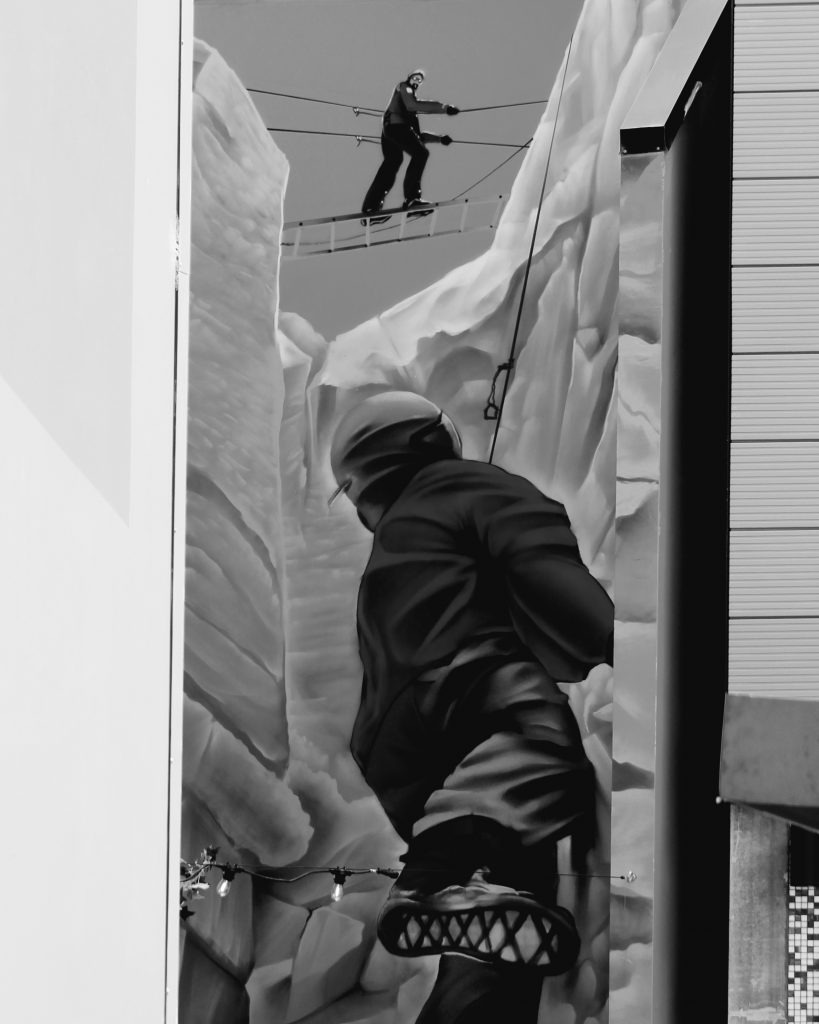
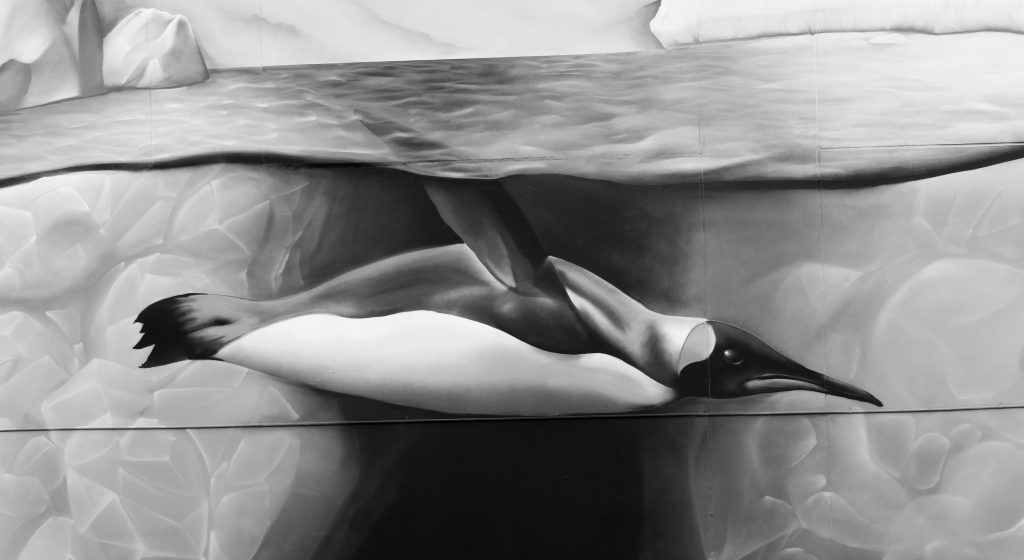
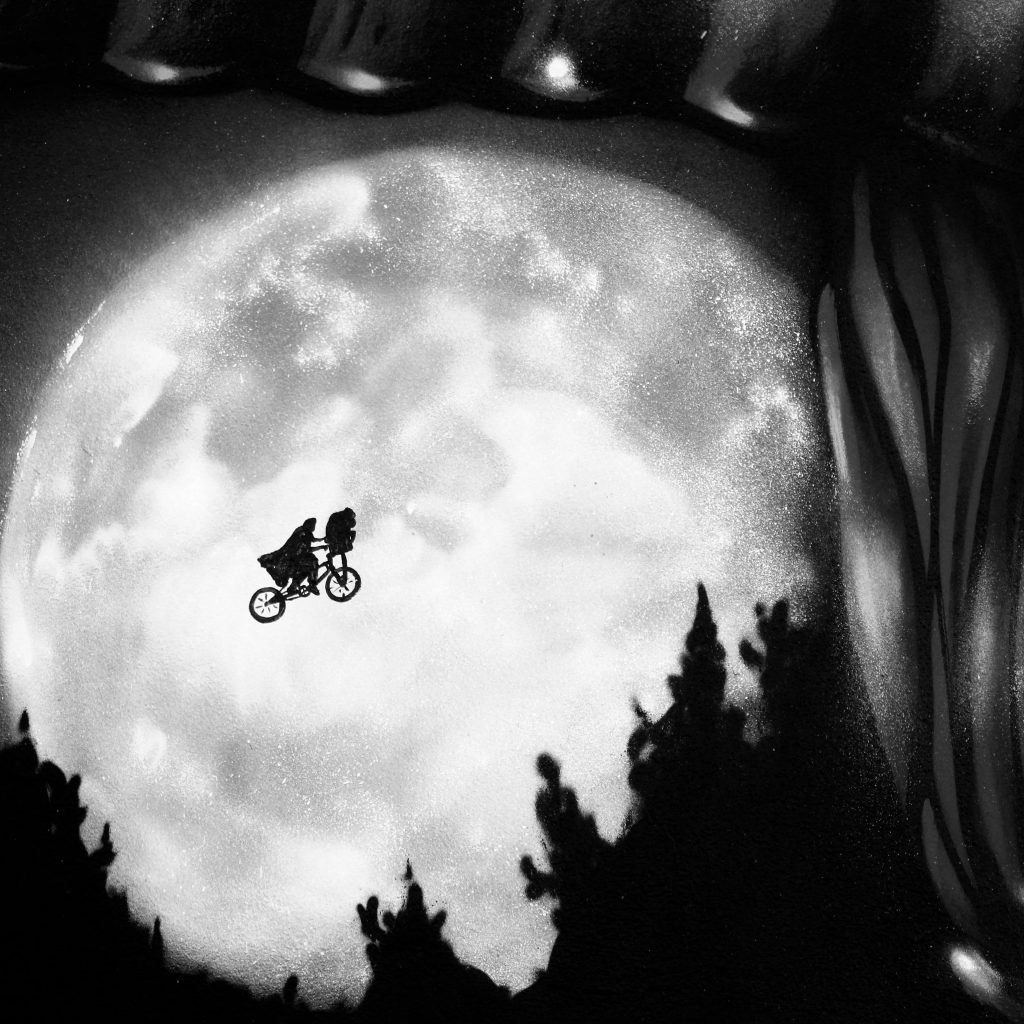
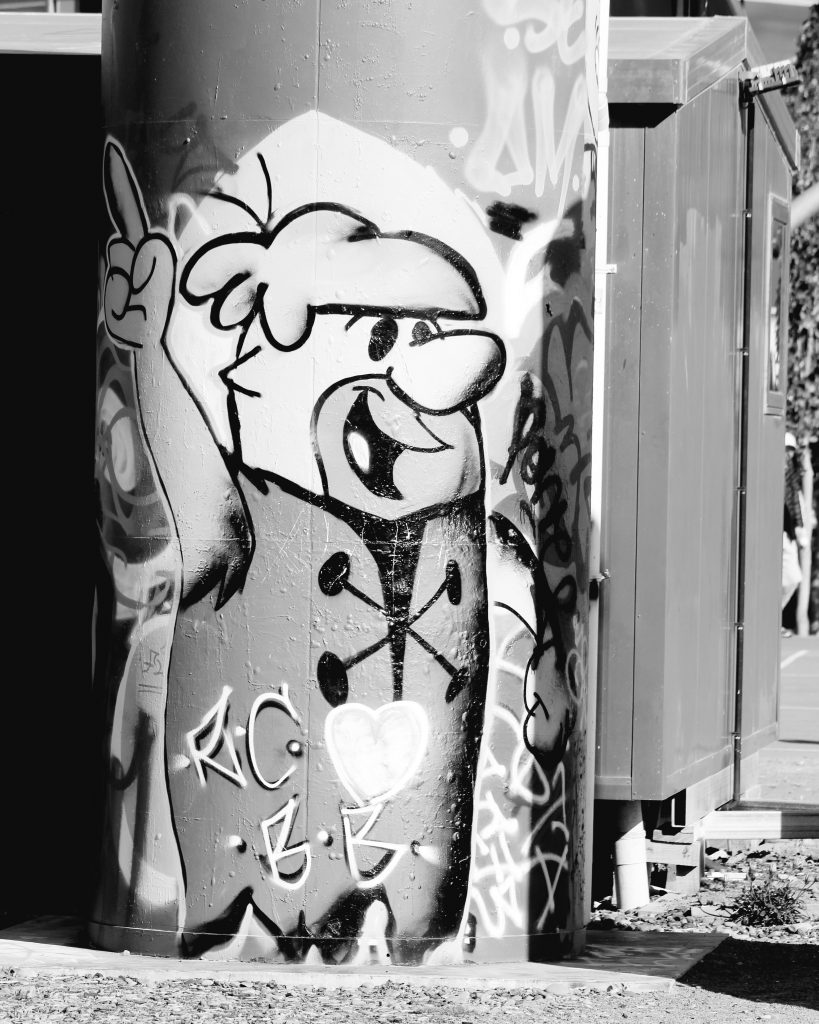
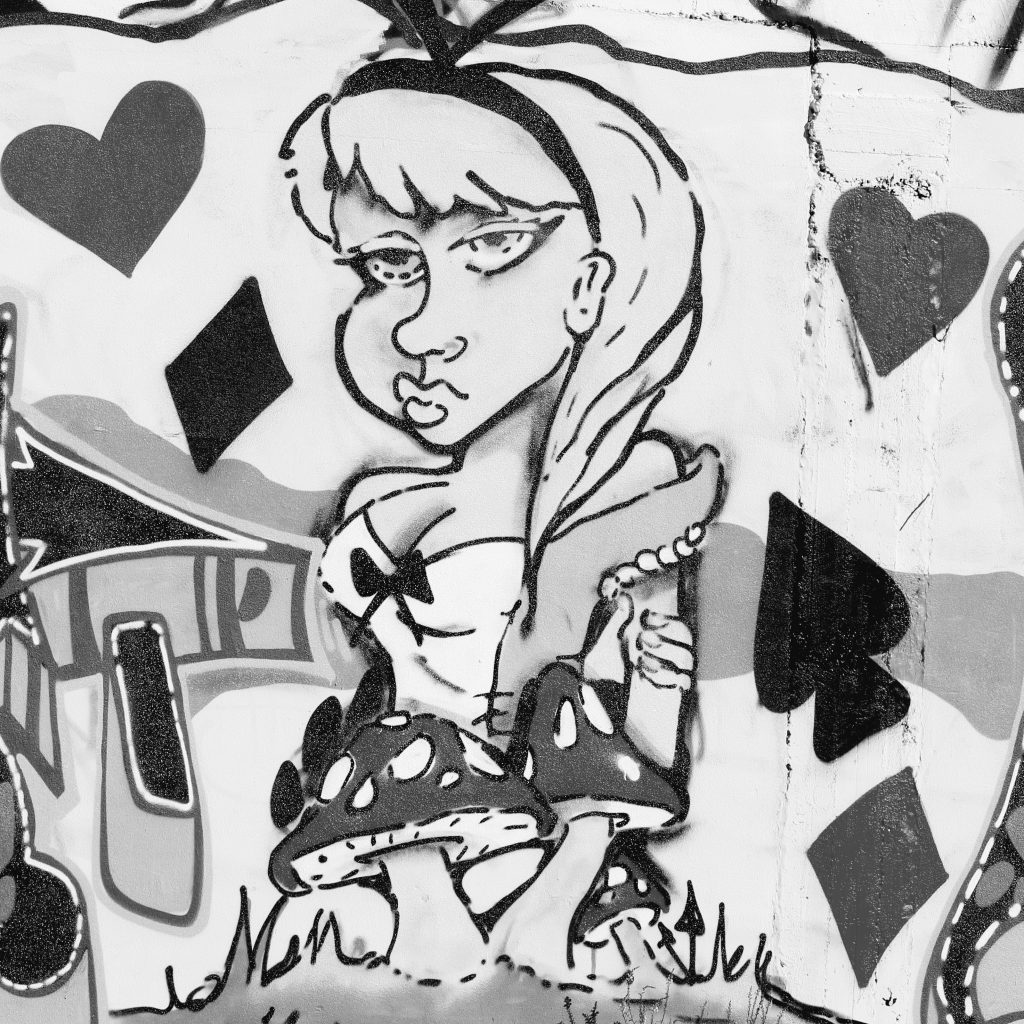
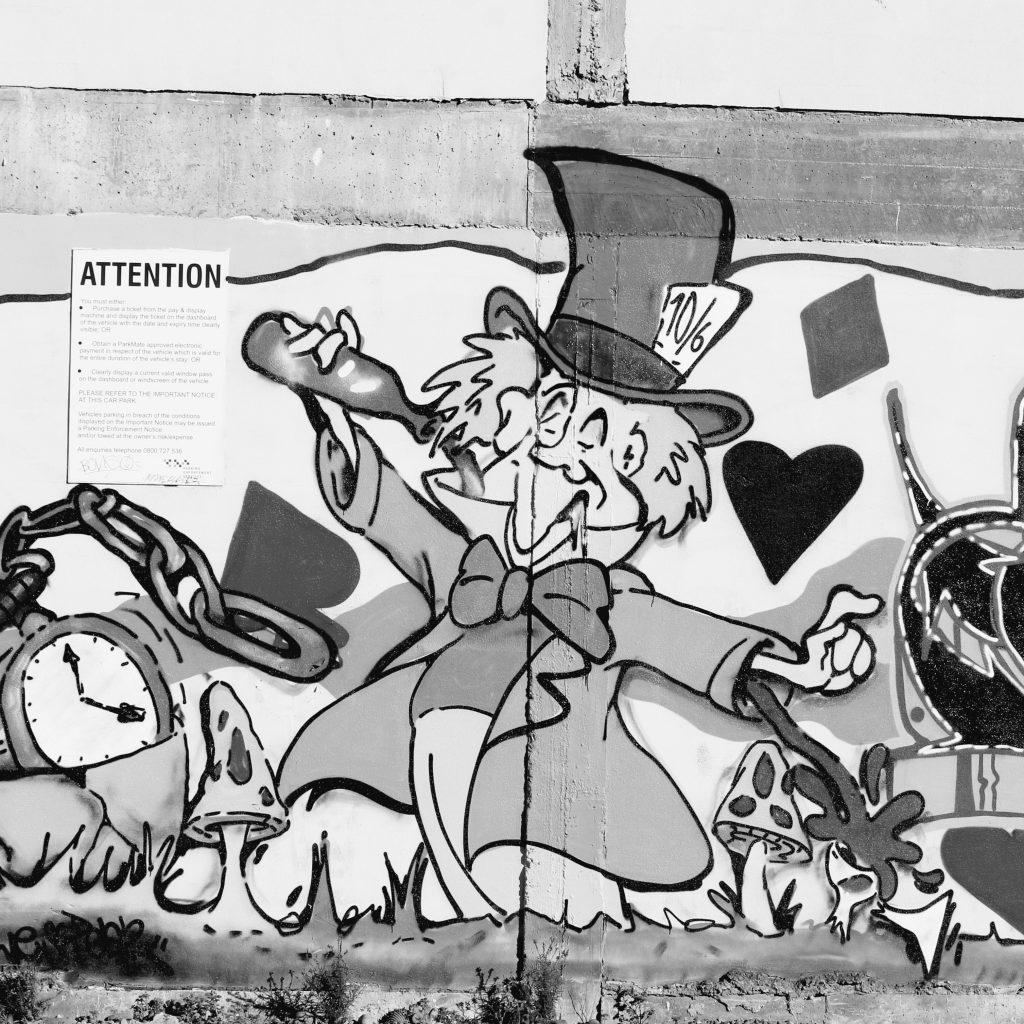
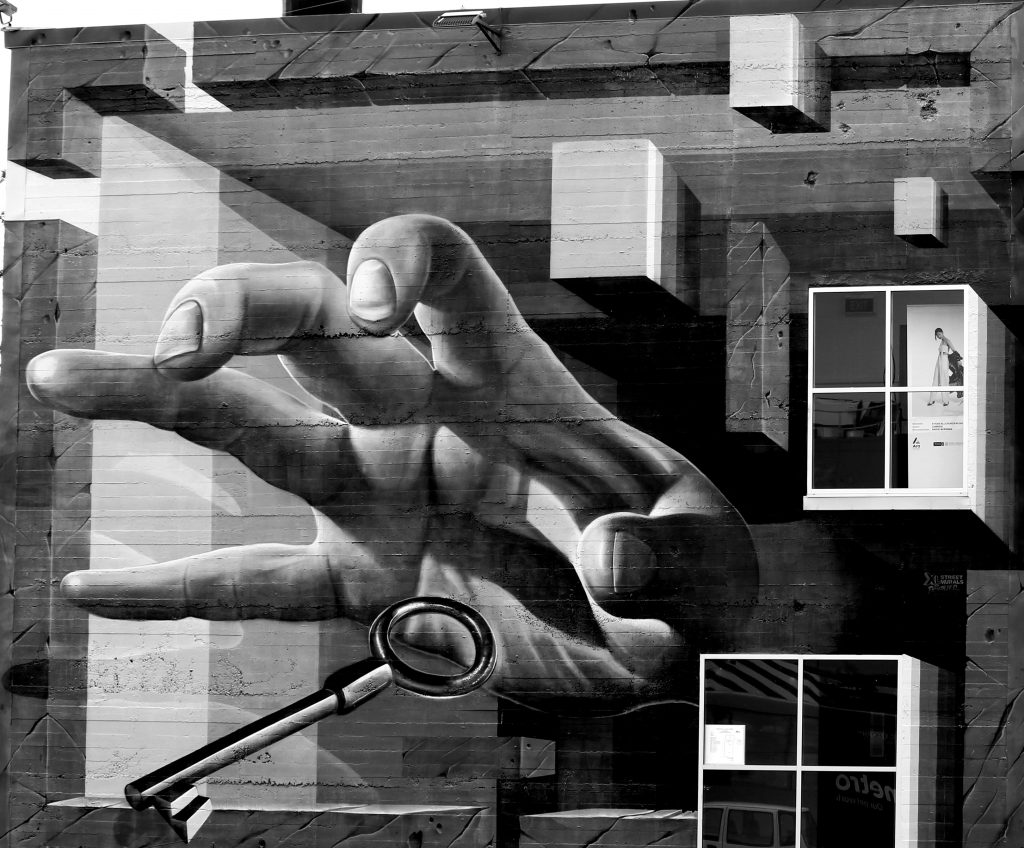
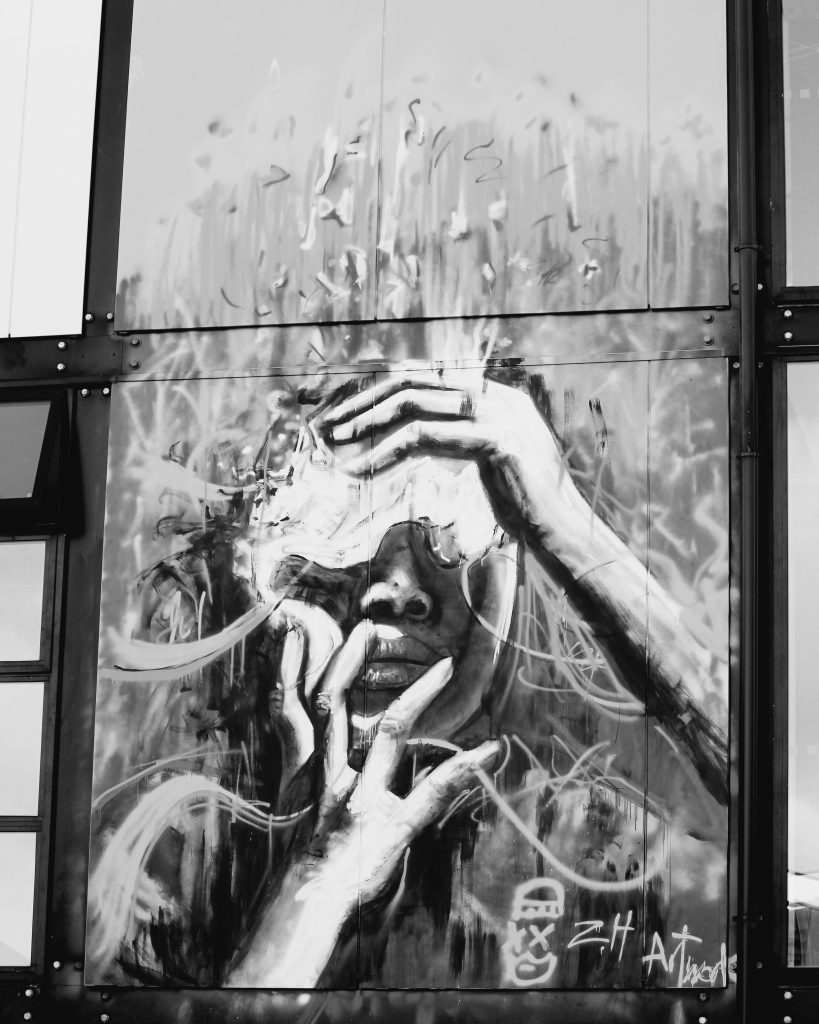
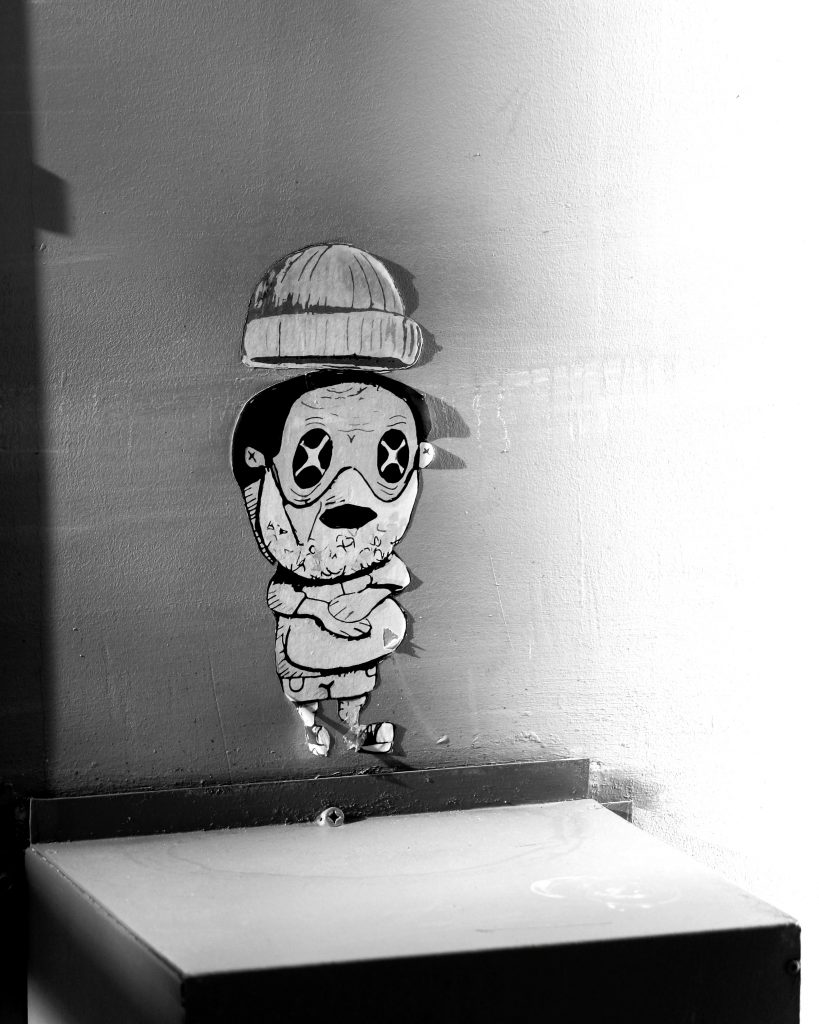
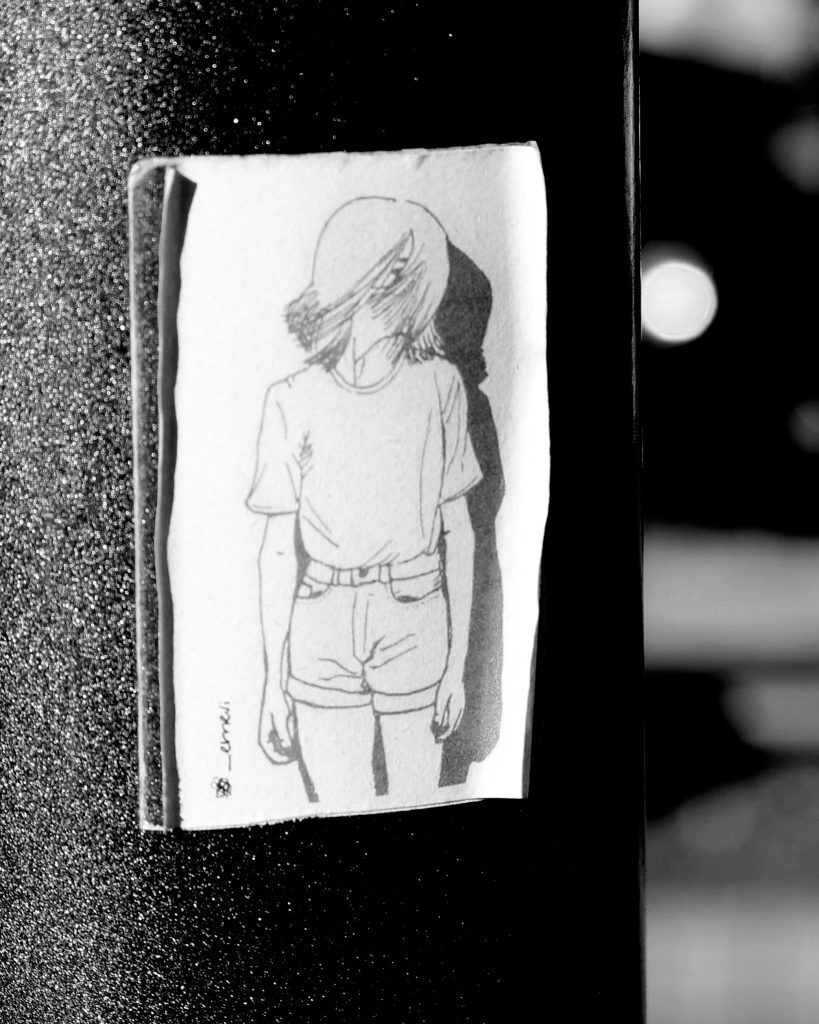
We first noticed Graeme Russell’s photography on Instagram, his striking black and white street imagery bringing to mind the observations of a flaneur, distanced yet right in the heart of the city. Street art has been a recurring subject of his photographs, often exploring close up details, re-framing larger works as disconnected and intriguing snippets. When we asked Graeme if he was interested in putting together a survey of his images as a photo essay, he revealed he was about to move to Oamaru. It therefore made this piece a fitting farewell to a city that the photographer has come to adore for the creativity on its streets…
____________________________________________

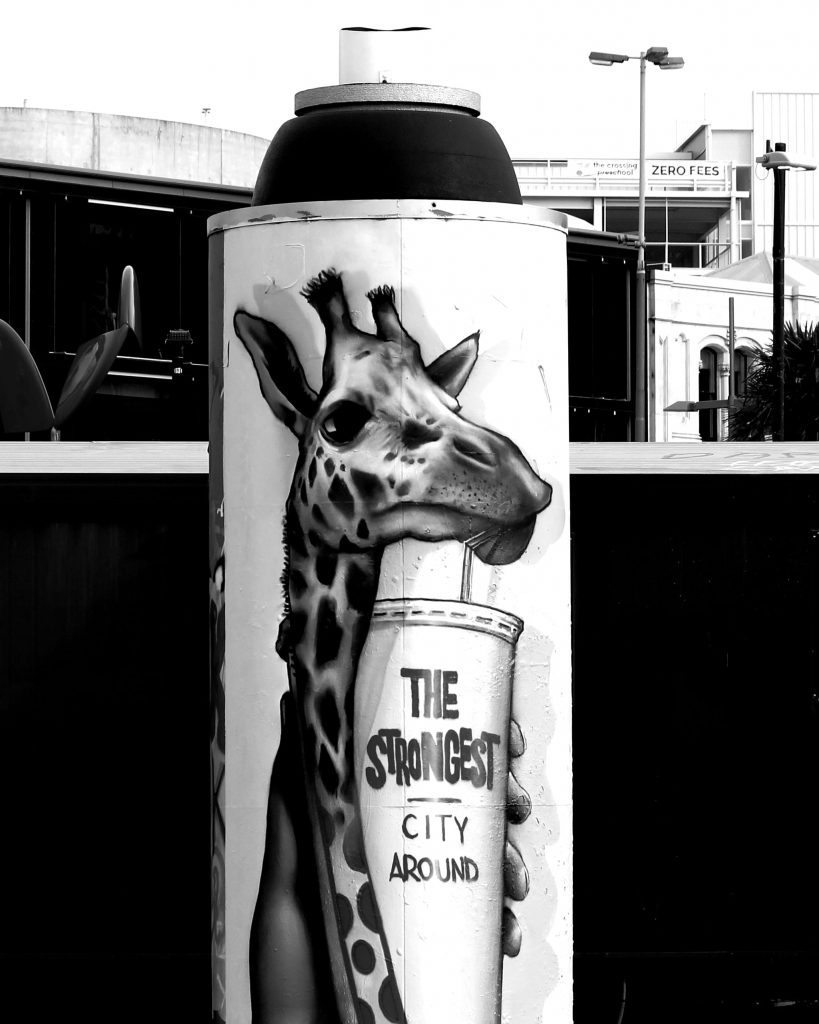
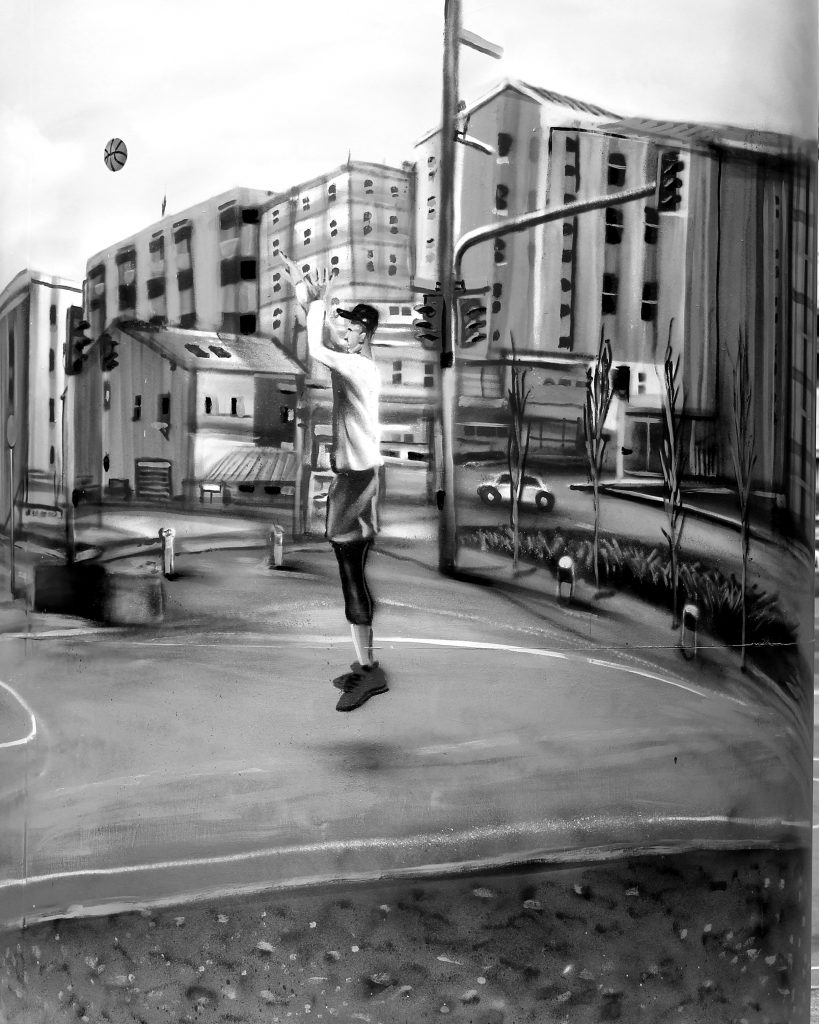
As a recent newcomer to Christchurch (I guess three years makes me a newcomer?), one of the things that I absolutely adore is the vast array of street art around town, it brings the city to life and adds a new perspective to the city. Those behind the art deserve a huge pat on the back. Almost daily I pop out with my camera to capture what is going on in town, what is new on the walls and, of course, on the lampposts.

Seeing something new around town brightens my day and gives me inspiration to shoot. Watching the looks on people’s faces when I’m taking pictures is interesting – they vary from smiles to a look of disgust, people commenting that I am encouraging graffiti.

For those not familiar with the Christchurch street art scene, it’s awesome. It brings the city to life, and every piece around town has a story to tell. So, if you’re in Christchurch or visiting from out of town (or when travel restrictions ease, from offshore), put on a good pair of walking shoes, wander around and take in the work of street artists. It is certainly worth your time!

People often comment about my photos on Instagram, saying that the content is great, and how they wish they had something similar in their town. I truly believe we need to get out there and encourage local artists to get to it and start producing art to liven up the streets of towns around the country.
So, what images have I taken that I want to share with this post? Yikes, I guess sharing 12,000 images isn’t possible, so here’s a small sample for your viewing pleasure…

P.S – Since being asked to contribute to this blog, I have moved to Oamaru, so I guess this is both a welcome and a farewell post. Thank you for the opportunity and an even bigger thank you to all the street artists who have enriched my viewing pleasure around Christchurch.

Follow Graeme on Instagram and keep an eye out for more photo essays!

If you would like to contribute a photo essay, drop us a message on social media or email [email protected] 

Street Treats, Vol. 6

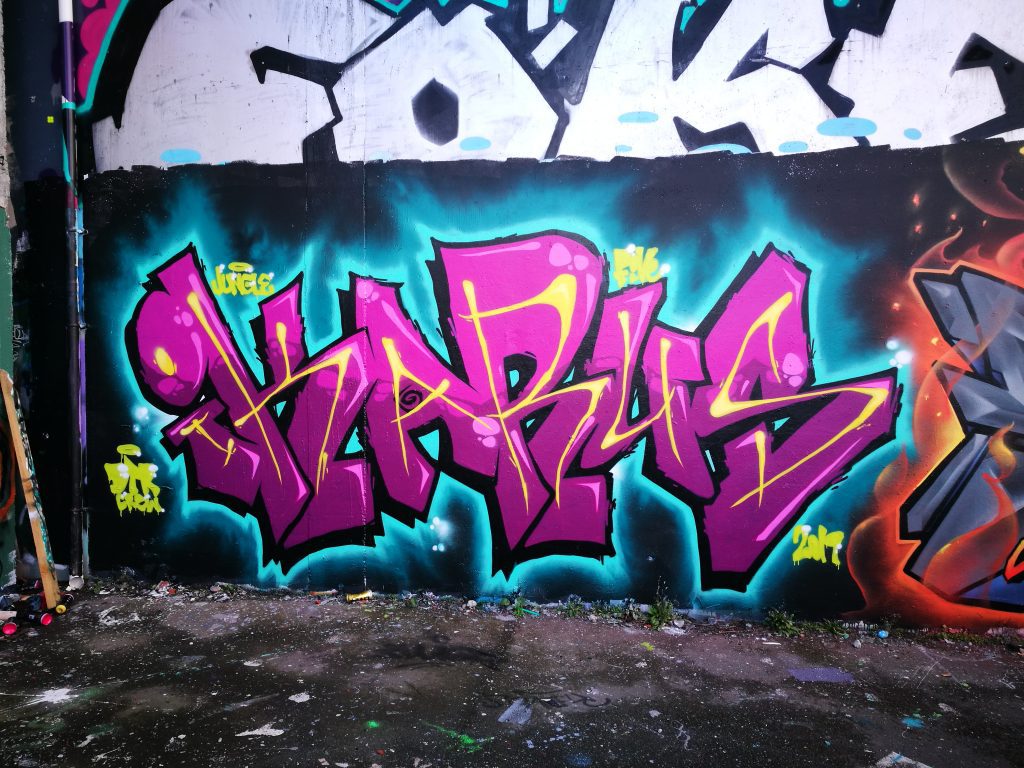
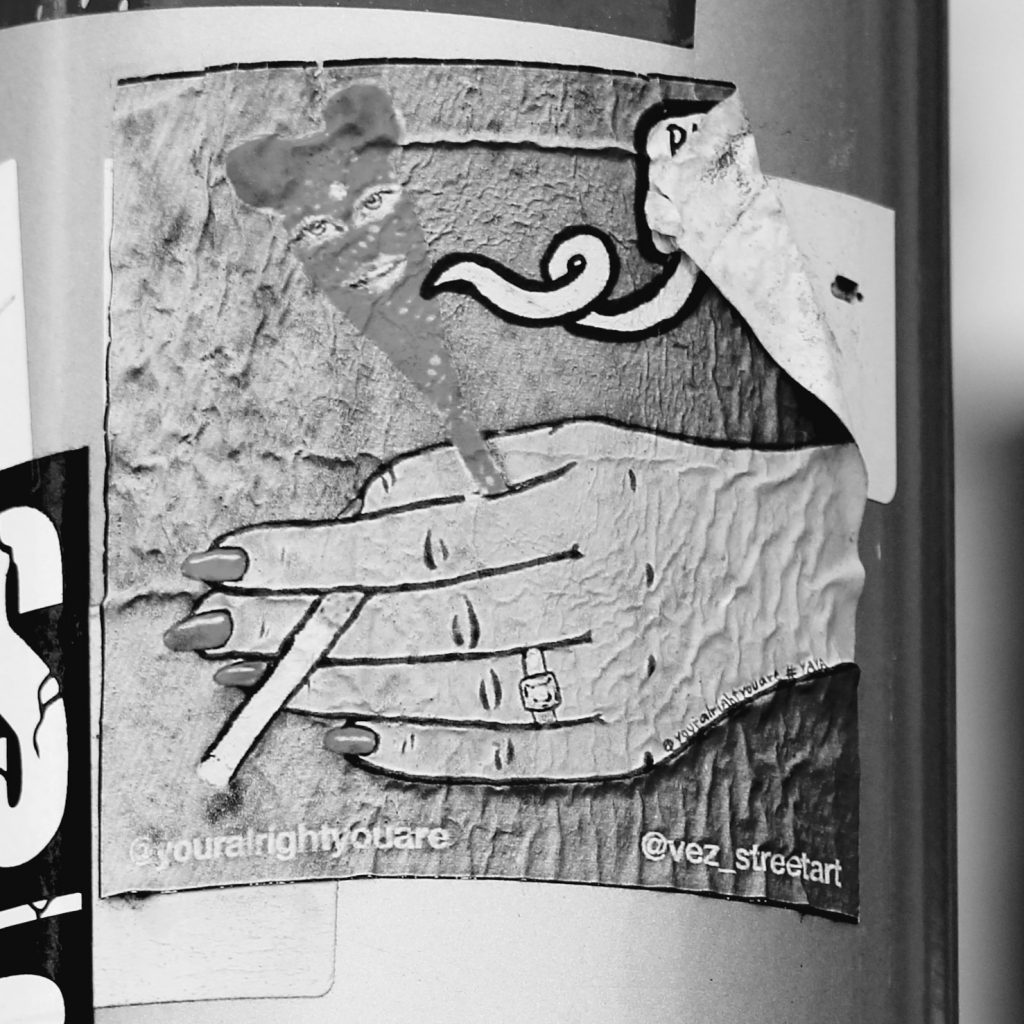
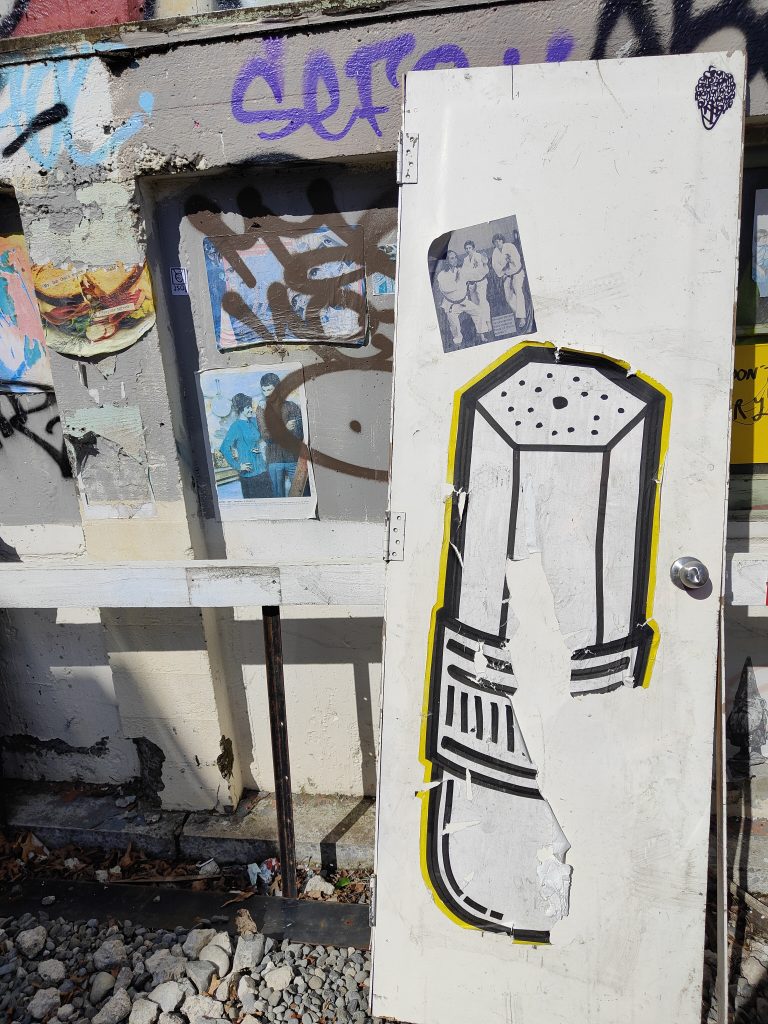
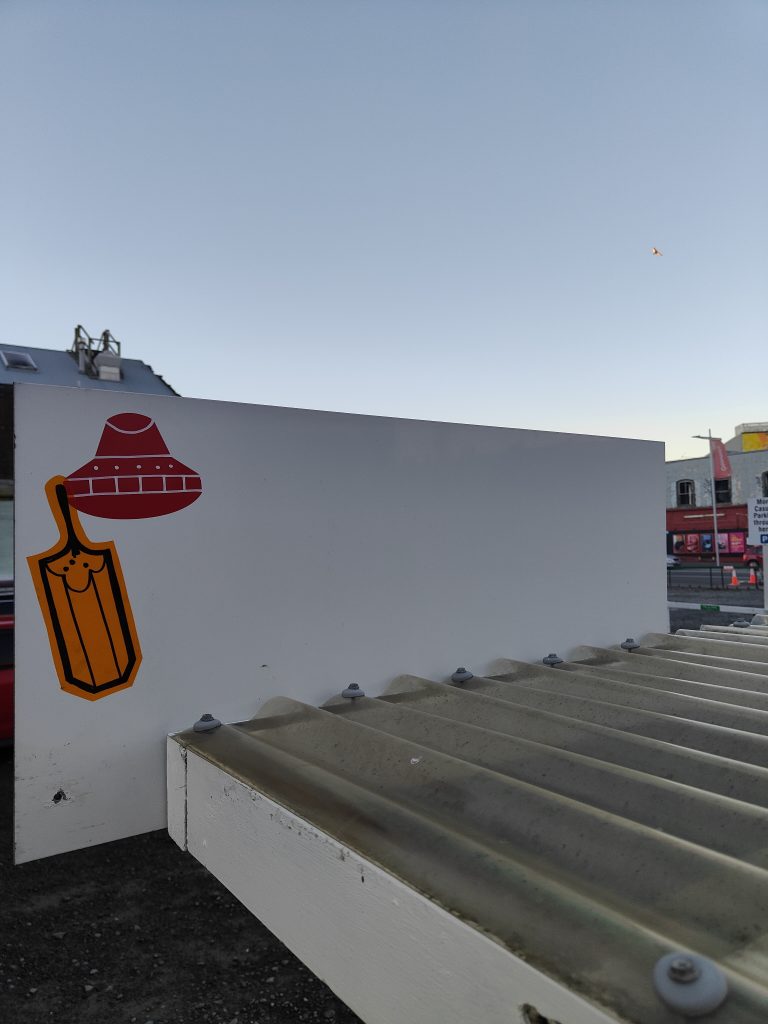
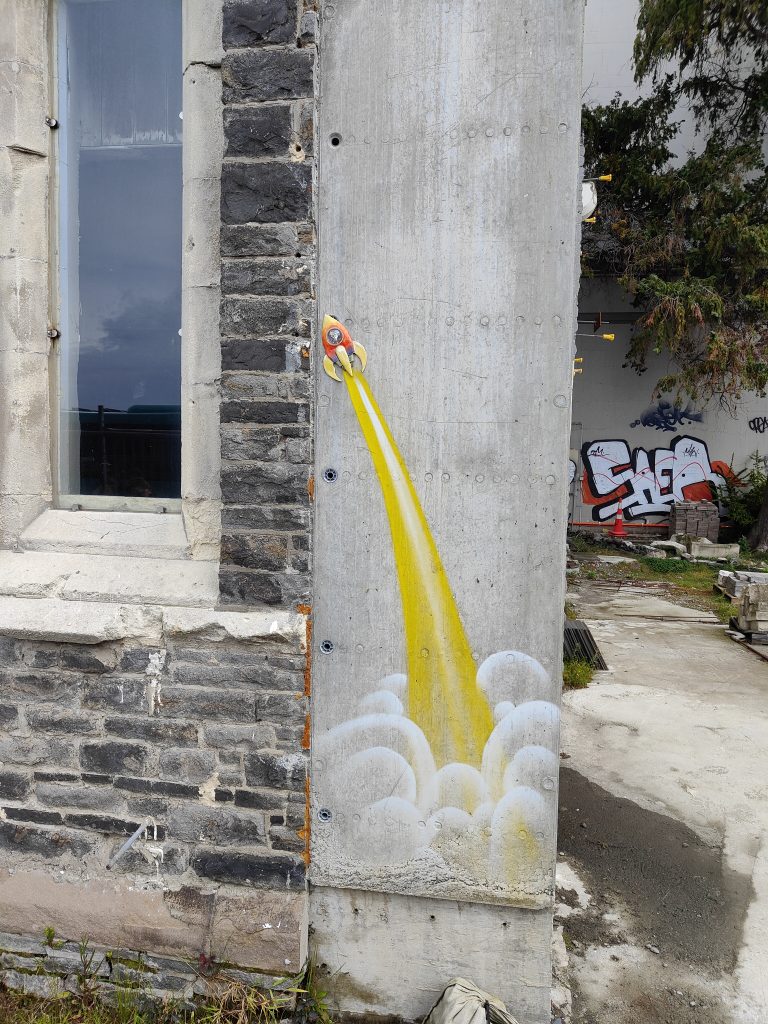
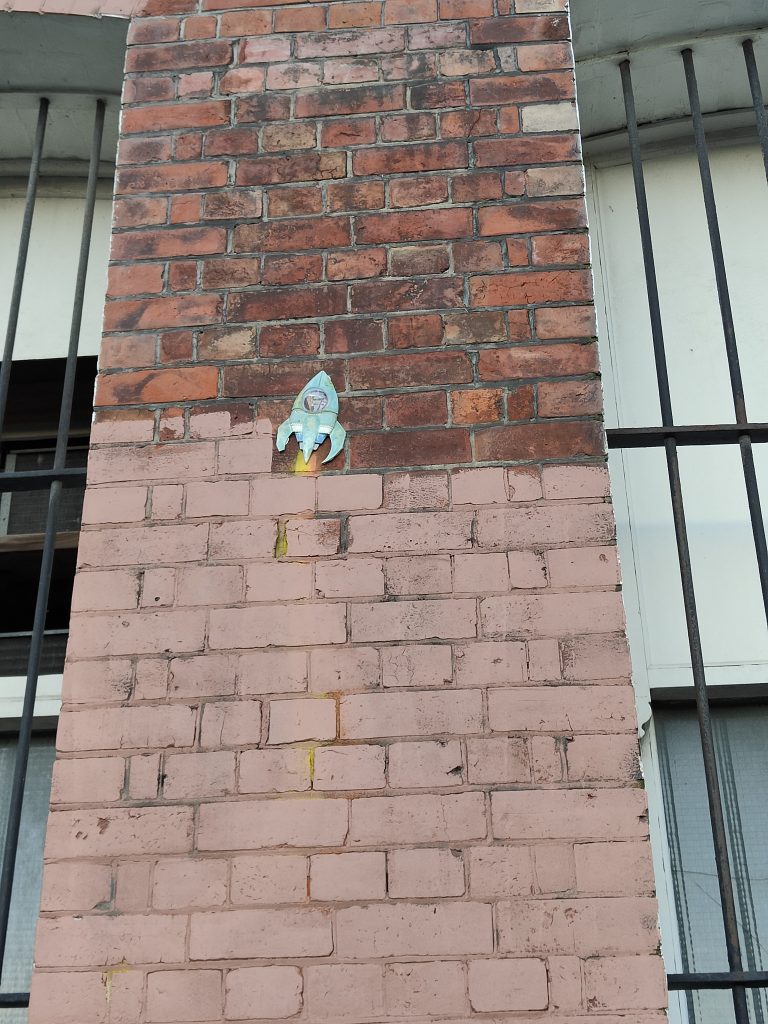
It has been a while since our last Street Treats edition, in part due to the lock-down situation, but even as we all play catch up on the livelihoods that were put on hold, the streets were a fascinating site to explore with the range of expressions and interventions to be found. This volume of Street Treats features a cacophony of diverse forms, and rather than dealing with explicitly political messaging, they are affirmative and declarative and playful, inherently meaningful concepts in a time where it is easy to feel invisible and somewhat powerless. Graffiti is a strong presence, bursts of colourful existential expression, bound by certain conventions but constantly searching for ways to stand out. The examples here run the gamut of styles and modes of production (some are legal, others not so much), but importantly they speak to the game and represent both a here and now and the countless numbers that have come before, a lineage of urban commentary. The repetition of other, non-signature forms lives up to the concept of post-graffiti, like characters, pencils, flowers and rocket ships, these symbols are both as mysterious as calligraphic tags, and yet also familiar and therefore more approachable. They share the idea of proclamation in the public realm, but are perhaps satisfied with intrigue rather than alienation. Why do so many find it more challenging when someone boldly writes their name than the positioning of an iconographic proxy to do the same job? Is a name a more confrontational and confident vessel for expression? Regardless of your take, the effect is the same; the city speaks, quietly, loudly, in whispers or in defiantly boisterous screams…

Stay tuned for more Street Treats soon!

If you have any corrections for the credits above, let us know in the comments!

The Paste-Up Project – ‘Community, Collaboration and Connection’ by teethlikescrewdrivers

The Paste-Up Project is a collaboration between Watch This Space, Phantom Billstickers and a selection of Ōtautahi’s finest paste-up and poster artists. With support from the Christchurch City Council, one of Phantom’s Manchester Street bollards has been transformed into a paste-up art installation space for the next 12 months, with local artists commissioned to push their work in new directions with a three-month takeover. The Paste-Up Project bollard serves as a supported platform for one of urban art’s most enduring forms and for the long historical lineage of urban postering (just ask Phantom!), with artists enabled to grow the scale and material qualities of their work within a setting that will challenge the perceptions of an ephemeral form of art.

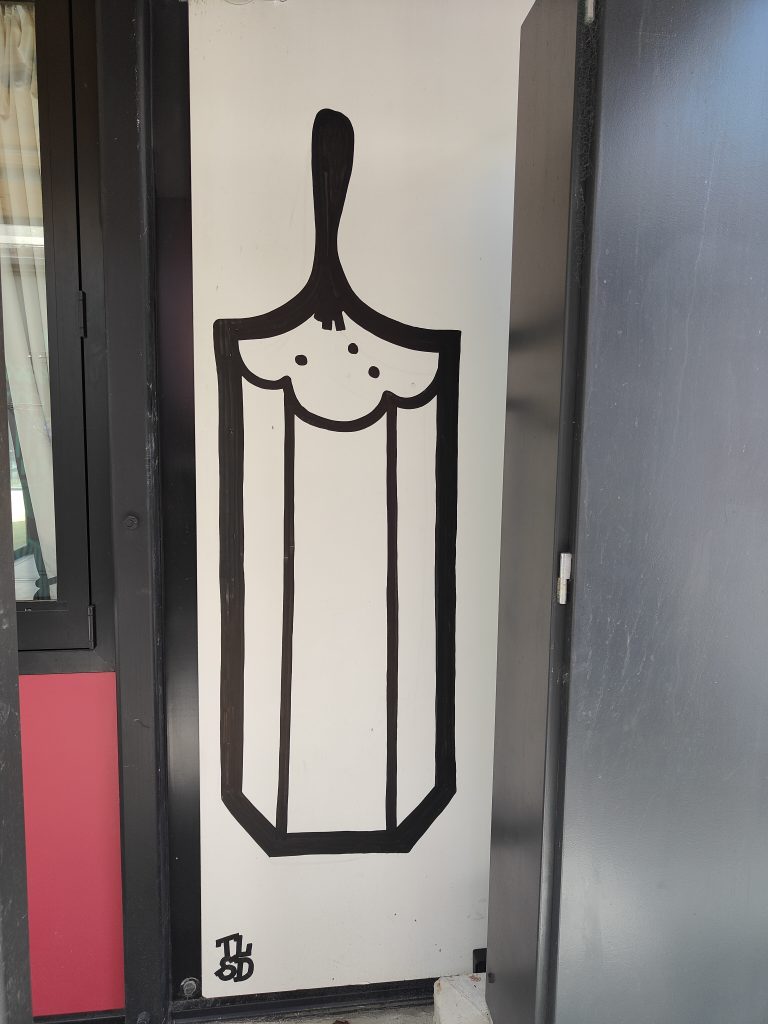
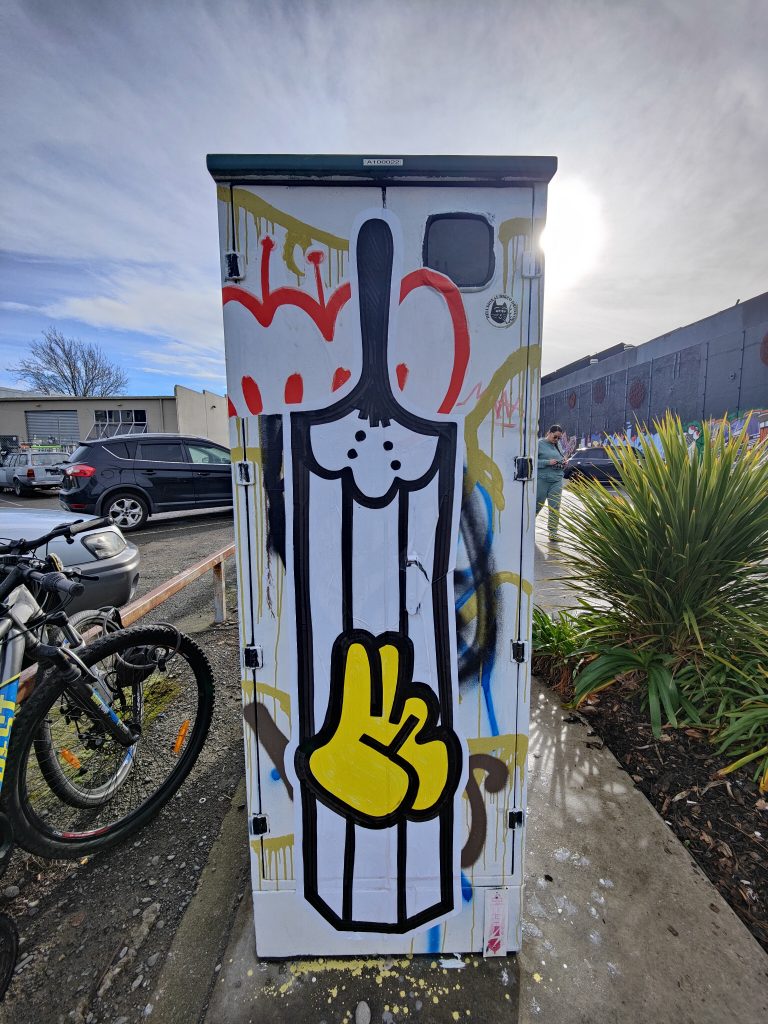
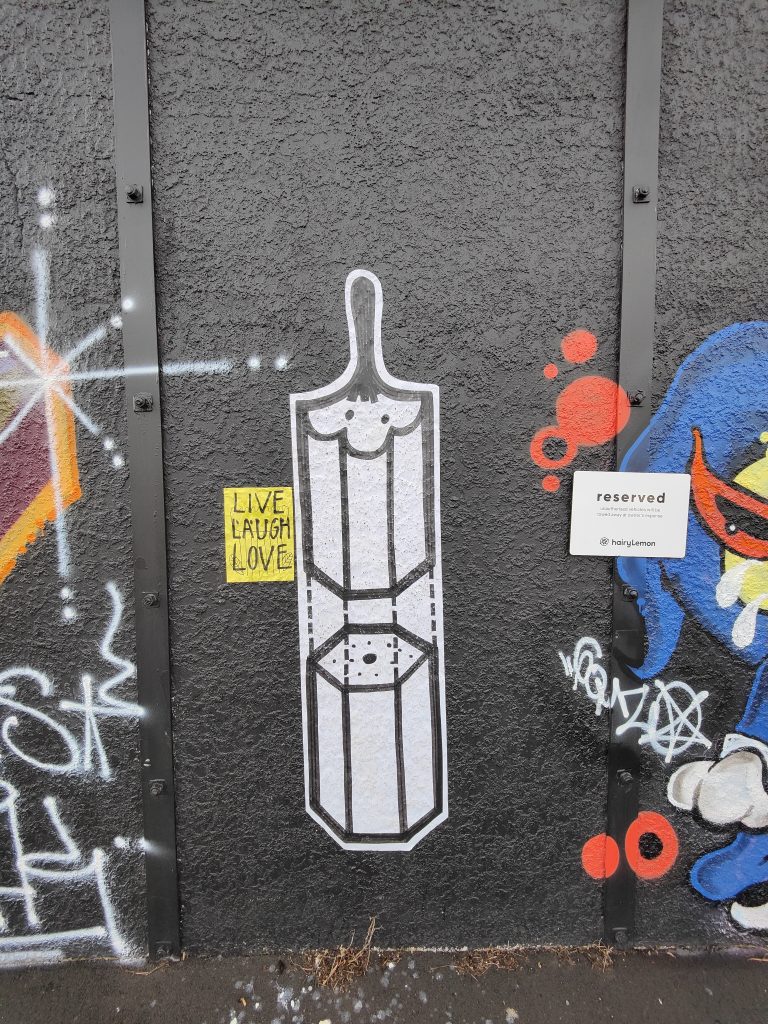
First up at bat is teethlikescrewdrivers, an easy choice really as he is the driving force behind SlapCity, the loose collective that has embraced the potential of stickers and paste-ups across Ōtautahi. His instantly familar, yet continually beguiling pencil icon has become a recurring feature of the urban landscape. The simplicity of the image opens up a range of potential readings, and yet requires none, it exists, it is, and that is enough. More notable for the Lyttelton artist, is the sense of collaboration and community that his urban art adventures have instituted – from online mash-ups to weekly meet ups to explore the city, teethlikescrewdrivers constantly strives for connections and in doing so has created an expansive network of disparate, yet kindred spirits who see the urban landscape as one of play.

His installation for The Paste-Up Project embraces these ideas, celebrating each in a segmented yet cohesive production that will be on display for the next three months in central Christchurch. Of course, the pencil is the star, refashioned and re-formed across the circular base, and in doing so speaking to the various personalities who have inspired, influenced and embraced the artist’s signature form. But that’s enough from me, let’s hear from teethlikescrewdrivers as he explains his installation…


Photo Credit: Linda Glasgow

For the two people who don’t know you already, introduce yourself…

Hi, I’m teethlikescrewdrivers and I draw pencils.

I will admit that there was really no other choice for the first artist up for this project – what was your take when we first discussed the concept?

Really? Oh man.

Initially I was doubtful, mostly of myself! I couldn’t really think of anything other than doing bigger pencils and I wanted to give the space something it deserved. I’m fine with doing more pencils, but it wasn’t really bringing anything new to the table. After a few discussions with people and reading the brief, I started to think more about the possibilities it offered someone who usually only does one thing.

It is a surprisingly big space, how did you come up with the concept to fill the bollard and what incarnations did you go through?

I was going to just use it as one giant nine metre-squared canvas. After a few visits with a tape measure and some really basic planning, I decided to divide it into small, medium and large ‘panels’. This then made me start thinking about three themes. It kind of rolled on from there.

Your piece is titled Community, Collaboration and Connection, and it reflects the various elements that form such integral components of your experience in the world of urban art, how does each section relate?

After I settled on three panels, the themes were easy. I wanted to highlight paste-ups as a medium and have the chance to play around with that, I wanted to introduce more of the international sticker and paste-up community to Christchurch and I was always going to give our SlapCity family some love. I had to measure up pretty accurately for the community one, just so the pencil slotted in. The collaboration panel used the Vermin poster (Vermin is an artist from Manchester in the UK) as a starting point and then I just filled in the space like a sticker bomb. The big connection wall I had a rough idea for…kinda . I figured if I turned up with all the stuff I had, made and cut pastes on the spot and used posters salvaged from clearing the bollard something would happen. I just started throwing up stuff and discovering gems!

Photo Credit: Linda Glasgow

You got to play around with some cool material concepts, from large scale pastes to smaller overlapped pieces and of course the tearing away of layers, tell me more about each of these ideas…

Firstly the  bollard is bloody ginormous, so I knew making three-metre tall pencil was going to be a struggle and would basically cover a whole panel. By splitting it I was able to physically manage it and still give a chance for the stuff behind to be seen. On the connection wall I really got to play with all the layers; negative spaces and using cool materials such as the old posters and wallpaper. On the second day I came back and started tearing into the layers from the day before, I really enjoyed that element of the process. I also really liked making my own wallpaper and giving the whole thing depth.

You spent a sunny weekend on the bollard, what was it like to have the time to explore the ideas you had developed – it must have been a new experience compared to the missions with friends. Did you find it still quite communal? I imagine it was like a mural painter – do you have any interesting stories of people stopping to chat or asking questions about what you were doing?

I kind of set up camp for the weekend, it was ace. I had a picnic table for drawing and cutting paste-ups, a speaker playing music, my car right there and my shit spread out all over the place. It was ideal! I had lots of good chats with passers-by about the bollard and my car; both great conversation starters. Having the time to step back really helped the big panel come together. That one is more artistic, I guess, it’s less about one piece and more about layers and how they fit together so time helped.

Oh, I almost got signed up to the Peninsula Trampers Club by one old fella who I had a good chat with! Did you know there are a whole bunch of boulders like the ones at Moeraki, but in the streams inland!? You do now!

My whanau popped by and I had a lunchtime beer with a bunch of mates and lots of people came and hung out. It was like a paste-up Glastonbury!

What were some of the challenges you faced? It is obviously not a traditional flat surface…

The wind and the physical size of the paste-ups were the big ones. But because I had time I was able to leave stuff and come back to it, or think my way around it.

What are your hopes for The Paste-Up Project, not just in terms of your own installation but as a concept? Do you see it as a way to change perceptions, or at least the visibility of paper art in Ōtautahi?

I hope it opens the door for more artists to get their stuff up. There is a real delight in putting your work up in the streets rather than in a frame or on Instagram. Having a dedicated paste-up ‘show’ really lets people see some of the more established artists’ work and hopefully inspires others to get out there into the streets with a bucket and brush or just a pocket full of homemade stickers. Down the line I would love to see this kind of collaboration move into different towns and cities.

You have developed a web of connections around the world with artists through collabs and trades, and many are featured on the bollard, have you had any responses from those people overseas yet? What have the responses been like from the local scene?

Instantly! The collab wall was really just a huge collab and mash-up sticker bomb and everyone is always stoked to see a bit of their work in one, especially way down here in Christchurch. I think there are mash-ups and collabs with over 50 artists on that panel; everywhere from Brazil, Russia, most of Europe and even just down the road.

I’ve had comments from people about how well my pencil scales up, this was a good test for that! I was really stoked with the Vermin collab, it looks epic as a huge poster and you can really appreciate all the details. I was also really pleased to get work up in New Zealand from good friends from overseas.

Do you hope this is just the start of more opportunities like this, and if so, do you have any ideas of how it might be harnessed?

I really hope so. I would love to see sticker and paste-up walls as part of the ‘street art’ scene alongside graffiti and murals here in New Zealand. Maybe down the road a sticker and paste-up show? It would be amazing to see some dedicated paste-up walls or permissioned spaces in the city. Personally, I’m going to keep doing what I’m doing and see where it leads me.

While the weather was perfect for installation, it rained heavily just a day later, what impact did that have and were you philosophical about it?

I think putting a layer of straight-up PVA onto wet paste last thing was a double-edged sword. The next day the whole thing was covered in white streaks and all the paper was still really wet, I thought I’d knackered it! But after a while it dried clear and I think will add a bit more protection in the long run. The good thing about all paste-ups is you can always add more layers. If it all falls to bits over the next few months I will just go and tear a bunch off and add more.

Who do you want to shout out?

Watch This Space, Phantom, the Christchurch City Council, the SlapCity family and all the amazing venues that have let us use their spaces over the past two years. All the artists here in Christchurch who paved the way and have got us to a point where a project like this can even happen. My whanau and all the rad artists who have let me use their art for mashups or who have taken my pencils and messed with them.

Follow teethlikescrewdrivers to see what he gets up to next, and keep your eyes and ears peeled for more about The Paste-Up Project on our channels!

Oh, and get down to the site on Manchester Street to see this amazing installation in the flesh!

Tune! with Bols

Tune! is a brand new series where we ask artists about the importance of music in their practice. For many creatives, forms of art overlap and provide incredibly important influence, whether it is those who are multiple threats (you know, the amazing musician who is also an incredible painter), or those who admit to the vital sustenance consuming one form has on their production of another. Music and visual art or object-based art have a long entwined relationship, from bands formed at art schools to iconic album covers, or even the idea that a fully formed creative eco-system is vital to any subculture, such as the four elements of hip hop. So, here, Tune! allows us to create an ongoing eclectic playlist of music to make art by…

For this edition, we hear from local stencil artist Bols about his failed dreams of rock ‘n’ roll stardom, how his tastes vary and what music he listens to while at work…

____________________________________________

I was nine when my parents gave me a cheap guitar and I started lessons. Unfortunately, I showed neither an aptitude nor a willingness to practice and after just a handful of lessons my fledging path to superstardom came to an end. Yet, I never completely gave up that faint dream of somehow writing a song that would change the world, I just made sure I didn’t tell anyone until now. I cringe when I say this because it is such a common response, but I have diverse musical tastes. It might seem weird, but I love abstract painting and sculpture, but musically I have always connected with songs with potent, evocative, cinematic storytelling rather than beats, whether that is edgy alternative, soundtrack indie, conscious hip hop or even morose alt-country. I was probably the wrong age for the rise of electronic music, that was the domain of the nerdy kids who knew something the rest of us didn’t. I have always appreciated the way music can evoke a spectrum of emotions, I like nothing better than a song that makes me sad. Music connects with a time or an event in my life and as I get older that becomes even more powerful (there is a line in a song, When You’re Ready by Brian Fallon, where he talks about watching his daughter colour in while wearing new pyjamas and it gets me every time), it might be in the way it makes me feel, it might be because I was listening to it whenever, but my life has played out to a soundtrack. I tend to think of my art in musical terms, from perfectly phrased lines to more abstract lyricism. I find inspiration not just for ideas but also for a call to action to work as well. There are a heap of artists I could have included, but for now, here are a handful of songs that inspire me…

Lord Huron – Twenty Long Years

This album, Long Lost, is on high rotation right now and this is my favourite song from it. It has an old-time feel, with feelings of regret in a last guy at the bar vibe. It’s lonesome and romantic: “I gotta find a way out of this mess, I’m in trouble and it sure looks bad..”

Bruce Springsteen – Jungleland

Springsteen is not everyone’s cup of tea, but this song pretty much sums up my creative outlook – it’s cinematic, it’s romantic (“kids flash guitars just like switchblades”), it’s sprawling, it’s escapist, it’s epic (“the street’s on fire in a real death waltz”), but it is also relatable in a strange way. I rise and fall with the tides of this song, and always seem to find some new line that resonates – I feel like every time I hear it, I scramble for a notebook thinking there is some way to add that to a work…

Big Thief – Not

I discovered Big Thief when I heard the album Capacity and was immediately smitten. I was one of those people who raved about them every time I got the chance. I had tickets to see them in Auckland, but Covid. Not is still the track that stops me in place – it has an urgent energy combined with evocative lyrics that have me singing along while trying to unlock what Adrienne Lenker is saying…

Frightened Rabbit- Keep Yourself Warm

I heard Frightened Rabbit’s Swim Until You Can’t See Land first, and I loved it, but when I listened to their second album Midnight Organ Fight, it was stuck on repeat for months. The whole thing was so relatable and anthemic. It ultimately took on even more meaning with the death of Scott Hutchison, the leader of FR. Keep Yourself Warm is a cathartic song written in Hutchison’s style of witty self-deprecation that is also affirming, it is vulgar and yet uplifting. The version by The Twilight Sad after Hutchison passed is heart breaking and cathartic.

Aesop Rock – Blood Sandwich

My taste in hip hop stems from Public Enemy and follows a path through Arrested Development, The Roots, BlackStar, Common, Brother Ali, Atmosphere, Doomtree and of course the verbal master Aesop Rock. Blood Sandwich is just amazing song-writing and makes me want to wrangle words, Aesop evokes eras and moments in such visceral quality it is hard not to feel present in these events: “Can you even imagine a death in the fam from industrial fandom?”.

Reigning Sound – Stick Up For Me

I’m a fan of that guitar-driven British R’n’B sound, I think it comes from my Dad who with some mates ran a nite club in Christchurch when he was younger with a house band in the style. It is the grimy sound and energy that hook me, with this a particular favourite from the mid to late 2000s revival… It is a motivator, which is always vital for me as a procrastinator.

WU LYF – We Bros

I was introduced to WU LYF by Hitnes, an Italian artist who visited Christchurch in 2013. He played it but I forgot the name of the band and struggled to find them again for several years as they had disbanded. But when i did finally find their album Go Tell Fire To The Mountain, I listened to it over and over. It is menacing and mysterious and heavy and it allows me to drift off as I paint…

Follow Bols on Instagram and keep an eye out for more editions of Tune! coming soon!

Cracked Ink – The Character (Part Two)

We pick up with the second part of our interview with Cracked Ink immediately where we left off, discussing the artist’s entrance into the festival scene and how it necessitated a different approach to his work. For Cracked Ink, his character-based creations have unlimited narrative potential, dancing their way across walls, their interactions place them as story tellers. Jump back into our conversation with Cracked Ink as he reflects on the importance of knowing your worth, the role of social media, and the balancing act of an artistic career…

____________________________________________

As you started doing events and festivals like Sea Walls, did it make you think more about the process of creating murals? A lot of artists coming up now, they are almost immediately thinking of large-scale muralism, but that hasn’t always been the case, that transition for writers and for character-based artists or artists who were working in that post-graffiti style, muralism wasn’t necessarily the end goal…

It certainly became more narrative driven, which was actually really good for me, it made me look at my own work. The Sea Walls stuff, it’s all about ocean conservation, which allowed me to start to drill into different narratives. Is it just a visual that people want to see, or a story? It really made me look at my stuff and ask how can I push it in different directions and use different narratives? It was a kick in the ass for me a little bit, it got me thinking again. I started off with good intentions of trying to do something with content, but sometimes you drift off into this little abyss and you forget what it was all about. So that really helped me to re-centre and rethink my own game and what I was doing. From my perspective, these days new people are coming into it from different worlds, which is totally cool and amazing, there are talented artists coming into this world of muralism and stuff, but they didn’t necessarily get the opportunity to grow up the way I got into it, which is going out and painting. I don’t think it is right, I don’t think it’s wrong…

It’s just different.

I think it’s just the way life is. The trajectory of these things, the whole thing has changed.

Cracked Ink's design for the Home mural festival event in 2020, delivered by Pangea Seed, Sea Walls, the Alternative Arts Initiative and Whanganui Walls
Cracked Ink’s design for the Home mural festival event in 2020, delivered by Pangea Seed, Sea Walls, the Alternative Arts Initiative and Whanganui Walls

It will be interesting to look back and see the direction of muralism under these new influences. Askew made a similar point recently about how the motivations for graffiti are completely different now that young people have more platforms to express themselves. It used to be that you felt invisible and graffiti was a way to be seen, now you can post selfies 400 times a day on Instagram. That doesn’t mean graffiti becomes futile or pointless, it just means that the motivations have changed.

It’s interesting the whole dynamic with social media. As it has picked up speed over the past five years, it has changed so much. When I first signed up for all this social media stuff it was exciting, because it was about getting your work out there. But it quickly became a bit of a drain, just that whole thing of checking my phone and going through it all. I mean it is an amazing tool to share your work and for people to follow it and catch up on what you’re doing, but that need for likes and follows can make it tough to navigate…

I sometimes think it has the potential to take people away from the primary act of making and doing. You get the feeling for some people, understanding and manipulating algorithms of social media becomes the drive, rather than celebrating the work, it feels less organic. That original power of allowing people to put things in the world, empowering people, it feels like it is now overshadowed by the commercial potential of it all…

I feel sorry for the guys and girls growing up on these platforms. I feel like the purpose of why you do your art, it should always be for yourself. It should never be for someone else, the purpose of being creative and doing art is for you. It’s that outlet of yourself. When you start trying to please other people, it changes. You should be doing it for yourself, and from that people are going to like it, people are going to dislike it, but that shouldn’t change what you do. That’s a big thing that I have stuck to, I always do it for my own reasons. If other people like it, then happy days. If they don’t, that’s not my problem. I’ve always had that attitude. Once you put it onto that platform, whether people are hating it or people are loving it, you have no control over that, it shouldn’t be a focus. Creativity has never been about that.

Once you start fishing for things it becomes problematic because you start listening to an audience rather than building an audience. That’s another issue with the likes of Instagram, we are exposed to styles and trends and we start thinking about how to jump on them. In the past, it was more localised, the engagement was more real and immediate, it didn’t seem so curated. But it also meant that you were influenced by what worked in your surrounding environment. Speaking of local environments, you established the Whanganui Walls event in your hometown a few years ago, what was the inspiration to start your own festival?

Being part of the scene for 20 years and being part of so many festivals, I found it had a really interesting dynamic. When I first started, the chance of painting a big wall was kind of the ultimate goal, and with festivals you would get to paint what you want, generally. Over the years, seeing and being a part of these events, the major thing that I noticed was the amount of stuff that a city was getting and the artists were willing to go and do it for free. It is tricky because when we initially started painting, we’d go and paint stuff in the street, because that’s your zone, that’s your place, you want to be there. But there is a difference between painting a festival and painting in the street. The festival is a curated thing. Ultimately, the festival gets funding to pay for the paint, to pay for the machines, to house the artists, feed the artists, all that kind of stuff. After doing so many different festivals, it really interested me that the festivals never thought of actually compensating the artist. Some of these festival walls are absolute bangers, and the time and the effort the artist takes out of their schedule to come and paint these walls, for me, it seems unfair to the artist. Even though the artist wants to paint that wall, don’t get me wrong, they also have to pay their bills…

Cracked Ink's work for Street Prints Otautahi in Christchurch, 2017
Cracked Ink’s work for Street Prints Otautahi in Christchurch, 2017

It’s not the super-strict commissioning relationship that you might get in another project, but it is still being used and leveraged as cultural capital…

Yeah, you see cities claiming: This is what we did! Well, I’m pretty sure there were other people that were part of it as well!

There are real benefits in having something painted on your wall. A lot of cities use murals for their tourism profile. So, why shouldn’t artists be compensated for doing that work? What other industry would you see that?

It’s such an old view, but it still exists and it’s a strange one. It’s one that I’ve been fighting for so long. I have painted a lot of festivals for nothing. That is the big misconception of going and painting a big wall, I end up going there for a week of my own time, I get materials, I get my accommodation and I get food, the basic things in life that you probably should get, you know? So, what more do you want? Well, that’s kind of old school from my perspective. Starting a festival with my partner Shanti, we wanted to bring something interesting and different to Whanganui because the city has never seen anything of this nature. It’s a small place. Compared to Christchurch, it’s just chalk and cheese. So, it was about bringing something different. But for me as an artist, it was mainly trying to create a festival that could substantiate paying the artist something. The artists get part of Whanganui Walls. We want to make it worthwhile for the artists to come to Whanganui, to take that time out of their schedule, to share their creativity with us. Like we said before, the benefits to a place are just so big. So, I feel like we have definitely helped to breakdown some barriers, and there are other guys doing it as well, like Deow down south with South Sea Spray. It’s important to go into bat for the cause, because there is a lot of old school thinking and often it comes from funding process. But ultimately as a festival organiser, its on you.

It is a big undertaking to fund a festival…

These events require substantial investment. We get support from Harrison Hire Master, who really come to the table for us, and Resene, who are the kind of company that have the backing to go OK, we’re going to give you X, Y and Z for free, which is great, but we’re not asking for stuff for free, we are saying, if you are going to give us a discount, then that’s how much money we need to obtain through funding. The whole principle of Whanganui Walls was always for everyone right through the system to get something for their efforts, whether you are part of the operations crew or you’re volunteering, you’re getting something. That was always the principle of the festival. Because these people are putting so much effort into it, and not just the artists, why are you doing it for free? The time it takes to put on one of these festivals is massive.

It’s not something that you fit in on a lunch break or after work. For an artist, its traveling for a week, working the whole time. You may be getting your accommodation and food paid for, but everything else still goes on back at home as well, so they need to compensate for that. It is also important to remember the years spent refining their work to get to this stage…  

I’ve always been a big advocate of knowing my own worth as an artist. Sometimes, you have to walk away from things to make things right. I get it. Any artist, no matter how well you’re doing, there are always points in your career where you have your highs and you have your lows, but you have to be careful about how you devalue yourself. It is tough if you just continually bounce up and down. If you want to get some stability in your career as an artist, in my opinion, you have to stick to your guns.

We have so many super talented artists in Aotearoa, is there a real need for more mentorship to build up younger artists’ sense of self value? In New Zealand, we have a tendency to think ourselves down, is this festival a way for you to serve as a sort of a mentor figure?

It’s good to spend time with artists and ask where they are at, because there is always that tendency of not wanting to talk about this whole aspect of being an artist. Let’s take pricing a mural. There is always this tendency to just shut down about it, whether that’s because people are not confident of putting a value on what they do, so that they can survive. I’m super open with the way I do stuff. So, if an artist wants to have a conversation with me about what I do in terms of pricing or whatever it is, then I’m super open to it. I feel like without those conversations, we both don’t learn about it. One size doesn’t fit all, and if you’re at the start of your career in the art world, and in particular in muralism, there’s always things that you feel like you can’t account for, or you can’t price into a job. But even if you’re relatively new to it and you are competent and have the skills and stuff, well, why are you devaluing yourself? You’re going to produce something just as good as the next artist who may be charging double that price. I remember when I started first getting some bigger jobs, it’s nerve-wracking man, it’s nerve-wracking pricing a job because you feel like by asking for this much money and you don’t get it, then you’ve lost that job completely. But even now, if I get some decent jobs there are always tools within that process that you can use to give options to clients which ultimately will not scare them off.

Cracked Ink mural for Garage Project in Wellington, 2020

Other industries take a really hard-nosed approach to pricing, charging travel costs, time, materials… But for a lot of artists, there is the feeling that you can’t charge for things like petrol costs, or you need to take this out so that clients are more likely to agree. As much as we don’t want to emulate aspects of the commercial world, it is actually beneficial to adopt some parts…

What are your expectations if you were being commissioned to paint a wall? When you go to do that job are you wanting to pay your own travel costs? Are you wanting to pay for the machinery or for your accommodation while you are doing that job? You’re not trying to dupe anyone by doing this, but you have to try and align yourself with the expectations of a client. If they’re not paying for it, you are, so it’s really just trying to get that happy medium. From my experience doing quite a lot of large-scale commission work, you just have to be fully honest, be honest with yourself and be honest with the client, and then the conversation starts. They can always say, actually, we can’t do that, but if you don’t ask, you don’t get…

As you noted, you need to set the bar for yourself…  

This has come up quite a lot recently. Being realistic about how you put your pricing in means you might not always get the dream. It’s about trying to be fair to yourself and to the client. You want to get the job, but you have to be really fair to everyone, and managing your own expectations is the hardest bit. There’s always self-doubt, there’s always that feeling that I would love this job, or I need this job, so that’s when we tend to low-ball ourselves, and before you know it, the client snaps your hand off. So, just go for it.

Out of Touch, for Sea Walls in St Croix,2020 (from http://crackedink.com/)

As an artist, you’re not beholden to only one way of working, you can always balance out projects to satisfy both your practical and creative needs…

It’s a malleable situation. Depending on how you want to operate, nothing is right, nothing is wrong. The main thing is if it is right for you. I have a certain style that I paint and I’m super strong on that in terms of commission work. But if you have a multitude of styles within your work and you can adapt to different commissions and you’re happy to do so, then it’s right for you. It’s just finding within yourself what is right for you, and if someone else feels that it’s wrong, that’s irrelevant. If it’s right to you, you do it. If it’s not right to you, don’t do it. You’ve got to find those boundaries. I feel like I’ve found my boundaries. I’m super black and white in terms of my artwork and in terms of the way I process things. If it’s not what I do, I don’t do it. it’s simple as that. But that doesn’t mean that’s right for someone else. It’s about finding the levels that you’re happy with and that might also ultimately mean that I don’t get as much work, but if I’m good with that, and I can get enough work to balance the books and enable myself to continue being creative constantly, that’s the goal.

That’s the key. As an artist, you have to know yourself, right?

If you can get used to the highs and the lows and make it a part of your life as opposed to making a lot of stress for yourself, which is a hard dynamic to get used to, even now it still throws you, then you can ride it. But the one thing I would say is you cannot just hold in on that and just continue because as a creative, you’re doing it because this creativity has to come out somewhere. Things evolve. Things go backwards. It’s a back-and-forth situation, but I wouldn’t change it for anything. It’s an awesome lifestyle. Opportunities come, opportunities go, and when you really take time to think about what you’re up to and where you’ve been and where you’re going you get to see what you’ve built, and you see that you’re ready to keep on building. As a creative, if you are not questioning and challenging perspectives, you shouldn’t be doing it, and if you are, it will open up a lot of possibilities.

Follow Cracked Ink online through Instagram, Facebook and his website

Cracked Ink – The Character (Part One)

Cracked Ink’s work has always stood out as fiercely fresh and unique, with an undeniably playful vibe. His instantly recognizable black and white codex of monster characters have been deployed, in various shapes and sizes, across walls around the world, unfolding narratives inviting myriad interpretations. For the artist, this combination of a personal style and voice, developed over years, with an open-ended potential in how the audience receives the work, is a perfect balance between the need for his work to reflect his own impulses and the audience’s own agency. Moving to Aotearoa with his Kiwi partner from the North of England over a decade ago, Cracked Ink now calls Whanganui home. While he started painting in the UK, here in New Zealand the artist has turned it into his career, painting at international street art festivals, producing notable commissions across the country and establishing Whanganui Walls, applying lessons from the festival scene to a hometown mural event. Always willing to yarn and share his experiences, this conversation sprawled across topics and effortlessly passed the hour mark (hence the two part breakdown), covering his early days in Blackburn, England, his initiation into painting in the streets, moving to New Zealand, making connections, the need to be true and setting up a festival…

____________________________________________

Earlier this year you did some work with Westfield Riccarton Mall here in Christchurch, what is it like working with larger commercial entities?

It is always interesting working with a brand or working with a business. Generally, they have come to an artist because they like the work, so it’s always interesting navigating that dynamic between keeping everything you want, and knowing they are commissioning you to do the piece. You want them to be happy, but you also don’t necessarily want to cross any lines in terms of giving anything up…

Cracked Ink's Westfield Riccarton Mall mural in Christchurch, 2021
Cracked Ink’s Westfield Riccarton Mall mural in Christchurch, 2021

I imagine there’s also times where you are just waiting for the ‘but’…

Totally.

Often there are just so many stakeholders, right? It’s dealing with one person, but before you know it, someone else’s voice is part of that conversation…

You get it from the beginning, generally. If you get a surprise on a job, you just have to deal with it when you get to it. But I try and figure that stuff out straight away, I just put my cards on the table and tell them straight up, and if they don’t like it, then I just politely walk away from it. I don’t get all upset, I just explain that I’ve been doing it for years and cannot twist in that direction, but I always try and help them solve the problem by putting them in the direction of another artist who might be a good fit.

Did it take time to get comfortable with walking away? There must have been times when you just weren’t able to do so, or have you always had that as a kind of philosophical base?  

I set that out pretty much from the beginning. There are a couple of jobs that I shouldn’t have done, but I can count them on one hand, so I have stuck to it. It’s easier for me to stick to that anyway because my work is so quirky. It’s not as if I’m painting realism where a client would say: “Well, we want something really specific…” They know what they’re getting and it’s really easy to twist a narrative into my works while keeping my style. But it means that I don’t get as much work as someone who paints more realistic stuff, because when you paint realism and all different kinds of subject matter, it’s way easier to relate to in some form or another, whereas my work is definitely more specific. But I like that, I don’t want everyone to get it.

It’s an interesting trajectory, from the heyday of the early Millennium, when people working in the streets had that very iconographic, stylised approach, to the rise of realism, which is entwined with large-scale muralism. It was a case of technical development, but also the reality of serving a commission…

It is interesting and it is something that I think about a lot. There are so many different angles, but ultimately, I feel like it is going along with human nature and the laziness of society. For example, you paint a portrait of a famous person, that image is so relatable, and so accessible, that it’s never going to be a failure…

Another Westfield mural, this time in Newmarket, Auckland, 2019 (from http://crackedink.com/)

But where do you go from there? How do you ensure it develops as a distinct voice?

For me, the creative process is starting a sketch with an idea, coming up with a story, then having these different, weird, interesting, non-functional, kind-of-human-but-not, characters bring it to life. That’s what it has always been about for me, actually being creative, trying to make something that’s completely new, that has a style and also has a story from the beginning of where I started. It’s like a family growth…

Even the poses and the actions of those characters have come directly from you, they’re not drawing from another source. In that regard, when did your characters crystallize? Did they come out of another form of expression, or was it a conscious thing to sit down and develop a character?

I was in the second year of my degree for graphic design and this guy, Dean, came onto my course. He was heavily involved with graffiti and we just connected straight away. I feel like until then it really wasn’t my path to get into doing street art if not for meeting him. I would have been 18, so it was quite a while ago, but I feel like my pathway into doing that stuff was purely because at that moment in time I met this person. It’s interesting how a time, a place, a moment can change your life.

We are a similar age, so were you aware of the street art scene emerging in the UK around the turn of the Millennium?

Definitely. I was studying graphic design, I was always doing something creative, often on Photoshop or layout programs like QuarkXPress. Skating was a massive thing when I was at college as well. Skate culture really interested me, even though I wasn’t massively into skating myself. I had a lot of mates who were into it and that whole movement and style from skating got me interested in what was happening in that scene, particularly when I met Dean. At the time a lot of artists were blowing up, The London Police were massive, they blew up around ’96 through to ‘99, straight away it drew me in…

A Cracked Ink character in Christchurch, 2016

They had that really graphic quality that must have been attractive to someone studying graphic design…

It drew me straight in. At the same time there were so many different artists that were doing it, the thing I loved about it from that character perspective is that you could interact with any type of medium and apply it to a wall. Other artists were important too, Swoon was massive at the time. I was living in Manchester and Swoon had been in town and you could see her amazing pieces, that intricate detail. I loved both of those styles. It was always a case of how I am going to do something for me that incorporates a super graphic style with these other influences…

You were looking to find a balance that resonated with your own interest?

Subliminally, for sure. Whatever form of art you do, whether it is muralism, street art, illustration, sculpture, you always have your peers, you always have someone that influences you in some way or another, whether that’s directly or just something that sits in the back of your head. I always wanted to head towards a kind of sketchy style because when I was at University, I did quite a broad spectrum of study that included printmaking and photography before I specialized in graphic design. So, I did all the printmaking stuff and I loved it, but when I was doing it, it was more just trying to implement the techniques without really knowing how to twist them into what I really wanted to do. So, when I got into doing all this character work, which was super graphic, super bold, I got a little bit, I wouldn’t say bored, but there were a lot of people starting to jump on that direction, so it was like, how can I keep that essence, but drive it in the direction I wanted it to go? I felt like I didn’t have the confidence to make that switch because once you jump into a style, you kind of get stuck and it becomes scary to jump again…

In those early stages, were you making things in the studio exclusively? How long was it before you started getting up in the streets?

It was actually pretty quick. Dean arrived at the beginning of my second year and when we started hanging out, we were basically a couple of stoners. He had a place over in Preston which was close to where we were studying in Blackburn, we would just hang out and have our little sketchbooks. It quickly became something pretty obsessive actually, just constantly sketching.  We would go back to his place, get blazed and just start sketching. At that stage he was painting quite a lot, so he would be like, come out with us for a jam. I remember the first time I went out. It was under a train bridge near Preston and it was freezing. It was 3:00 AM in the morning, it was pitch black, we had pre-rolled some joints and we just went out freestyling. As soon as I gave it a go, I was hooked on that rush of just going out and painting.  From there it evolved into: how can I take what I do and change it into different things? Paste-ups were massive, I would draw intricate stuff and could literally just turn up and do it…

A character at That Good Will Social Club in Winnipeg, Canada, 2017 (from http://crackedink.com/)

How early did you become aware of how to approach a physical space? Was it part of what you were learning in graphic design as well? A graphic designer has a functional element, right? Designing objects for packaging, things like that. Did you pretty quickly understand that the streets provided an important context?

It is something that comes with time. I think everyone has something in them, an aesthetic that they can produce or do and apply to certain principles, but actually just getting out there and having a go is how you become aware of certain things and how things should sit, so I think you kind of learn those things on the go. I don’t think you can ever plan for that kind of thing, it’s something that builds, and then as you get deeper into it, you start thinking differently. You start thinking, what can I do with this? I definitely couldn’t plan for it anyway, but my expectations were small at the time, I just wanted to go out and be in that moment of painting. The more you paint, and the more you go out and interact with the outside world and the surroundings, things kind of evolve, things happen to you, and you become immersed in that world.

There is a long tradition of characters in graffiti, were you thinking of your characters as accompaniments to graffiti or were they always intended to stand alone?  

I think initially that was the thought because I came into it with a graffiti writer, and it works well having the piece and the character. That was definitely the thing for a little bit, that was what was happening. But I wasn’t really tied to that whole situation. I was fresh into it, so it quickly became about how can my characters exist in this world by themselves? I was motivated to get out and try different things. But it’s been a bit of a mixture for me, it started off as a graffiti thing, but it quickly became more, I guess…

Paste ups in Wellington, 2021 (from http://crackedink.com/)

Studying graphic design, I assume you were thinking of that field as a career, when did you start to think what you were doing in the streets could be something more?  

It wasn’t for ages, really. It was never a part of my thought process when I got into doing stuff in the streets that this was going to be something that I do as a gig. It was just about going out and painting and enjoying that and it was heavily about being with your mates.

Were you making a full-time living from art or graphic design in the U.K. before coming to Aotearoa?

Definitely not in the UK. I was still working a job and all my art was on the side. I was doing exhibitions and stuff in Manchester, and I was trying to earn some money out of some gallery work, but it was never in my thoughts that this was going to be my full-time job. I came to New Zealand in 2006 with my girlfriend who is a Kiwi, we weren’t actually coming to stay. We came with a six-month work Visa but my partner decided she wanted to go back to study. I was pretty chill, I loved the life here, it’s a whole different world over here compared to growing up in the North of England. You’ve got time here, you can breathe over here, there’s more space, less people. It allowed my mind to slow down a little bit and focus on the direction I wanted to go. So, I jumped into it. I just went for it. In the back of my mind I wanted to make something with art my full-time gig, but the reality at that stage was that I was still working on building sides and all sorts of different things to pay my bills.

Cracked Ink's mural for Pangea Seed's Stay at Home Festival for the Planet in 2020, a collaborative project between Pangea Seed, SeaWalls, Alternative Arts Initiative and Whanganui Walls where over 800 artists painted works at home during the global Covid pandemic (from http://crackedink.com/)
Cracked Ink’s mural for Pangea Seed’s Stay at Home Festival for the Planet in 2020, a collaborative project between Pangea Seed, SeaWalls, Alternative Arts Initiative and Whanganui Walls where over 800 artists painted works at home during the global Covid pandemic (from http://crackedink.com/)

How did you go about building connections here in New Zealand with other artists? Did you consciously reach out to people, or was it a case of diving into the work and letting it occur naturally?  

That happened just from diving into it, getting out and painting. I did an exhibition in 2007 at this space in Auckland. It was my first little show, and it was in this semi-immersive kind of exhibition space, a community centre type of space in Devonport. It was very low key, but Cinzah lived around that way, and was connected with them through some projects, and he left a message in the sign-in book, saying: “Where the fuck did this come from? Here’s my email, get in contact and let’s go for a paint…” I became really good mates with Cinzah and it just evolved from that. Flickr was massive at that time as well; everyone was posting stuff. That was how I met Drypnz. We became mates on Flickr. He asked if I would be keen to do an exhibition in Wellington. Eight or nine months later, still not having had a real-life conversation with him, I rented a car, loaded it up, and I drove down to Wellington with all this gear. I got to Wellington and met Drypnz on Cuba Street for the first time. The opening for that show was a big occasion in terms of meeting a lot of creatives, especially around Wellington at that time, PNTR, Editor, Ghostie. I met Kell Sunshine, although she wasn’t painting at the time, the BMD boys…

That’s an impressive list! I was in Wellington just a couple weeks ago and the footprints of so many of those names are still strong, not to mention their work further afield as well…

It was crazy man. It was such a good time to be around. Meeting all these guys that were in the scene and were already cranking on what they were doing, it just made me want to crank it up more. It just kind of all grew from there really, having that inspiration of those guys and girls to just get in on it and get painting, it really pushed me to where I wanted to be.

Kaikohe Hotel with Cinzah and Wert159, 2013 (from http://crackedink.com/)

Fast forward a few years and in part through some of those connections you find yourself painting in different countries, that must still be pretty amazing. Do you still think about how you travelled all this way to be here in Aotearoa and now you are travelling the world for festivals like Pangea Seed’s Sea Walls

Oh man, I don’t know if you call them manic episodes, but you know when things like that happen, it takes you back a little bit. When I got involved with the Sea Walls crew, it was initially to be an artist as a part of the Napier event, and that was a bit of a leg up for me. Cinzah was running that festival, so he got his mates involved. He mentioned he was talking to these guys from Pangea Seed. He had already been to Mexico for a project, and now he was thinking of bringing Sea Walls to New Zealand. He contacted me and asked if I wanted to be in the line-up, and I was like, sure, and things just went from there. I never expect to be part of the Sea Walls crew, that’s for sure, so to end up travelling to different festivals was crazy.

Continued in Part Two

Follow Cracked Ink on online on Instagram, Facebook and his website