Dcypher – Homecoming (Part One)

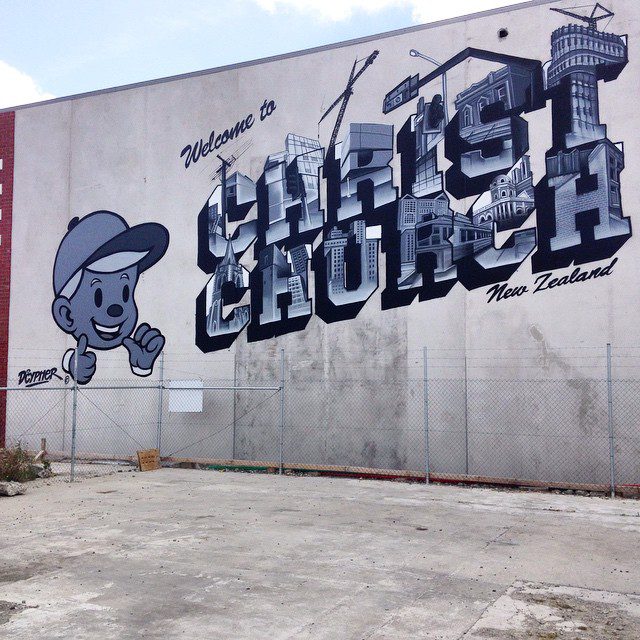
Dcypher has been living in Los Angeles for a decade, but the Christchurch-bred artist has still made a significant contribution to the post-quake city’s walls. From commissioned works such as his cut-up patchwork of iconic kiwiana on the Wharenui Pool in Riccarton, or his on point ‘Welcome to Christchurch’ greyscale postcard for 2015’s Spectrum festival, to more informal jams and productions with his DTR crewmates, he has made the most of his sporadic trips home. Dcypher, of course, has pedigree, he is not some out-of-towner drawn to the opportunities in Christchurch, but rather an important figure in the city’s pre-quake graffiti history. Dcypher’s legacy now extends across decades and geographic settings, tracking the progression of an artist across the globe, and the transition between graffiti traditions and the new mural renaissance. Prior to heading State-side, Dcypher had already developed a notable local and national profile. From his role as a tutor and artist for Project Legit in the early to mid-2000s (an art programme that served to mentor young graffiti writers and provide legal opportunities for painting), and numerous local projects and commissions, to his regular inclusion in issues of Disrupt Magazine and even Askew’s 2007 book InForm, where, alongside Lurq and Pest 5 (although the latter had relocated to Auckland by that time), he was one of the few featured artists from outside of the North Island, Dcypher was able to fashion something of a career from his graffiti roots, a transition that might have been unexpected, even amongst the graffiti culture renaissance of the mid-2000s in Aotearoa. However, when he left Christchurch for the United States in 2008, he, like most people, had no idea of the monumental changes the city would endure just several years later, and indeed, the creative opportunities that would emerge in the recovery period. As a result, Dcypher has been returning to a different city, not only from the hometown he left behind, but also in comparison to the sprawling and stretching metropolis of Los Angeles to which he has become accustomed. That environment, coupled with the wisdom of experience developed over years of work, has ensured Dcypher’s output expresses a well-honed practice, striking and crisp, distinct but ultimately indebted to graffiti as the culture from which he emerged, a balance he continues to maintain. While he was recently back in town, I sat down with Dcypher to find out about his views on Christchurch’s current scene, his experiences as an artist abroad and what his future may hold. While the open-air setting of Smash Palace may have made the difference between mid-winter Christchurch and bright Los Angeles abundantly clear, it was obvious that while the man might not reside in Christchurch for now, he maintains deep connections to the people, places and unique characteristics of his hometown.

You have been back in town for a couple of weeks now, what have you been up to since arriving? From all accounts you pretty much hit the ground running…
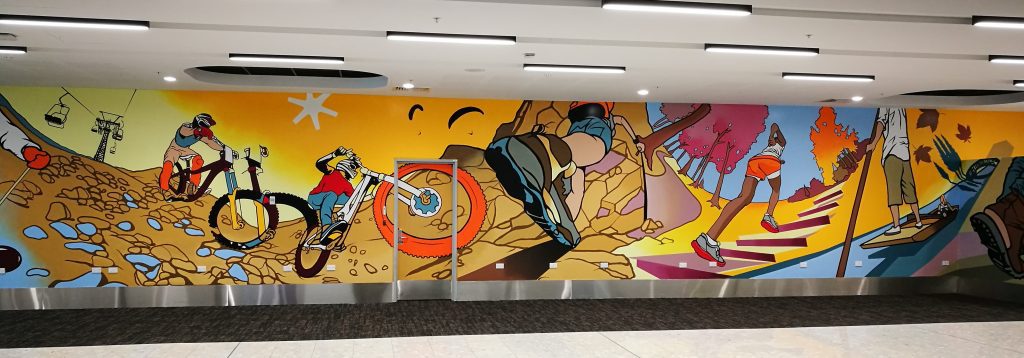
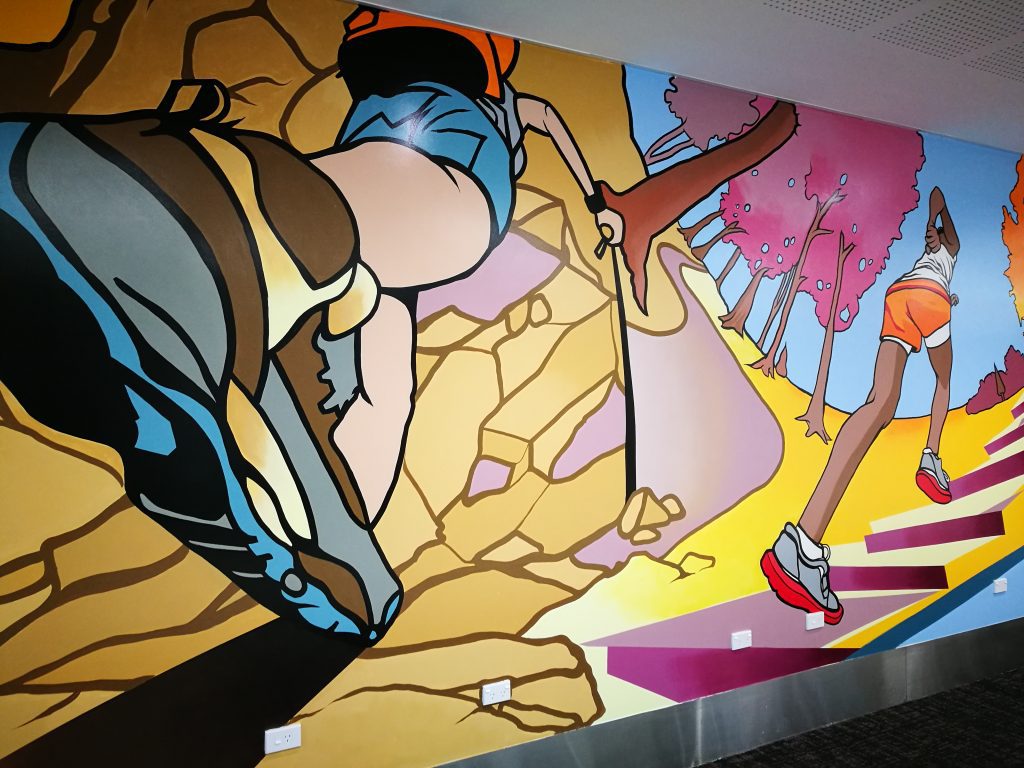
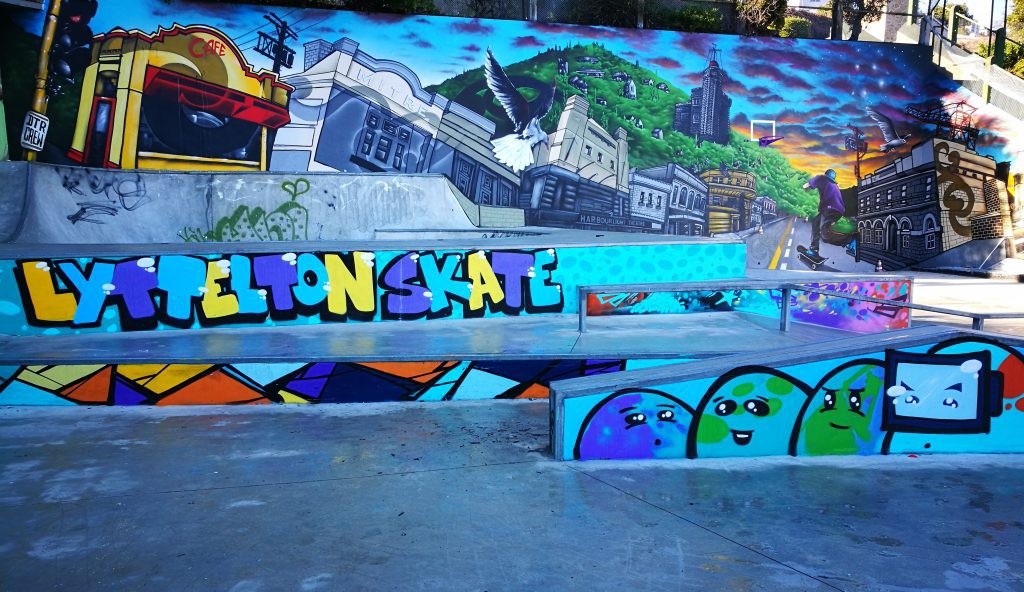
I started the Lyttelton skate park mural with the rest of the DTR crew, Ikarus, Yikes and Wongi, pretty much a few days after I arrived, and that took about eight straight days of just painting. The weather was good though, and everything worked out. Then I just got straight into the Airport mural with the Oi YOU! guys, George [Shaw] and Shannon [Webster]. That was a good fucking two weeks of straight work. I think George added up five hundred hours or something, so, we had all of us working on it. It was all acrylic, which is pretty much the first time I’ve ever done like a full acrylic mural, so it was a learning curve for me. But yeah, the result was good, and yeah, I have just been trying to relax after that.

So, when you say acrylic, you mean with brushes rather than cans?

Yeah, brushes, rollers, trying to learn new techniques for fading without spray paint, that kind of thing… But mostly, yeah brushes and rollers.

Was that just a condition of working at the Christchurch Airport, because the mural is located inside the actual building, right?

Yeah, obviously with all the passengers and commuters within the airport, they can’t have spray paint fumes going about the airport, so they were pretty adamant about just keeping it all acrylic.

A section of Dcypher's mural at the Christchurch Airport, 2018
A section of Dcypher’s mural at the Christchurch Airport, 2018

Having made a career out of wielding a spray can, did it take a while to get your head around the brushes and rollers? Using a can would be second nature now, and you mentioned having to work on fading techniques, did it impact your stylistic approach as well?

Yeah, I had an idea that it was going to be the case, so I designed the mural with that in mind; using various techniques with acrylic paint to achieve the look I wanted. But in knowing that I was going to use acrylic paint, I had to design it and sort of tone it back a little bit and keep it quite simple, which isn’t necessarily my kind of style. The style that I chose was also something that I knew the Airport and the general public could palette. So, I guess it’s not necessarily my most interesting  work in that sense, but it was an awesome learning curve to be able to use acrylic. I mean, I guess we’ve always used acrylic paint from the get go alongside spray paint, so I’ve always had an ‘in’ on how to go about it, and I’ve always tried to mess around on canvasses and use acrylic paint on a smaller scale where it makes sense to use brushes. Spray paint only works down to certain scale…

I was just going to say, it’s kind of the opposite of cans, they are easier to go bigger, whereas with brushes, it’s easier to go smaller, although obviously rollers help with larger works as well…

Yeah, but just seeing what a lot people have been doing overseas, especially in Europe and stuff, as murals get bigger and bigger, people are starting to shift to using acrylic with brushes and rollers on that really large scale. It is actually easier to use acrylic paint than spray paint; it’s cheaper, it goes further, it’s faster, the longevity is better…

A lot of people I’ve talked to have mentioned environmental concerns as well, not completely moving away from can use, but it seems to be something people are wary of…

Yeah, I think, if you were an artist that had the opportunity to be able to do that, then that would be cool. But I think it is probably not really an environmental thing, it’s more of a technique thing, just because best results are the end goal, you know what I mean? And environment is secondary, like everything else that humans do! (Laughs)

Detail of the Christchurch Airport mural, 2018

I guess as well, the evolution of this contemporary muralism movement into its own beast, it means you are getting artists from different backgrounds now, you aren’t necessarily coming from a graffiti writing background or even necessarily that aerosol experience. Mural artists are increasingly switching between streets and studios, combining those two worlds, like, I think of the Spanish artist Aryz, as a prime example of that sort of approach, he is definitely taking muralism into a painterly direction…

Yeah, that’s who I was referring to before. That guy is definitely the best muralist by far at the moment. And he was doing a lot of that stuff with rollers and brushes, ten years ago, you know what I mean…

To see some of the latest stuff he’s been doing, it literally looks like a studio painting on a massive wall, the painterly quality brings a totally different element to it…

For sure…

You mentioned that the Christchurch Airport mural came about through Oi YOU!, you have developed a pretty good relationship with George and Shannon over a couple of projects, beginning with your inclusion in the first Spectrum show (at the Christchurch YMCA in 2015). What was it like for you coming back for that show? Experiencing something like that in your hometown, and having some international context for festivals and events, was it easy to get on board with what they were doing?

Yeah for sure, they totally went about it the right way. They could have just had international artists of a high calibre come through, but by also involving local artists to do their thing, people who have set their feet in the city, a long-time before they arrived, it showed George and Shannon understood having that as an important part of it all. Those artists being represented in the festivals was a strong point to get across, that there are people that have been doing it in the city for a long time before this stuff had come about…

Witnessing, and of course contributing to (as one of the headline artists) that Spectrum show as it came together, and thinking back over all the years growing up in Christchurch, were you still taken aback that it was actually happening in your home town?

Yeah, I always feel like whenever you leave somewhere, awesome things happen, and you feel like you are missing out! (Laughs) I was just stoked to be invited back to produce work. I could have been overlooked, going off and doing my own thing, so definitely, it was awesome to get involved and to have that event and be a part of it all…

Dcypher's Welcome to Christchurch wall, for Oi YOU!'s Spectrum festival, Welles Street, 2015 (photo credit: Dcypher)
Dcypher’s Welcome to Christchurch wall, for Oi YOU!’s Spectrum festival, Welles Street, 2015 (photo credit: Dcypher)

It must have been cool that all the DTR crew were involved as well [the exhibition even featured a DTR colab room, with portraits of the members in a darkened room]; to have that collective recognition as a crew as well as individually…

Those guys were all involved from the get-go, George got them all involved, I just kind of came in from the side, off the back of all that, which is cool. But yeah, it is awesome that they have been able to give an amazing amount of people opportunities to produce work and that’s kind of the essence of the whole idea and how it should go down…

As you said, the first thing you did when you got back this time was the Lyttelton skate park project with the rest of the DTR crew. You guys have a pretty lengthy history in the context of New Zealand, and Christchurch graffiti history, how is it getting back and painting together? Is it a different type of relationship than you have with CBS, your Los Angeles crew?

Yeah, you know growing up with a bunch of guys and painting regularly, there’s probably a little bit more of a brotherhood sort of thing. In the States, there are so many players that it’s a huge family and it can be hard to make those same types of connections. So yeah, working with those guys is always awesome, you don’t even have to think about it, you know, everyone’s already on the same wavelength and you just go ahead and make it happen. Whereas in L.A., there’s a disconnect so to speak, with guys you haven’t necessarily grown up with since you were fourteen years old, you know what I mean…

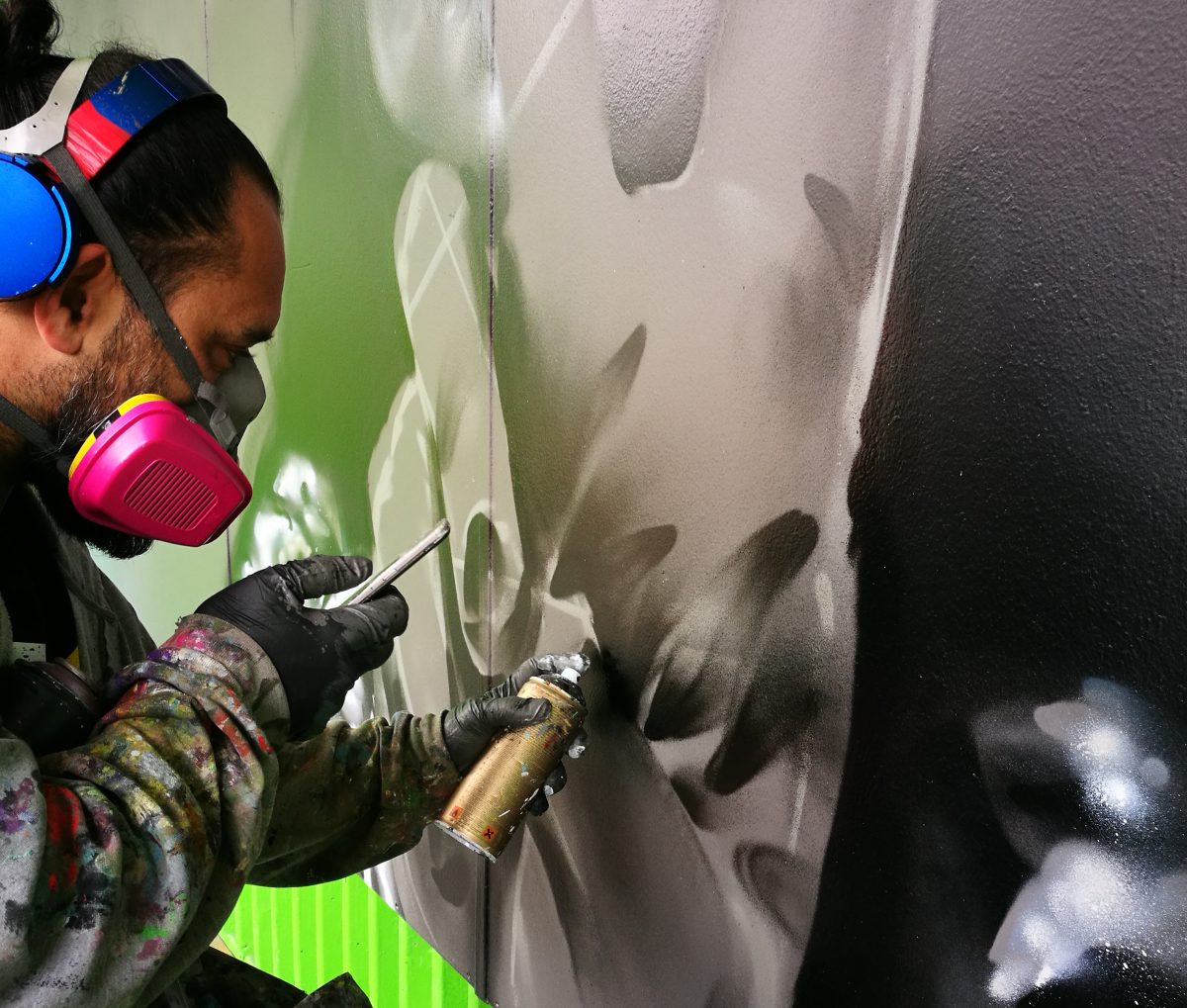
Section of the DTR crew (Dcypher, Ikarus, Yikes, Wongi) collaboration for the Lyttelton Skate Park, 2018.

When did you leave for Los Angeles?

I left in 2008, during the global recession. (Laughs) I basically landed, and Obama was elected. People were crying and shit. It was pretty amazing to be in the United States for something like that, at that time, and to be part of it, to feel like you were a part of it. But being there wasn’t easy in the beginning, I was doing a lot of construction work, there weren’t a lot of opportunities. I was sort of working my way up, meeting a lot of other artists, painting various little projects. Doing things to prove yourself to people who have already lived and worked in the city for a long time and have their foot fucking firmly in the ground. Slowly but surely, I was able to become a full-time artist over there…

Did you have any connections before you went? Were you down with CBS before you went?

No. I had some good friends of mine who I grew up with in New Zealand, two American guys, whose father was based here through Operation Deep Freeze when they were kids. I grew up skating with them, doing graffiti with them, and they had moved back to the States. They were originally from San Diego, and one of them was, actually both of them, were in L.A. at the time I arrived, so I had two really good friends that I hadn’t seen for a really long time to go and start the whole thing alongside. They had already figured out a bunch of shit. To go to Los Angeles by yourself is a big undertaking, and to have someone there as a liaison to help you get through it and figure it out, is ultimate, so I owe a lot to those guys, for sure…

I remember your profile in InForm, the 2007 book produced by Askew featuring a number of New Zealand graffiti artists, you commented on how the Christchurch scene was really small and everyone painted together. That probably highlights how daunting it must’ve been to move somewhere like Los Angeles, which would be like ten or more cities the size of Christchurch…

At least…

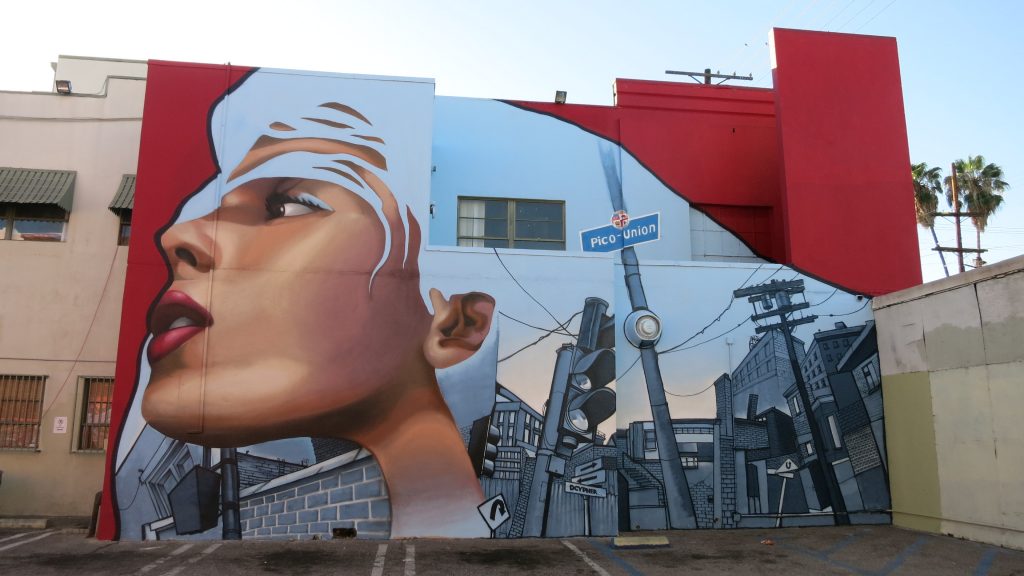
Piece for the Pico Union housing corporation, aka the Grafflab, in Los Angeles, 2015. (Photo credit: Dcypher)

That feeling of starting again, of starting over in terms of reputation, that must have been pretty strong…

Yeah, for sure. But it is refreshing, its humbling to have to work your way back up again. The calibre of work in the U.S. is fucking insane. Just the level of competitiveness is crazy. New Zealand has that kind of tall poppy thing, where if you think you’re better than everyone else, you are going to get cut down quick, you know. Whereas in America, if you think you are better than everyone else, for some reason everyone holds you up on a pedestal.

Do you think that is a unique thing to the United States, something about the mindset there?

It’s a combination of both freedom and capitalism that sort of drives people to do what they do. I mean there are guys in the States who do illegal graffiti and have done illegal graffiti for their entire lives and have never been snatched up, they have refined that shit to an amazing level, where they can go out and produce work without running into too much bullshit. But, at the same time, the competitiveness, you know, it keeps you on your toes.

It is sort of L.A. in a nutshell I guess. It’s a city of contrasts. I imagine anything can happen at any time, in any place…

Yeah, for sure…

Was the American West Coast scene an influence on you coming up? Or were you more inspired by New York and the East Coast, or maybe European writers? An American tourist remarked to me recently, not knowing anything about you, how one of your pieces here in Christchurch looked like something from Los Angeles. Has that West Coast, or more specifically Los Angeles style become more of an influence by living there? There’s that long lineage of ‘West Coast’ artists across a number of fields, and that specifically Los Angeles aesthetic that can be found in music, film, fine art, street art, graffiti…

To begin with obviously it was the New York influence, Subway Art and books like that, before the internet. Then once the internet happened, it was definitely European stuff. I was always more into East Coast hip hop stuff than I was into West Coast stuff, and I kind of liked the grimy, cold aspect of the East Coast. My Mother’s from Boston as well, so I have an affiliation to the East Coast. But once you get to California, and you get a little bit of the lifestyle, it’s definitely influential. It always has had its own style and everything going for it, but my eyes weren’t necessarily open to that. I did see a lot of stuff through magazines and stuff before the internet too, that was all West Coast, but at the same time I wasn’t really thinking about where in the States it was from. When I was young it was just what was aesthetically pleasing. So, I guess it did have an influence on me. There were a couple of guys I remember, like this guy Clown, who had some interviews in some magazines back in the day, who I’ve actually been able to meet since moving to the West Coast, which is pretty crazy. There were a bunch of other guys as well, and obviously all the CBS guys too. I think the Europeans have always taken what writers were doing in the United States and really pushed it in another direction, in more artistic directions, whereas the States has always kept that illegal, raw sort of graffiti, like you’ve got to keep it the real deal, there’s no using some weird technique, people shut you down real quick with that sort of stuff!

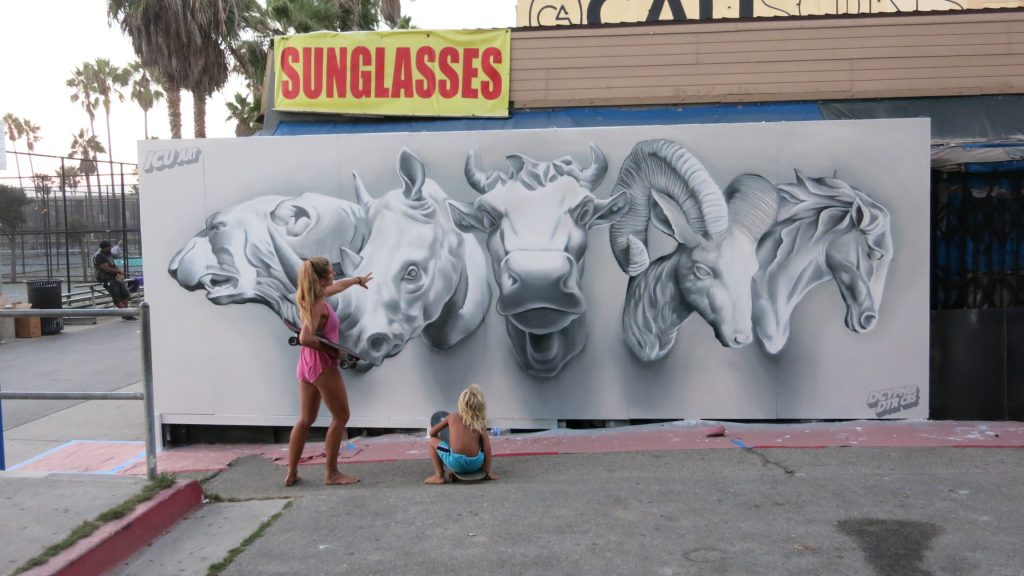
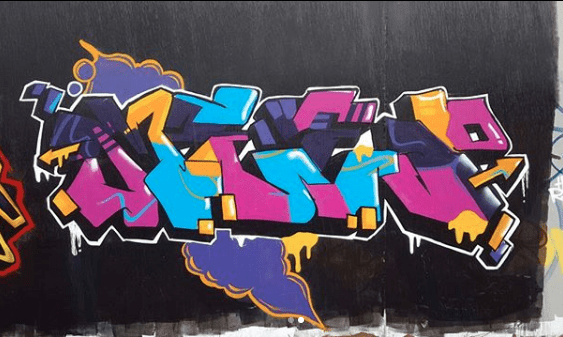
Extinction wall, Venice Beach, 2015 (Photo credit: Dcypher)

It feels like the Los Angeles influence isn’t only apparent in stylistic terms and letterform traditions, but through the environment itself, it is also evident conceptually and in terms of the imagery you often use. I’m thinking of the architectural elements in a lot of your work, to me, they have the feeling that Los Angeles as a sprawling, built environment, with a certain physical nature, is influential. Do you think that imagery, and even just the conceptual approach to your work, has been a response to living there, to that landscape?

Yeah for sure, obviously as you’re developing your work, you are taking reference photos and stuff like that all the time, and Los Angeles being the insane metropolis that it is, it was kind of inevitable that that was going to find its way into my work, because I’ve always sort of been interested in infrastructure and cityscapes and stuff like that…

Do you see a connection between building letterforms and architectural forms? In terms of how a letter, or a piece, is built up and constructed, it feels architectural in how space is considered, and angles are created and used…

I think earlier on I thought about that a lot. I remember doing some really sort of structural letters that almost looked like buildings in the past. But I do kind of separate my graffiti style from canvasses and mural stuff. It is always in there to some extent, but I try and stick to traditional letterforms, developing it in my own way. I guess always having some sort of architectural element in the background was kind of where I started pulling that stuff from, you know, backgrounds for graffiti stuff…

As you get older, when it comes to your letterforms, is there less influence from what other writers are doing and more of a continuation of what you have already developed? That idea of constant refinement, which is something that comes from the compulsion of writing, from repeating a tag ten thousand times, to perfecting a certain signature letter? For you, is your style becoming more and more insular as you get older, entangled in your own history of writing, more so than really taking notice of other sources?

Yeah, for sure. Like maybe from guys I initially painted with, but with any outside source, it’s not a good look to be doing that. Like you say, you do a tag ten thousand times, fifty thousand times, and over time you start to understand how everything fits together, it’s like an ongoing puzzle, within your own mind. It just refines over time. There are certain aspects that you might see another person doing, but it’s probably more technique than it is style. Because with style, it is hard to adapt someone else’s style, you are always going to have your own style, it’s almost impossible to reflect another person’s style, but technique for sure…

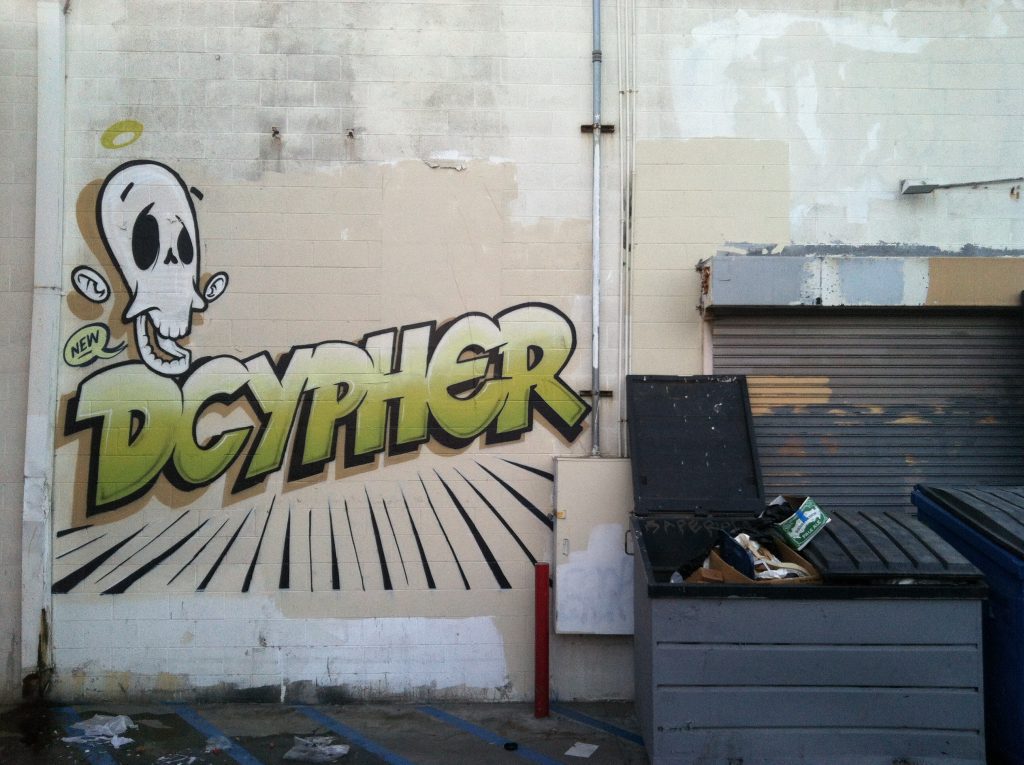
Los Angeles, 2014 (Photo credit: Dcypher)

Like you were saying earlier, that from the pre-internet era, there were the influences of Subway Art, Style Wars, and there was what was on the walls around you, those influences were what you had, now with the digital age, you can see all these different styles, you can see writers from all over the world, in some ways it must be harder to develop a personal style amongst so much information…

Yeah…

Because so many things have been done, but also, you’ve seen all those things as well. You are nowhere near as isolated. Of course, that isolation meant that some really interesting local styles developed as a mixture of certain influences, like in Brazil, with the combination of hip hop graffiti with pixachao, or even Los Angeles and the influence of Cholo graffiti, but it is getting harder and harder to even see that happening because everything is available to everybody, everything seems more global.

Yeah, I think that graffiti has always had regional styles too. You could pick someone’s style from where they were in the world, even with the internet you could pick someone’s style; if you understand graffiti, you know someone from the West Coast of America as opposed to someone from the East Coast, versus someone from Brazil, versus someone from Australia, to some extent. Graffiti has always had its own specific styles, even within countries, it’s sort of like, ‘oh this is more of a northern style or a southern style’, which is awesome. It means the direct influence of what you are seeing in real life is what really has impact on your style, rather than seeing awesome photos on the internet all day long, which won’t ever have as much impact as walking up to a wall of a legend dude who has been painting twenty years in your city and just being like ‘Holy shit! That’s insane!’

To be continued Homecoming (Part Two)

In the meantime, check out Dcypher’s various platforms:

Facebook: https://www.facebook.com/dcypherart/

Instagram: https://www.instagram.com/dcypher_dtrcbs/

Web: https://www.dcypherart.com/


Kophie Hulsbosch – Future Proof

Kophie Hulsbosch might be softly spoken, often punctuating sentences with gentle laughter, but it is quickly apparent that she is driven by a desire to use her creative output for good. I was introduced to Kophie when I was preparing for our story about the RAD Collective, and as I got to know more about her, I discovered the diversity of her practice, from her clothing brand, Future Apparel, to illustration, via graffiti and surrealistic painting. In her own words, she isn’t someone who ‘just sits back and lets stuff happen’, and as such Kophie’s output is always entwined with her socio-political and environmental beliefs. But her work also reveals the exploration of identity as a constant theme to be unpacked. This exploration is not solely an act of self-reflection, there is a sense Kophie is interested in identity in a broader stroke, in what it means to be an individual amongst a collection, not just in her quirky characters and portraits, but also in the inherent nature of graffiti, and her vocal concerns about consumption, our complicit involvement and its impact on our surrounding environment. Another example of a young Christchurch creative emerging from the influence of urban art to explore a diverse range of artistic approaches, Kophie Hulsbosch is a reminder of the potential to connect a creative impulse with a desire to change the world, regardless of the scale of such actions. We sat down and discussed how art became a vessel for her beliefs, how these ideas were fortified in her practice, and the dark side of the ‘fast fashion’ industry…

So Kophie, let’s pretend this is a superhero movie, what is your backstory?

I came from Wanaka, surrounded by the outdoors and people skateboarding. Then, when I was about ten, I moved to Christchurch. I never finished high school, I dropped out in year eleven, it just wasn’t for me. I worked terrible jobs and I just kind of figured out what I wanted to do through that. In high school, I had only ever really studied in my art classes (laughs), so after working those horrible jobs, I decided to do the foundation course in design at ARA. I loved the course and decided to continue with graphic design. My goal was to be self-employed, but I also wanted to use art for social commentary, mostly environmental issues. After I completed my Bachelor of Visual Communication, I received a scholarship to do an honours degree in Media Arts. At the same time, I decided to launch a business, making use of the facilities at ARA and combining everything I had learned; drawing, branding and graphic design. I wanted to make some sort of environmental comment with my work, so after discovering that the clothing industry was the second most polluting industry in the world, I decided to re-purpose clothes. I guess I’m not the sort of person to just sit back and let stuff happen! (Laughs)

When did that drive crystallise? Did it take a while for you to realise the direction you wanted to go, or was it engrained in your worldview from a young age?

Well, I enrolled at ARA because I just wanted to get better at drawing. But when I was 11 or 12, I became a vegetarian, and that sort of set off my ethical conscience, because once you start learning about one issue, all these other things pop up that show how so many things are interconnected. I started learning about the impact on the environment of animal agriculture, and the associated social issues, and then when I did a philosophy paper at ARA, I started finding out how the world works and how messed up a lot of things are, and I started exploring how to potentially change it…

Importantly, you have utilised art to engage with those issues. Was that just something that made sense to you, to communicate and explore ideas? Is drawing a way for you to problem solve?

I’ve always known it is one of my strengths, in Maths or English at high school, all I would do was draw on my hands, and I would just constantly get in trouble. I just think it’s the only voice that I have, or at least it’s the best outlet I have to get the message across.

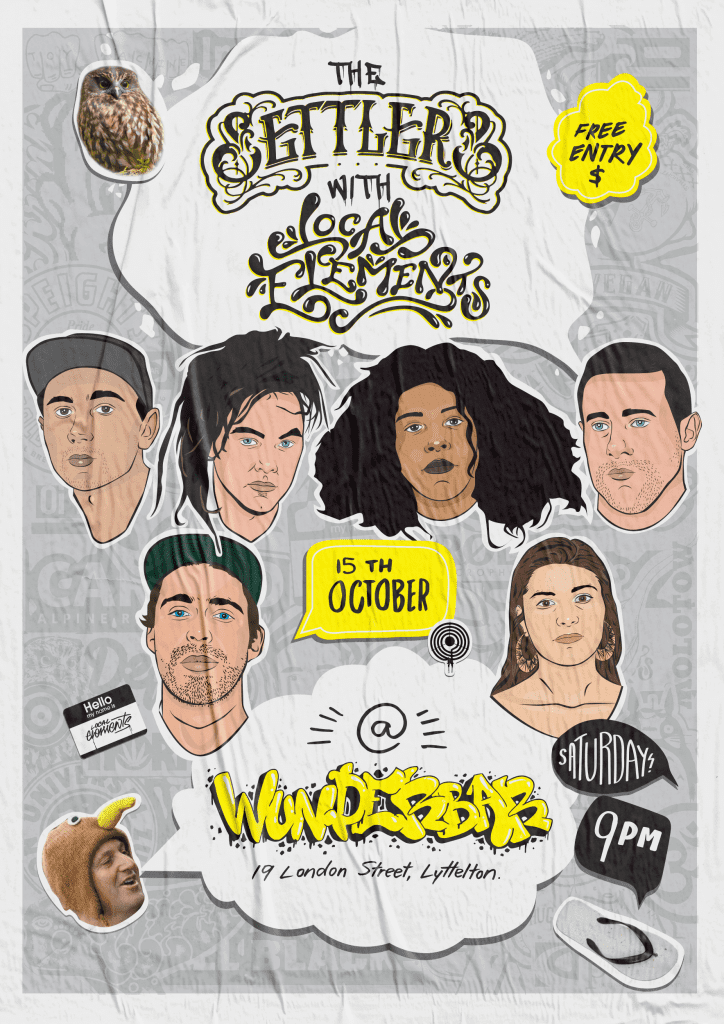
Gig poster for The Settlers x Local Elements, digital illustration, 2016

One of the first things I noticed with your work is the diversity; illustration, graffiti, figurative drawing and painting, design work, branding… Is it just in your nature to constantly explore different approaches, or is it necessary to express different ideas?

I think I just always want to try different things and learn. But sometimes I think I probably should focus more on one thing! (Laughs) But I just want to be creative in any way, and I mean, you can learn anything off the internet now. I taught myself how to sew on YouTube! There are infinite possibilities…

In some ways, the need to pigeon hole yourself has been broken down by the possibilities of the digital age to explore ideas and cross-pollinate. But would you proclaim yourself to be any one thing more than anything else?

I mean I started everything from drawing and illustration, just weird, obscure drawings and naked women! (Laughs)

There is a definite sense of the surreal or fantastic in some of your work, but there is also often a grounding in some sort of psychological reality, an exploration of identity, or that sense of social awareness that you’ve already talked about. Do you try and find a balance between intentionally expressing ideas and a subconscious approach?

Every project is different. Sometimes I think when it is from my subconscious, I look at it and I’m like, how did that come out of my head? But with graphic design work and commissioned projects, it is more controlled, I know what I’m doing. Most of the free stuff is influenced by hip hop, hip hop music and graffiti and those cultures.

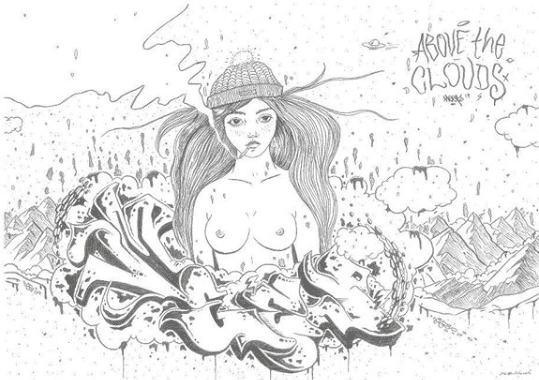
Above the Clouds, ink and pen on paper, 2018

What do you find the most attractive element of graffiti? Is it the creative element, the search for style? Is it the idea of the social communication? Or is it the act, the adventure of graffiti?

I think all three; I love the thrill, I love the idea that you can do whatever you want, whenever you want, and make spaces come alive. You see little areas and you’re like, that could be a face, or that could have a personality. The style is important as well, I mean I look up to people who have a really defined style and I always think of style over spots, personally…

With graffiti writing, obviously the issue of identity is a central concept as well, albeit couched within the expression of style. Do you make the connection between letterforms, style and the idea of identity?

I think my letterforms are probably the weakest element of my art, so I like to practice them a lot. But I try and paint every piece differently, so I never really have a particular style. Some of my stuff is quite creepy, and creature-like, but then other times it can be quite straight and sort of masculine. I like to make it look like a girl didn’t do it, whatever you think girly graffiti looks like, like love hearts and pink colours… I like to make my stuff look not necessarily feminine…

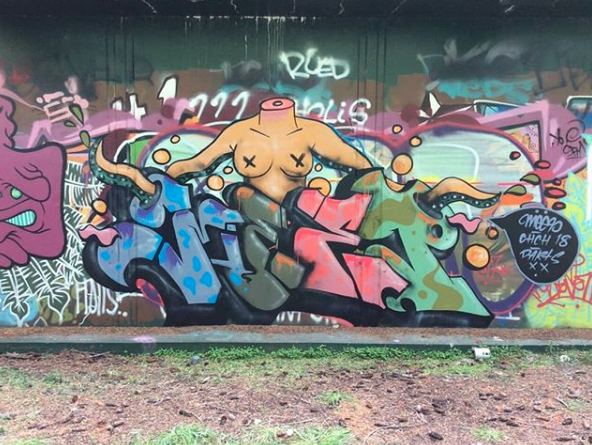
Christchurch, 2017
Christchurch, 2017

The discussion of gender has long been a part of the analysis of graffiti, at least from a scholarly approach, because there is this perception of graffiti being a very masculine pastime. When you think of the likes of Lady Pink, there is an acknowledgement of gender in her moniker. But, your name doesn’t have to be representative of reality, you can mask your identity when you write graffiti. By developing a personal style, that in itself can become the identity, is that your approach?

I guess so, because on my Instagram, and it is just my art Instragram, I never really post selfies or pictures of myself, because I like the idea of people not knowing who I am, if I’m a girl or a boy. People do tend to have a judgement if you’re a girl.

The pursuit of style can be all consuming, and with the digital age, the number of available influences has become so wide-ranging, that it seems harder to develop that distinctive signature in some ways, everything has a danger of seeming derivative, just because more people have seen more things…

The internet! (Laughs) I know back in the day, each town had a certain style, you would know if it was New York graffiti or whatever. Whereas now everything is just a massive collage of everything; every era, every style, and it is harder to find that identity, because there is so much that’s already been done. You have to think outside the box all the time, or just accept the fact that everything’s being re-purposed.

Queenstown, 2018
Queenstown, 2018

How did you become a member of the RAD Collective?

I was making clothes at ARA just before a pop-up shop. I was really stressing out and just running around the classroom getting things done. Becca and Jimirah (founders of the RAD Collective) came in to see one of my other mates, and I just had my clothes on the table and they were looking through them, and they were like: ‘Wow, this is amazing!’ Then a few months later they gave me a message on Facebook and said: ‘We are doing a thing. Do you want to be a part of it?’ And I was like, ‘Yeah!’

What do you personally see as the greatest benefit of the RAD Collective? That type of network, people with different skills, and the energy it generates, must be really helpful in the transition from a learning institution into the ‘real’ world…

They have been so amazing. They have just uncovered countless opportunities for me. They look out for me so much. They are just always so supportive, which is really cool. They are trying to suss out a space, find walls and organise exhibitions… You can’t do all that stuff by yourself…

That story about meeting Becca and Jimirah also introduces your clothing brand, tell us a little bit about Future Apparel…

As I said before, the main drivers of the brand have been the environmental and ethical issues, things like the conditions for workers overseas, and the number of animals killed for materials. The crazy thing that I can’t understand is the environmental and ethical impact of the day to day things that we do. By consuming in the over the top manner we do now, we keep making it worse and worse and worse, but we kind of just accept it. I know people notice things, but we are so used to the consumer culture we live in, it feels like you have to abide by it…

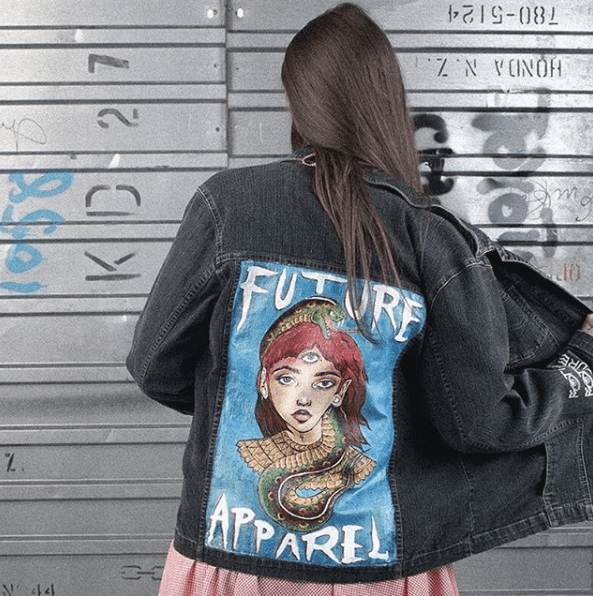
Second hand denim jacket with Future Apparel design, 2017

There is an unwillingness to explore alternatives because they seem too hard.

Yeah, is it cognitive dissonance? Is that the one? (Laughs) Through Future Apparel, I want to change the mindset. My ultimate goal is to create a different culture around how we buy and consume, to encourage people to think about the actual human aspect of things when you buy. Like, with clothing, most of us probably think it jut appears on a rack by magic, you don’t see any of the process behind the item.

Is it important to find the balance between your creative outlet and the real-world application; to not be dragged down by the realities of the political side, to ensure that you remain inspired by your creative outlets?

Yeah, it’s a constant battle: I want to change the world, but then sometimes I don’t think I can do anything, and that the world’s fucked! (Laughs) Sometimes you feel isolated, because you see people around you and you tell them things, and they are like, oh that’s terrible, but they don’t really do anything, they don’t care enough to make it their life to change the world for the better…

I feel like it is a result of how we receive and process information in the digital age. The internet allows avenues of widespread and instantaneous communication, but we seem to use them for the worst possible things. The potential is so amazing, but the reality can be so mind-blowingly frustrating! (Laughs)

Memes! (Laughs) I think it is crazy how we have all this information at our finger tips, but it is used, I’m not saying by everyone, but it is used by so many people to just watch silly videos. I can post a selfie on Facebook and get 130 likes, and then I share something about the planet, about the extinction of sea creatures, and people give me like maybe two likes! I don’t know…

You must have learnt a lot about the tricks of the corporate world, what things have you discovered that have fed into Future NZ as a concept?

I have looked at the idea of green-branding and green-washing, and how a lot of brands are using these ideas to drive profits, even though they aren’t necessarily a ‘green’ brand, so that was something I wanted to avoid…

Explain the idea of green-washing a little bit…

So, with green-washing, someone like Apple Computers say they recycle their products for new computers, and they have this whole eco-brand called Apple Renew, but they are also bringing out new products every couple of months and trying to push consumerism while also trying to have this other identity of being eco-friendly…

So, they are producing a semblance of a response to an issue they have helped create and are still creating…

Or say toilet paper companies who say they are donating one cent from every sale to help save forests; it is like a pretend persona, just to try and drive sales. One of my lecturers suggested there is a chance to do some further research, he thinks the whole sustainability approach can’t work under the capitalist construct, that it will always be undermined by profit and exploitation, even if it is green-branded or a green product…

It’s not a fair battlefield, right? The field is being created by those who gain most. How do you fit your conception of graffiti and urban art within the issues of sustainability and ethical consuming? Do you see it as a natural way to address that uneven battlefield?

I wouldn’t say my graffiti is eco-based, because I know spray paint isn’t the best for the environment, but I have made paste-ups in the past, and I always have ideas of big signs I can put up everywhere, like guerrilla campaigns around the city. I do want to do that sort of thing, but I’m just figuring out how to get it across. I think it could be a really good form of getting a message out there. You are forced to look at it, with social media you can just scroll past it, like ‘meh’, but if it is in your face in the streets, if you are driving past it every day, you might think about it…

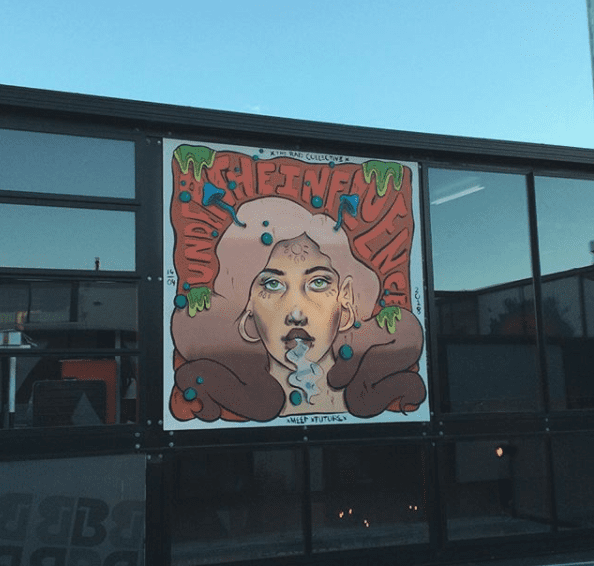
Live painting for The RAD Collective event Under the Influence, Boxed Quarter, central city, 2018

You recently had something of a run in with a well-known fast fashion company, what happened?

My friend sent me a picture of basically my exact design on a fast fashion shop piece. I didn’t really think much about it, but then I was lying in bed and I saw the image I created because I had put it on my wall, and I was like, it is exactly the same, like exactly the same: same colours, same font! I put it on Instagram and my friends got way more worked up than I did, Becca wrote a big post about it, and it got around a bit on Facebook. The New Zealand Herald contacted me, but I didn’t talk to them just in case, you don’t want to get sued. Then I found out about another girl from Australia whose work they blatantly ripped off as well, but she didn’t do anything about it, she couldn’t be bothered. So, I emailed them, I said, I think you’ve copied my design, and they basically replied that it was a coincidence and showed me their process. (Laughs) But they said like, ‘this was done at 11.50’. They gave an exact time something was done. When you’re doing your workbook process, you don’t write the exact time and date when you are doing it, unless there is something strange going on. But, I mean, it is what it is…

I guess in that situation, you have to decide how worthwhile the expenditure is, because it is a lot of emotional energy, right? But at the same time, it must be frustrating to think that as a result, companies probably get away with a lot, because their resources are greater. Did it also make you think about the role of social media? How when you post something, it is visible anywhere around the world and it immediately becomes so public?

I instantly thought of the recent thing with H&M and Revok, the graffiti artist, like they think they can just take anyone’s work because they are the rich big guns and they kind of have immunity because they are so well-known. But yeah, the most frustrating thing was the mass production side; they are making money from exploitation of labour and other ethically dubious practices, where I make one-off designs, re-purposed from fast fashion! (Laughs)

It’s the exact antithesis of what you want Future Apparel to be and to be associated with, which must have made it so much more frustrating than someone who was maybe trying to enter that world. In many ways I would hope it has steeled your resolve to opening people’s eyes to the realities of fast fashion and the alternative options that are available…

Yeah. I also think about how sustainable clothing tends to be elitist in a way, like it is always quite high-end and targeted towards more well-off people. But I wanted to also use street wear, skateboarding, hip hop, and cultures like that, and incorporate them all and make something for youth, because I feel like it’s a missed market. I want to make it affordable for that group and remove the elitism. So, like I know a lot of people my age, they care about this sort of thing, and they want to buy sustainably, but it is out of their price range, they are often studying and would never be able to afford one-off nice items…

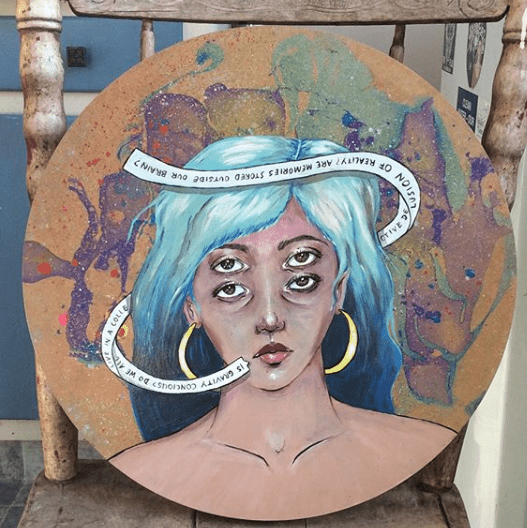
Thoughts, acrylic, aerosol and nail polish on wood, 2018

You obviously have some long-term goals, but what do you have going on in the short term? You’ve got a few things on the go, right?

I’m illustrating a children’s book for the Crusaders (The Super Rugby franchise), it’s going to be in every school in New Zealand, which is pretty cool! But I’m not allowed to make the horses smoke cigarettes! (Laughs) The Under the Influence exhibition was obviously a few months ago, I exhibited two portraits and painted live at the event. Some of my projections were also in the courtyard. I haven’t worked on Future Apparel much, (laughs) but hopefully I will find time to do that. I’m also working with a sustainability company, but I can’t say much because they haven’t got copyright yet…

You’ve got some mural work?

Oh yeah, I’m doing a mural at BizDojo!

With that many things on the radar, have you reached that goal of self-employment? Are you sustaining yourself through your creative outlets?

I’ve got the student allowance at the moment, without that I’d be screwed! (Laughs) I’m doing a business course as well…

As an artist, and being that your ethical concerns are pretty central to your approach, do you find that you are an odd one out in that environment? I am always interested in how ethics and morality are incorporated into commerce-based education…

Yeah, I just can’t mentally justify having a business without making it for the greater good, like not just for profit, I just can’t wrap my head around being driven by making money at all costs…

There are probably a lot of people who are exactly the same way and yet there are those who see business as a by-word for profit-making, so it is an interesting challenge to become comfortable in an environment and reach the goals that you’ve set for yourself…

Yeah, maybe that could be something, changing the consciousness of business, maybe its compulsory to have some profits go to a charity, or help impoverished communities. I mean another big thing I looked at was the idea that profit was just another word for stealing…

‘Making’ money is really just ‘taking’ money…

I still think the majority of people think that if you are not making money, you are not doing anything. That’s something I struggle with… (laughs)

It’s the idea that our value in society is based on the money we make, which is flawed thinking…

Money is evil! (Laughs)

That’s sounds like a pretty good sign-off! Thanks for talking to us Kophie! 

Follow Kophie on Instagram via @kophie or @future_nz, or check out her website https://www.yoitskophie.com/ 

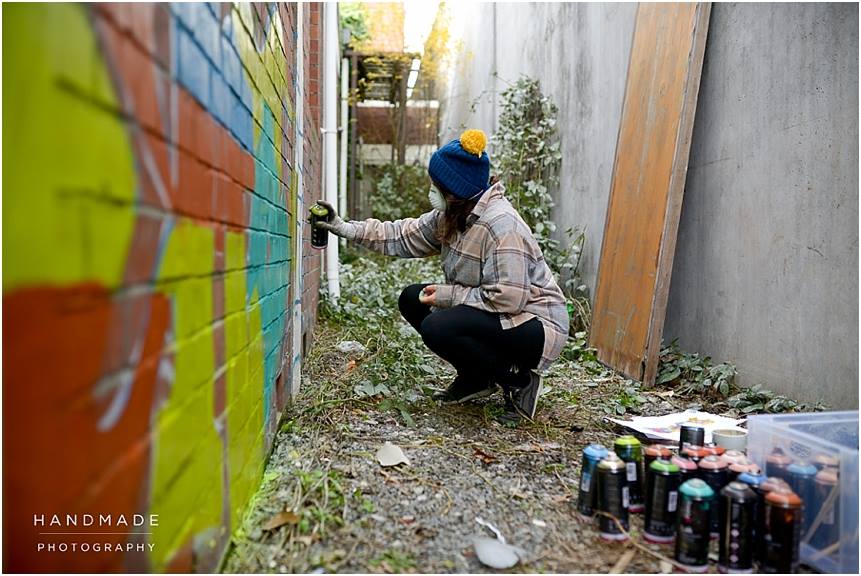
Featured image credit: Handmade Photography

Wongi ‘Freak’ Wilson – Travelling Man

Wongi ‘Freak’ Wilson has undeniably been one of the faces of Christchurch’s blooming graffiti and street art scene. From his skilfully rendered large-scale murals, to his presence in festivals, interviews and documentaries, he has been a central figure in the presentation and reception of the culture’s popular emergence. It is a no-brainer that we were going to sit down for an in-depth interview with Wongi, but as they say timing is everything. With an upcoming trip to Nepal on his horizon, a result of his artist series t-shirt design for local adventure clothing company Kathmandu, we thought it would be best to save the long-form interview for his return. But, then we thought, why not catch up before hand as well, just to get some insight into the Nepal trip and how it all came together. Think of it as a primer, the base camp before the summit if you will…

So, Wongi, what is it, six days before you’re off to Nepal?

Yeah, about six days, possibly even less now…

You found out you were going about six months ago…

Yeah, at the end of last year sometime, it was maybe November…

Has that time gone quickly? Have you had an ‘I’m actually going to Nepal!’ moment?

Yeah, it has crept up really quickly. Just in general, you know, life gets in the way. I’m working away and doing things, and then next minute it’s boom, I’m going next week, so…

You have literally just finished a workshop in the last hour, and on top of painting jobs, you were just saying that you’ve got house renovations on the go, so things have been full on as usual, have you had a chance to consider what sort of experience this is going to be?

No, not really. I’ve just been so busy with work and everything going on, I just haven’t had the time to let it sink in. I have had lots of people asking me: Are you prepped? Are you ready? Are you amped? And I haven’t even had time to think about it. A bunch of my Kathmandu gear arrived a while ago and that was really awesome, just pulling it out of the box and everything. But even then, it was more just ‘oohing’ and ‘ahhing’ at the product, not actually thinking: ‘I’m going to be using this in Nepal’…


Smash Palace, 2018

Over the last seven years or so, you have had some pretty amazing experiences; painting in front of royalty in Re:Start Mall; painting a large self-portrait inside the Canterbury Museum, being featured in the Rise and Spectrum shows, just to name a few. Amongst all these things that I’m sure ten years ago you didn’t necessarily expect, where does the opportunity to travel to a place like Nepal fit in? It’s not exactly somewhere that you would consider a traditional ‘urban art’ destination, and yet your art has given you the chance to go there…

Yeah, definitely, it’s such an amazing opportunity, but it’s not something I would have specifically saved up and chosen to do. There are many other places I would have chosen, but because of what it is, I’d be foolish to say no. It’s a once in lifetime opportunity to go and do this type of thing, so I’m diving at it. It’s amazing, really amazing.

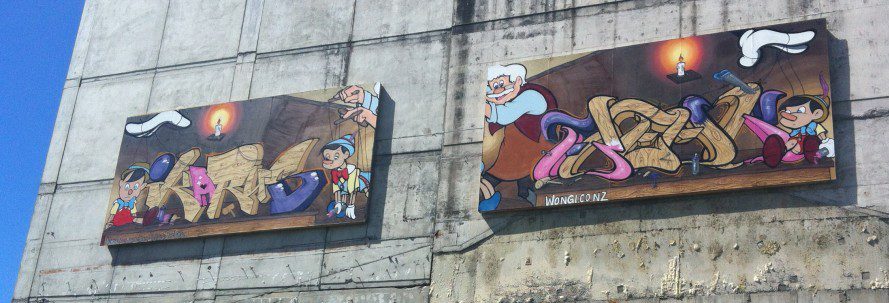
The Re:Start colab billboards painted by Wongi and Ikarus for the Art Beat programme, 2012

The trip is the result of your relationship with the adventure clothing company Kathmandu, and your role as one of the artists, along with Shraddha Shresthra from Nepal, to contribute to their limited-edition artist t-shirt series. How did the opportunity to design a t-shirt come up?

That all came about because when Kathmandu opened their new branch and offices in the city centre they had already started the process for their limited-edition artist series t-shirts. Shraddha was the first artist to create a t-shirt, so as a part of their opening for their central city location, they flew her in from overseas to paint a mural in the neighbouring laneway as part of the whole event. So, since she was here painting in Christchurch, they wanted a local artist to paint in the laneway as well, so they got me involved, and that’s where my t-shirt came in. I think they just really liked what I had painted and my style, and I think that helped push me into being the second artist in the series. I also think as the Kathmandu brand was originally born in Christchurch, I think being a local artist helped as well…

So, is your t-shirt available yet?

It might be online currently, but the actual official release date is the 23rd or 25th of this month, I think. They are releasing it on the date of the 65th anniversary of Sir Edmund Hillary reaching the summit… so it all lines up…

You have a fair bit of experience designing and printing your own t-shirts, but I would suggest your photorealistic style, especially in aerosol, doesn’t necessarily translate as well into the more graphic qualities of t-shirt designs. Technically, you are a versatile artist anyway, so I’m assuming you are pretty comfortable taking on different approaches, but how did you find the process of creating the design, and how did it come out?

Yeah, it was really fun actually. With a t-shirt design I can’t really go to the in-depth level of the photorealistic stuff, so I pulled it back and went the other way with the more cartoony, raw graffiti style. I chose a big block format and filled it in with graffiti lettering and graffiti-styled characters. It’s got a bunch of things related to Christchurch and Nepal: I’ve got a Kathmandu bubble letter, it’s got Christchurch written in block letters within the brick format, and then I’ve got a bunch of different characters and things in behind it; some related to Nepal, like some yaks, temples, and Buddhists, then some things relating to New Zealand; the hills and ferns and that type of thing, as well as more traditional graffiti stuff; throw-ups and spray cans and all that kind of thing.

Boxed Quarter, 2017

I feel like the inclusion of elements of graffiti culture is important. Obviously the references to the locations, Christchurch and Kathmandu, are necessary, but as an artist with roots in graffiti art, it is also important to represent that culture too, because it is what got you where you are…

Yeah definitely. That creative freedom to celebrate my style and artistic background definitely helps build a good relationship with Kathmandu. They are a lot more understanding of that side of things, but I was also working with the design team there to make sure they were getting a product that they are happy to promote in that sense. So getting to work with their team, the back and forth process, that was really cool as well…

In the past, when you have produced your own t-shirts, you’ve been the designer, the printer, the distributor, you’ve done all of it…

Yeah for sure, that was a cool element, working with another team who specialise in certain products for their brand as well, so that was fun…

Does it make you want to do more limited-edition t-shirts?

I wouldn’t say no! It is an amazing opportunity, but it all just depends on certain factors. It boils down to the imagery that’s wanted, the level of creative freedom that I’m allowed, and of course, the company who I’m trying to work with, and whether or not I relate with them on a personal level. I’m an animal and nature person, an environmental person, so I think that also helped with the whole Kathmandu relationship, knowing that they are quite ethical with their products…

Did you research their ethical stance? Because it is important that artists know who they are working with…

Without a doubt. We had a general idea of how Kathmandu work, but when the proposal came in, we did a lot more research into it, just to make sure, because you don’t want to have yourself aligned with a company that you don’t agree with. So, yeah, we definitely had to make sure that that was the way it was, and that I wasn’t going to be associated with a company that isn’t thinking about the environment and all that type of thing.

As more and more opportunities come up for artists to work with brands, holding companies accountable in a way, making sure your ethics align is so important…

You don’t want to be associated with a brand that is working in a way you don’t agree with. So yeah, anything like animal cruelty, I’m not a fan of, but Kathmandu were really strong around their ethics with their clients…

In terms of the actual trip, what’s on the agenda? Will you get a chance to paint while you are there?

No, I’m not. We looked at it and we were trying to get that sorted, but I guess it just boiled down to the fact that there’s not a lot of time outside of the trek to actually get a painting in. Then there was the whole problem around getting artist grade spray paint into Nepal. We’re trying to tee it up to paint something for one of the schools I’m stopping off at on the trek, but then there’s the whole issue of being in the Himalayas, you are so far up in the air there is a lot of pressure involved and a whole heap of problems around that side of things…

Is there a chance to do something that doesn’t involve cans, like drawing workshops?

Yeah, they touched base on that, so there is still a possibility to have a draw with the kids type of thing, so that’s a potential option, but I don’t think the actual painting itself is going to happen…

To go all that way and not leave a mark in that way seems a shame, but I can understand the logistical challenges. Have you thought about how the trip, and the experience of the trek, might inform your work in a wider sense?

Kind of, it’s been in the back of my mind, just thinking about what the environment is going to be like. I’m really looking forward to seeing some of the villages, and the temples and that type of thing. So yeah, I think it’s going to be quite a new experience and that in itself will give me a whole new angle to my art…

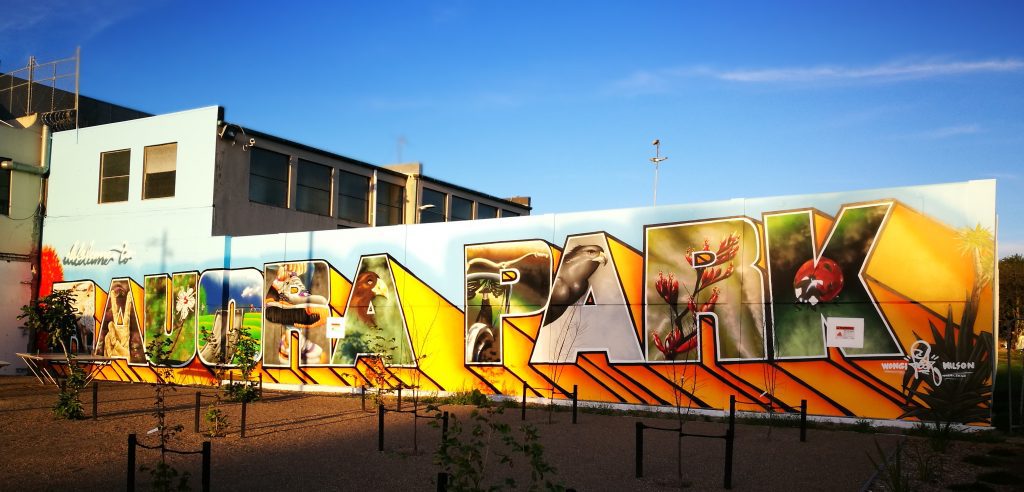
Rauora Park, 2017

I guess that reflects the rise of contemporary muralism and the globe-trotting mural artist, where all these different influences from different environments shape people’s practice, rather than just the specific setting you came up in. I mean it is a hard thing to put a point on, because it is likely to be a philosophical influence, more than a stylistic or technical influence, but still it is sure to be a unique experience and it will be interesting to see how your work evolves as a result…

Yeah, like you said, it’s hard to pin point the whole situation. I don’t know what it will be, but I know something will lend a big impact to that kind of thing…

I remember at Style Walls, you were joking that you will come back as this enlightened soul who always talks about your time in Nepal! (laughs)

Yeah, yeah, ‘that one time in Nepal…’ (laughs) Yeah, as long as I come back wearing shoes you know, not bare footing it around everywhere; ‘I’m just getting back to nature!’ (laughs) So nah, I’m looking forward to it, it is going to be amazing!

Lastly, it is going to be a pretty physically intense experience, I know you got a gym membership in preparation, have you been putting in work?

Yes and no! I went quite hard out for a bit, but then with a lot of work and everything, I haven’t had that time to go the gym and train like I should. I feel I’m pretty active with the work I do anyway, I’m always on my feet, up and down ladders, all that type of thing, so hopefully that is going to be enough to get my fitness level at least up to par. I was talking to one of the head guys from Kathmandu and saying ‘Yeah, I’m going to get my gym pass, I’ve been exercising quite a bit…’ and he just laughed it off and said how one of his mates who kind of helps with the treks, said: ‘Oh you don’t need to go to the gym, you work that out in the first three days!’ So, I’m kind of hopeful that will be the case!

Well, we look forward to catching up when you get back and hearing how it all went and talking more in depth, so go well…

Cheers, man, thanks for your time…

The shirt Wongi has designed for Kathmandu as part of the Artist Series and in honour of the 65th anniversary of Sir Edmund Hillary submitting Everest is now available online or go visit your local Kathmandu store. A portion of each sale goes toward the Australian Himalayan Foundation.

Want to learn more about Wongi?

Check out his website and follow him on Facebook.

Porta – A Helping Hand

A few years ago, I would have said Porta was one of Christchurch’s best kept secrets. But to make such a claim now would be misleading, his street and studio work continue to gain exposure and opportunities to work with an array of amazing talent and in a variety of contexts. Having known Porta for a good while, it is refreshing to be able to say that such reward is justifiable evidence that good things happen to good people. With his infectious energy, he constantly reminds me that getting ‘amped’ on things, as he would say, is a vital ingredient in enjoying what you do.
His array of images, heavily drawing on pop culture and his magpie-like inquisitiveness, have a strong street style, but also a sophistication that has developed with his sustained practice. Primarily a stencil artist, Porta’s work ranges from walls to found objects, such as skateboard decks, reclaimed thrift store paintings, street signs and even randomly recovered pieces of wood and metal, and even extends to large MDF cut-outs and, of course stickers. His images increasingly juxtapose pop culture references with abstract designs, distressed surfaces, or revealing indications of the aerosol medium. These playful qualities ensure his work is both accessible and attractive, easily shifting between locations, while still seeming authentic in approach. I sat down with Porta at his shared studio space Fiksate Studio and Gallery in New Brighton, and we reflected on the various projects and adventures he has experienced over the last several years, his take on his own practice and why ‘liking people’ is always a good starting block…

Although you never admit it, the last several months, actually, several years, have been pretty busy for you! Recently you assisted Dcypher and Oi YOU! with their project at the Christchurch Airport, and a few weeks prior you helped Flox with her Plymouth Lane mural in the central city. You have worked with Oi YOU! quite a bit, so there is a relationship there, but how did the opportunity to work with Flox come about? And what did you make of the experience?
I basically just put up my hand to help out where I could, if she needed it. So, I ended up buffing out big squares of colour for her and filling in some of the letters, so she could stencil over the top. I was mostly on the brush and roller…

Flox making progress on her No Place Like Home mural in Plymouth Lane, central Christchurch. Photo credit: Porta

As a painter by trade, you have a practical versatility to be able to do different kinds of things and help people in different ways, and that’s given you many opportunities to work with artists on an array of projects, as well as influencing your own work. Did you always see those skills as transferrable, that they would open some doors?
Yeah, I feel like still like I’m more skilled behind a brush and roller than I am with a can, any day! (Laughs)

On the flip side, as a stencil artist, did you take the chance to step back and observe Flox’s techniques and learn from her?
I did, and she is really open when chatting about her processes, like just about the stuff she uses to cut her stencils from, and that sort of thing. She’s really open about it all, which is really cool, because sometimes, you can understand why someone might want to keep it to themselves…

I kind of feel like with stencilling there is a mystique about the process sometimes, but when you can pick up little things, you can take them in different directions. For instance, seeing such a large-scale stencil piece being produced must have been a valuable experience for you…
Yeah! The size of that work blew me away. Seeing a stencil being produced at that scale was really impressive, and seeing that it was actually do-able, it was crazy!

Speaking more broadly, not just from the ‘handy on a roller’ perspective, you have a real willingness to offer a hand wherever needed. As a result, you have worked with a wide array of people. Is that attitude just a reflection of your approach to life? Or is it that you see opportunities when they come up?
It’s important to me, I like people, so that’s a good start. From there, I really like street art and I want to see it do well in Christchurch, so it’s a combination of those two things really.

It has been a pretty amazing few years in the city, and in many ways, you’ve been right in the thick of it. Amongst a raft of well-publicised events, there has been the growth of your own ‘baby’, CAP’D, which has now been staged three times. You conceived of CAP’D a few years ago, so what was the initial idea, how has it evolved, and where do you see it going?
I asked people if they would be keen on a show of local artists who worked on the streets or were influenced by that scene. I put it to a few people, ‘what do you think if I did this…?’, and everyone I mentioned it to was just super enthusiastic and receptive to it. I had friends who wanted to be involved and put art in it. So, next thing, it really took off and it was just, ‘well, I guess I’m doing this…’ Which was a cool way to do it because it got me motivated, and the next thing I knew, I had sorted dates, found a place, and people were just so enthusiastic that there was no way I could back down!

I remember when you first started putting it together, it was originally a much smaller idea, but by the time the opening came around, it had grown into something quite different…
The support was amazing, it was meant to be this small, chilled out thing, but it ended up featuring artists from overseas, not just local artists. On the night, it was quite overwhelming, the amount of people who turned up, the amount of art that was there… Which is why for the events after that I had a wee crew of people, with Jen (Jenna-Lynn Brown), Dr Suits (Nathan Ingram) and yourself. It was definitely a team effort after that, which was a relief! (laughs)

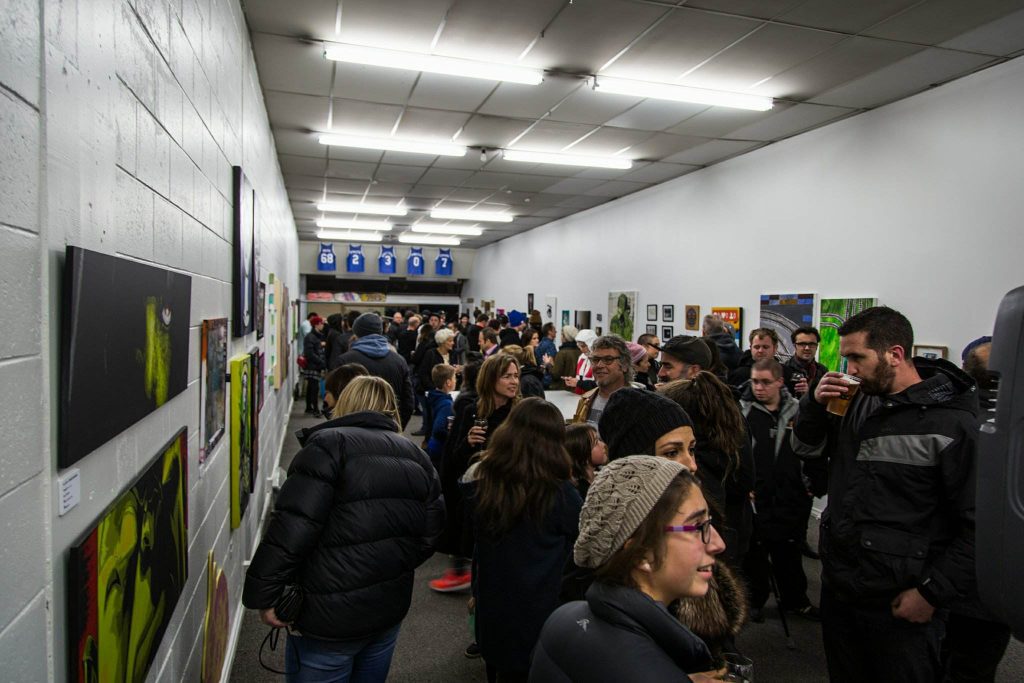
Opening night of the first ever CAPD show, New Brighton, 2015. Photo credit: Abigail Park

I think it showed how Christchurch has an audience that wants to see this kind of art, and these kinds of events, but also it revealed how you can connect with people from overseas, and that those networks are closer than we ever thought. Over the last several years CAP’D has featured artists from Sydney, Barcelona, Japan, Los Angeles and more, but even in the first show, there was work by artists from Melbourne and Brazil, so it kind of set the precedent…
Yeah, that just kind of happened…

It showed you can approach artists from the other side of the world and say: ‘Hey do you want to be part of something?’ and often the response is ‘Yeah!’ Were the positive responses a surprise to you?
It was, because not long before CAP’D, I’d just sort of got into Instagram, and I realised how approachable everyone was, people I considered quite well known, I didn’t expect them to respond to comments but they did, and then I thought, I’ve pushed my luck already, I should ask them if they are keen on being in an exhibition and a lot of them surprised me…

Which must be a good feeling, because that old saying ‘never meet your heroes’, isn’t always true…
Nah, sometimes it’s great to meet your heroes!

So, where do you see CAP’D going? It is now hosted at Fiksate [Design Studio and Gallery in New Brighton], and it has evolved slightly over the last few years, do you think it’s going to keep growing or are you happy for it to keep to a specific scale?
Yeah, I like the size of it. It wasn’t ever anything that was supposed to get bigger and bigger. It was supposed to be pretty small, so now it is the size that it is, and I just want to sort of keep it here, keep promoting new people, new talent, and putting them alongside talent from around New Zealand and the world…

Opening night of the second CAPD show, Fiksate Design Studio and Gallery, New Brighton, 2016. Photo credit: Porta/Abigail Park

That’s the really important part, right? It’s giving a forum for young artists, lesser known artists, artists who come from particular backgrounds, where finding ways to exhibit works can be a real challenge…
Because a lot of these artists are not new artists, it’s just the first time they’ve put their art in this particular kind of environment…

Most of them have been drawing, writing, painting, making in the streets, or some of them in their bedrooms without putting anything out there, and it’s just a case of creating this new forum, so there’s real value there, and it’s partly the response of the artists that reflects that, they appreciate that you’ve created something that gives them the opportunity, so it must feel really good! (Laughs)
It does, it really does.

Talking about CAP’D’s evolution brings up another big development in your artistic life; setting up Fiksate with Dr Suits and Jen. That seems to have provided you with a real stimulus. How did it come about?
So again, I was just yarning with Nath and Jen, and saying I’d be keen on opening a spot, and then we made some connections with people who could make it happen, and all of a sudden, that momentum had picked up, and we had our spot. We did check out a couple of other places around New Brighton, but in hindsight I’m glad they didn’t work out, because our spot seems pretty perfect really…

Do you find being in that collaborative environment has expanded your practice? Does the shared, dedicated setting make it easier to explore ideas than if you were at home in the garage?
Well, I do, but sometimes I think I almost get an equal amount of satisfaction when I’ve been able to help someone get to where they want to be, rather than if I was getting myself somewhere. I think that’s why a lot of the time people want to get together with me, because they know I try to be a willing helper…

When I have been around Fiksate, there is a real feeling of coming together and problem solving, offering advice and feedback. Even when it’s not you making something yourself, that experience of thinking about somebody else’s work can be just as beneficial in the long run… Working with Jen and Nath, who both have quite diverse practices, has watching their different material approaches influenced your stencil making technique?
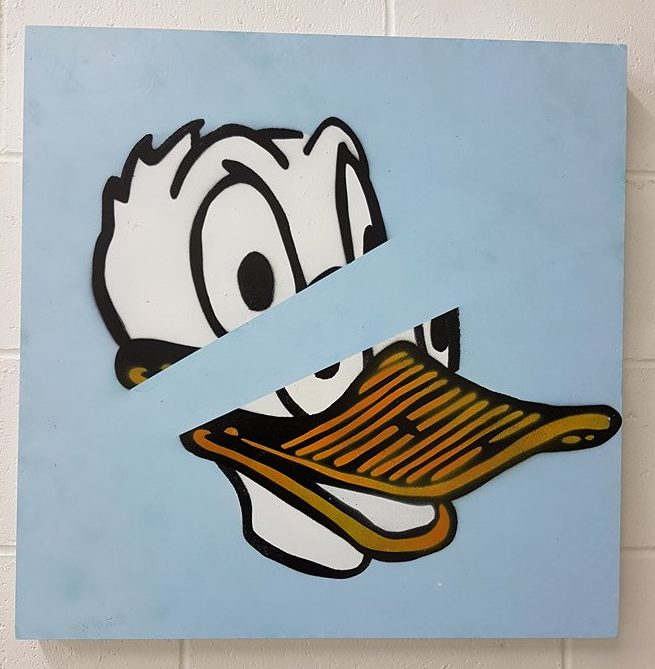
Yeah, (laughing), and it’s made me do things in a way I didn’t think about and to go in directions I didn’t think I would go. Like, Nath will just be buzzing on something I’m doing, and then I’ll be buzzing off something he’s doing, and then when we are all finished, whatever we have made will usually have a few similarities (laughs) and not on purpose, but we just realise we are both being so inspired by what is happening in the studio that it comes out in our work… Like with the piece I did for Blind Date, which was an exhibition for First Thursdays last year, and probably the series of Donald Duck works that came from that, I think they came together in that way, even though the piece was a colab with another artist, Kara Burrows, we kind of worked separately, and it was at the studio that my part really came together. I feel like Nath had a bunch to do with that, and you were there that night too… I was trying something new and you guys were getting really hyped off the stuff I was doing, and I think that excitement came out in the work, so yeah, I think that is what it’s all about, just getting each other really hyped on the new stuff you’re doing and then you want to do heaps of it and take it further…

Collaboration with Kara Burrows for Blind Date, part of the First Thursdays event, Dilana Rugs, Sydenham, 2017. Photo credit: Porta

Tell me about the development of your stencil style over time, because, to me, your stencils, despite their diverse nature, from the actual images to the material surfaces you use, they always seem to reflect a street vibe, how did you get started?
I think I had been influenced by a stencil I saw in town, on Manchester Street years ago, like in the mid to late nineties, so I tried to make a stencil, I was listening to a bunch of Foo Fighters, and I tried to make a Dave Grohl stencil and I ended up with a bunch of shredded cardboard that didn’t stay together and I just hiffed it away! Then I sort of revisited it, it must have been four of five years later…

It seems like everyone’s first attempt is always some pop culture icon, a musician or an actor… Do you think it has something to do with the medium? Does the technique encourage you to try and produce something realistic, and then we are just drawn in by pop culture through the image saturation of celebrities? Maybe it’s just the association of that type of imagery with street art’s vocabulary and traditions, that immediately recognisable image to grab someone’s attention…
That’s funny when I think about it, I don’t know why that would be, but it does seem true, they are probably the things that are making an impact on your life at the time. Thinking about those early stencils, I used to make stencils from the outside cover of an exercise book from school, and you just sort of made do. I think I had a huckery old craft knife. I think the drawing I did of Dave Grohl, I was pretty amped on it, and then I just tried to make it into a stencil and I couldn’t quite pull it together!

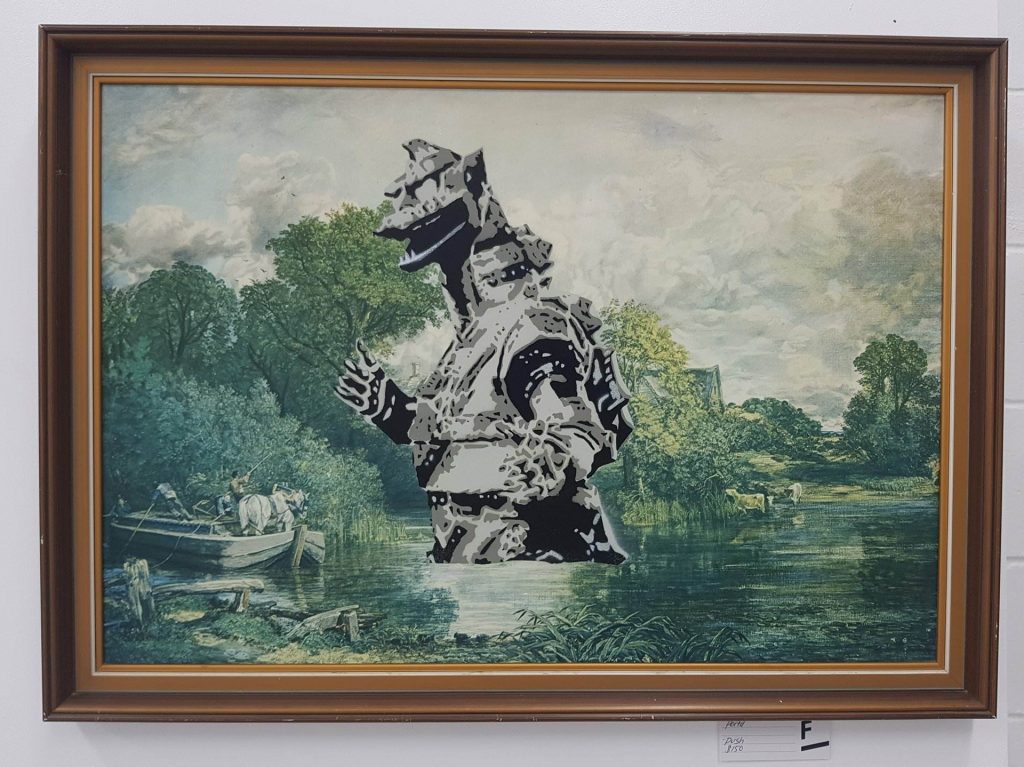
Godzilla, stencil on reclaimed framed print, 2016. Photo credit: Porta

It’s a technique where there is value in just trying and failing, and then starting again. I think there is also a lack of pretense as well, I mean using the cover of an exercise book, using a cereal box, like that approach is entirely fitting, and even now, you’ll know, you have a preferred method to use to cut stencils, but it varies wildly, different people use different things and it’s all about the way they’ve developed their techniques. So, then you picked it back up after murdering Dave…
Maybe four years ago? Maybe more, I can’t pin-point it. I know the next one I did was based on a sketch of R2D2 [the droid from Star Wars] that I’d done, it’s on the rubbish bin at home, that’s the only place it ever went, but I think from there I started messing round with the technique more and more…

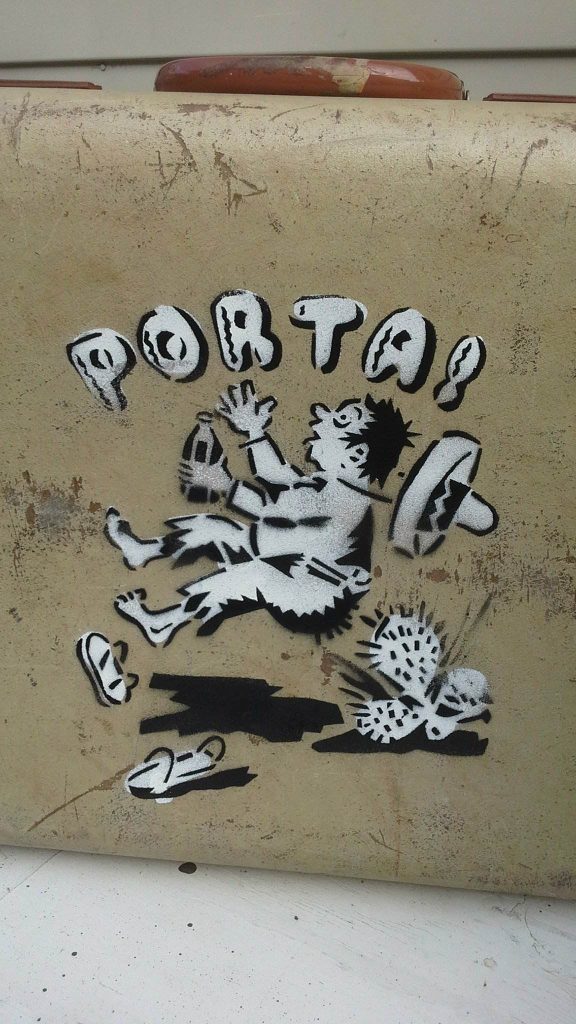
Porta!, stencil on reclaimed suitcase, 2015

Who were your influences? Who, or what made you think, ‘Yeah, stencils are for me…’?
Of course, Banksy would have been an influence and I think he’s great. I liked that he was doing things I didn’t expect. I mean everyone likes to be surprised, and when I saw what he was doing, it made me want to try different things. But there were other people too. I like a Mexican artist called Acamonchi. I like his punk style, I was never into punk so much, but his style and that aesthetic just appealed to me, it was gritty and dirty and cheeky, the images were sort of taking a whole heap of ideas and layering them up in a messy way, just making really interesting mash-ups that came together super well, in a really free sort of way.

Can, stencil on MDF board, 2015. Photo credit: Porta

Even though graffiti is so strongly entwined with hip hop, for the wider street art culture, or post-graffiti, and I guess some graffiti writers, punk is a really significant influence, in visual style, material forms, like the influence of band fliers and posters, and of course the anarchic, DIY attitude…
Yeah, there is definitely a strong punk influence in the history of stencilling, it’s an unavoidable influence.

Did you primarily see stencilling as a street technique, or did you also perceive it as something that could transfer from wall to canvas, so to speak?
When I started I just wanted it to be on the street, I didn’t ever want to stencil on something you could keep. But then over time, I started appreciating the time you could spend on a stencil, that you could layer them up. Then I started wanting them to, you know, stick around a bit longer, and just look at them and see what I was going to do with my next one, stuff like that…

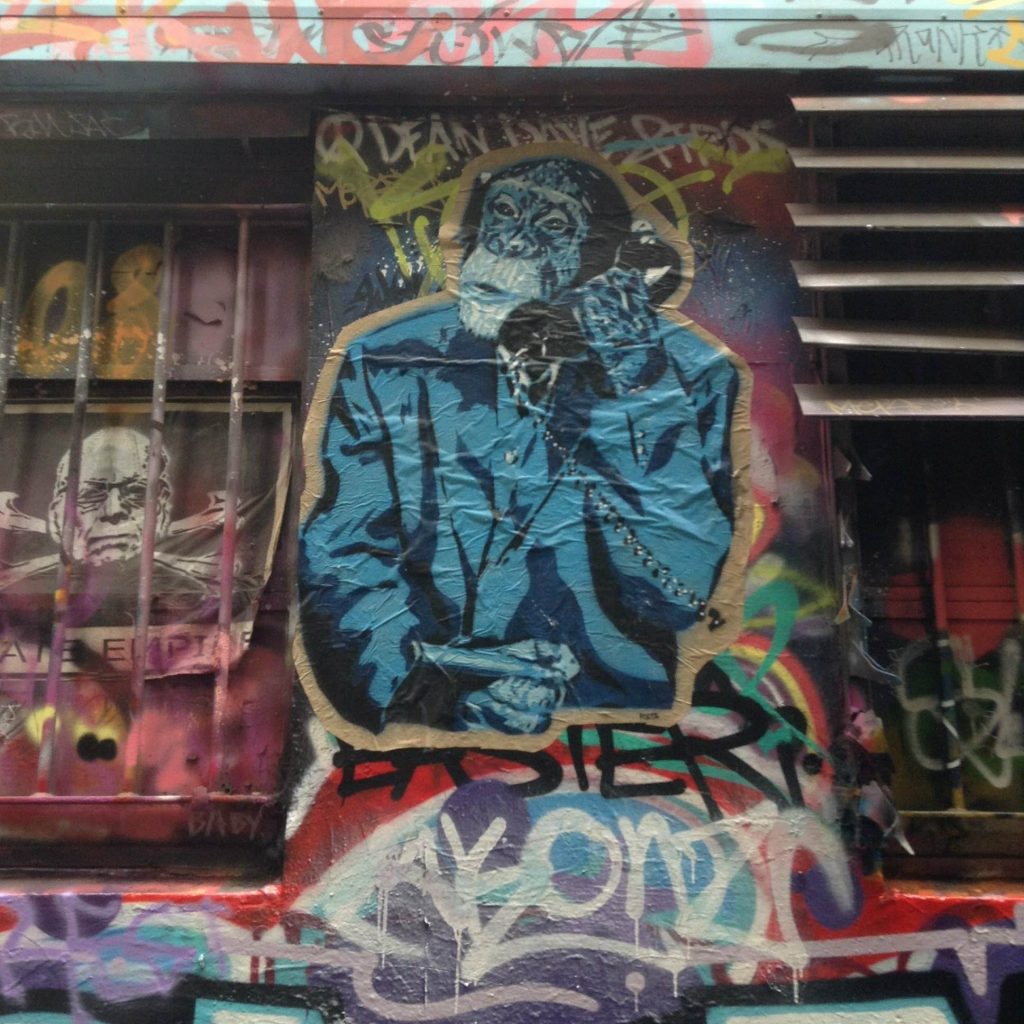
Monkey, Melbourne, 2016. Photo credit: Porta

Now you work on a whole range of different surfaces and objects, but in many ways, they retain a sense of street work, at least in their visual style. While stencils are your primary method, your other love is stickers and slaps…
Yeah, definitely!

You have made thousands of stickers; hand-drawn, stencilled, you have even used block printing techniques, when did you start to making stickers? Did that come after starting to cut stencils?
That would’ve come before. I was always trying to draw stuff and I think one of the guys who influenced the sticker side of things for me was definitely [Christchurch artist] Xpres. He’s always been a real sticker guy, he’s always collected them, always made them, always putting them up around the streets, always with really nice hand styles. Eventually I found out the sticker culture was big in America. I was on the internet all the time trying to find out more, and I discovered a magazine called Peel Magazine, that I couldn’t actually get in New Zealand, but I could find stuff about it online, and so I just got real obsessed with that for a bit. I also came across a guy called Chris RWK, doing these designs called Robots Will Kill, and I just thought what he was doing was so cool, and the more I looked into it, the more I liked it. I think stickers, even though I do stencils, stickers will always be my favourite…

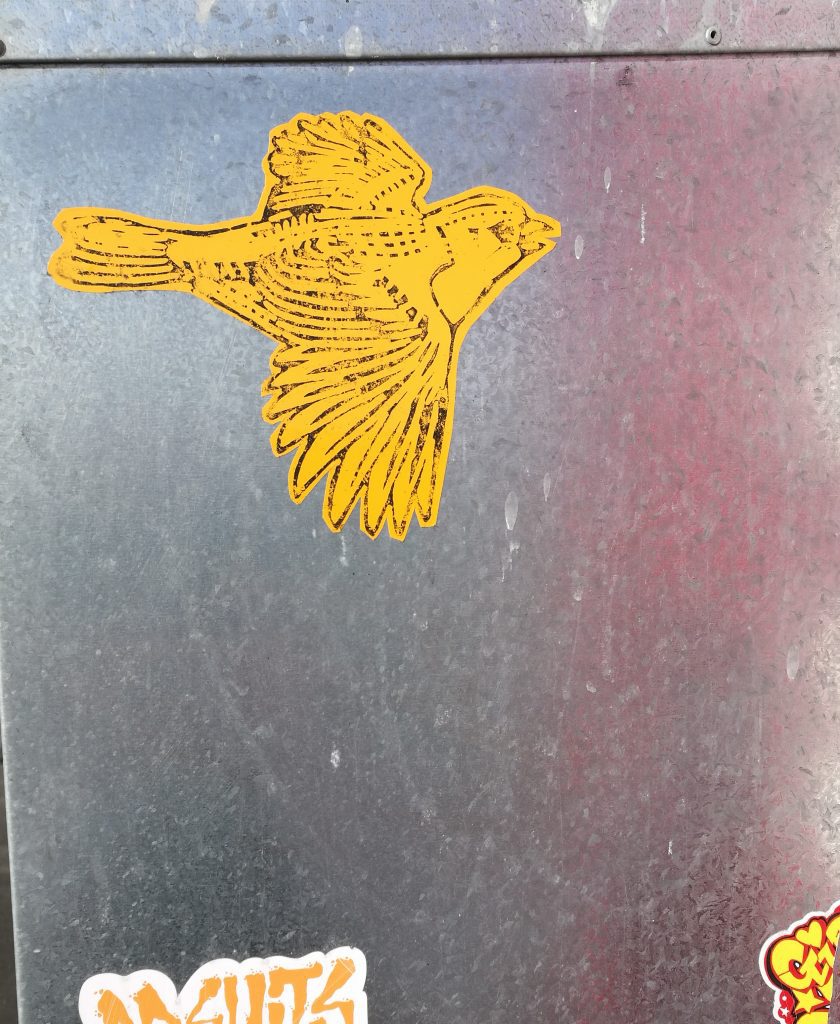
Sparrow, hand printed sticker, 2016

Speaking of stickers and Xpres, we were lucky enough to be involved with the ‘Stick ‘Em Up’ room for the first Spectrum show at the YMCA in 2014, and I remember how deep you got into the concept there, which was built on the idea of social media networks and dissemination, which was how we collected so many stickers from all over the world. You were just hounding people for stickers! What are your memories of that whole experience?
Again, I think it was before Facebook and Instagram worked the way they do now, because they play with the algorithms and stuff, but at the time, when people put stuff up, you saw it right away, and so we were messaging all these sticker artists we stumbled across, I was getting in touch with them, telling them about this event and trying to get them interested by name dropping people who were going to be in the show. And so many people, like eight out of ten people, were keen to be in it and then two would be like: ‘This some sort of scam and you just want to get some free art off me!’ (Laughs) Which I understand!

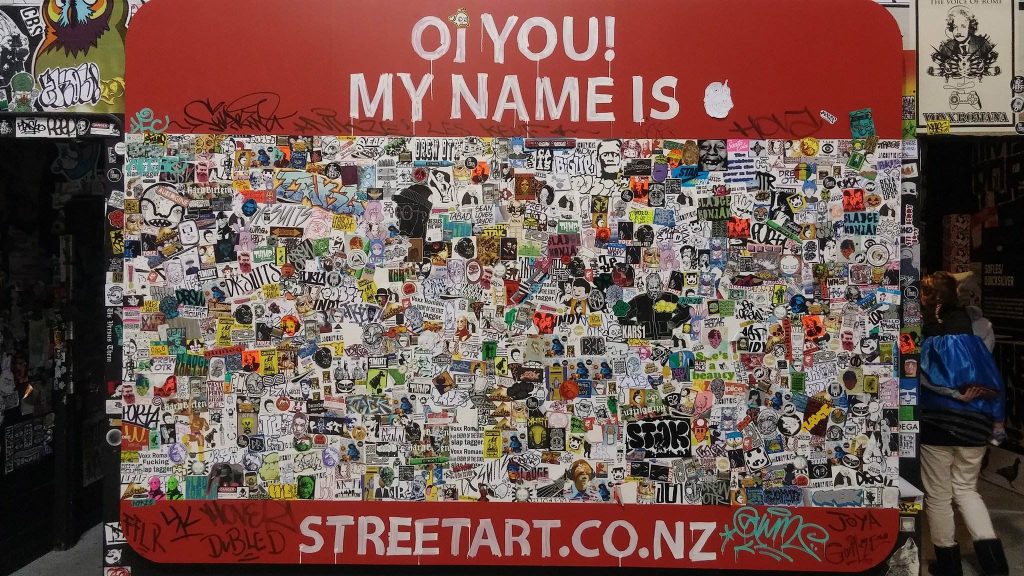
The My Name IS… sticker board from the Stick Em Up room, Spectrum, 2016. Photo Credit: Porta

Yeah, it is understandable because of the nature of social media interaction, but it also shows that if don’t ask, you’ll never know…
Exactly, I remember, I had this book and I had written down, I think there was close to 800 people that I had contacted! Some people didn’t get back to me, but I remember thinking: ‘Man, it would be a crack up if on the day we are able to start the room, we had a big sack of stickers’, and I didn’t see it happening, but that was exactly what happened, like exactly! With that project, the other thing that sticks out was the whole team thing as well. It was Xpres, Nathan, Jen, yourself, and me, and I think it was such a cool team and we were all getting amped, everyday when something new turned up in the post we were just so excited, I’ve never been so amped!

For me, the temporary nature of that project was really cool, the fact that it is no longer there, that you can’t go and see it anymore, it’s an experience that was so ephemeral, and yet completely consumed our little team for so long, and we were so involved in the evolution of that space…
It’s like, was it even real? (Laughs) I walked around the room and made a video and I sometimes have a look at that. It was pretty cool…

You have been exhibiting more and more over the last few years, with CAP’D, at Fiksate, First Thursdays, and recently in some shows at the Welder Collective, are you more comfortable about making work to exhibit, or is it still something you are coming to terms with?
I don’t know if I’ll ever be super comfortable with it, but yeah, I’m more comfortable with it than I was at the start. But I’m a chronic procrastinator as well, so I’m always doing stuff down to the line and luckily a lot of the people I’m working with know me well and are quite patient (laughs), which I appreciate, because I know I always cut it fine! I don’t know why, it’s like if there’s no urgency, there’s no priority. But, I did always say, right from the start, if I ever felt like I was being pressured with this stuff and it wasn’t fun, I would stop. I do wonder if I get a buzz off doing stuff at the last minute…

Porta’s stencils, left, alongside Finn Wilson’s work, from the Face Value exhibition, Fiksate Design Studio and Gallery, 2017

You need the adrenaline?
That could be it, I don’t know, I’m just sort of thinking that i always seems to end up that way!

As well as exhibiting more often, and helping other artists, you have been doing some of your own public work, probably the most noticeable larger public piece you did was the First Thursdays billboard on Colombo Street in 2016. Do you want to do more outdoor legal commissions, or you would rather make smaller stencils and make stickers?
I think that smaller stuff is really my style, but after working with Flox and seeing how she made that larger scale stuff look really fun, I think it would be cool to revisit it. That panel I did for First Thursdays was a bit of a nightmare, it was a bit of learning curve. The stuff I made my stencil out of was too light, and as I went to hang it up the wind came up. I was so stressed out, I didn’t enjoy it so much. I was so relieved when it was all over, which has made me not really want to do that size again, but then again, working with Flox, she made it look like something that can be quite manageable, and that makes it attractive again.

Portas billboard for the Life Aquatic themed First Thursday event, Colombo Street, Sydenham, 2016. Photo Credit: Abigail Park

Making large scale stencils does bring a whole heap of challenges, especially when working in a public space. I guess often it comes down to compartmentalising the process, and that relates back to the stencil process itself: when you make a stencil, you cut layers and build those layers, so in making a larger scale work, it’s sort of the same principle, in that if you make those layers manageable, and build it piece by piece, you can take away some of the problems…
The other person who is great to work with and watch as far as doing large scale stuff, is Joel Hart, just seeing how, I don’t want to say he cuts corners, but I’ll feel like there is a way to do it and he’ll go: ‘Nah, there’s an easier way’, and he’ll just think outside the box and think of something different, and it’s amazing, it’s so cool to watch.

Speaking of local artists, who are you excited about? Who do you always keep an eye out for in the streets?
I am really interested to see what Kill is going to do next. I enjoy him because I never can predict what he is going to do. I sort of feel like maybe he is drifting towards doing more music, but that dude never fails to surprise you, which is great. I remember the first time I ever met Joel Hart, looking back, I was doing a market with these budget as, horrible stencils and he wandered up and his little girl was with him and we just got talking and he said he liked stencils, he didn’t say anything else and I was like would your girl like one of these, and I just gave it to her, and now I wish I had given him a better one! (Laughs) But from there, he took off with his stencils and got all famous and stuff! (Laughs) But it’s funny how things work out. I love seeing his stuff, I get amped seeing his work…

A few months ago, you helped Dr Suits with his piece for the Carnaby Lane event in New Brighton, which Joel was also part of, it looked like a fun day…
It was great! That was so much fun. I had so much fun with that. It was originally supposed to be a collaboration, but just the way things went, we ended up working with one of Nathan’s designs. So, I ended up helping him more than putting my own design up, but I just had an absolute ball. I’ve never been so relaxed working on a big piece, working outside. Nath’s just so chill about everything, and the sponsor was flicking us beers, so we were pretty happy!

Porta at work on the Carnaby Lane mural, New Brighton, November 2017

In a way, that brings us full circle to where we started: you got to use your painting skills, cutting in, masking off, to help someone out…
Yeah, I’m stoked when those skills are useful, I think that’s where my talents maybe really lie!

I think everybody knows you’re a man of many talents! So, what is coming up in the next few months?
I am going to be part of Stoked, which is an exhibition of surf-inspired art as part of the Duke Festival in New Brighton, and then we have a Fiksate show, Visitors, at The Welder on the 16th March, which should be good times, New Brighton comes to the city! Come and check it out!

Cheers Porta!

Visitors opens at The Welder on Welles Street on Friday, March 16, at 5:30pm. Alongside Porta, Visitors also features work by Jen, Dr Suits, Bols and MFC Lowt.

Follow Porta on Instagram

Roll Call – Style Walls 2018

Style Walls is back!

Style Walls has become an institution in the city’s post-quake urban art scene, and this Saturday it returns for its fourth incarnation. Style Walls 2018 will be staged at the youth park on the corner of Manchester and Lichfield Streets, with the competitors adorning the giant free-for-all spray cans, a further activation of the unique space’s stated role as an evolving art space.

One of the five giant cans competitors will paint for Style Walls 2018

Established and run by the legendary DTR crew, Style Walls will pit five finalists against each other in a live, head-to-head battle format that both celebrates the traditions of graffiti and embraces the inherently competitive nature of the sub-culture, where outdoing others is always the goal. Furthermore, and perhaps most importantly, the supported setting aims to encourage young and emerging artists to push their talents and drive the city’s creative graffiti scene forward. Ikarus, one of the founders and organisers of Style Walls, (as well as a competition judge), explains that the event is all about growth and progression: “Seeing the guys who were in early  battles improve and continue over the last few years has been great…”, he also adds that it provides a sense of aspiration for young graffiti artists who “look forward to being involved when they are at a higher skill level, so it gives kids something to work towards as well.”

The 2018 finalists were chosen from an array of submissions, a task that Ikarus believes “is getting harder because the level and amount of entries is increasing each year.” The five finalists, Twiks, GOR1, Wyse, Exact and Germ will do battle over three rounds. Judges will score competitors on various criteria (such as style, can control, use of space and use of colour) and a winner will be declared after each round. The supreme winner will be determined by the highest cumulative score following all three rounds. With iconic paint brand Ironlak on board as sponsors, winners will be rewarded with prizes, but perhaps the truly crowning glory will be found in the bragging rights earned by the champion.

The inaugural 2014 Style Walls final, held in the central city’s Re:Start Mall

Style Walls is an important event in the city’s urban art, and specifically graffiti, scenes, providing a unique forum for local graffiti artists to be supported and celebrated, all within the internal values established and evolved over generations. Despite interest from stencil artists (a sign of the expanding influence of graffiti and street art on the city’s creative scene), Style Walls maintains a singular focus on free-hand graffiti artists, and elements such as letter-forms and can control, which is a significant stance and a reflection of the event’s explicit goals. Ikarus accepts that it is not surprising to see “more non-traditional graffiti and street art entries as the popularity and public acceptance rises…” Style Walls recognises the limited opportunities of this type for graffiti artists in Christchurch, where the positive attitude towards ‘street art’ often still marginalises pure, letter-based graffiti, and the specific qualities of the influential artistic sub-culture that truly spawned urban art as we know it today. And while Ikarus acknowledges that the variety in the city’s urban art scene is a good thing, he asserts that it is important Style Walls keeps things of a more traditional graffiti nature: “because there are still very few avenues for the art form to be seen in a positive light, whereas the new wave of street art gains an easier, more immediate popularity because it is more pretty pictures than bold, stylised fonts, and that is easier for your average person to relate to or understand.”

So, who will come out on top? Head along to Style Walls 2018 to find out…

Style Walls 2018 kicks off at 1:30pm on Saturday, February 24th, at the Youth Park, corner of Manchester and Lichfield Streets in the central city. Visit www.stylewalls.co.nz or look for Style Walls on Facebook for more information…

Shraddha Shrestha – Shared Lines

Shraddha Shrestha is an example of street art’s truly global spread. In mid-September 2017, the Nepalese designer, illustrator and street artist arrived in Christchurch, by way of Glasgow (where she was completing her master’s degree in design), as a guest of local adventure clothing company Kathmandu. Shraddha’s journey to Christchurch signalled her selection as the inaugural artist for Kathmandu’s ‘Artist Series’ t-shirt collection, a project in support of the Australian Himalayan Foundation.

Shraddha’s arrival was marked by a ‘Nepalese street party’, where she and local hero Wongi Wilson painted on shutter doors in the laneway outside Kathmandu’s offices in the ‘Innovation Precinct’. Also featuring music and food trucks, the event provided a lively activation of the inner city area. Shraddha’s t-shirt design for Kathmandu, Yeti meets doko, exemplifies the artist’s distinct style; a mixture of contemporary illustration and pop culture with old world references. Her whimsical imagery and repeated patterns are immediately endearing, drawing on her own cultural identity and love of popular culture, meshing together in a playful, but often poignant synthesis.

I was able to get to know the softly spoken Shraddha as she painted a wall in New Brighton, observing her approach and chatting in between painting sessions. After initially planning to sit down and record an interview, a series of unexpected obstacles instead ensured we conducted a back and forth via e-mail in the weeks following Shraddha’s departure. The result is an interesting insight into Shraddha’s background, her perceptions of Christchurch and the growth of street art in Nepal…  

Shraddha, tell us more about how you came to be in Christchurch. What is the Himalayan Foundation Art Award and what impact has it had on your career?

I was awarded the Australian Himalayan Foundation Artist Fellowship in 2015 by the Australian Himalayan Foundation (AHF). The AHF is an NGO (a not-for-profit non-governmental organisation) in Sydney, Australia, who work towards the improvement of life in the mountains of Nepal through things like education, health and sanitation. Each year the AHF awards fellowships to two artists from Nepal, and I was one of the artists in 2015.

Through this recognition, I was connected with the clothing company Kathmandu, who collaborate with AHF and have been contributing to the education, health and welfare of the communities in the mountains of Nepal. This year (2017) is Kathmandu’s 30th anniversary, and for the occasion they were planning to bring out a limited-edition t-shirt designed by an artist from Kathmandu. So that’s where I come in. In September 2017, they invited me to the t-shirt launch in Christchurch. I was also invited to an AHF fundraising gala dinner programme in Sydney.

The fellowship has allowed artists to create their own bodies of work and exhibit in the very well reputed Siddhartha Art Gallery in Kathmandu, Nepal. Winning the fellowship was a huge deal, as I was supported to create my own exhibition. After the exhibition and the fellowship, I am now one of the contributors towards AHF and it’s social work in my community. The award also helped me build a stronger portfolio and to get connected with many art enthusiasts and art buyers in Nepal.

How did you find working with Kathmandu? For many artists, it is important to know that any company they work with has a strong ethical foundation…

Working with Kathmandu was an absolute pleasure, they have been very supportive. I did not know the company properly before, I just knew that their brand name was the same as my home town. After I started working with them and after I visited the head office in Christchurch, I was surprised by how much work and time they invest in creating their products and trying to make them as environmentally friendly and ethical as possible. I got to meet the team there which was amazing! Most importantly, I observed that the people working for Kathmandu are so motivated and conscious about how the company works and their objective of making ethically manufactured products.

Shraddha’s painting for the Kathmandu laneway party and t-shirt launch, outside the central city Kathmandu offices.

While you were in Christchurch, you managed to fit in quite a few adventures. You spent time in the North Canterbury village of Cust, painted in both the CDB and New Brighton, and you also went surfing and skiing. What were some of your impressions of Christchurch?

I found Christchurch very interesting, unlike other big cities, I felt it was very open and spacious. It must be because of the earthquakes, since there were less high-rise buildings. It felt like Christchurch had a bigger sky! Since I am from Nepal, I am more used to hills and mountains than flat land, so when I saw hills when I was in Christchurch, it felt a little bit like travelling back home. It was so amazing that you could see the mountains and the sea in one day! The sea always fascinates me because we don’t have oceans back home. The first time I saw the sea or touched sea water was just two years ago. I like adventure sport and I like trying out new things. When I was searching the internet for things that I could do during my visit to New Zealand, skiing and surfing were suggested. I had to do both as there is no skiing in the mountains and there is no sea to surf in Nepal. And I did it! and I loved it! I will definitely do it again if I get a chance.

I found the people in Christchurch very friendly and sweet! I especially felt this when I was working on the wall in New Brighton. Many people who passed by the wall smiled and greeted me and talked to me. It was very nice to talk to them and talk about the artwork I was doing. Moreover, they were from different age groups, small kids or old grandmothers, they seemed to be interested in what I was doing in their part of the city and they tried to talk to me which is really nice and heart-warming. Even today I get messages from people from New Brighton in my Instagram, complimenting me about the wall and asking me if I am still there! They make me want to come back again!

It was also interesting to see how the street art scene has become an important part of the city. The people of Christchurch love their street art and the street artists! They have accepted the art form as a way of them rising from the devastation of the earthquakes and a way of rebuilding which is very positive and motivating. I feel that it not only promotes the art form and the artists, it also makes art as a part of life and the city’s development. We need this approach and attitude back home in Nepal as we are rebuilding from the effects of an earthquake too. [Nepal suffered a massive earthquake in April 2015, with thousands of people dead] We are also trying to help people to get over the devastation through art events, workshops and of course street art. Now I feel that we need to continue this process like Christchurch has done.

Shraddha’s mural on Switch Espresso in New Brighton

How did the shared earthquake experiences of both Christchurch and Nepal influence your perception of Christchurch’s ongoing rebuild?

As I explained before, I found it very motivating as an artist and as an art lover how the city of Christchurch has accepted art to re-emerge and rebuild from the natural disaster. But I also think there are other connections between Kathmandu and Christchurch, or even Nepal and New Zealand more generally, other than the earthquakes, for instance, Sir Edmund Hillary climbing Mt. Everest along with Tenzing Norgay Sherpa, a Nepali mountaineer. During my trip to New Zealand, I talked to some people who sadly did not know the place ‘Kathmandu’, they only knew ‘Kathmandu’ as an outdoor adventure clothing brand, so I guess it depends on who you talk to…

You explained that street art is very new in Nepal – there is really only five or six years of history. How did you come to be a part of the culture and how did you start? Did you have any specific influences?

Yes, street art is very new in Nepal. Although, we have traditional and religious murals which are hundreds of years old, the contemporary idea of street art is new. The street art scene started to grow in Kathmandu around 2010. During my Bachelor’s program around 2008, I was very interested in graffiti. I used to see it on television, like on MTV and Vh1 music videos and in magazines and books. Also, in Kathmandu, we have a lot of political vandalism, political writing and propaganda on the walls. If you ever visit Kathmandu, you would see a lot of big writing in red colour. I used to think, if people can do that, then why not do it in an artistic way like graffiti? I started to sketch, make my own graffiti in my drawing book and tried to copy the style of graffiti artists. That’s how I started to explore. At that time, street art was very rare in Kathmandu, and very little graffiti could be found in small alley ways and in some restaurants made by some tourists visiting Kathmandu.

Later, around 2010, a French artist based in the USA, Bruno Levy, produced big pieces in several parts of the city of Kathmandu. His works were very vibrant and provoking. After seeing his work around the city, I felt that if a foreign artist can do it why are not any local artists doing it? I think from his work the young artists of Kathmandu really got into the medium. Me and my other friends then started to work together and experiment in the street. The good thing there was that it’s not illegal to paint on the street like other cities all over the world. We could paint in the broad day light and nobody would stop us, unless it was a private home or property. That’s how I started painting on the street. From there, our group got bigger, we had more artists who were interested in street art like us. We did a lot of collaborative works creating big pieces. Gradually street art projects started to happen which brought in other street artists from other countries, commercial companies, embassies, and NGOs started to recognise the art form and its growing public profile. So, artists started to get support from these types of organisations. At present street art is one of the growing art forms in Nepal and I can say that within these short six to seven years, we have been successful in bringing up many talented artists who right now have been successful in showcasing their works worldwide. Of course, street art is a truly global attraction, so it isn’t surprising that it made its way to Nepal as well.

Is there a graffiti culture in Nepal that is at the roots of street art, or has the culture grown from different influences – travelling artists, online access to the global popularity of street art?

The street art culture has definitely grown from different influences. Travelling artists, online access to the global popularity of street art, media like television and books and magazines, local artists travelling abroad and more.

Did working in the streets influence your illustrative style, or was your street art influenced by your illustrative practice and the art you were already making? And how have these influences evolved?

My street art is influenced by my illustrative practice and my drawings. I was already working as an illustrator and graphic designer when I started with street art. I started with characters and free-style graffiti. I enjoyed how my small drawings of these characters transformed after I painted them on the street. It is like watching a tiny thing grow into something huge, which fascinates me a lot.

I am very much into stories, children books and character designs. I like the concept of monsters and aliens and I am very much fascinated by the iconography of Hinduism and Buddhism. I try to merge the traditional icons with modern styles and create my own characters. I am from an indigenous society from Kathmandu known as Newars, whose lifestyle is heavily influenced by Hindu and Buddhist religion and iconography. Therefore, my art works are inspired by these influences.

I am also into stories and narrations, I do storybooks, zines, comics. One of my inspirations is Herakut, I love their illustrative style and the messages and stories behind their work.

I love the mixture of your local culture with the influence of 90s cartoons, can you explain more about this combination? It also feels like there is a strong narrative element in your work, but it is subtle and suggested rather than too obvious – are there autobiographical details or do they draw from observations, or fables/stories etc.?

I grew up in a very old city called ‘Patan’ in Nepal in a traditional society. It is surrounded by medieval temples and palaces and is famous for its wood and stone carvings and metal sculptures of Hindu and Buddhist deities. As I said, I am very interested in Hindu and Buddhist iconography. For example, Hindu gods have three eyes, ten hands, four heads and blue skin. These are some of the unique physical characters of how we depict religious icons in the Hindu mythology. However, if we look further, some of these characters resemble how extra-terrestrial life, aliens and monsters are portrayed, especially in animation and movies. For instance, animations like the Power Puff Girls, and movies like Monsters Inc., they all have characters which share somewhat similar physical characteristics to our mythological icons.

Hinduism is based in cosmology and spirituality and does not have any fixed governing bodies. It is more of beliefs and traditions that on should follow. Therefore, perhaps, these religious icons too are from the outer space, perhaps, the gods and goddesses reside in the eternal galaxy. This is the idea that I play with when I design my characters. Therefore, these characters look whimsical and often monster-like.

Your process combines stencils and freehand painting, creating a strong, crisp graphic style. How did you come to explore the stencil technique? Particularly the repeated forms that create decorative patterns…

The work is very much inspired by Bruno Levy, the use of stencils and patterns too. Also, Nepali culture has lots of patterns like in traditional clothing and architecture, so I try to bring it into my art work. I like stencilling because it is a very efficient medium. I like my work to be neat, with sharp clean lines and fills, which is another reason why I am drawn to stencils.

Local hero Porta lent a hand for Shraddha’s New Brighton piece.

Watching you paint, you seem both very thoughtful but also very confident in a technical manner – do you feel that combination when you are working? 

I am not that confident technically to be honest! I do not have much experience working with spray cans. Back home we don’t get proper graffiti spray cans. Therefore, whenever I get the chance to use brands like Montana or Molotow, I get very excited and try to learn as much as I can. I used to work with acrylic paints back home. I am more confident using a brush. I have to have a sketch before I paint on a wall. I need to do the basic planning at least before I start. I find it difficult if I do not have a sketch, and get very conscious of making any mistakes. Perhaps that is why I do the outline with a brush as am not confident with free-hand spray paint. Since I have graphic design as my background, I feel that my work is very graphic, using flat colours, patterns, bold outlines and more. I apply this style to my murals too.

Thanks Shraddha, I hope we see in Christchurch again soon! 

Follow Shraddha on Instagram (Macha_73) and online (https://shraddhashrestha.carbonmade.com)

Cinzah – Something Bigger

Napier artist Cinzah has a calm, relaxed demeanour. But that laid-back manner belies his busy schedule. The artist, whose work spans muralism, fine art, illustration and beyond (in 2012, along with his friend, filmmaker Karl Sheridan, Cinzah produced Dregs, the first feature-length documentary film about the New Zealand street art scene), is a regular in festivals around New Zealand, Australia and further afield, exhibits his studio work, completes commercial commissions, and in addition serves as the regional director for the Sea Walls New Zealand mural festival, working with the international PangeaSeed Foundation, a not-for-profit ocean conservation organisation. Add to the mix a young family, and you get the feeling that you might be able to do more with your time.

I first met Cinzah in 2012 while he was shooting through Christchurch on his way to Dunedin to film for Dregs. I was able to hang out, watching while he painted a wall in a dishevelled post-quake New Brighton well into the night. Some five years later, we were able to catch up as he painted another wall in New Brighton, this time for the event Street Prints Ōtautahi. There was a fitting quality to his Street Prints station, returning to the seaside village, but this time under very different conditions and surroundings. We sat down at a rowdy suburban pub, and between bursts of classic rock cover music, reflected on Cinzah’s varied experiences, his distinctive style, and the street art and mural culture in Aotearoa…

So, Cinzah, like many of the other Street Prints Ōtautahi artists, it has been a pretty busy few weeks, you basically arrived in Christchurch straight from the Street Prints Mauao event in Mt Maunganui. With such a hectic schedule have you had a chance to think about the different environments? Although both events come under the Street Prints umbrella, just from a physical point of view, they seem like quite different locations in which to be painting, have you reflected on the change in setting and the distinct qualities of each event?

We kind of all just arrived and hit the ground running. It’s been flat out from Street Prints Mauao up in Tauranga, straight down to Ōtautahi. But yeah there’s definitely differences, in terms of the geographies. Tauranga, Mt Maunganui, it’s a very beachy town, with summer vibes you know, it is very tourist-orientated, whereas down here,  the architecture’s completely different, the mix of gothic and Victorian English styles and straight up rubble and construction stands apart from the Mount. Obviously, things are still in repair and there’s a lot that’s still going on, it’s also really interesting to see how the quake and rebuild has affected the local graffiti scene, with the last few years of festival-produced works, large scale commissions as well as the juxtaposition with unconventional, un-commissioned, guerrilla works and interventions, like the array of graffiti.  It’s good to see all the different elements of the culture are alive and thriving. There’s basically no graffiti in Mt Maunganui, apart from what we’ve produced over the last few festivals there. (Laughs) So yeah, that’s an immediate difference…

There is an echo for you specifically at least, painting by the sea in New Brighton, you’ve still got the ocean air…

Yeah, exactly, except that it’s arctic! The easterlies are chilling my balls! (Laughs)

Welcome to Christchurch! (Laughs)

Yeah! (Laughs)

There’s also a nice personal narrative for you because in 2012 you painted in New Brighton during a brief stop-over in Christchurch. Looking back, how has the area changed in terms of your personal recollection?

There’s a lot more art. More public works, graffiti, interesting uses of abandoned spaces, some good cafes, and Fiksate Gallery is an awesome little addition to the hood.  When I came through in 2012, there were the odd piece around, the main mall was all just shut shops, there was basically nothing open. I started painting one little semi-abando (abandoned building), which had been partly demolished, and I remember one guy coming out, I don’t know if he had one of the businesses there, but he basically gave me permission to paint the entire street: ‘Oh yeah, you can paint here, or you can paint here, you can do this shop or that shop…’  It’s great to see positive changes here, there’s a lot of potential for this neighbourhood, its good to see people inhabiting these spaces and the community taking ownership.  New Brighton is heading in a positive direction.

Cinzah’s piece in New Brighton, 2012. The building was eventually demolished in 2013.

You have a lot of festival experience; do you have a process for getting to know cities and places? Is it just hit the ground running and get a vibe as you go, or do you like to spend a little bit of time exploring before you start painting?

Definitely, if the schedule and life allows, I like to have a day or so on the ground to acclimatise and adjust to my environment and the surroundings. I like to get out within the community and meet people and talk and get a feel for what’s going to work in that environment, what sort of work would suit, depending on what is going on around there, and also just to get a feel for whether the community is supportive. Is art really going to add to that environment or will it detract from things that might be happening there?  I usually have a preconceived idea, or concept mocked up before arriving, but I like to allow room for this to breathe, grow and be influenced by my surroundings and experiences that may present themselves.

There is a definite responsibility, right? It feels as though within the muralism movement there is a growing recognition of the need to respect and engage with locations and the communities, not just the people, but with the local cultural, social and even spiritual histories and narratives. Have you found your thinking around these issues has had to grow as you’ve been more involved in events? You offer an important perspective as both an artist and as a festival organiser…

Yeah, definitely.  You’ve got to look at the motives behind an event.  What is the purpose of the festival? Is it just a beautification project? Does it have a specific mandate to engage people into deeper discussions socially, politically or environmentally, or is it contributing to an act of gentrification?  More and more cases of this are popping up globally with big developers and corporations that have an ulterior motive behind these events, pushing out homeless to allow for new hospitality hubs and ‘arts’ districts, where artists can no longer afford to live.  It’s important to do your research before getting involved in a project.  I’ve always considered my environment and held this responsibility fairly close to heart, although I’ve been walking this walk a lot more frequently lately with my role within PangeaSeed, working in small communities, with local iwi, tangata whenua and so on. Art can be considered invasive on some notes when a festival rolls into a town, produces a bunch of work and leaves, without following certain protocols or doing the proper research. As a result, the locals can be left feeling startled, without the opportunity to express their unique voices and stories. The work needs to be well considered and thought out, it’s important to engage with the local communities, and create work that is relevant, that acknowledges and speaks to it’s audience.

With that changing ethos, and the strong socio-political foundations of many festivals, it also raises questions for both artists and curators. Do you select artists who already engage with specific concepts that suit a theme, or present a challenge to artists with an interesting visual style to expand their work into new areas? As an artist how do you respond to a brief that is possibly outside of your existing approach?

With Sea Walls, first up, the artists we work with need to be good people, produce good work, and be easy to work with. We often approach artists that dabble in the environmental arena thematically, although it’s a bit of both.  If someone has killer work, and can tackle a massive wall, but hasn’t experimented with work that relates to the mandate of PangeaSeed, that doesn’t limit their opportunity. We have a massive family of over 200 contemporary muralists from all around the world, and this whānau continues to grow.

Personally, I really enjoy responding to a brief, it’s good to have some boundaries to get the ball rolling, to spitfire ideas off.  Working in the public arena artists have an integral role to deliver a message with our work, it’s an amazing opportunity to really say something when you’re thrown a giant canvas smack bang in someone’s town.  It can definitely be challenging at times to work within a guideline in a festival environment.  With these two Street Print festivals, Tauranga’s theme was: ‘He aha te mea nui o te ao / What is the most important thing in the world? He tangata, he tangata, he tangata / The people, the people, the people.’ I think that theme really hit the nail on the head for Mt Maunganui. The works created a really strong identity for the area and paid homage to many important local figures, it really connected with the people that will be living with these works.

Graffiti and post-graffiti have traditionally been about a search for personal style, and that’s where this challenge really becomes apparent: evolving a personal style to make it engage with issues or ideas raised for a specific event or commission…

Tauranga’s theme lent itself perfectly to the majority of the line-up. Portraiture was pretty dominant, there was Fin Dac from Ireland and he paints his female portraits, Adnate was over from Melbourne, his work often focusses on indigenous people with a hyper-realistic kind of approach, Mr G, Askew, who has been going in different directions recently but still has elements of figuration and portraiture within what he does, Claire Foxton, I could keep rattling them off… A huge amount of the line-up were portrait artists, so that becomes a really fitting interpretation of the theme behind the festival. But I think when you throw somebody in who maybe has a graffiti background, like writing letters, or somebody who has more of an abstract approach, or just doesn’t paint figures, then you’ve got a whole other super interesting hurdle, you’ve got to think outside the box as to how you approach things.

Cinzah’s Street Prints Mauao wall, Mt Maunganui, 2017 (Photo credit: Cinzah)

A lot of that comes down to public reception as well, right? Because it is generally easier to understand portraiture, and that human connection, I mean that’s why it has always been such a prominent theme. So, it’s not so much that it’s not possible when you’re dealing with graffiti letter-forms or abstraction, it’s just that possibly achieving that immediate level of understanding is more difficult…

Exactly, it is instantly recognizable or relatable, but art is all subjective, it is all open to the viewer in terms of the interpretation of the work.  People make all sorts of calls as to what my work is about. Sometimes I paint things that are super obvious as I want to deliver a strong, direct message, other times it’s a little more expressive and abstract and that’s when you get all sorts of interesting responses to the work.  In San Diego I painted a 35 metre long wall depicting local shark species, with a massive 100,000,000 type piece in the background, as this is the estimated number of sharks that get killed annually for the global finning trade. I couldn’t really be more upfront and obvious with this work but that was the intention, to be in the public’s face and to educate on the most basic level about this issue.  I still get tagged and messaged all the time on social media about this work, people have spread the mural all around the net and it’s become a really strong conversation starter. The works I’ve created for these two festivals are definitely more abstract or symbolic with their meanings, a little more in line with some of my personal studio works and gallery based stuff.

It really shows the growing maturity of graffiti and street art muralism as public art: the ability to engage with and explore themes that haven’t necessarily been part of the culture previously, so this is allowing that growth and evolution to occur, even if it is challenging some of the bedrocks that people still hold dear…

Yeah, definitely. I feel like it adds a whole other level of substance behind the work, it doesn’t make it so much about the artist, it is about a greater purpose and you are addressing something bigger than yourself and it is not flying in on an ego trip and making work that you think is fucking rad and leaving. There’s a little bit more guts behind it, I think.

With Street Prints Ōtautahi, you are painting in New Brighton, you’ve got others painting in Lyttelton, other artists are dotted quite disparately around the central city, is it strange to be somewhat isolated when you are part of something that is essentially a shared experience as a group of artists? You told me about the amazing programme you put on for Sea Walls artists [including cultural excursions such as sailing on waka hourua with Te Matau a Maui, visits to significant local geographical and cultural landmarks, and even giving artists the chance to swim with sharks in shark tanks, giving them a personal connection with the often misunderstood animals], and with Street Prints Mauao, you all spent a night on Motiti Island staying with Mr G’s whanau, these types of experiences must be important elements now, especially with so many festivals and the need for a sense of legacy and identity…

I guess having an extra-curricular programme pulls everyone together. We are all staying at the same place, we’re eating together, we’re hanging out together, we catch up every evening, so you know there is a real community vibe with what we are doing here, but definitely, the map is kind of dotted out, I’m out here like you said, there’s a couple in Lyttelton, others are more central, which in some ways means you’re kind of pushed off the map, out to the side, although I’m really happy about it, its great the festival curators considered other areas that might kind of get left off the map, because of the geographic lay-out of the city.  Talking to a lot of locals while I’m painting, they’ve been saying: ‘Oh you are out East side, this is great! Don’t forget about us out here!’ People have been saying it is really brilliant you are out here, because New Brighton needs a bit of love, it needs an uplift, so it’s all been really positive, and I don’t mind because it is a well-organised event, I’ve got my own wheels, so I don’t really feel like I’m miles out from everybody else.  It’s a different vibe altogether from Tauranga.  Mt Maunganui was a really close circuit, which creates a really seamless legacy of work after the festival, I’m not sure how this will hold up with the separation of the works…

Fill us in a little bit about what your piece. What is the concept? Paint us a picture with words…

The work that I’m painting has got a large moth that’s migrating towards a big golden sphere which could be read as the moon or the sun or whatever, but the concept I was thinking about was how to translate what has been happening here and the idea of the reconstruction of a city, with basically a new beginning, a new birth, a new undertaking or some sort of transformation. So, I was thinking about different ways to interpret that, I was thinking about the life cycles of insects, from eggs, or larvae, to caterpillar to pupa or chrysalis to adult, it’s more or less about transformation and the symbolism of having the perseverance to push forward, to follow the light side and keep progressing against all odds. Follow the light! (not Jesus, unless you’re into Jesus) I want the work to inspire hope… It sounds cheesy, super fucking cheesy! (Laughs)

Cinzah’s Street Prints Otautahi mural, New Brighton, 2017

That’s the problem with painting with words, right?! (Laughs) Because the wall looks awesome…

Yeah, just go look at the picture! (Laughs)

In terms of your work more broadly, for me there is a storytelling element that is suggested through almost mystical or mythological imagery or iconography rather than overt narratives. For instance, the animals that you depict, like serpents, moths and even manta rays, for me, they have symbolic associations, but they don’t need to be explicit or obvious to the viewer, and when they are combined with the graphic, decorative style, including the use of gold, there’s a really suggestive quality to the imagery, is that a fair reflection?

I think you’re on the money there, I’m naturally really interested in art that has a narrative, is telling a story, often from different cultures’ folklore and mythology.  My works are inspired by life, what ever is going on around me at the time, from physical as well as metaphysical experiences.  Some of my works have an iconographic feel, possible due to the use of gold. In my gallery works I use 21 carat or 23 carat gold leaf and actually I’ve done some murals where I’ve used gold leaf in them as well, although due to budget and time this piece is basically straight fat gold chromies.  I love the way gold catches the light, it has this other quality to it. I like the idea of creating icons, although I wouldn’t say my works are inspired by religious icons… because I’m not religious at all… (Laughs)

I see them as more elemental, more mysterious, almost ancient symbols that are open to interpretation. With that said, I can totally see them on illuminated manuscripts or something…

Yeah, that’s really awesome to hear because I am inspired by mythology and folklore, and I think it is really interesting to see how ancient civilisations have interpreted events throughout history. I like to weave my own little narrative, and create my own little plots within my work…

You mention your use of gold leaf in your studio works and of gold in different forms in your street works, do you feel like the relationship between street and studio is stronger than it was in the past, or are they still quite distinct for you personally?

Yeah, I feel like they are quite distinct, but at the same time they cross over a lot with subject matter, and lately more thematically as well. I think it is getting more and more seamless, heading in a direction where it is becoming more and more entangled between each other, and I do really want to explore different techniques that I use on my paper works, but on a large scale on walls, maybe limiting the colour palette or potentially going completely monochromatic and seeing how that translates to a large scale. I used to paint really loosely and really gesturally, like the piece I did back here in New Brighton in 2012 with all these loose splatters using Astro caps, Blaster caps and home made jobbies, just making a big fucking mess, and it is so much fun! And I guess over the years I’ve become more and more refined with the mural work and got tighter and tighter and tried to apply as much detail as I can, while holding a really strong graphic approach. I really enjoy painting the way I paint now, but at the same time it can become a little bit clinical, so the direction I’m heading probably brings a little bit more of the looseness and freedom of some of my ink washes and gestural studio works, potentially experimenting with using more acrylics. I mean I don’t think I’ll ever really stop using aerosols all together because I just love them as a medium, but from an environmental point of view, and for the body, they’re not the greatest…

Detail of Ethereal Flow, a studio work (Photo credit: Cinzah)

That’s a question a lot of artists are facing right? The paint companies are starting to explore how to combat that, but it is a difficult dilemma because there is a quality to aerosol painting that is really distinct and really attractive, especially when it forms such a strong part of the culture that has raised you.

Absolutely.

When you were here in 2012, you were in the midst of shooting Dregs, your documentary about the New Zealand street art scene. If you were making Dregs in 2018, how would it differ? Do you think the scene has changed dramatically?

It was definitely a snapshot of a time. It’s a little capsule as to where all the different artists were at that time, I mean, I haven’t watched it for years and I don’t know if I will watch it again! (Laughs) But, it was a really amazing experience to produce that documentary, looking back, it is really awesome to have that period and everybody’s views, practices, goals and aspirations documented historically for the New Zealand scene, before Dregs there wasn’t really anything produced in a feature length format. It is interesting looking back and seeing where all the individual artists were with their careers and their projections of their trajectories of where they wanted to go. I remember one of the questions we asked was: Where do you see yourself going in the next five to ten years? Looking back at each and every artist, they’ve pretty much all done it, and that’s really awesome to see! (Laughs) It would be really rad to do a part two, and visit the same lineup, get some proper funding and go and see all these artists internationally to celebrate where all the ‘Kiwis’ have got to…

It is interesting because if you look at the size of the culture in New Zealand, and even the sense of isolation that is still felt, the talent that’s developed here over a relatively brief period is incredibly high…

Absolutely, there’s such a strong scene in New Zealand, we’ve got some incredibly talented artists that are world class, and I think nowadays you’re seeing the rest of the world kind of realising that. You are getting a lot more of us that are working internationally, getting flown out for different events and so on, which is really awesome. When we were making Dregs, I had a turning point, I was internally fighting with the whole Kiwi tall poppy syndrome of ‘you don’t make it until you go overseas’,  I had this huge desire to go and travel and to paint internationally, but at the same time I thought, fuck that! Why do you need to go to New York, or travel to these other places to prove yourself and to prove your talent back home? So I had this idea to flip that and to bring the rest of the world to New Zealand and I didn’t really seriously plan to do that you know, it was just something that I thought would be a really amazing thing to achieve, but I guess that thought stayed with me subconsciously as down the line I ended up being involved with PangeaSeed and bringing Sea Walls out here, and over the last two years we’ve brought some of the top contemporary muralists from around the world to New Zealand.  Recently there have been a number of events that have brought amazing talent to our shores, including this event right now which has a really strong line up of national and international artists.  We’re getting a lot more attention down on this side of the world…

In many ways, the world is, at least logistically, a smaller place, right? From a Christchurch point of view, to think back that the likes of Jorge Rodriguez-Gerada, Tilt, Buff Monster, Sofles, all these artists that you see in book and magazine pages, have all visited the city is amazing, but in many ways, you appreciate that they are just normal people who came up in the same way. And in that way New Zealand is an attractive place to come, because I imagine a lot of them didn’t expect to end up here when they started painting in the streets…

Exactly.  When I started out there was no way I ever imagined I would have been to the places I’ve been with my art, and it still blows my mind, I’m incredibly grateful for the opportunities that have come about my way, and like you said, vice-versa, having these guys come down here and be involved, and meeting these guys and you’re completely right, everybody’s just normal, awesome, regular dudes that are doing the exact same things we’re doing but on the other side of the world. For them, New Zealand is this remote, isolated, exotic island nation at the bottom of the world that a lot of people would really love to visit, so to throw them that opportunity, it’s just as exciting as it is for us to head to America or the Caribbean, or to Europe or whatever…

To finish, there is one question I’m obliged to ask, just to keep up a tradition you started: Potato or Kumara?

Argghhh! It’s still kumara man! Haha, I had forgotten about that question! Awesome!

Cheers Cinzah!

Check out more of Cinzah’s varied projects:

www.cinzah.com

MrCinzah on Instagram

Sea Walls Napier 2017 – https://vimeo.com/216788917

Sea Walls Napier 2016 – https://vimeo.com/172784145

Sea Walls Mexico 2014 – https://vimeo.com/102981926


Ikarus – Guardian of the Name, Part 1

He won’t remember, but I first met Ikarus in the early 2000s. I was a University student and as part of a course on hip hop culture I was taking, Ikarus was painting a demonstration piece as part of a ‘hip hop summit’, as the lecturer called it, at the old student’s association bar. I had taken every opportunity in my studies to write about my fascination of graffiti and street art, and I spent the afternoon intently watching Ikarus paint. I meekly mentioned my interest in graffiti, but understandably, Ikarus seemed non-fussed by some student type’s attraction to a culture that he lived and breathed in real life, not in essays, only serving me a nodding acknowledgement. Close to ten years later, I was re-introduced to Ikarus for a project in the central city Re:Start Mall , affording me the chance to work with him and Wongi ‘Freak’ Wilson. Since that re-introduction, I have been able to get to know Ikarus as the funny, acerbic and insightful personality he is. Fortunately, now I consider him a go-to figure for advice and opinions on graffiti matters. I even joked with him that when I have to reflect on any writing or statements, I use the phase ‘What Would Ikarus Think?’

While he laughed my motto off, Ikarus is deserving of his place as a true legend of Christchurch graffiti art. From his early days getting up in the streets, his place in the mighty DTR crew, working as a mentor and tutor for Project Legit, and his involvement in the Rise and Spectrum shows alongside countless independent productions, he has earned respect. Over the years he has forged strong opinions on graffiti’s traditions and history, as well as the rise of the mural art movement that he finds himself part of, despite never holding such goals as a young graffiti writer, reflections that show a deep understanding of his, and the culture’s roots and potential futures.

In early December, we sat in a loud, windy laneway in the Central City and over pizza slices, discussed some of Ikarus’ recent projects, his take on graffiti and street art, and his own work’s development over a long and winding path…

So, Ikarus, you have a couple of busy weekends ahead, this weekend is the opening of the East Frame youth space, where you, Freak and Yikes are painting three of the Oi YOU! donated spray cans (with other selected artists painting the five other cans), and then next weekend you’re off to Auckland for Berst’s Forum event, which will have you painting, giving an artist talk, and are you part of the event workshop?

No, we go home before the workshop, but we’re painting a couple of walls. They got us one wall that we have to paint and then there’s a couple of optional ones during the weekend as well, which we can do…

As for this weekend, give us a little bit of background as to how you guys came to be involved in the youth space project and the idea behind the giant spray cans…

Basically, we were approached by Oi YOU! and GapFiller regarding the installation. Oi YOU! donated the eight large spray cans, and GapFiller along with Fletcher Living, have created this youth space. The whole youth space itself is going to have a basketball court, a café, a little youth centre area, and of course the spray cans. The way that it’s going to work is that three of the cans will be sectioned off and will be for semi-permanent to permanent works, and myself Yikes and Freak will be painting those tomorrow, and the other five grouped together will be what they’re calling an evolving art space, which will be an open space where young artists can practice and not worry about getting into trouble. It’s kind of the first spot actually in the city that’s been officially declared for young people to come and practice their stuff, so that’s really good…

The DTR cans in progress at the East Frame Youth Space opening day event. Left to Right: Jacob Yikes, Wongi ‘Freak’ Wilson and Ikarus

You’ve been pushing for this kind of concept, as an alternative to kids ending up in other spaces, for quite a while and yet you’ve always met some resistance, so what do you think has made this possible now?

Part of it would have a lot to do with the amount of different graffiti art and street art that’s been popping up over the last few years. Public perception towards it has changed a lot than, you know, ten years ago. People see it as a much more positive thing after the earthquakes when the city was really destroyed. A lot of people started to appreciate the splashes of colour and pictures and stuff everywhere. But also, Oi YOU! donating the spots and then GapFiller having done so many different projects over the years, I guess those two names and the results that they’ve shown over the years for projects that they’ve done, I think that probably helped sway the Council towards them giving it a shot. And yeah, like you say, I’ve been trying argue the point for legal walls for a few years now because obviously kids are going to go and practice somewhere and you may as well structure a place where they can do that without fear of getting into trouble, because you know it wastes a lot of tax payer money just to have the Police called and they’ve gotta go down there and chase it up and whether they end up arresting them and charging them, I mean it’s all those things, it’s counter productive and also leads that kid to have a bad attitude about the community, about the Police and you know about the Council and stuff. Even symbolically, having eight giant spray cans in the middle of the city is a crazy thing in far as it being a statement on Christchurch’s part that they now view graffiti and street art as forms of art. So now it’s really good to have a spot where kids can actually come and practice and try and hone their talents and turn it into something more positive than it has been in the past.

Spray cans have had this sort of stigma attached to them for a long time, so as you say, symbolically, these objects show a shifting of the guard. I also remember you saying quite often that what authorities are doing, what they have been doing, is not working, that it’s time to change and try something new…

Yeah, exactly, I mean it’s that classic saying: the definition of insanity is to continue doing something that isn’t working, and expecting a different result. For years the policy or the stance has been anti-graffiti, anti-tagging. It’s been catch a kid tagging and whether they arrest them, charge them with wilful damage, give them community service, or on a couple of occasions people have done small prison sentences for it, but like I say, all that does is foster negative energy and it’s a lot easier for a young person, if they are interested in the art form, it’s way easier for them to get one can of spray paint and go out and write their name on a bunch of stuff than it is for them to be able to gather half a dozen to a dozen cans of spray paint and then find somewhere that their allowed to go and practice. It’s sort of like the proactive vs reactive measure you know, there’s not much point just continually catching kids that are doing it, punishing them and then having no real change. I haven’t seen the statistics, but I’d be surprised if graffiti ever went down based on that approach…

It’s important to reflect on whether the culture of today would exist if there wasn’t that history of having to react against the institutional response. I mean there’s now this really big divergence in how artists come to be defined as ‘street artists’, but a lot of the roots of what is now this immensely popular culture, have to be acknowledged as coming from the resistant nature of graffiti right? It’s born from the need for people to express themselves and to get out and do it. You’re a traditionalist around this in some regards, and it’s going to exist either way, but as you say, just giving a space like this which is going to remove some negative energy is a positive move…

Yeah, one of the things I would always try to explain if I was having this conversation with Council members or just general members of the public that don’t understand the whole art form, is that graffiti and vandalism is going to exist because its so easy. It’s always existed you know, people have written their name on things before spray cans and before graffiti as the culture we know it today was born, people were still writing their names on things. When we were young and there was nowhere for us to paint, the only reason that we got to learn the things we did was because people we knew gave us places to paint. There were a couple of walls you were allowed to paint, like we’d gotten through, not public ones but through owners of buildings and places. So we would have our own spaces to paint, and without that we would’ve, I would’ve just kept on the same path without ever probably evolving into anything else.

Graffiti also suggests that you can understand urban space in a different way through commandeering areas. Graffiti writing is kind of symptomatic of the ability to navigate a space whether you are given permission or not. A graffiti writer will go to those places that a normal member of the public shies away from. I think there is something interesting in that, and particularly in Christchurch, where we’ve had so many spaces that have been empty or available, but now these spaces are being redefined. There will always be a need for people who head out and explore the city and actually illustrate to other people that there are spaces we ignore or forget or don’t know…

Yeah, absolutely, a lot of that has to do with the fact that originally and historically graffiti has that stigma attached to it, and oftentimes it is forced into those areas because they are the spaces that the general public aren’t paying attention to, you know like an abandoned building, your train lines, your rooftops in the middle of the night, your alleyways, stuff like that where regular people aren’t going to be as much, so it was sort of a necessary thing. Plus there’s that aspect that graffiti and street art are, or in the past have been, largely youth cultures, and as a teenager you’re always out exploring a city, through skateboarding or graffiti, or whether it’s just through being among friends. Like when I was young, long before we were even thinking about graffiti, we used to climb a lot of rooftops around the city just because it was accessible, and we wanted to see what’s there and you want to be there. Graffiti became that thing where like I will make a small mark so that the next person that comes will know that I was here as well. It has all grown from that.

Post-quake there is a new generation that have experienced this really unique landscape where there has been so much access to the myriad damaged and abandoned places, so it will be interesting to see where these creative impulses lead a newer generation who have grown up knowing a city that is basically a giant playground…

One giant playground for that sort of thing, absolutely. We’ve definitely had that conversation among ourselves that if we were younger and still in our earlier destructive phases (laughs), when this all happened it would’ve just been like the biggest playground! It has, not necessarily created, but spawned a lot of extra graffiti and vandalism and art because things were in such a state of disrepair, because youth are going to go out and explore these areas, they really blew up. But then also because it had such a huge visual impact, because there was so much, you started to get more and more regular people taking notice of it, and now you know there’s a lot of areas, and I’m not talking about large scale murals, I’m talking about like some of the car parks and alleyways around the city that have just traditional graffiti characters and name pieces where like no matter what time of the day you’re there, you’re generally going to run into people who are there taking photos, whether it’s people who live here, or tourists that have come to see the city in the way it is. I feel like we’ve got a lot of earthquake and graffiti and street art tourism in the last few years, so there’s just constantly people in all these areas now. But ten years ago, even if we were painting a legal commissioned wall, people would see us and call the Police. People would think we were doing something wrong until we spoke to them. Now, 95 to 98 per cent of the feedback you get from your average pedestrian or onlooker as they come past is all super positive and especially from Christchurch residents, you know a lot of them have told us stories about how seeing a certain work really uplifted their spirits in times when everything was super bleak around here…

Ikarus in the Hereford Street carpark

That broken environment exacerbated the impact that those sorts of expressions can have. The interesting thing now is how people reconcile the shiny glass facades that have popped up everywhere against the knowledge that there are all these other types of expression that can make a city lively and vibrant as well. It will be interesting to see how those reactions evolve…

Yeah, definitely, I feel like during the rebuild there has been a really great amount of integration of art and large-scale mural work alongside the rebuilding of the city. It’s becoming a focal point. People see these big walls they have and see there’s an opportunity for a good piece of art or a large-scale work. I think that’s possibly going to continue until it bottlenecks, and everything has something large scale on it… (laughs)

I think the interesting thing is how the different types co-exist, because, as you say, the large-scale murals are generally going to bottleneck, there are only so many walls. But there will always be other smaller spaces for people to leave a mark as well…

There’s only so many artists as well…

Especially wen it comes to artists who have the experience to work on a larger scale, the chance to get to that level is, at least traditionally, tied to those smaller spaces…

Yeah.

So, the Forum event in Auckland is a good chance to connect with other well-known graffiti artists, which must be pretty exciting. Berst has organised the event and he is a pretty key figure in the New Zealand graffiti scene, what is your relationship with him like?

Yeah for sure man, it’s exciting but also just fills me with dread and anxiety! There will be a couple of top tier guys there, but we know these dudes, we’ve met them and painted with them several times over the years. We met Berst in like 2006-07, and back then he was just a super active graffiti writer. He was really amazing, literally the first time we went painting with him I was amazed, but he was just a regular cat man, painting a bunch of freights. But he was super motivated though, that’s the difference. He’s a bit of a super human you know, and he’s really active in trying to widen, I mean similar to what Freak and myself have been doing for years, just trying to widen the general public’s perspective on what graffiti is, what street art is… The event is called ‘Forum’ and maybe half a dozen to ten artists are coming from various places around the country, a couple from Wellington, some Aucklanders. Everybody who is doing it is coming from a different avenue, some are graphic designers for example. Myself, I’ll be speaking about my time with Project Legit, back in 2008-10, as well as some of the stuff we’re doing now, like the youth space project, the workshop stuff we do. Freak  [Wongi ‘Freak’ Wilson] is going to talk about his business. It’s sort of a talk about the various offshoots that graffiti has led a lot of people to. There is a lot of stuff that I never would’ve imagined doing or even that I was aiming towards when I first started out, so it’s good to give people an idea about this, about what is behind it, and what can come of it as well…

How you see the traditions of graffiti fitting into what is now commonly referred to as the ‘street art’ movement (which is a problematic term anyway). Specifically in a formal sense, because the formal elements of graffiti, the letterforms, even the elements like character work, the techniques that are important for graffiti writers, they’re distinct and street art has sort of opened this big bag of other approaches which are not perhaps faced with the same stigmas that graffiti writing has had to deal with. As someone who is a graffiti writer and a constant defender of it…

Staunch defender, advocate!

How do you place it within everything that is going on and how have you managed to maintain your roots as you’ve been part of it as well?

The bottom line of all of it is, I feel like with this new wave of street art, and this isn’t to bag any particular image or artist or anything, in regards to the large-scale murals, but a portrait of a face, paint a giant bird, you know, paint a nature scene, give them a pukeko and some native fauna or flora, and it’s an easy sell, you know what I mean? It’s easily digestible and palatable to the public. It’s a commodity and it’s able to be commercialised in that respect. While all of those things are great, a lot depends on where an artist has come from and their general stance on various aspects of it. Like you say, traditional graffiti in the way of name-based colourful pieces, cartoon style characters, bright cartoony colour combos, stuff like that, is often, I feel, driven to the wayside in the wake of this new emerging style of street art and street murals and large-scale work. They are all great together, but I personally would hate to see the traditional stuff pushed all the way out of the way for the new stuff. As anybody who has sort of invested in the history of any movement, the new stuff couldn’t exist without the old stuff, and I feel like it has to have some sort of precedence, it has to have some sort of importance.

Ikarus, Christchurch central, 2017

Talking about lineage and legacy, I’m thinking about some street art imagery and some of the imagery you’ve talked about, and you know often it’s coming from people commissioning work rather than artists. Because if you think about some of the imagery that would have defined street art at the turn of Millennium, it was those subversive riffs on popular culture, and you don’t really see those images turned into murals either. Likewise, it can still be hard for artists to get the chance to do something abstract when it comes to commissioned work (at least in Christchurch), and with letterforms there’s a lot of the same qualities as abstraction as well, so many artists have to exist within this compromised, dichotomous approach: “this is what I want to do, but this is what I’m going to have to do…”, and reconciling that becomes a real challenge…

Yeah absolutely, I find it the same. I do a certain amount of commercial work and from time to time the subject matter is going be something you’re not the most stoked about, but as long as you can keep it true to your own style and the definition of what you’re doing, then you can basically do it. Like I say, the bottom line with graffiti, and the whole idea of it as an art form, is that you do what you want to do, but with that said, within a defined set of rules and guidelines, an as much as you can bend and break those guidelines you do need to know them, to know the history. I mean it’s the same as any culture, you’ve got to learn to walk before you can run and you’ve got to know something of the history of the thing you’re interested in and where it came from…

Like you said earlier, some of the defining characteristics of graffiti, it doesn’t seem like people should have such an antipathy to things like bright colours, names, cartoony characters… We all write our names thousands and thousands of times over and over again, we use signatures in our day to day business, and we take pride in our signatures, so there’s not that much difference, but that affront to private property overrides any aesthetic enjoyment…

Yeah and that’s it, traditional graffiti in its name-based, character-based cartoony form, is of course derived from tagging and vandalism and destruction of property, so it is always going be tied in with that. Newer street art, like with a bird, or scenery, or a portrait, is very far removed visually from the idea of writing a name. Often as well, the mediums the new artists are using, it’s paint rollers, brush work, there are still cans involved, but it’s not the same thing, and I think that lends to the palatability of the new forms of street art and mural work. Whereas traditional graffiti as an art form is always going be difficult, and so it should be. But they are branches of the same tree, it’s an evolution. Graffiti as an art form is an evolution of a basic signature, it’s all based around a name and around having your name known, manipulating letters, the structure of letterforms, working with different colour palettes to create something unique and visually appealing. But yeah, like I say, the main problem it has as an art form and the main reason it is held back is that vandalism side. Plus, a lot of people that are practitioners, traditional graffiti-style artists are perhaps not the most personable people (laughs). You know they are not always the most eloquent, they don’t always want to explain themselves. We’ve gotten good at it because we’ve spent years at the forefront of it, trying to change people’s perception of it, so there’s sort of like a bunch of go to phrases and references, that I can draw on.

Check in next week for Part 2, where we talk about the public perception of graffiti and the technical qualities people don’t necessarily see, Ikarus’ own stylistic development and influences as well as some of his experiences in Christchurch’s post-quake explosion of art in the streets… 

Can Do – Reflections on an evolving art space…

Saturday, December 2nd, saw the official opening of the new ‘Youth Space’ in the central city’s East Frame. The space, a project facilitated by GapFiller, Ōtakāro and Fletcher Living, combines a basketball court and a rock climbing area, with perhaps the most forward-thinking element: an evolving art space that allows artists to freely paint in public without fear of repercussion. This is a first for the city, a step further than those spaces where painting is tolerated or ignored, but not technically allowed (those peripheral spaces that have long served graffiti and street art’s development, such as alleyways and train tracks). This is an innovative move that has been pushed for a long time by those from the cultures, but has too often fallen on deaf authoritarian ears.

The space contains eight giant spray cans which have become literal objects for art. The eight cans are physically split in two groups, with three cans intended for more established artists to produce long term works that will be refreshed sporadically, and five serving as ‘free-for-all’ surfaces, as evolving canvasses. They will operate on a first come, first served basis, and as artist Wongi ‘Freak’ Wilson has noted, people should be prepared to document their work, as any contribution may last a week, a day, or a minute, as is the nature of such a space, and of course, is an undeniable aspect of guerrilla street practices anyway. On the opening day Wilson, Ikarus and Jacob Yikes, from Christchurch’s famed DTR crew, painted the three ‘permanent’ cans, while local artists Beksi, Dove, Bore, Smeagol and Drows were given the opportunity to give the five other cans their first layer.

The ‘permanent’ cans with works in progress by Jacob Yikes, Wongi ‘Freak’ Wilson and Ikarus

Notably, the surfaces on which people are invited to paint are part of the lineage of the city’s ongoing love affair with urban art: the giant spray cans were fabricated as part of Oi YOU’s Spectrum shows, and if they are aware of history, the city’s youth can now paint on surfaces to which artists such as Jorge Rodriguez-Gerada, Sofles, Berst, Seth Globepainter, Tilt, Flox and many more are historically connected, even if no longer visible. That these objects are in proud place in the inner-city streets is testament to a shifting opinion around the art with which they have an unavoidable kinship. It is also important to note that the cans are not buildings, they are specifically in place as surfaces for art and that is both unique and partly why the concept works; their decoration is not an affront to private ownership, not even by association.

Of course, such a concept is not without risk, and it should be admitted, it will not prove a cure-all for vandalism (which is not the explicit goal of the space, but will surely be read as such by some). Vandalism, which is not a by-word for graffiti, and exists without a pen or a can of paint, is driven by a desire to fracture physically and symbolically, and a permissioned space will not attract those who are interested purely in transgression. But it will importantly provide an opportunity for artists to develop, to experiment, and to grow and that is no small thing. Indeed, the potential this space provides should be celebrated as a significant shift in thinking around these artistic cultures. Also, it should not be expected to rival the sheer scale and cohesive appearance of the grand murals dotted around the city (and notably nearby). The space will instead produce an aesthetic more akin to urban art’s natural state, a visual quality that many find infinitely fascinating, created in layers over time and representative of thousands of voices, but admittedly, others find harder to comprehend. This is always at the heart of such an undertaking, the various positions and desires of contributing factions will be at odds, a microcosm of the city at large.

The future of this innovative approach will of course be in some way determined by outcomes authorities are interested in, regardless of whether such desires are realistic. But with planned workshops and other events, it will become an important and fascinating location for the city’s ever-evolving graffiti and street art cultures, an important step in the city’s creative evolution, potentially unearthing new stars and providing a continuing reminder of the potential found in opportunity.

Carnaby Lane Party Recap

New Brighton’s Carnaby Lane got an impressive facelift over Canterbury Anniversary weekend, with several notable artists producing an array of works along the bright green wall that frames the small laneway. With the sun beating down and DJs Ruse and Nacoa providing the musical backdrop, Wongi ‘Freak’ Wilson, Joel Hart and Dr Suits (assisted by his Fiksate crew-mate Porta) captured the imaginations of the passing crowds. Throughout the day the artists, all working in close vicinity, provided intimate insights into how their work comes together. The relaxed but vibrant atmosphere, created by the mixture of music, food, drinks and art, as well as the ideal summer conditions, made for a perfect storm. We were there throughout the day and captured the artists in action…

The Carnaby Lane Party on Saturday, 19th November.

Wongi ‘Freak’ Wilson: Wongi’s work, the largest of the three, depicts a monotone female figure, with her hand thrust forward, two fingers raised in a peace sign, the hand bursting to life in colour and sharp detail. A segmented disc of translucent yellow, orange, pink and purple separates the figure and the hand, framing the image and popping against the dark grey background. Wongi noted that he had chosen the image to play with a “beachy vibe” in honour of the location, but without the usual cliché, instead of seagulls or surfers, his character has a summery, music festival feel. The image is another example of Wongi’s ever impressive photo realistic technique, highlighting his aerosol mastery, an expertise that was made apparent to the crowds that stopped and watched the Christchurch legend in action, gaining insight into the sketching and refining process with which he builds form and brings his images to life.

Wongi’s wall buffed and ready to go
Wongi refers to the original image on his phone, an example of how technology plays a part in his working process
Wongi starts to bring the detailed hand to life with colour, while his toolbox lies in the foreground
Nearing completion, Wongi makes some final touches
Wongi ‘Freak’ Wilson’s finished piece

Joel Hart: Joel’s signature work, titled ‘The Shadows’ was an impressive sight coming to fruition, highlighting his swag bag of techniques and sure-handed processes, from his large stencil plates to the use of screens to print directly on the wall. The female portrait, her hand extended outward and three butterflies fluttering above, is indicative of Hart’s current body of work, where he is experimenting with “more-multi-layered” details of patterns and embellishments that reward inspection. Assisted by young up and comer Jacob Root (Distranged Design), Joel’s greyscale subject is brought to life by the violet backdrop and flashes of pink and green that all deftly play off the garish bright green wall behind his work.

Joel’s stencil plates lay in wait
The plan, and the necessary tools
Joel Hart works with one of his large stencil plates
Joel applies a screen to the wall
Joel Hart’s finished work, ‘The Shadows’

Dr Suits: Dr Suits’ geometric abstraction provides a unique example in the context of Christchurch’s mural scene, suggesting an exciting direction for the artist. The work draws on Dr Suits’ ongoing exploration of printmaking and mixed media techniques, here transferred to a wall and the colours heightened and flattened out to create a crisp, vibrant composition that pops off the wall and draws the eye in multiple directions. Detail is added in a section where the black paint is pulled, rubbed and scratched to mimic printing techniques. For Dr Suits the piece is indicative of his preoccupation with creating works that can be “translated by the individual but have no certainty”, instead evoking more visceral or emotive responses fed by associations of memory.

Dr Suits’ wall, marked out with blocks of colour being added


Dr Suits at work with the roller
Porta takes on the technician role and tapes up an area of Dr Suits’ work
And the tape comes off…
Dr Suits’ finished work