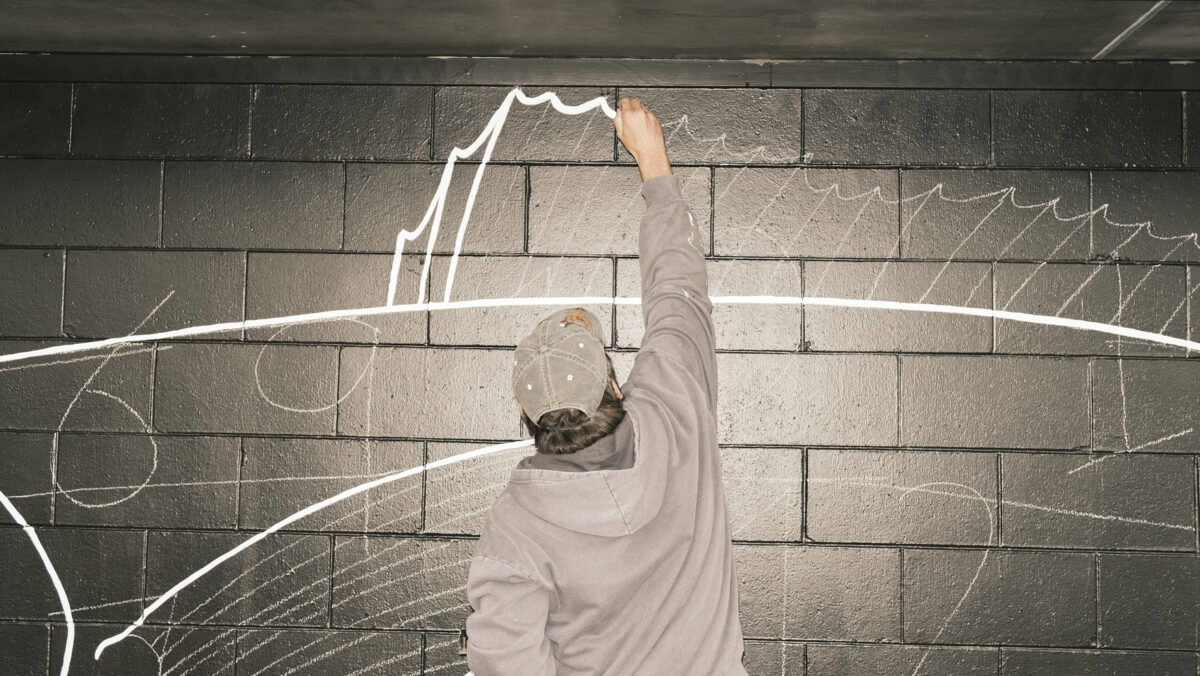
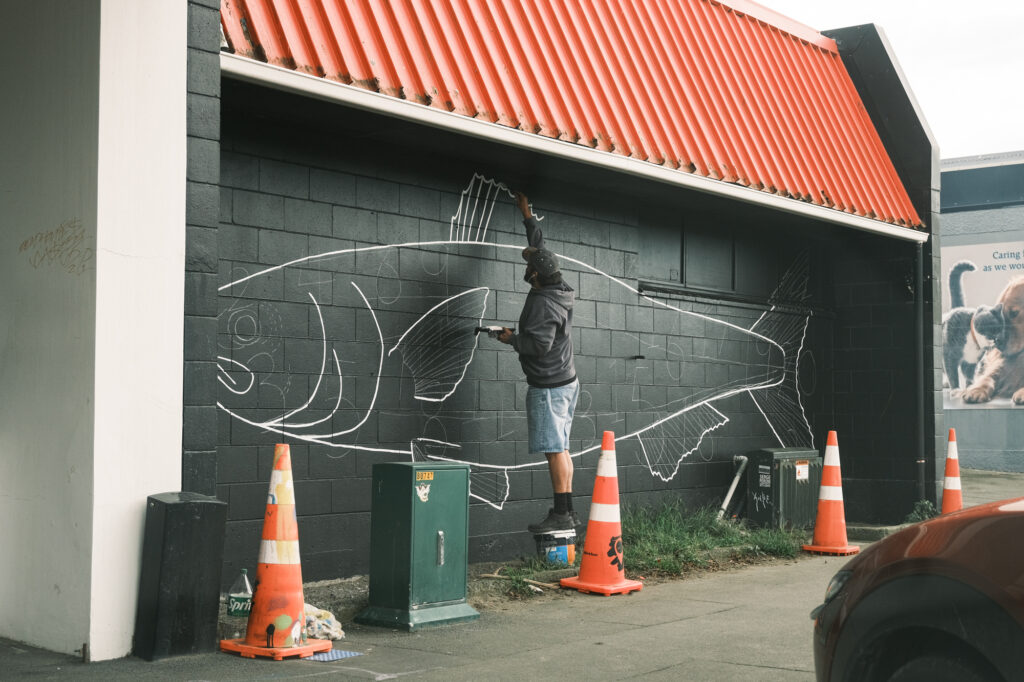
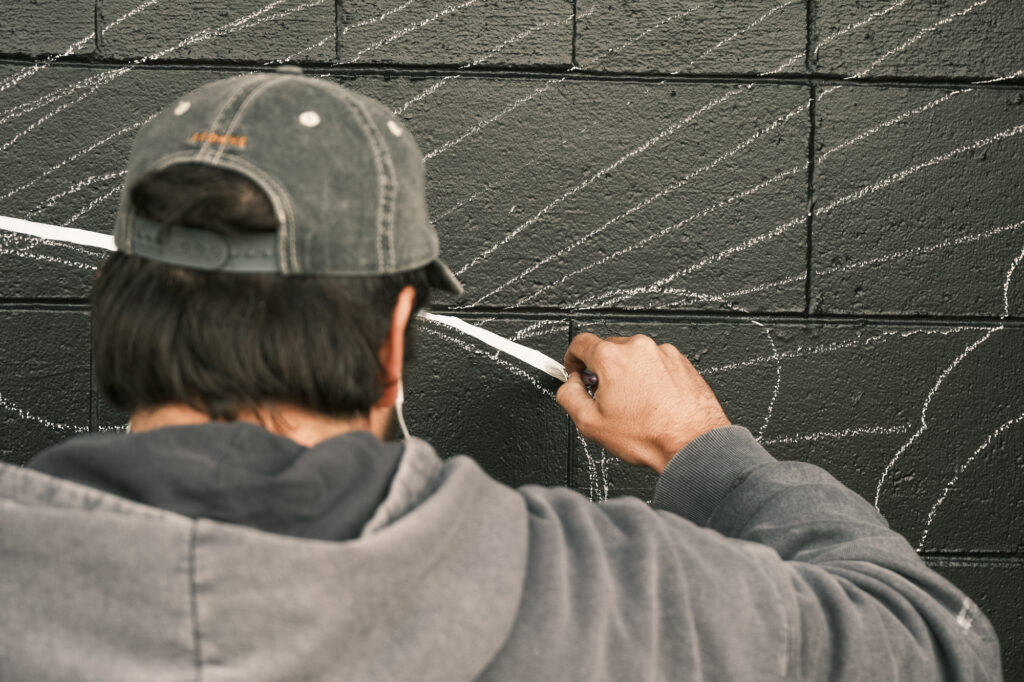
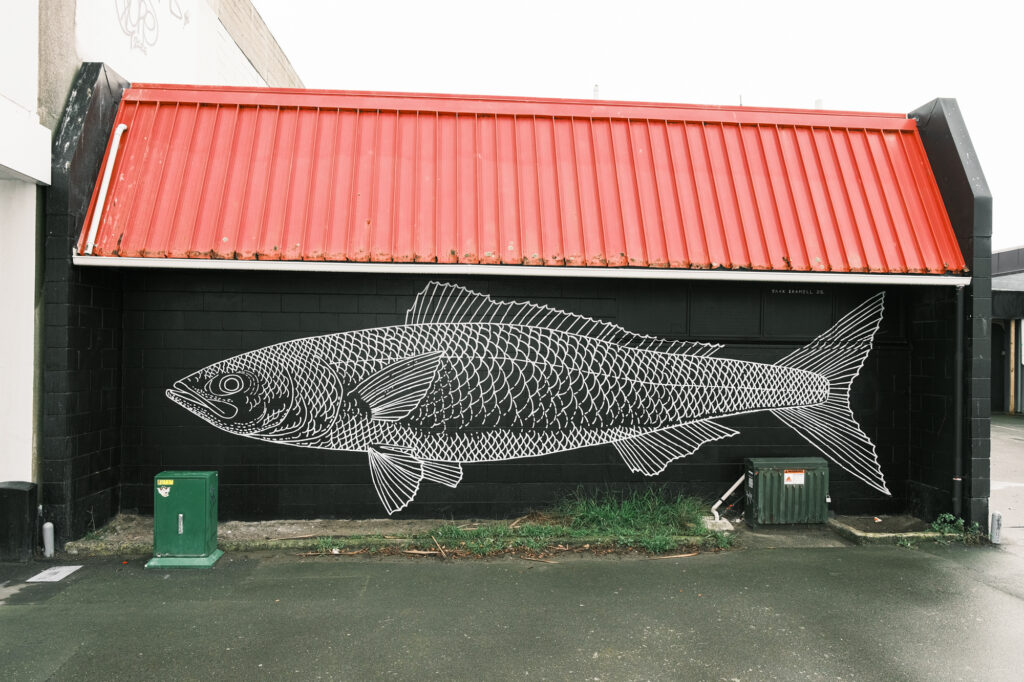
Perth-based artist Jack Bromell’s work is inspired by the natural world around us, elegant birds in flight, the patterns formed by flora and fauna, the sweeping curves of lizards. But these depictions go beyond record, there is a strong sense of symbolism, of mythology, of interconnection. Painted in various sizes (from huge panoramas to depictions of postage stamps) and with subtle colour palettes, Bromell’s murals transform public spaces by using nature to speak to both our surrounding environments and our shared conditions and histories. It is no surprise then that he found ample inspiration while travelling Aotearoa. Watch This Space was able to help secure a wall for Jack to produce a work here in Ōtautahi, a large Kahawai fish that exemplifies his confident, illustrative linework, presented as an almost scientific diagram in white lines on the black wall. The oversized production inviting the audience to acknowledge the beauty of our native animal life. After finishing his mural in New Brighton, we sat down for a chat to discuss his roots in Busselton, just outside of Perth, his trajectory as an artist, and New Zealand’s lack of native mammals.
So, Jack, you’ve been in New Zealand for almost a month?
Almost a month.
You’ve made your way over from Western Australia, is that where you were born and raised?
Yep. I was born in Perth, and I grew up in a town which is two and a half hours south of Perth called Busselton. It’s actually a city now, but when I was a kid, it was still technically a town. It’s a beautiful coastal city.
So, do you think of yourself as a small-town lad?
Yeah, but nowadays, because it’s called a city, Busselton kind of doesn’t have the same feel as it did growing up…
What’s the population?
I think the population is probably pushing like 40,000.
If I think about comparisons in New Zealand, you know, those smaller places can either be really great for raising creative minds, or sometimes it can kind of be where creativity is pushed out of you because, you know, there are farms to tend to and stuff like that. Obviously, you’ve become an artist, so, what were the inspirations in Busselton growing up?
I mean, the biggest one was being surrounded by nature. Because Busselton’s on the coast, and then in that whole southwest region, there’s just so much diversity in the wildlife. There are so many beautiful sections of the coast and there’s the forests. My family was quite into just taking us kids out to the beaches. I guess, my appreciation for nature and the landscape and everything like that, that kind of subconsciously had a huge influence on my art. Then I guess outside of that, my personal interests, like Pokémon, come to mind.
Right!
I used to be really into drawing superheroes and stuff like that. So, I guess the drawing didn’t start with nature. It started with stuff I was interested in when I was a kid.
Which feels like a shared experience, right? A lot of creatives remember drawing a particular superhero or comic book character, like, for me, it was trying to perfect how to draw the Teenage Mutant Ninja Turtles…
Yeah.
Scrolling through comic books and trying to replicate them perfectly. From those early influences, how did you progress? Did you go through arts education?
Not technically, but when I was in Year 11 in Australia, you either decide to go off and do a trade or you can do TE (Tertiary Entrance), which sets you up for university, which is the route that I went. At my high school, they offered an art course for TE. When I was in Year 11, which is the second-to-last year of high school, they offered it, but they said that you have to do the Year 12 TE art course because there weren’t enough Year 11s in my school group to make up a Year 11 class. So, there were two of us from Year 11 that were mixed in with the Year 12s. Thinking back, that year, being in that class was pretty inspiring because of what our teachers kind of brought out of us, the different assignments that we had to do and the different art mediums that we got to explore.
Speaking of that, your work has an illustrative quality where drawing is obviously very central, with strong line work. Was drawing always really central to your creative process?
So that, like the real line work style, kind of emerged after high school. I’d attempted to study architecture for a year and then dropped out of it. I dropped out because I realized it wasn’t for me. Then I tried to study film. When I was around 21, I was living with my cousin and some other people, and they started forming a band. So, there were a lot of creative people in and out of this share house.
Yeah, right.
That kind of re-inspired me. I was like, I know that I’m good at drawing and I used to love it when I was a kid. I always wanted to do something creative. I was working a shitty labouring job. So, I was kind of inspired to start drawing again. The style that immediately emerged was because I had a bunch of paint pens and I just started drawing lots of line work stuff. Then that has led to what I’m doing now.
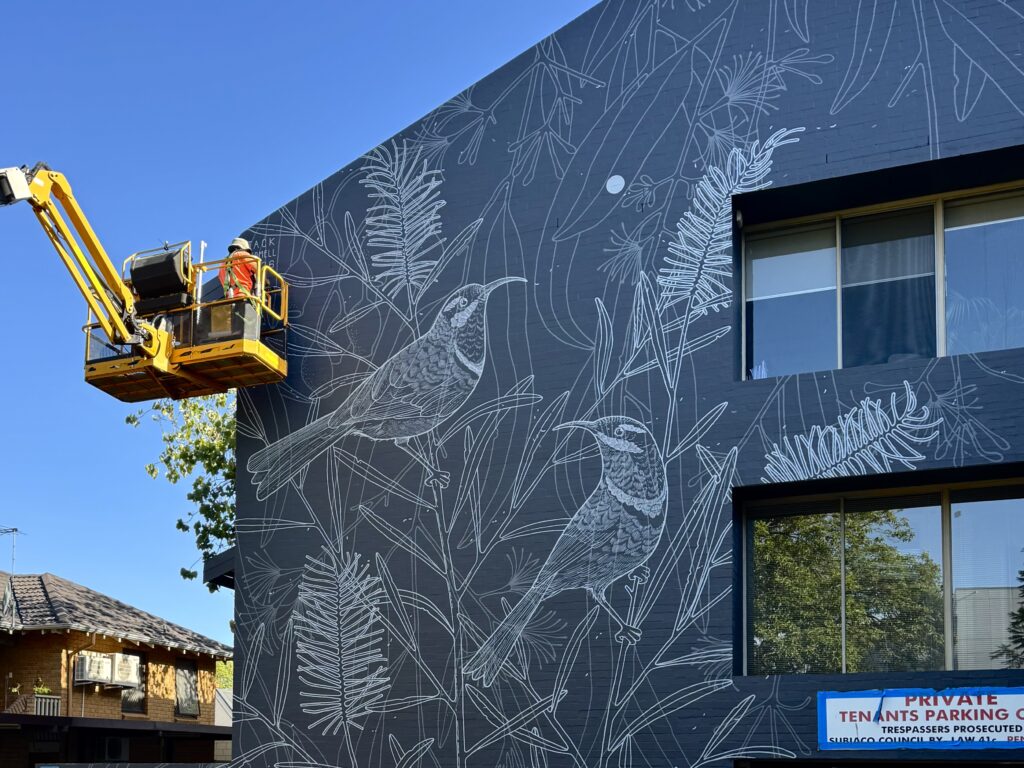
How did you make that jump into painting walls and painting outdoors? Was that something that you had a particular connection to, or did it come about in another way?
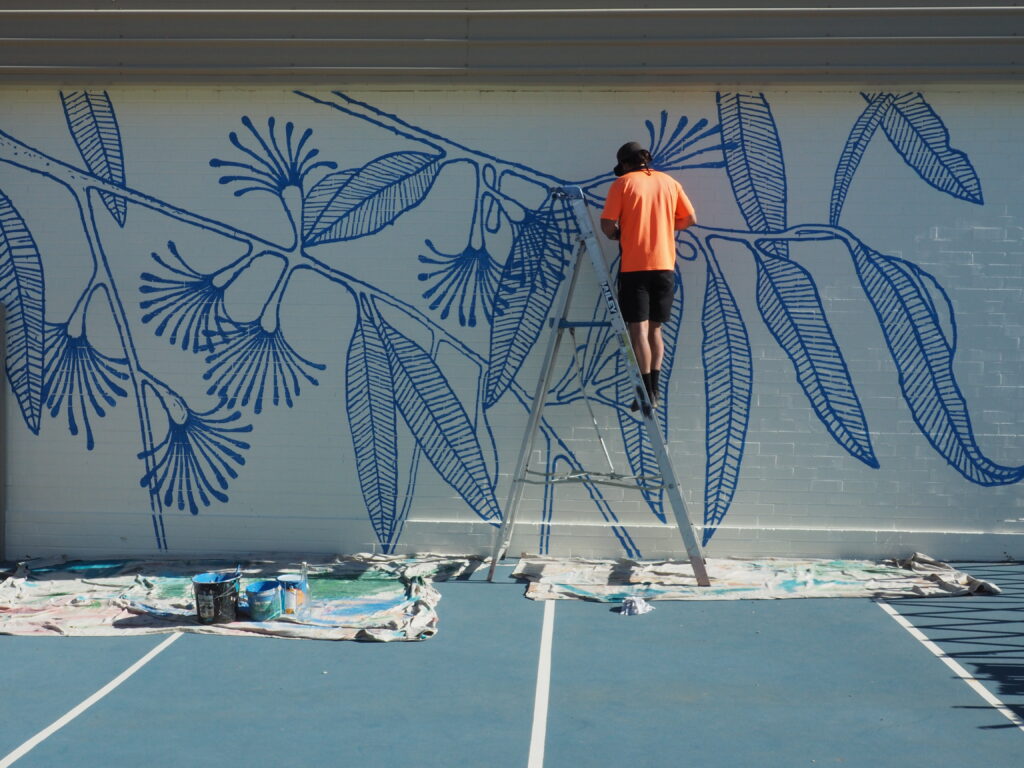
So, it was actually when I was working an industrial cleaning job. I had some colleagues that were stripping plaster to expose the brick in a bakery. I wasn’t on that particular job, but I started showing the art that I was working on at home to some of my workmates. Then my workmates showed this guy they were working for because he’d said he would love to get a mural on the front of the bakery, on the signage. They were like, oh, we work with a guy that has been doing some sick art. So, they showed him and then he ended up calling me and he was like, hey, do you want to do this? He liked my style, so then we teed it up and that was my first paid job.
Did you have to adjust your approach much for that first job? Going from, you know, paper or canvas or a screen to a wall?
Yeah, I pretty much jumped in it, man. I had my style and he liked it. The only difference was that he gave me, because it was a bakery, a kind of brief to illustrate the process from harvesting wheat all the way through to like the bakers actually baking the bread. So, it was like a storyline. That was the first time that I approached something like that and had drawn like a storyline. Which turned out to be really cool and I really enjoyed it.
I suppose that relates back to like the inspiration of comics and stuff, right?
Yeah, that narrative kind of project.
Talking about drawing from cartoons or comics, your work, you know, even just in our conversations in prepping for the wall you have painted here in New Brighton, which became a Kahawai in a sort of schematic illustration, you had several concepts that you worked on. From the fish drawn from nature to a character which was very much imagined. Do you work from reference, or do you work more from imagination? Which is the stronger approach for you?
Oh, man, it’s always different. But for example, with animals and plants and stuff like that, quite often I will use source reference photos. Then when it comes to the character-based work, sometimes I’ll use references to help me with the posture of figures and stuff like that. But I also sometimes just like to completely put away any references as well and just draw from my imagination. That process always takes longer, but it’s possibly more enjoyable and something that I’d like to get more into in the future.
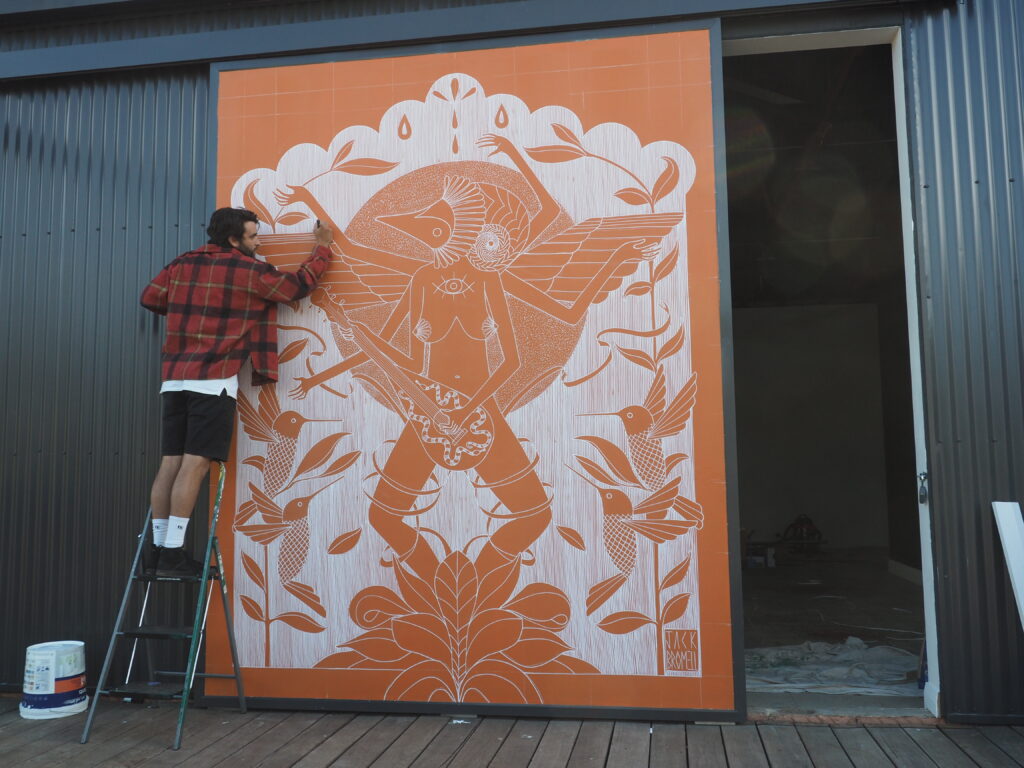
How have you gone about finding opportunities for work that gives you more creative freedom? That’s always one of the challenges with public work, right? When you start to paint publicly, you often have to balance the person who owns the wall and has a specific vision, with your own interests. How do you approach that? Do you try and maintain as much creative freedom as possible, or are you quite happy to just get opportunities by working with someone and making it work for you?
At this point in Perth, I’ve kind of built the practice to a point where I can say no to certain jobs. But like, you just saying that now made me think of when I first started trying to get paid work, there were times where I’d attempt to do things for clients that I didn’t necessarily want to do. Then I discovered just by doing them, that that whole process was difficult. And sometimes if I couldn’t agree with the client or something like that, the work itself wouldn’t look anywhere near as good because I didn’t have the positive energy behind it. So now the compromise is quite often I’ll get commissions that are nature based. The good thing about that is that I love nature. So, even when I do those jobs that bring me my income, there’s still an aspect of them that I really enjoy. Because it still really interests me.
Well, that’s the sweet spot, right!
Yeah. It’s just less of drawing it from like a subconscious place or drawing it from a more abstract place. It’s very literal.
Thinking about the work you painted in New Brighton, a white on black diagrammatic illustration of a Kahawai, did you use a reference? I’m guessing you didn’t catch one off the pier and take a photo of it!
I wish I did that. That’d be way cooler. But I had I originally planned to paint a freshwater fish (Inanga). But then I thought, like, New Brighton’s right on the beach. I walked down the pier and there were people fishing. There was a plaque at the end of the pier and it had all the different fish species that people could catch. I like that all the fish have their Māori names as well. I was looking at them all and the Kahawai looked cool, so I wanted to paint that. I think it connected it to place a bit more. Like, if it was a native freshwater fish or something, then it’s still kind of relevant, but it’s not as relevant to, like, the coast.
Just that little bit more site specific. New Brighton is always a lively place, did you have any interesting encounters while you were there?
There were no encounters, but I bought a step ladder from Bunnings the day before, and I left it the wall to go have a coffee with Hambone. When I came back, the step ladder was gone! But aside from that, when I’d nearly finished it, there were some people who lived across the street who are about to open some kind of restaurant, they asked me if I was available. They’re like, oh, are you from here? Could you paint our restaurant? I was like, no, I’ve got to go back home!
You could have asked them if they could pay for flights back!
I think when I said that I’m actually from Perth, they were like, maybe not, maybe not.
But it’s cool to see the impact that just putting something out in the world can have that…
Right.
Someone looks out their window and it creates this connection, which is one of the most pleasing things, I guess, about art in public space.
I would consider a lot of my work to be quite safe in that sense. It does invite a positive reaction. Which I do think about, it’s obviously really good to have that, but then I think the more that I can establish myself in the future, the more likely it is that I might play it less safe. But that’s a different conversation.
Do you think that would happen stylistically, or would it be in terms of environmental messaging? The world is obviously facing a huge threat to our natural environments, that must be something that you are passionate about.
Big time. Yeah. A lot of my work, because it is nature based, I’m not intending it necessarily to make a political statement or to talk about subjects like that, but it’s more like if people just see it, then it’s in their subconscious, temporarily or for however long, and it makes them at least think about what’s outside, the ecosystems that we’re constantly within every day.
Even just working at a larger size, you take a Kahawai and you make it several metres big, it makes someone look closer and think about it. That’s enough of a spark for that conversation, right?
Yeah.
You mentioned you had a coffee with local artist Hambone, who you connected with through one of your friends back in Western Australia. Did you already have connections with the graffiti and street art world with or is it something that came about as you started painting murals?
It came about as I started painting, for sure. Even though Busselton is a city, it seemed very small when I was a kid and there wasn’t a graffiti scene at all. We had like one skate park, and I think maybe sometimes people from Perth might have come through and tagged it or done some throwies on the skate park. But aside from that, I had no exposure to graffiti. It was only when I moved to Perth and then started making my own work that I’d meet other artists that were in the scene, like graffiti artists. I have a lot of respect for it. I kind of think if I was raised in the city, that’s probably what I would have been doing.
Have you done any collaborations with graffiti artists?
Not specifically in the realm of like traditional graffiti, but I’ve definitely collaborated with other artists that have a graffiti background.
What have been some of the highlights of your artistic career? What are some of the more notable projects that you’ve completed?
I wouldn’t say I’ve done too many festivals at this point. I haven’t really broken into the international festival scene, but I also haven’t been proactive in applying for it. I feel like Perth right now is a really good place to be for an artist because we’re still one of the smallest cities in Australia, so you have less artists to compete with. But also the [state] government supports the arts a lot. There’s a scheme in Western Australia, I’m not sure if it’s the same for the rest of Australia, but any construction that’s worth over two million dollars, by law, they have to put one percent of that overall funding towards some art or decoration. That can be sculptural or that can be like facades with artworks, and quite often it’s murals. So, once I could tap into that, it’s led to some of the bigger jobs I’ve done. Metronet [a multi-government agency in Western Australia, responsible for managing extensions to Perth’s rail network] was extending some railways in Perth to some of the outer suburbs. The furthest north the railway goes is to a place called Yanchep, which is like higher up on the coast. I won the commission to paint the platform walls at the train station. Getting something like that is kind of life changing, both financially, but then also because of the scale of it.
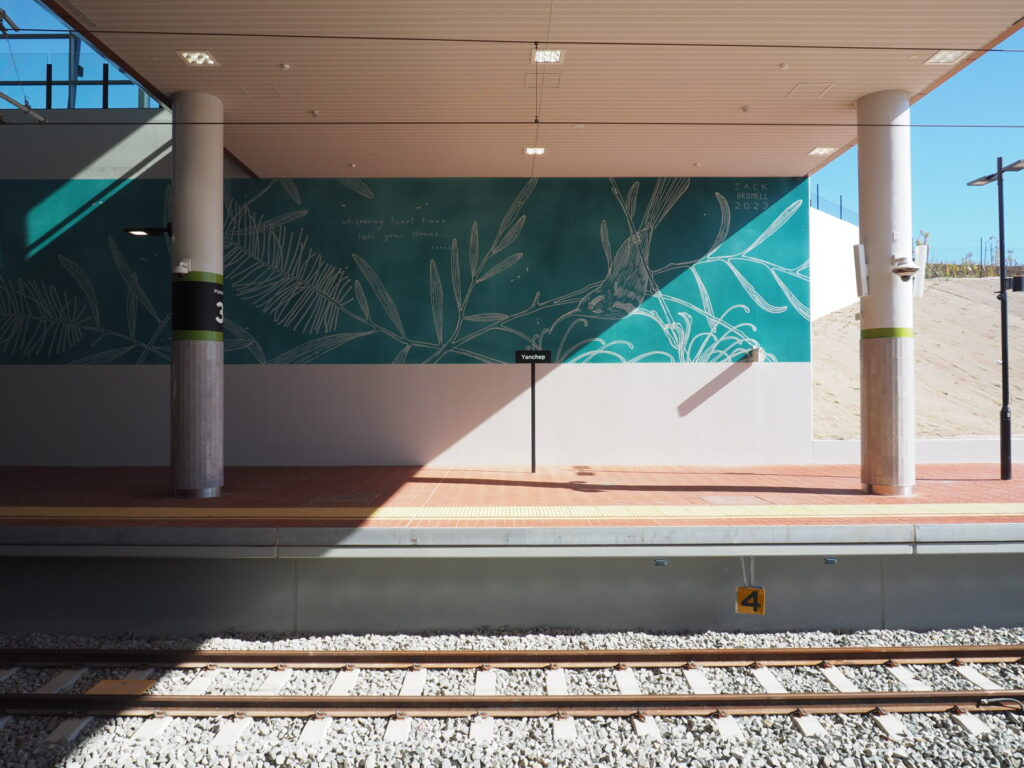
Just the visibility, right? Like the number of people seeing your work every day, that’s so inspiring in itself. Do you catch the train in Perth? Do you sometimes take the route that way, just to see your work?
Actually I don’t! I used to a lot, but I try to avoid public transport these days. But yeah, it’d just be cool for people to be able to see something which is relevant to like the place they live in, you know? It gives them a sense of pride in the nature where they live.
Yep. Speaking of nature, in your travels in Aotearoa, what have been some of the highlights while you’ve been here?
Going to Milford Sound. That’s probably the first one that pops into my head. On the way to Milford Sound, on the road, we saw a bunch of Kea, like four or five of them just by the road. You can see how smart they are, it was almost as if they were kind of asking for you to give them some food, you know, or just sussing out all the cars. We saw some seals in Milford Sound as well. Then while I was in Queenstown, I stopped off at a Kiwi sanctuary, that was cool to just see some Kiwis in real life. We also saw some Kākā and a bunch of other birds and lizards.
New Zealanders have this really strong affinity with our birds. Is it similar with Australia, like the birds or other native animals?
Well, we’ve got obviously way more mammals in Australia. I was surprised to find out that the only native mammals to New Zealand were bats.
[Watch This Space Project Manager Sofiya interjects: And dolphins!
Jack: Dolphins, yeah, dolphins. They’re in the water, though.
Reuben: Someone else told me that…
Sofiya: I told you about the bats!
R: I feel like it was someone else. Is it just like really hot topic at the moment?
S: I used to run quizzes for my clients back in the day and most of them were kiwis. No one knew the answer. I was appalled!
R: You know where I did hear it? It was Jermaine Clement on a podcast.
S: Okay. Well, that was after I told you, which just shows that you don’t retain the information that I tell you. Wow!
R: Well, no, it just shows that lots of people want to talk about this!
J: Local people don’t know.
S: I’m biased because I love bats.]
So, Jack, you’ve got a couple more days here in Aotearoa. This has been your first time here, has it made you want to come back again?
For sure. Now that my sister lives in Wanaka, I’ll definitely be back, regardless if she stays or not! I Really enjoyed it.
Have you got any projects coming up when you get home?
Not immediately, but I’ve got a studio space which I’ve got to move into. I’m pretty excited to move into that and be part of like a bit more of a tight knit creative network.
Awesome. Travel well – thank you for the chat and thank you for the artwork!
No worries!
Follow Jack on Instagram (@jackbromell) and visit his website: www.jackbromell.com
Thanks to VetLife for providing a wall for Jack to paint!