
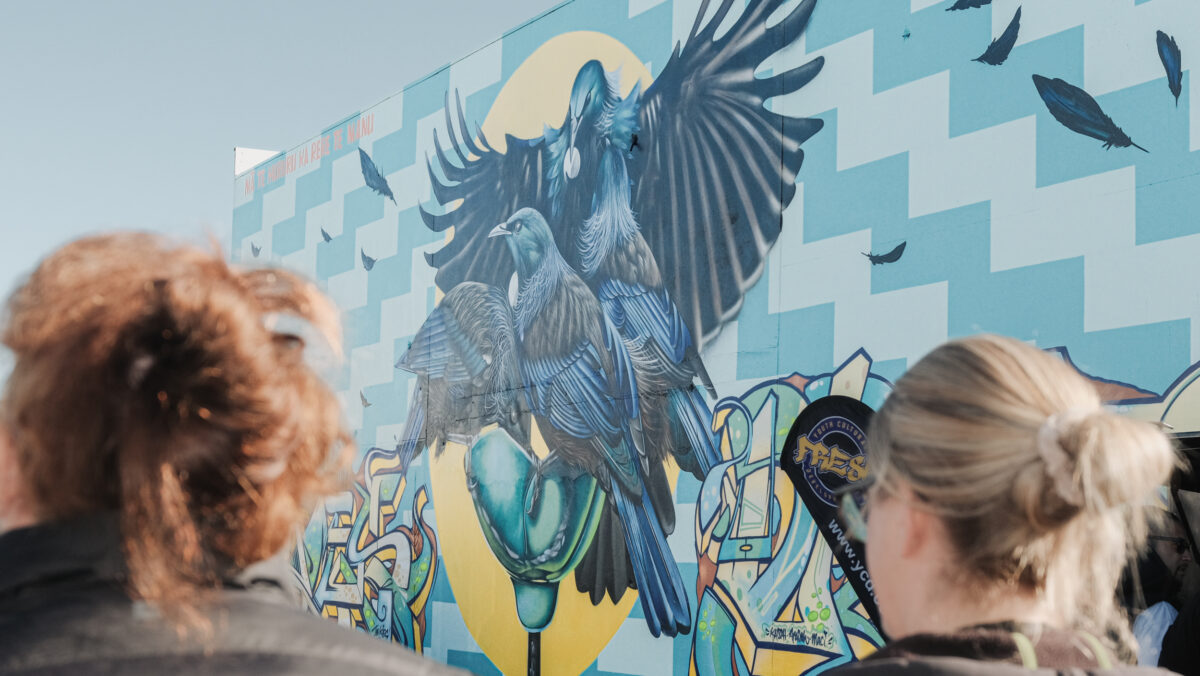
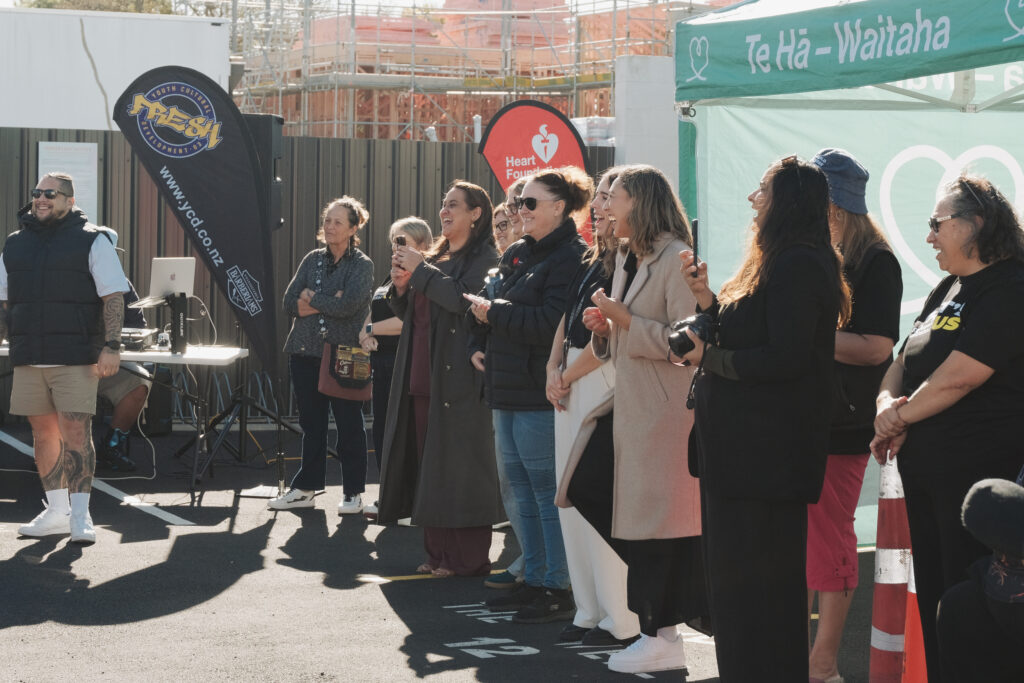
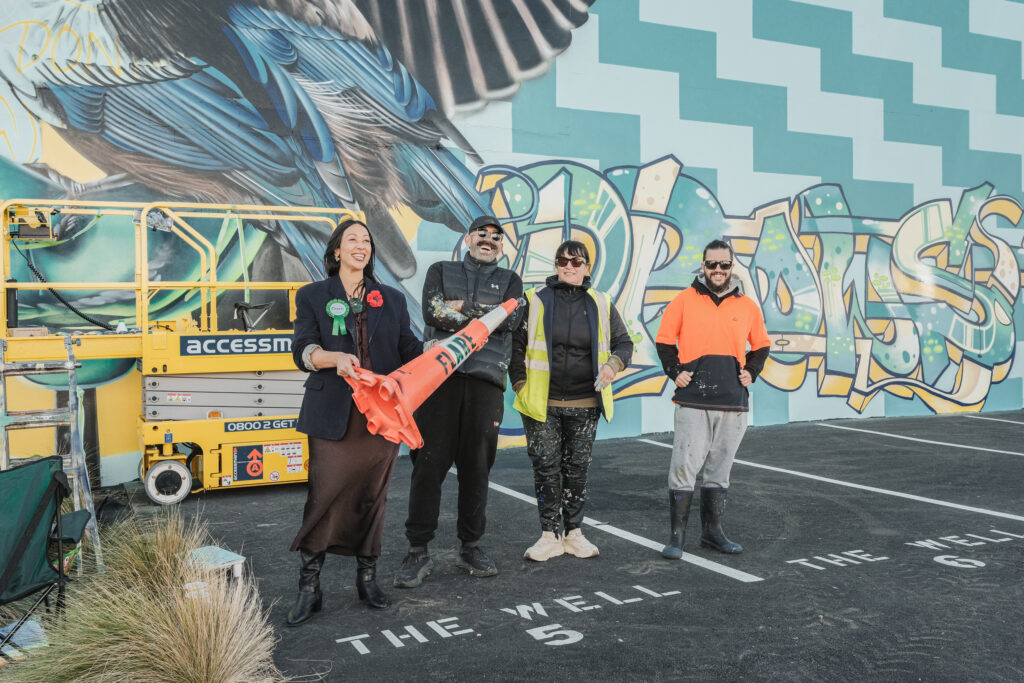
On the sunny morning of the first day of May, a vibrant new mural by Ōtautahi’s own Drows and Tāmaki Makaurau powerhouses Charles and Janine Williams was unveiled to mark World Smokefree May 2026 – the collaborative work a powerful expression of how our hauora (health and wellbeing) is shaped by the support of the communities surrounding us.
The mural’s title, Mā Te Huruhuru Ka Rere Te Manu (Like a manu needs feathers to fly, it is whānau and community that carry us to success), reminds us that it is by equipping people with the necessary tools and support, they will be enabled to thrive and succeed. To be smokefree, the artists note, people need the support of their whānau and community, drawing necessary “emotional, mental and spiritual strength”. The design is built upon a central group of four tui congregating around a feeding bowl. Nestled close together, the group reminds us that “we are never standing alone”. By extension, the group is a reminder of our own decisions and their impact on our surrounding community.
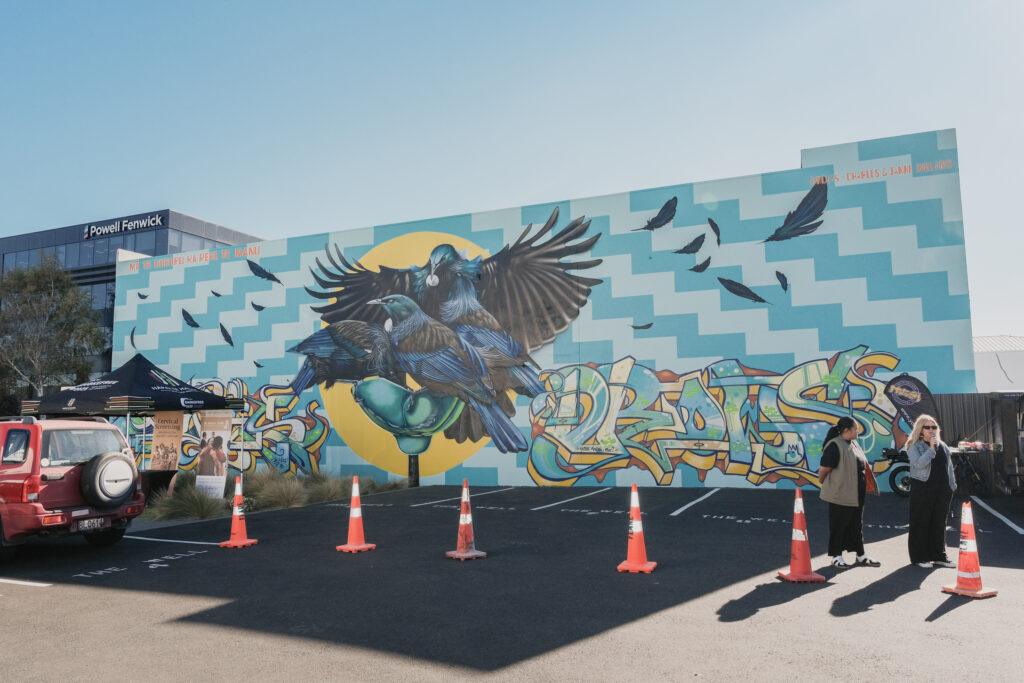
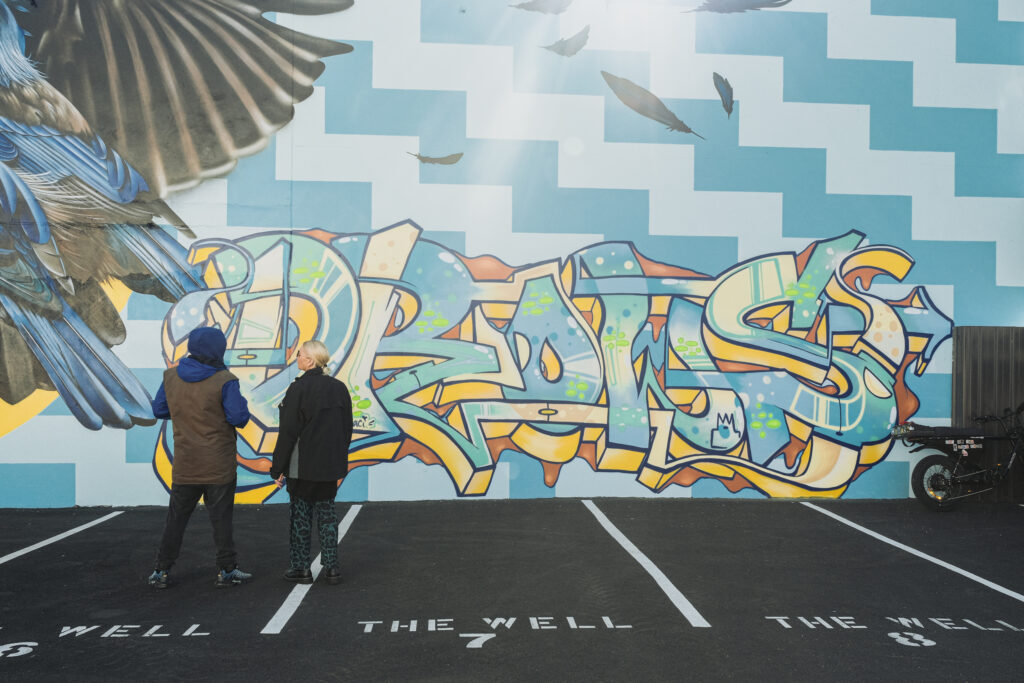
Poutama adorn the background, speaking of the pursuit of knowledge as a driving force for change. On either side of the central design, dynamic traditional graffiti pieces by Drows and Charles add a sense of individuality, identity and connection – a reminder of the art form’s evolution and ability to work within large-scale murals. Mā Te Huruhuru Ka Rere Te Manu was brought to life with support from Hāpai Te Hauora Tāpui, along with YCD and Flare Ōtautahi Street Art, and has transformed it’s Sydenham setting, itself a space with a unique connection to the artists, as we found out when we caught up with Drows and Charles as they finished up the mural in time for the unveiling…
Thanks for taking some time to chat about this project, and, of course, thank you as well to Janine, who is up on the scissor lift carrying on the mahi! Drows, can you tell me a little bit about this mural project?
Drows: It’s about being connected and supporting each other and the growth that you get by being smoke free.

There’s been a lot of conversation around Smokefree Aotearoa, and especially the repeal of the “Smokefree Generation” law in 2024. The impact of smoking is a really important kōrero for our youth and our country generally, is this project’s kaupapa something that resonates with both of you?
Charles: Yeah, 100%. I don’t actually know too many people that do smoke, so it’s changed a lot.
It wasn’t that long ago that going out on a Saturday night meant you would come home and smell of cigarette smoke…
Charles: Especially night clubbing, going out to hip hop gigs.
It is really important that the smokefree messaging needs to continue, right? In terms of the messaging of this mural, what was the process of developing the concept, Charles?
Charles: I think this one was really tricky. This was definitely one of the harder ones [I’ve done]. We didn’t necessarily need to have ‘smoke free’ or anything literal in the design of the mural, so, it made it even more challenging because I really do love a narrative that’s already set before me. It leads my ideas more than, hey, just come up with something roughly around this, where I’m like, what, no way! So having to come up with something was super tricky. But we ended up agreeing, all of us, on this idea eventually. And you can never go wrong really, with nature, you know what I mean? What it reflects, what it stands for, what it can demonstrate, what it shows us. I think when we’re trying to promote a message of well-being, our best demonstration of well-being is the taiao [environment] and what it reflects to us. What a great standard. It’s been tricky, but I think we got there with the centrepiece, these four tuis around a feeding bowl, you know, because it really does demonstrate a lot, from community, to family, togetherness, Kotahitanga, all these great messages that we want to promote. Then you’ve got the poutama surrounding it, that can also mean education, enlightenment, all these things which we need, especially around those types of messaging.
There’s something really lovely about the way the four tui are nestled together. There’s a real closeness to their interaction, just like we should be within our communities. In an age where we’re increasingly distanced from each other through screens, togetherness and community is a really strong message. The other really prominent thing, of course, is the presence of the two graffiti pieces. Drows, how important was that inclusion of graffiti within the work?
Drows: Well, like anything that grows, graffiti has been around for a long time, and being able to incorporate it in a mural like this shows the growth and the ideas that we can push with it. Like, for these particular ones, we have used the same sort of colours that reflect the rest of the wall, and it fits quite well together.
The idea of graffiti’s growth is important, it’s an art form that has, in many cases, emerged from the shadows, but it’s a statement of existence, of presence, of community in itself. In Ōtautahi, graffiti art has been such a vital thing to activate spaces, so there is a recognition that graffiti shouldn’t be marginalized as an art form. It can be incorporated into murals that are doing other things and make them stronger. Speaking of that, Drows, you’ve been painting for a long time, but how special is it to be working with artists like Charles and Janine, who have such a long-standing presence in the Aotearoa scene?
Drows: It’s an awesome opportunity, being a graffiti writer back when I was younger and looking up to them and being able to see their growth and doing murals. I remember actually watching them do their first mural here [In Ōtautahi] and then being able to watch the footsteps that they’ve laid for me to be able to follow and for others to be able to follow. To be able to actually connect on a mural like this, I reckon it’s a real good opportunity to see the processes and connect it all together.
And that journey must resonate with your own exploration of your Māori identity, your toi and incorporating that into your career…
Drows: It’s definitely been a good learning experience!
Charles, you and Janine actually painted this very same wall some years ago. The city of Ōtautahi has obviously changed a lot, even the area surrounding this wall. What’s your relationship with Ōtautahi?
Charles: Yeah, so we’ve been coming here for a while from Auckland. Obviously, it started with the Hip Hop Summit, the first ever Christchurch Hip Hop Summit. We came here, I think it was 24 years ago [2002]. It was the first ever one, and we did a wall. I don’t know where it was, but it was with a whole bunch of local guys, which was awesome. A lot of them are still painting. It was also with DLT and some others. So that was amazing introduction. We met a lot of guys. Then we came back again, did a few more walls, more graffiti-based projects, and then eventually we started getting into murals. I think with this wall, we came for [the festival] From the Ground Up and it was early post-quake. It must have been 2013, 2014? so a good 12 years ago. From the Ground Up was a small project run by Fluro, but it was in collaboration with the Rise festival as well [at Canterbury Museum], and there were some real heavy hitters that came for Rise. That was our introduction to really good street artists. A lot of us were more graffiti-based artists slowly making our way over to doing street art, but these guys were already established, already really good, they already actually had a name. So, Janine and I had an attempt at doing a big wall, and it didn’t work out so well. We didn’t really know what we were doing on a large scale. Most graffiti artists work at a small ladder height, and at that time, if you were going any higher than that, it was too big! So, we had this giant wall that was like eight meters high and about 15 meters wide! But we didn’t use the whole wall, and it didn’t really work out too well. But the great thing is that we’re able to come back and do a real nice one now. We’re really stoked with this one and I’m really happy with the graffiti inclusion. I’ve always wanted to try and figure out how graffiti can be included in street art murals, because it kind of gets rejected a lot, it’s just not allowed, you know? I don’t know why. I don’t think people have found the perfect formula. But you can do it. I think Drows and myself have really figured it out in this work. I can’t wait to see more murals like this, where graffiti is included with pictures, imagery and design.
As Drows mentioned, the colour palette ties it all together and the graffiti feels perfectly fitting. In graffiti, flow and direction are really important, when you start to see how those elements work with the steps of the poutama, the way the birds’ wings spread and their bodies sit and interlock, it all starts to come together. But there is challenge that for a lot of people, graffiti can’t be part of a mural. But why do artists who have developed their style around graffiti have to change to make murals? Rather than leaving them behind, graffiti aspects should be encouraged and incorporated. This mural does that powerfully. Talking about that, Charles, you and many of your peers have spread out in really interesting directions, whether it’s the mural work, public art, contemporary practice, it shows the trajectories that are available. What is your opinion on the next generations of graffiti artists coming up?
Charles: What I can say is there is potential. I reckon there needs to be more mentoring. It’s not a word that we use a lot in the graffiti community, but I think the gap is too far. You’ve got these older heads and then you’ve got these younger artists, graffiti writers, whatever, and the gap’s too far. I think we need to close the gap where the younger guys need to know a lot more so they can become more established, all the way down to being more business savvy, the whole nine. Because, I love the energy, but when we were the same age as some of these guys, we had a lot of mentors, a lot of influences. We had the likes of DLT, Otis and older graffiti guys from DAF Crew who would show us caps, magazines, technology that we didn’t have yet, resources that we couldn’t get. And I would love to just see this next generation be more exposed to what we all know, because we know a lot that they don’t necessarily get from social media, stuff ChatGPT is not going to give you! You’ve got to kind of sit down with some of these older heads and actually have a real-life conversation and I think the gap will become a little bit closer.
That seems like sage advice. Would you agree Drows?
Drows: That’s a way better way of putting it than I would have done! It makes a lot of sense.
I know you guys have got a little bit more work to do and not so much sunlight left, so I won’t hold you up anymore. Thank you for the artwork and thank you for the chat!
Charles: Awesome. Thank you.
Find out more about Hāpai Te Hauora and Smokefree May 2026 here