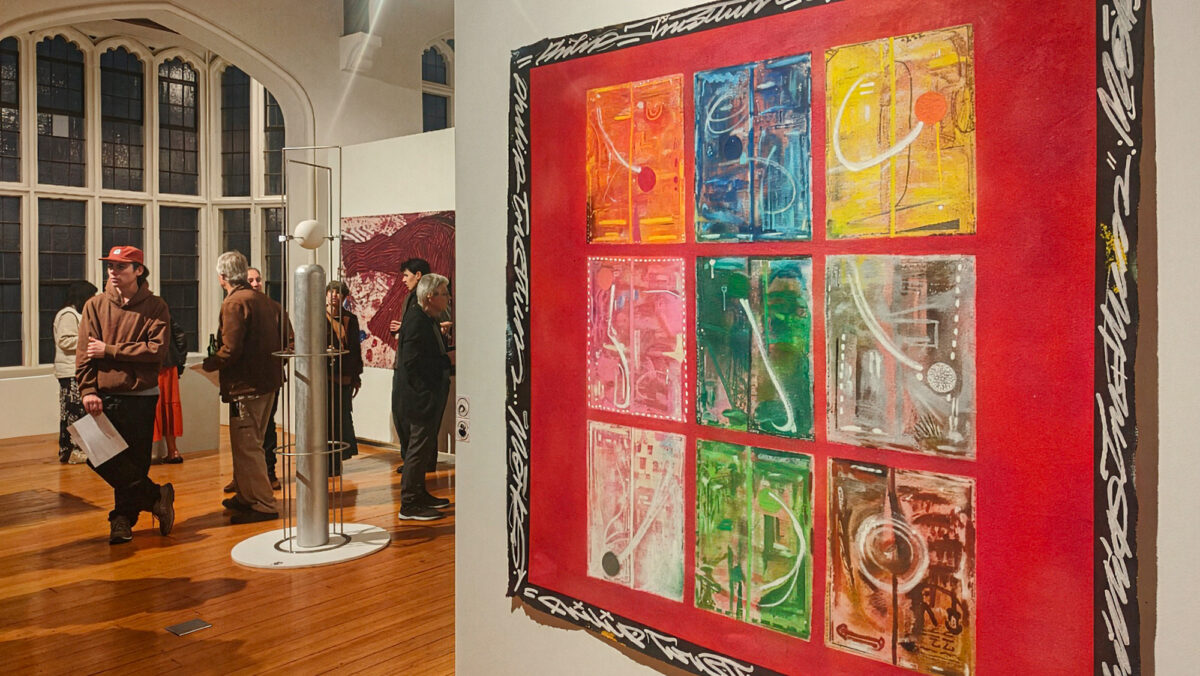
Over a career spanning multiple decades and ranging from graffiti and tattooing to his increasingly prominent studio output, Morks is a singular creative force. The artist from the foothills of the Southern Alps is in the midst of a busy period – opening two shows within a fortnight: the survey-like Enter the Void at Oxford Gallery – Toi o Waimakariri, where a range of works represent his myriad influences, from folk art to skateboarding, his military service, love of nature, tattoo, graffiti and more; and Two-Way Street at The Central in central Ōtautahi, a group show centred on the mentor-mentee relationship between Morks, sculptor Luca McDonnell, and the late Philip Trusttum, ONZM, one of Aotearoa’s most accomplished painters.
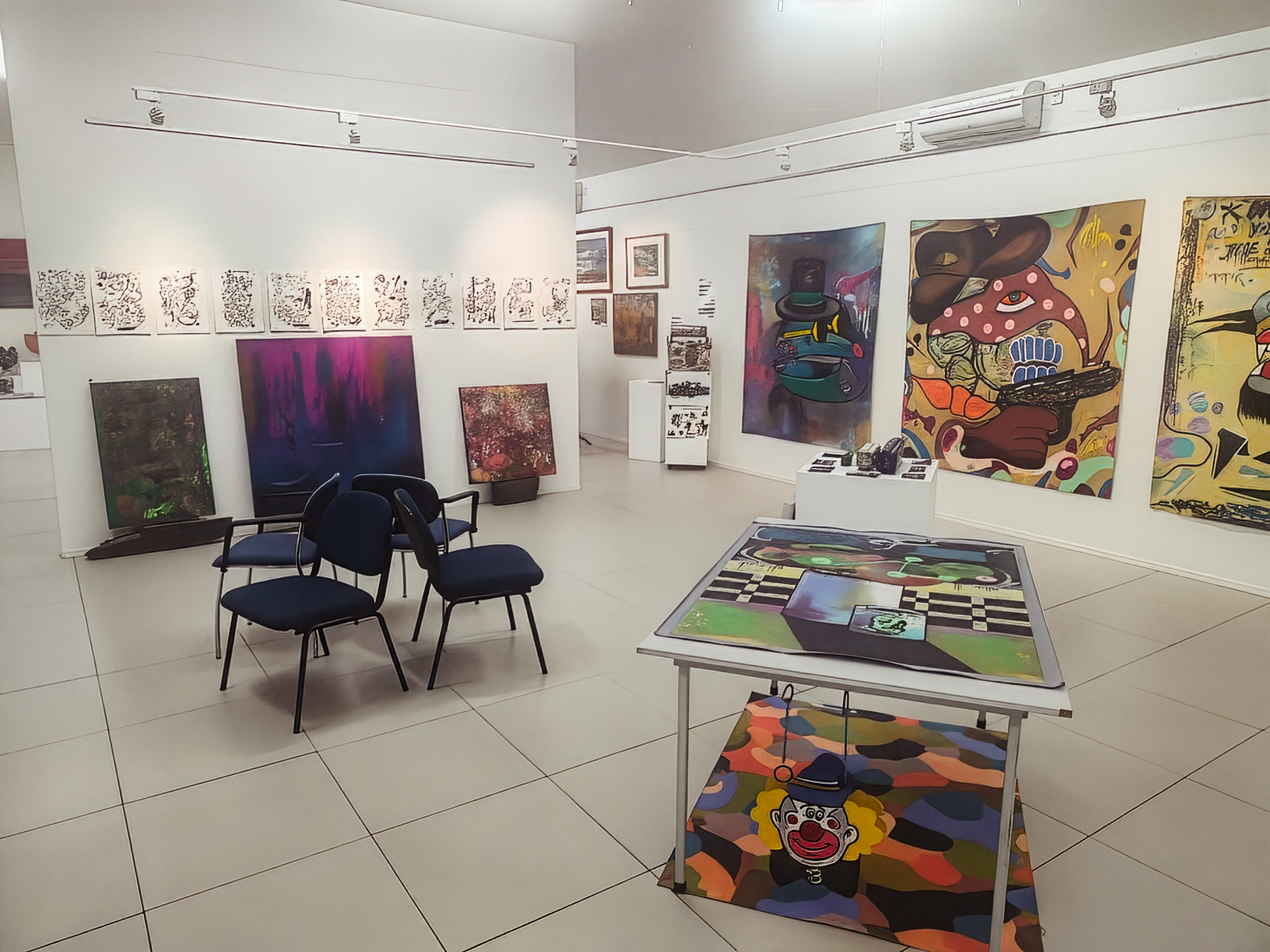
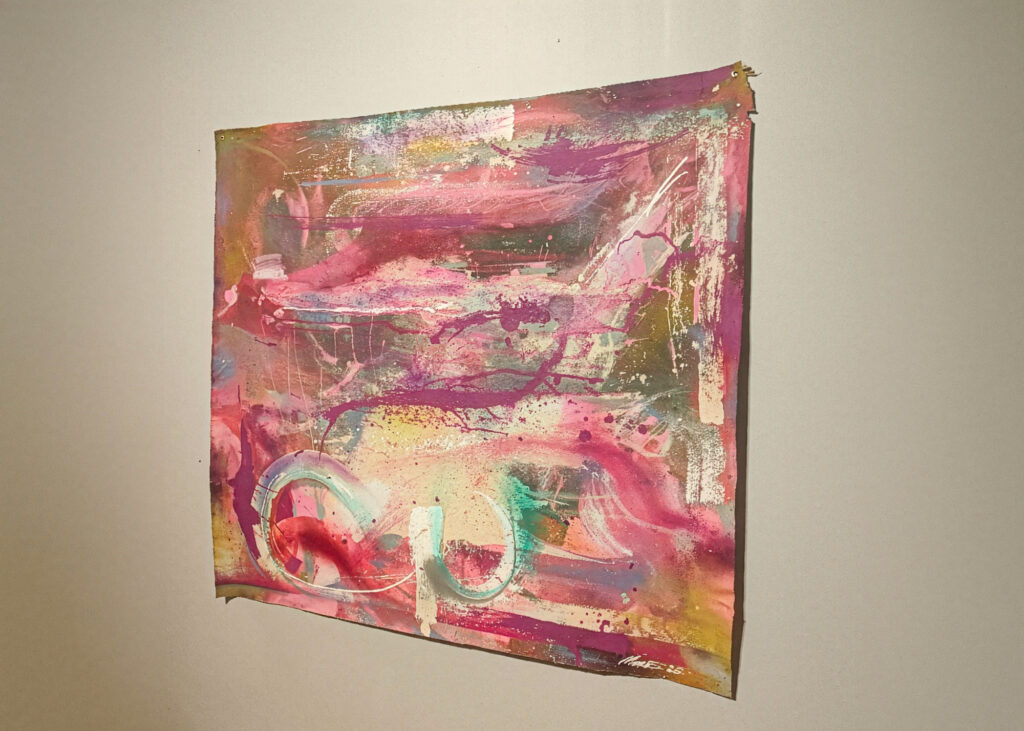
Morks and Trusttum developed a fast friendship in the last years of the older artist’s life, a connection that provided Morks with invaluable knowledge and guidance. While the two shows are decidedly different, Trusttum’s influence is clear, especially in the larger works on unstretched canvas – a format that pushes Morks’ exploration of colour, dynamism and scale. In the Enter the Void, Morks’ imagination runs free, found objects are transformed and juxtaposed with painted and illustrated two-dimensional works, creating a dizzying effect where the viewer is invited to immerse themselves in whirring life. Morks’ collection of works in Two-Way Street is more focussed, but highlights his growing confidence, a sense of maturity that ensures his paintings fit perfectly alongside those of Trusttum. The day after the opening of Two-Way Street, we took the drive out to Oxford, and after an obligatory pie from the Sheffield Pie Shop, we took in Enter the Void, before sitting down with the artist to discuss what has been a busy time – fitting for someone with a self-described busy creative mind…
So Morks, this is a big fortnight for you! Two shows at two galleries – here at Oxford Gallery – Toi o Waimakariri and also at The Central Art Gallery at The Arts Centre in central Ōtautahi. There are more than 60 works here at Oxford Gallery, how many works are at The Central?
Morks: I’ve got seven large works at The Central.
There are large works across both shows – what size are the bigger works?
Morks: The bigger works are 1.8 metres by 1.8 metres.
I mentioned it is big fortnight, but really, this reflects a big few years – particularly as these shows draw on your friendship with Philip Trusttum that was fostered in the years before his passing. How are you feeling at the moment?
Morks: It’s definitely exciting. It matches my energy. It’s cool to actually see all the art on the walls for myself, you know, to get it all out there, bits of this, bits of that, some new, some old. Especially out here at Oxford, where this show is a representation of sort of letting people know that I’ve done graffiti, tattooing, a bit of folk art, it’s a show of juxtapositions. Whereas at The Central, it’s my larger paintings that show the influence and inspiration that Philip had given me, not just as an artist but as a friend as well. I tried to really put through our friendship in that show, you know? I really wanted to honour him, not just as a famous artist that was helping me and mentoring me, but as a really good close friend. It was pretty special for me to do that one.
How did that connection with Philip come about?
Morks: I was always a big fan. Philip had been my favourite New Zealand artist for probably 25 years. Then when he did the big takeover at The Colombo [Mall], I rushed in there and really took it all in and it inspired more than ever because of the scale of the show and the works. I went in to see if I could meet him. The first day I missed him and then I went back the next day and I missed him again. So, then I just thought, oh, well, I’ll knock on his door! I just went and knocked on his studio door…
You were able to connect in a range of ways – you said in your speech at The Central that one of the first things you connected over was when he found out that your granddad was an All Black, and you also mentioned to me that you saw aspects of graffiti in Philip’s work that built another connection. What were some of the biggest things you took from that friendship?
Morks: Definitely the large scale, and the use of the 16-ounce canvas to be able to create those large works. I’ve said to many people, what impressed me the most about him was his work ethic and his drive. He’d paint every day and he was often completing a new painting every day or every second day, right up until he was 85. So, I took his work ethic and his drive, and I thought, you know, if he can do that at 85, what can I do at 40? There were a lot of other influences as well, colours and stuff like that. He once said to me, he pointed at me real serious and tapped me on the chest one day, and he said: “there’s only two people that use colour like us in New Zealand, one of them is me, and one of them is you – and if your paintings were any closer to mine than what they are now, I’d never speak to you”!
It sounds like the two of you developed a really strong rapport…
Morks: Oh, for sure. I mean, you meet people and you have good friends and lifelong friends, but it was definitely a unique, special friendship. We bonded so closely and, you know, the art did come second. We became friends before that. He wasn’t even interested in looking at my art for the first six months! I think he finally said to me, just show me a few photos of your art on your camera. I showed him, and he said: “a couple of these are good”. He was more interested in my tattoo work. He pulled out two or three images, including a cowboy skull with a gun. He’d seen that I had tattooed it a few times, and he said to me: “this, paint this on canvas. Picture the canvas like a piece of skin – I want that blown up onto canvas. I want that”. He wanted a matching series of 12 paintings and wanted them within a month. So, it was a challenge to see how quickly I could work, how serious I was and if I was the real deal. When he said that to me, I thought, I’ve got to do that many paintings this quickly? I went home, and before I know it, I’d actually finished them within two weeks. I eagerly took them into them, and that’s when he slowly started taking note. He actually told me that they were good, he said some of them were really good, he said, in fact, none of them offended him! I remember that word for word, because that was the first comment he ever said to me about my art. I drove all the way home thinking about it!
There are clearly different approaches to each show, the Oxford show is a much broader representation of your work, whereas the show at The Central is perhaps more focussed on that relationship with Philip. But across both shows, there is a sense of the physicality and energy in your work, which is something that I think is tied to both your formative influences, and also is indicative of that connection with Philip as well…
Morks: Yeah, there is a bit of life in them, and that’s heavily influenced by him. Philip talked about not just painting in the middle of a canvas, not having one stick man in the middle of the canvas, he said: “make the stick man kick the edges of the painting”. I have taken that on board, you know, you can really push everything to the edge. Even if there’s a border, I just give it some movement. You know, don’t do a front on image of a horse, turn its neck a bit, you know, and show a bit of movement in the muscle. That’s that whole movement thing, which I was probably doing in some of my works, but I’m definitely more aware of it now.
That must also be influenced by your background in tattooing and graffiti, right? When you tattoo, you are applying art to a living canvas that has an inherent sense of movement, the art moves because the canvas breathes.
Morks: Right.
And with graffiti, it’s a physical pursuit as much as anything. You use so much of your body when you are painting at the large scale of graffiti and in spaces that require that physical movement. You have talked a little bit about how you kind of see some of those influences in Philip’s work as well, like how he was almost a graffiti artist without knowing it?
Morks: There’s a whole bunch of his earlier paintings, even, like, right up into the mid-60s and some of the ones he did in the 70s, to look at them, if you put a black outline around them and shape them into letter forms, they looked like some real wild style sort of graffiti. That was even before he had been to New York in the sort of mid-80s, when I would guess he almost subliminally brought back some influence of graffiti, like colours and shapes. I think that’s what caught his eye when he saw my stuff, it maybe gave him a bit of a flashback.
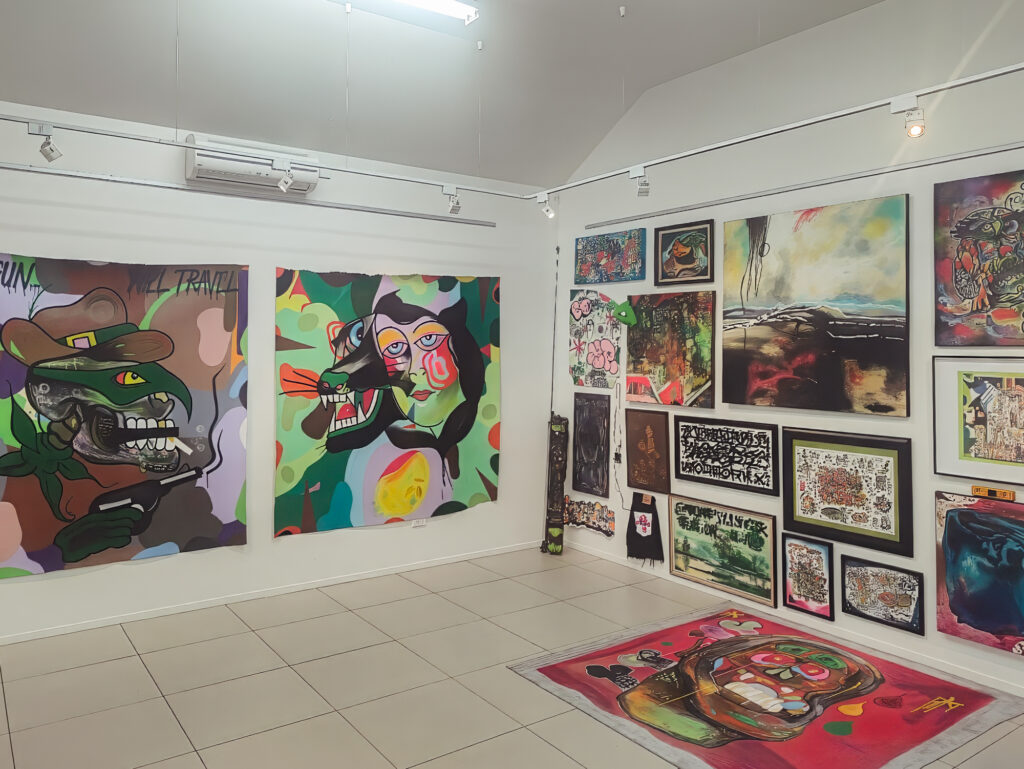
The Oxford Gallery show, Enter the Void, is like a snapshot inside your head, there is a lot of work and it spans several years of practice across different approaches, there are folk art aspects, tattoo aspects, found objects, clothing. It feels like a belief that you can make art from anything…
Morks: Oh, yeah. 100 per cent. I think it’s a good reflection of having a busy mind, a creative mind that’s never short of ideas. As an artist, you’re constantly on the lookout for anything that could turn into a bit of art. The Horse with No Name piece, that is made from an old seat from my backyard and a plastic horse I got for three bucks from the op shop, next thing you know, I added some bits of driftwood and it’s a piece of art. I’ll tell you what, there’s been some people having a laugh at it and that’s what I wanted. Usually with the folk stuff, if I can make a bit of art out of something I found for free, I will. For instance, I’m making native New Zealand birds out of railway sleepers. I’ve done a few of those. I’ve done moreporks, I’ve done a kereru and I’m working on a magpie at the moment. They usually just come to me when I’m walking up the river. I’ll see a piece of driftwood or, you know, if I’m walking down the tracks and there’s a shape of a railway sleeper snapped in half, half the work’s done for me. It might have the little bird ears at the top. So, it’s a case of find something, make it into art, which I enjoy.
I’ve absolutely loved seeing both these shows. It must have been a lot of work. But knowing you as well, you’re already thinking about what comes next…
Morks: Bigger. Bigger paintings just fuelled by the inspiration from Philip. That friendship and sort of mentorship have got me into this gallery world. At the opening at The Central, a lot of people who have collected Philip’s work came up to me, asking about the similarities in our work. One guy was standing in front of my PST (Alphabet Soup) picture thinking it was Phillip’s picture. I had to tell him that I had painted it, not Philip! So, you look for little happy moments like that. You know, these little wins of, oh, that guy thought that was Philip’s painting. Not that I’m trying to be him, but it was a compliment, you know?
Next is definitely bigger and brighter. It’s exciting because I was lucky enough to inherit all of Philip’s paint. So, I’ve got probably hundreds of tins, I’ve probably got 30 or 40 colours that I’ve never really had at my own calling before that I might not usually buy or source myself. So, I can explore new colourways and just experiment. I think the general direction is kind of just a little bit bigger now that I’ve seen that the galleries can sort of handle these bigger paintings. So, yeah, I’ll probably look at maybe doing ten big ones in the next couple months or so.
Finally, how long are the two shows up?
Morks: Enter the Void at Oxford Gallery runs until the end of this month [31 May] and then Two-Way Street at The Central gallery runs until the 20th of June.
Awesome. So, get out to Oxford, get into The Central and see the work of someone who is a unique and powerful force who is just warming up but getting everything that you deserve at the moment. Congratulations on all of this success!
Morks: Cheers, bro.
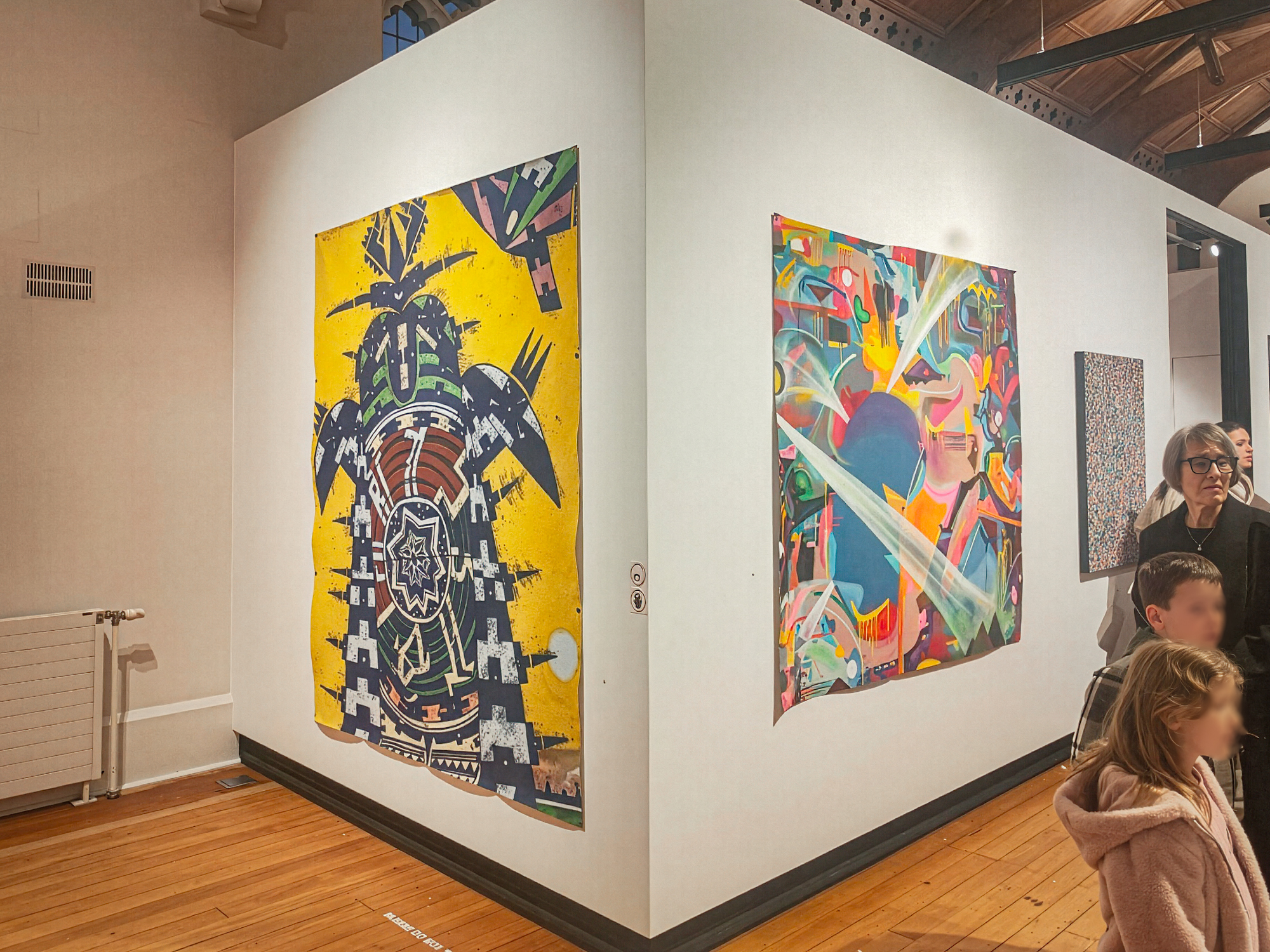
Morks: Enter the Void – Oxford Gallery – Toi o Waimakariri, 72 Main Street, Oxford, 23 April – 31 May, 2026
Philip Trusttum, Morks and Luca McDonnell: Two-Way Street, The Central Art Gallery, Library Building, Te Matatiki Toi Ora – The Arts Centre, 2 Worcester Boulevard, Christchurch, 7 May – 20 June, 2026