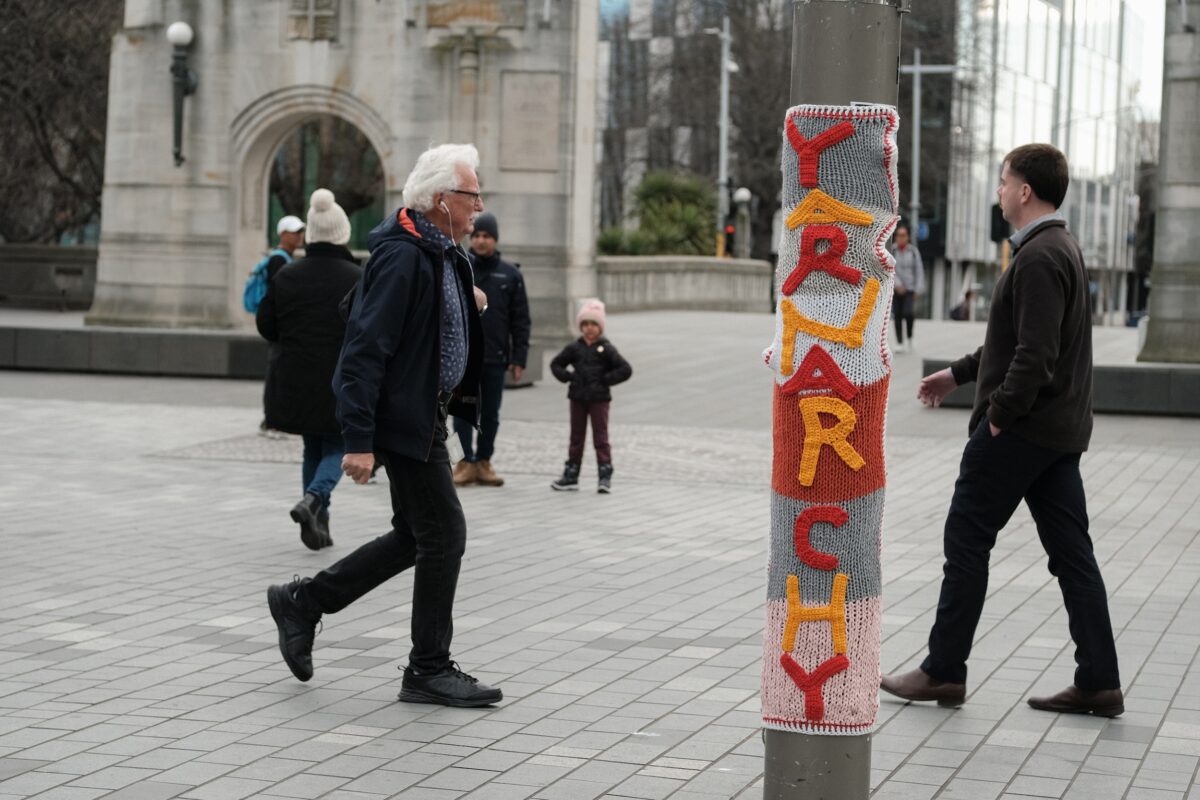
Gap Filler’s Yarnarchy is a unique part of Ōtautahi’s urban creative scene — a festival dedicated to yarn-bombing and craftivism that celebrates both the power of urban intervention and the ability of urban craft to engage a diverse audience and community of artists — turning those with a passion for craft into street artists! Founded by Gap Filler’s Play Programme Coordinator Kate Finnerty, Yarnarchy is a vibrant activation and reconsideration of the city that is now into its fourth year. Growing and evolving over the last three festivals, 2025 is now in full swing, with an array of surprising artworks installed and a special collaboration with the amazing Jolt Dance — a local organisation that empowers people through the accessibility of dance. We chatted with Kate about Yarnarchy, the roots of the event, its evolution and why it is such a powerful experience…
Yarnachy is becoming a bit of a local institution — is this the third or fourth iteration?
Kate Finnerty: It’s the fourth. I think there were just eight of us or something that did a few little things the first time, and it kind of seems to have grown from there!
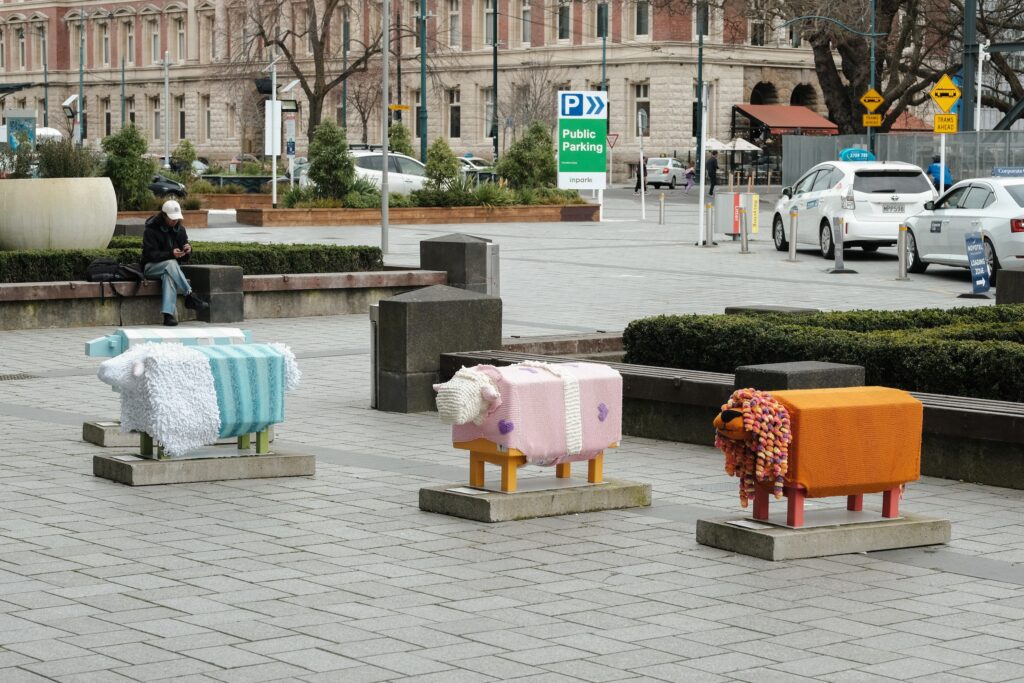
What was the inspiration for the festival and how did you see yarn bombing fitting within the scope of place making?
Kate Finnerty: I’m a crocheter to start with, but I’ve always loved yarn bombing because it seems so fun and playful. It’s just a real joyful expression. There was a lot of yarn bombing after the earthquakes, but once the city was being rebuilt there were less spaces where you could freely do stuff. So, I chatted to a few people and they seemed keen, so it kind of grew from there, really.
The thing that’s always struck me about craftivism and yarn bombing is there’s something lovely about the time spent creating works that are then put into a public environment, which is unique. In the past, I’ve talked about this idea of the baggage of craft going beyond the actual object and into the social element of time spent making and doing. Has that always been at the heart of Yarnarchy as well? You have stitching sessions and things like that, was that idea of spending time making things always inbuilt into your thinking?
Kate Finnerty: Yep. Just that idea of slowing down and learning a traditional craft as well is getting a bit more popular. There is something very special about it. With a lot of public art, you might design it, but then maybe a fabricator might make the pieces. But yarn bombing is quite unique in the fact that every piece of the artwork that you see has passed through human hands, which is quite spectacular when you think about it. The hours involved, and the cost of the materials are all pretty high, but then it’s just put out there with no security around it — it feels like a real gift. This year we went out to a few library meet-ups because one of our keen ‘Yarnachists’ is in the library circles, we talked to them about Yarnarchy, and always came away feeling really relaxed, peaceful, and excited about the world.
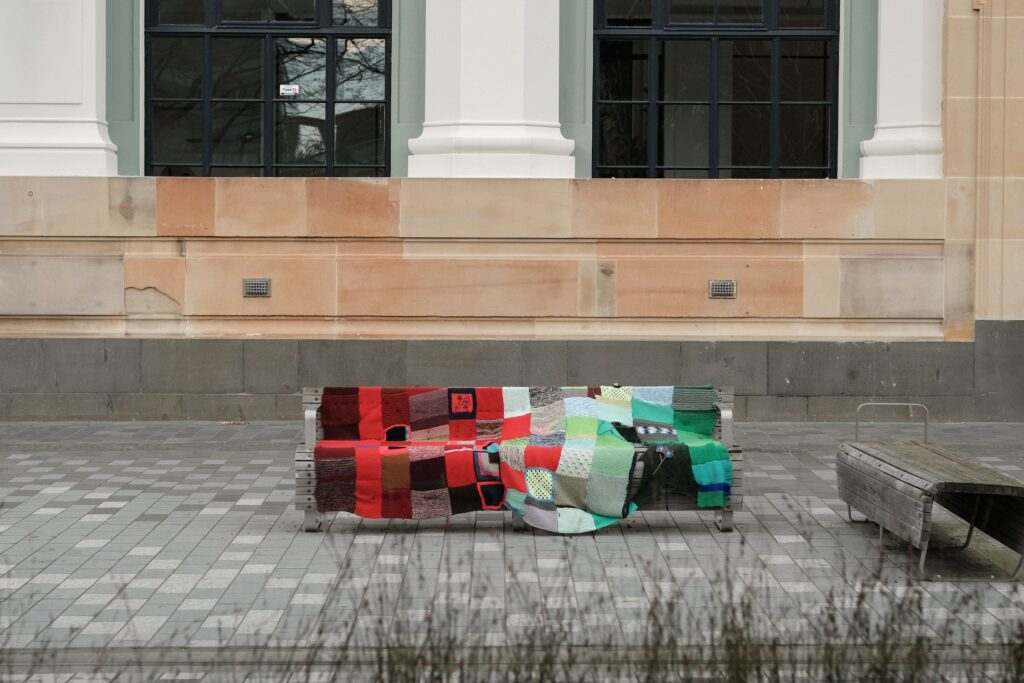
The other side of Yarnachy — and you’ve touched on this in terms of putting art out into the world – is this nice contrast to the construction of an urban environment, contesting the hard-edged nature of a lot of urban space, softening the concrete and steel and iron with yarn. How important is that material aspect?
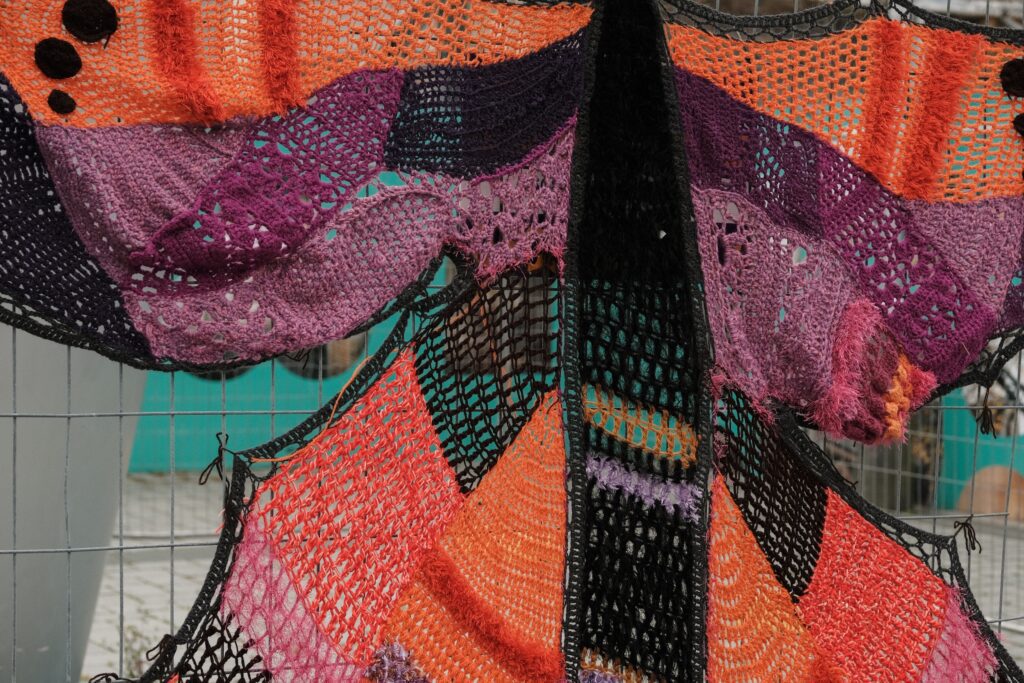
Kate Finnerty: Well, the material is soft and comforting, but there are also the colours involved, which are often so bright and vibrant. A friend said I came up with a new word talking about the ‘grayness’ of the city, and by putting these colourful, bright things out in the world, it makes you stop and think. People have been saying that they feel uplifted and joyful, even when it’s only been a day, and it’s like, wow, all this from creating something out of wool and putting it out there. And when people see it and think “I could do that”, I’m always keen to try to involve them in it, saying “Hey, you can be a street artist as well!”. This enables people of a different generation, and generally women, to actually be a street artist, to have a presence in the city and be noticed.
Absolutely. That’s at the heart of any type of urban expression, whether you’re a young graffiti writer or someone entering the world of yarn bombing, it’s the sense that you get to shape the environment around you a little bit. We tend to just accept the environment we’re given without suggesting or without recognizing that we can inform the way spaces can be used, altered, and imagined…
Kate Finnerty: You can interact with people as well. There’s so many instances where I’ve heard of artists installing pieces and lots of people coming up to them and having a chat. It breaks down the barriers of just walking around and not talking to anybody, it’s like, oh, there are humans here as well!
For a lot of people street art is made with an air of mystery and anonymity. That is attractive, but also it can create a sense of distance from the human presence. Just like with muralism, the visible presence of someone doing something can help connect the idea of the value of the act with the legacy left behind, which I think is really important because you want people to recognize that it’s something anyone can do with the right energy, and sometimes seeing someone actively putting art in the streets is the key to inspire someone else.
Kate Finnerty: Yeah. I think it’s easy to just leave it for somebody else to do. But when you’re actually seeing the people, who they are and how they’re doing it, it’s like, oh, yep, this is for everyone! This is a way we can all participate in city life.
In terms of introducing different groups of people to urban creativity, this idea that anyone can become a street artist, I imagine many of the people involved in Yarnarchy have a history of crafting, but putting their work out into the public must be new. How much discussion have you been part of around what that means for people, how important that is for people? Has it also meant that people have had to re-imagine their existing practice a little bit to make it adaptable?
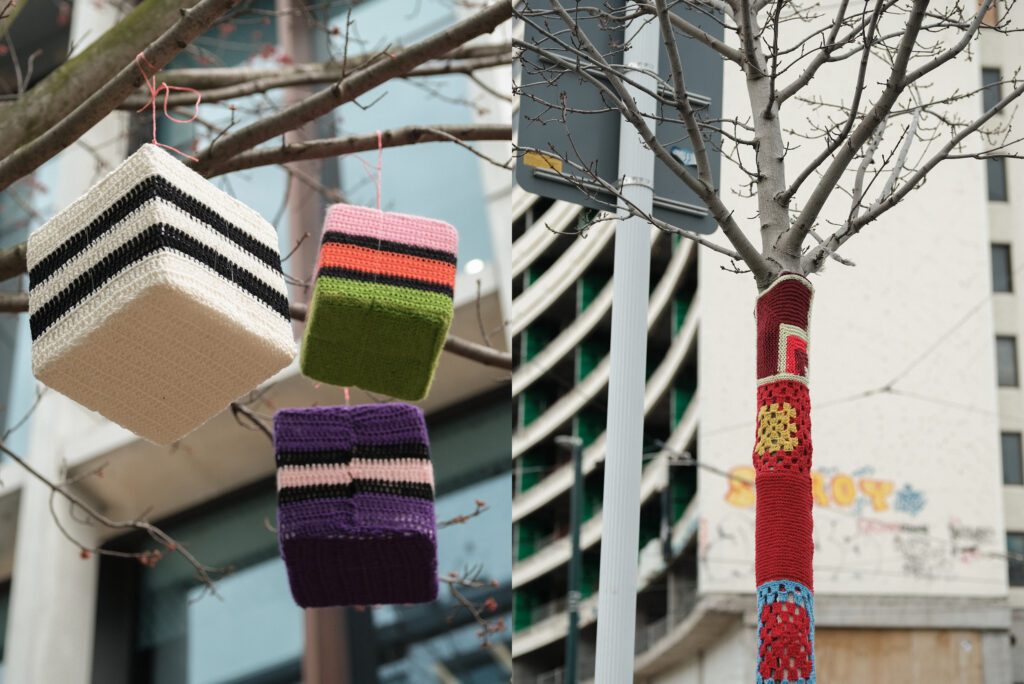
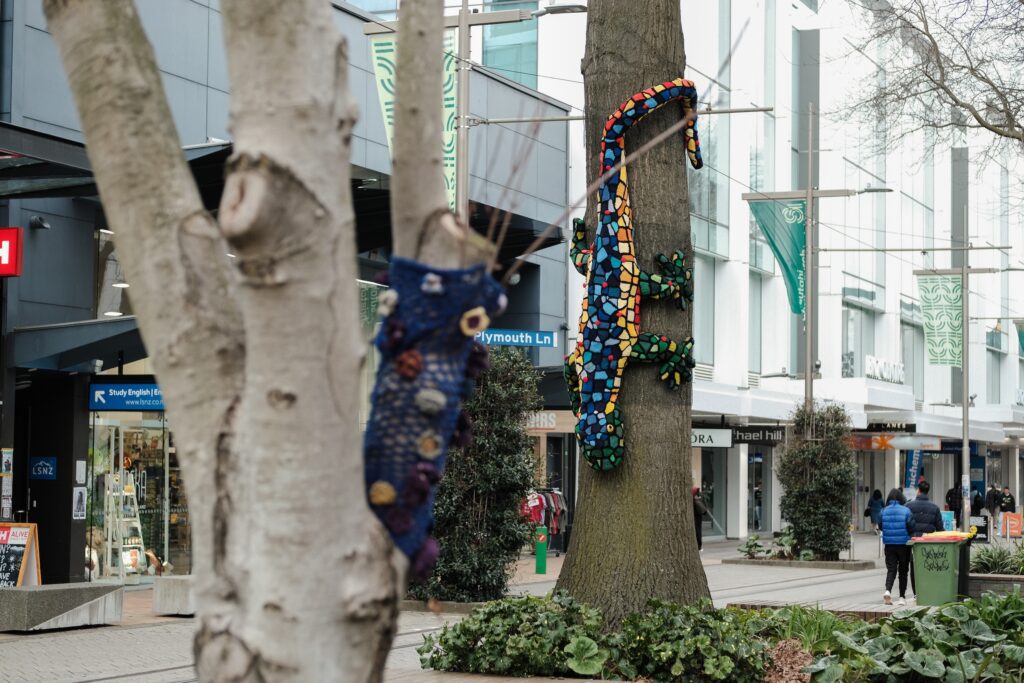
Kate Finnerty: In the initial conversations we had, people were saying “oh, I don’t know what to make!”. There are some people who’ve been there from the start, and it’s been great seeing that evolve into them saying “I want to make a giant lizard”, or “I want to do giant liquorice all sorts”, or “I want to do bike racks”. It expanded people’s imagination. It’s pretty scary putting stuff out there; as an artist, if you put on an exhibition, it’s scary, and if something happens to it, it can be quite crushing as well. So, some people had to build up a bit of resilience to that as well resolve to go through with it. It’s another form of strength, I suppose; it’s like, “right, I’m doing this!”.
It is interesting one, isn’t it? If you’re making something in that traditional craft approach, you tend to think about the lifespan of it as being something that will be sustained or passed on. If you make a scarf, or mittens, or a hat, those have this functional use, and you know that they’re going to be looked after and cherished by someone. And when you’re making something and then putting it out into public space, you have to hope the public will cherish it. But as you say, you also have to come to terms with the fact that it’s not necessarily going to survive as long. The longevity isn’t there, which is quite a change, particularly when you are putting in a lot of time and effort to create something. It is one of the big challenges that I think a lot of people who come to art in the streets from a different background struggle with. I think a lot of people who come from say, graffiti, they’re reconciled to that already. So, it is a big change and something that people really have to come to grips with. You’ve touched on some of the things that people have made over the years, do you have any personal favorites that you have seen come to life?
Kate Finnerty: I love the standalone artists, I think they make amazing stuff, but I’m always surprised at the community projects and what they produce. It’s because we’ve had over a hundred or something squares made from various people, who’ve gone to the effort of making a little square and dropping it at a library, and then we’ve pulled it in together into multiple tree and bench wraps and stuff. When I see them, I think of how many people were involved in those pieces of street art and that always makes me feel pretty special.
It reminds me of the big shipping container in Sumner post-quake that was covered in squares that people contributed. There is something really sweet about a lot of people coming together to contribute to something, because in the streets, what you see is a lot of voices, but they’re often jostling against each other. Seeing people come together and contribute to something more collaborative is really nice.
Kate Finnerty: There are a couple that kind of mirror what else is around as well. For example, while we were walking around the city one day, Deb, who helps me coordinate Yarnarchy, saw a little graffiti character. She said, “Oh, why don’t we try and yarn bomb it!”. There was a fence in front of it, so we’ve made a yarn bombed version of the character that’s behind it. Another one was a tree that had eyes painted on it, but you could only see them when you looked closely. They were super faded, I don’t know how long they’ve been there. So, we thought, why don’t we make some eyes that mimic those and just put them on? It just highlights what’s already there. They’re pretty cool.
When you do an event that recurs, you have to keep it fresh each year. This year, you’ve added a new element with performance, working with dancers from Jolt (a community organisation dedicated to the inclusive joy of dance). Tell us a little bit about those performances over the opening weekend…
Kate Finnerty: Last year, I was thinking of collaborations we could do and someone suggested a collaboration with a yarn bomber and a street artist. So, we did that last year and I thought that combining different practices was really good. I think Jolt’s an amazing company, and I am now working for them as well, so I put that to them and they were all super keen, marrying up the yarn bombers, making outfits for the dancers and just highlighting the diversity of all sorts in our city. The yarn bombers were just so lovely. They came and met the dancers then created costumes especially for them and that kind of built a relationship. The performances in the central city on the opening weekend were just something you don’t really see in Christchurch. The inspiration came from my mum being in Rome and sending me a picture of two women dressed in crochet outfits that were doing this very slow dance, opening up an art exhibition. So, that actually was the catalyst for this project. The Yarnarchy dance has totally unique choreography that the dancers have done with their school performance group. A friend said that when the dancers put on the Yarnarchy outfits, suddenly they were like, boom! They were in character, and they were really popping — seeing the elements combined was pretty cool to see. We wanted it to be fun, be simple, but also have a bit of an interaction with the audience. So, the dancers went out and handed out crocheted flower brooches to passersby, it was really great. We’re going to do it again next Saturday as well, with a few more Jolt dancers, so it’s going to be a bigger thing.
Speaking of which, in terms of the Yarnarchy ‘25 experience, how long will people be able to see the works? Where are some of the spots to find the works, and where can they see the second performance of the Jolt dancers?
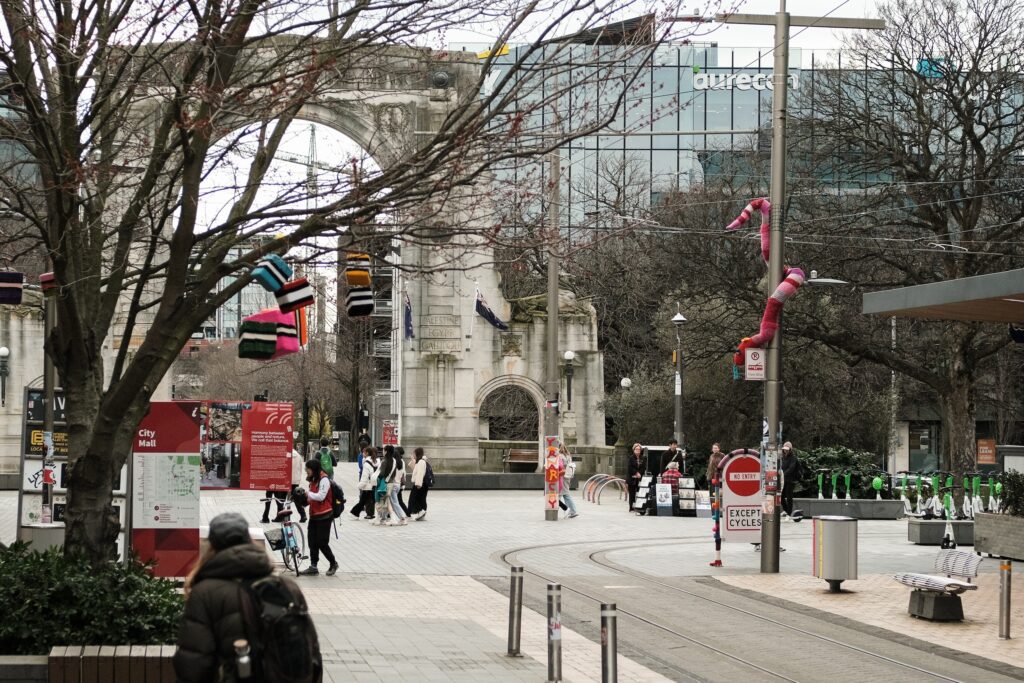
Kate Finnerty: We’re going to take the works down on the 21st of September, so it’s up for three weeks this time. We’ve extended it out a week just so people get to see it, but we also don’t want to leave it up too long because then it feels like a bit of an invitation for people to disrupt it. Most of the works are along Cashel Street and then Oxford Terrace and Worcester Street, just around the corner of Oxford, Worcester and Cambridge, and a couple of things in the square as well. The dancers will perform in Cashel Mall.
And what is the future for Yarnarchy? Can people be excited for in 2026 and beyond?
Kate Finnerty: Yes! I’ve had a few people ask what’s happening with Gap Filler and they said Yarnarchy has to continue, in capital letters! It is building such momentum and people are saying it gets better every year. There are a couple of people in the Council who I’ve worked with right from the start and they are really supportive as well. So, I think with this sort of energy and people being so keen — you know, they were walking past going “Oh my god, I love this! I remember Queen Victoria, you need to yarn bomb Queen Victoria again!” — it’s definitely going to be back!
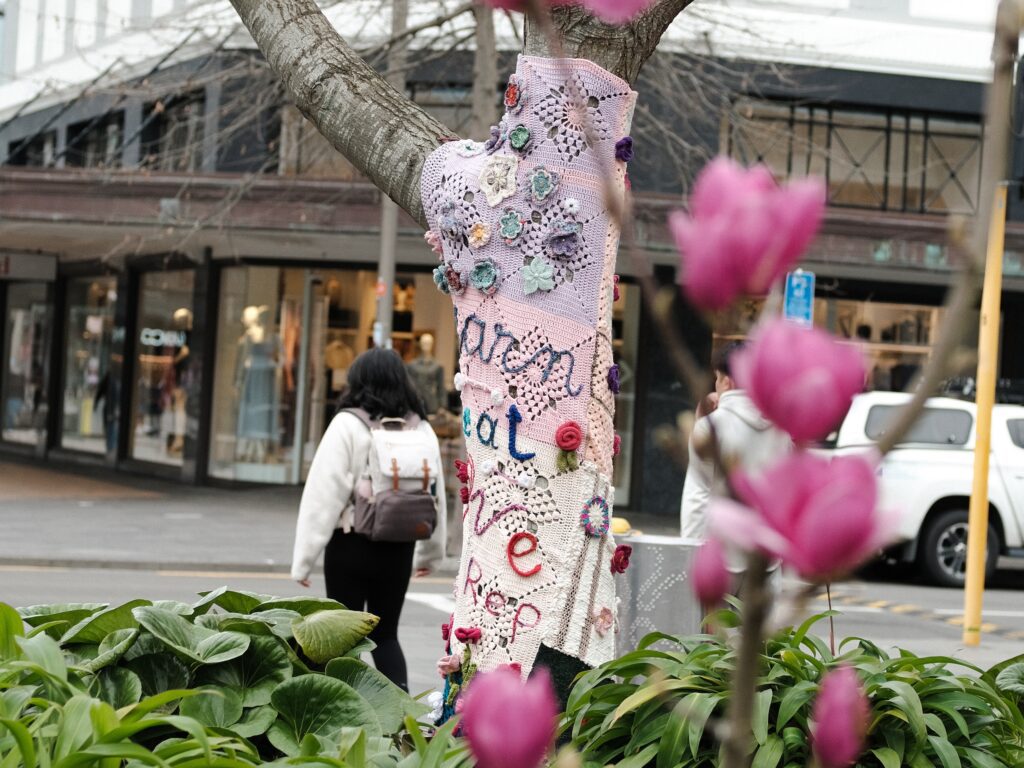
Go out and explore the magic of Yarnarchy and follow Gap Filler‘s socials for updates, performance times and more!