Over the last several years, Klaudia Bartos has produced a constantly evolving body of work, her twisted characters exploring a wide range of material forms and locations, from her plaster ‘clone’ heads found across the city to exhibitions of layered textile creations. For her latest show, Cut Outs at Absolution, Bartos continues to reframe her approach, exploring digital sketches and three-dimensional collage pieces. We sat down with the artist on opening night to discuss the collection, the process of putting together a show and how her work all connects.
Watch This Space: Kia ora Klaudia! How are you feeling tonight?
Klaudia Bartos: Good. Nervous. Overwhelmed, but very good.
WTS: How long has it taken to put Cut Outs together?
KB: I think two months. They [Absolution] originally offered me a month’s lead in, and in my brain, I was like, I can do this, I’m gonna do it! But then I was like, wait, hold on, I should actually be nice to myself! So, I gave myself an extra month, which was a perfect amount of time for me.
WTS: Did you already have an idea of the types of works you wanted to make?
KB: No, nothing!
WTS: So, when you are presented with an opportunity for an exhibition, what is your creative process to develop something cohesive?
KB: Oh my God. It’s so random in my brain! When Absolution confirmed the show, I was literally at work [at Gordon Harris Art Supplies] and I was like, what should I do? I just looked around and got inspiration. I thought, oh, I’ve been meaning to use the jigsaw and MDF. I’ve been wanting to do that for a bit, so, I thought, okay, I’m just gonna do random shapes because that’s kind of how I work. I just quickly do like an outline and then focus on the detail later. So that’s kind of what I did. It’s very random though. I went to op shops and stuff and found things that inspired me rather than planning it. I went and found leather and fur. I cut up a teddy bear, which was one of the hardest things I’ve ever had to do!
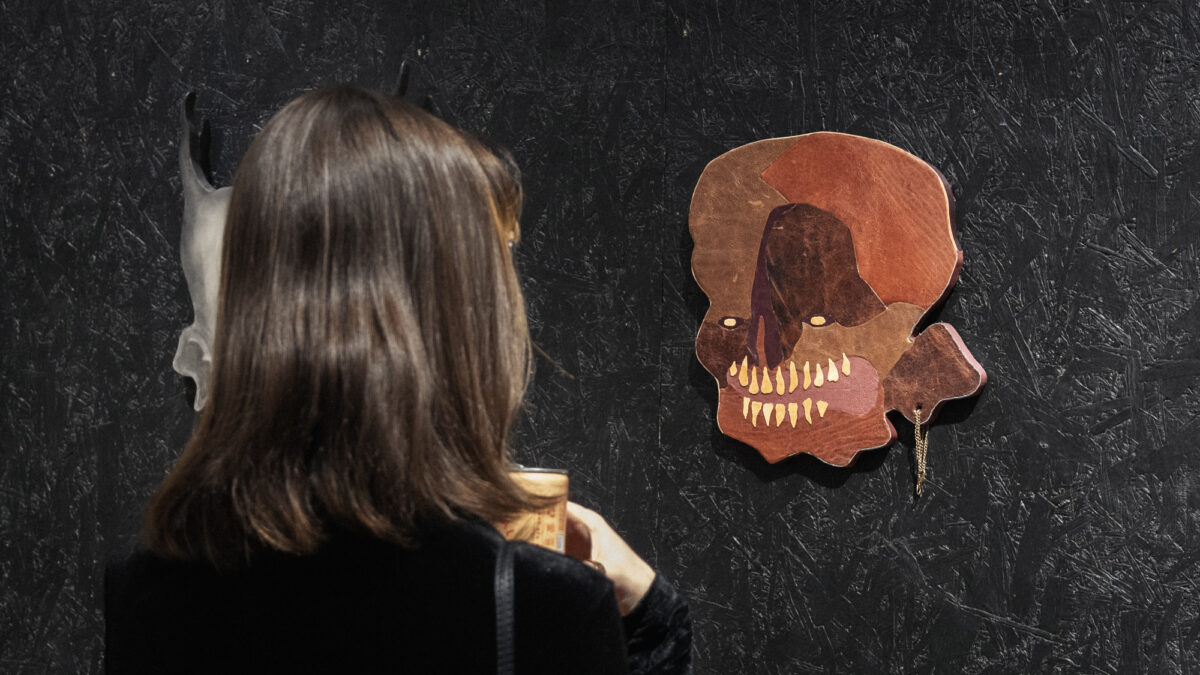
WTS: One of the defining traits of Cut Outs is the material diversity. As you’ve already mentioned, there’s leather, there’s the fur, there’s wood, there’s various adornments. There’s even collaged photography of teeth in one of the pieces…
KB: Yeah, that was random as hell!
WTS: Exploring material qualities feels like something that’s increasingly become a big part of your process. Do you generally find the material first or do you decide you want to work with a material and then seek it out?
KB: It’s very much finding it first. I just let it come to me rather than decide. The shape is my plan, but then what’s going on to that shape is the universe’s plan. That’s so cringe, but you know what I mean…
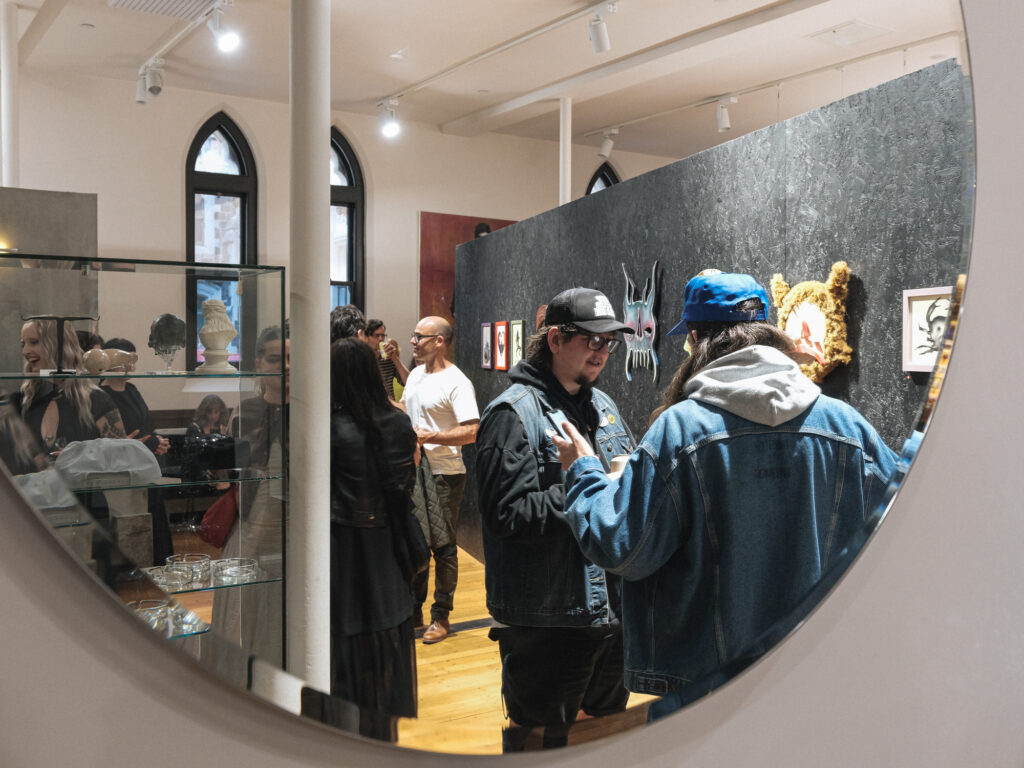
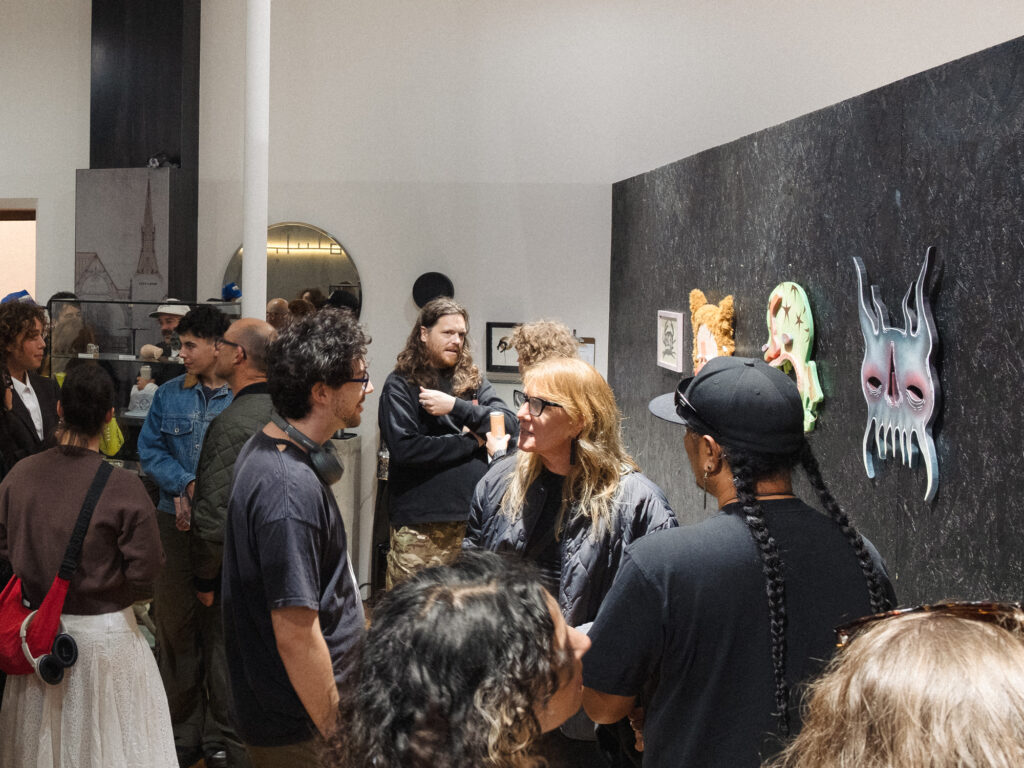
WTS: There are essentially two bodies of work within the show, you’ve got the cut-out forms, which could be characterised as heads or masks with textures and layers and tactility, and then there are the series of digital works that are flattened, almost silhouetted forms. How did those two threads develop?
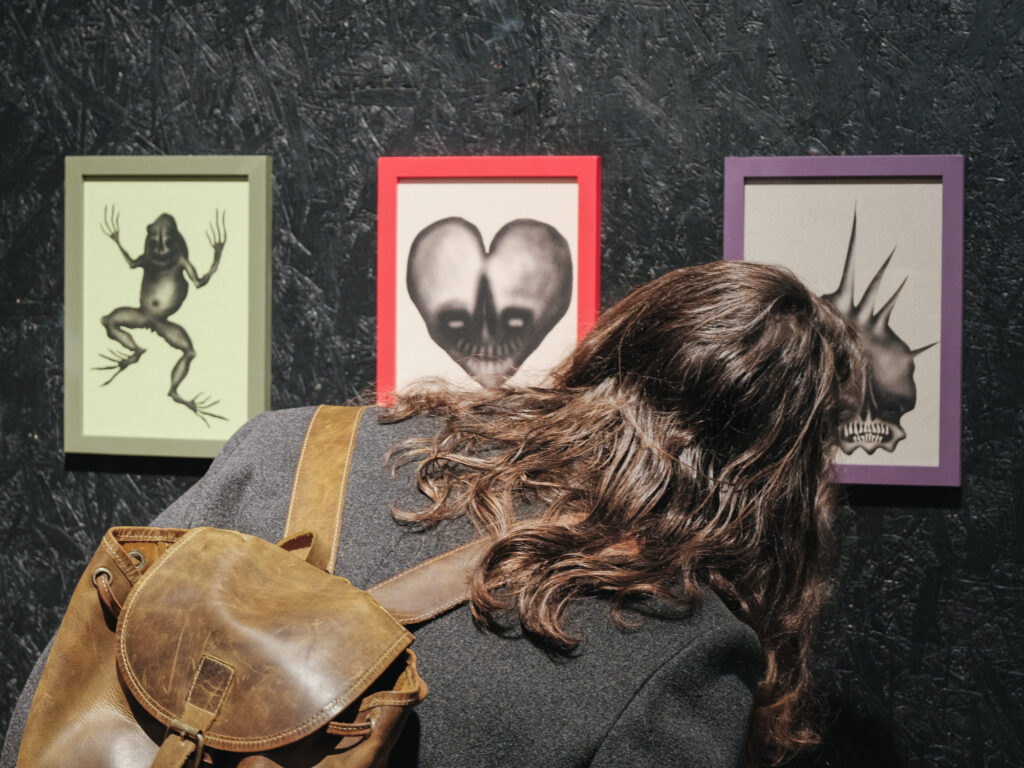
KB: I’ve just been doing the digital work in bed, when I feel like doing art that’s not in the studio, but I still want to play. So, the same way I do the larger three-dimensional cut-outs, I would do the digital ones where I just draw a random shape and then I made a paintbrush on Procreate that was kind of like an airbrush, because I can’t afford an airbrush, and it allowed me to fill it with shading and stuff.
WTS: When I first saw them from a distance, I assumed that they were actually charcoal drawings…
KB: Someone else said they thought they were charcoal as well. What I like about the digital process is that you can just build the image up layer over layer. I just start really light and I build it up, build it up, build it up. I also like the idea of being able to reprint them so they can be a bit cheaper for people, to have a more accessible option for people.
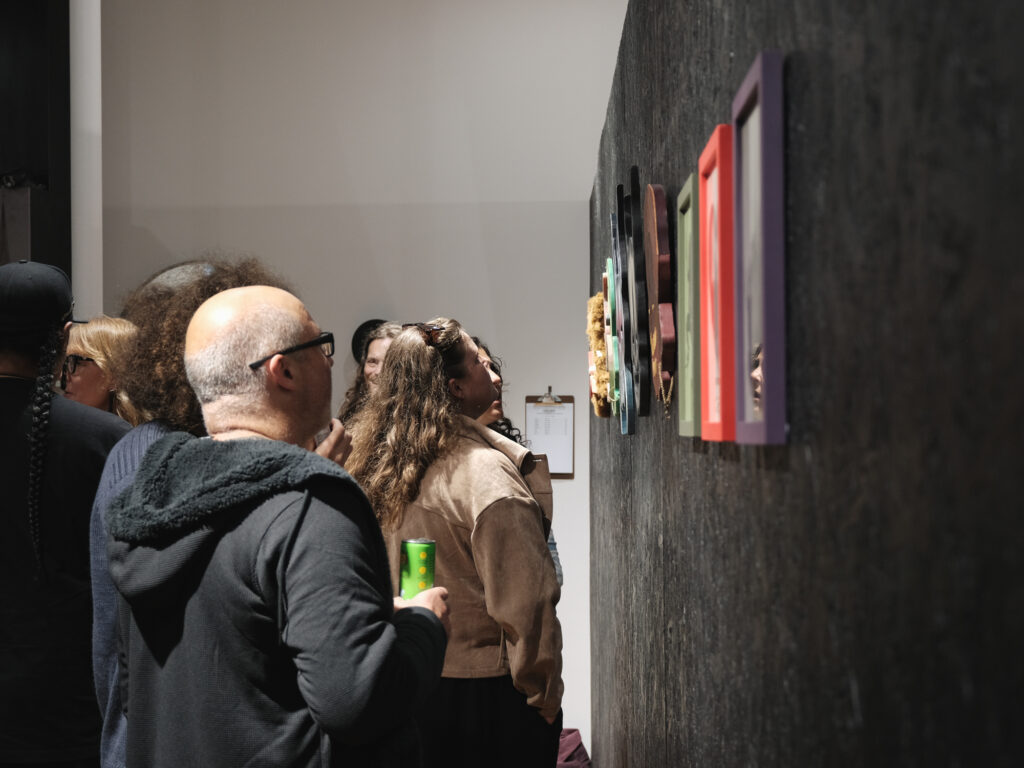
WTS: Yeah. The coloured frames are also striking.
KB: I printed them on coloured paper as well to match the frame. I think that’s fun. I spray painted the frames because I still wanted to have something that I did to those pieces physically, to make them unique pieces.
WTS: Along those lines, I really love the textured surfaces of the cut-out pieces. Some of them have this lovely kind of worked surface quality where that tactility is really obvious. It’s really hard to resist touching them!
KB: I know I was thinking that. I was like, should I put up a do not touch sign?
WTS: As you have increasingly put your art out into the streets, that idea of people directly engaging with them is unavoidable in that context. When you go into a gallery setting, do you still want to invite that kind of connection?
KB: You have to buy it to touch it!
WTS: Is that something that you give more thought to now – the difference between the street and the gallery as a setting for your art?
KB: I mean, when I first started putting up my heads and stuff, I remember someone telling me, ‘I just took one of your heads’. It was still like fresh and I was like, okay, that’s all good, so it’s kind of always been a part of that side of it and I think I adjusted to it quite quickly…
WTS: You do see so many of your plaster heads where parts are chipped off because people have obviously tried to pull it off.
KB: I like that.
WTS: I really like the fact that it’s almost impossible to do it though. They kind of self-destruct in a way, and then you see these faces with like, battle scars. It’s kind of like they’re insistent on staying there.
KB: I always imagine someone trying to get one off, I’m like, dude, just message me. I can just give you one! You could buy one for like $10. I don’t care.
WTS: Do your exhibitions influence your thoughts on what the next sort of street installations might be?
KB: Maybe. I have been thinking about more street stuff, but I’ve also only just relaxed my brain after this one.
WTS: For a lot of people, there is a necessary distinction between the two spaces, each supports slightly different approaches.
KB: I guess the main thing for my street work is that they need to be easily reproduced for me, like made into multiples. One thing I do want to keep doing is kind of what we did with the Little Street Art Festival [Klaudia’s 2024 Little Street Art Festival series I See You], like, there are these green gates at a park that I would love to fit my heads into, kind of blend them in…
[Dark Ballad, unaware of our interview, joins us at the table and begins talking…]
KB: We’re doing an interview!
Dark Ballad: Oh, sorry! I’ll go!
WTS: That was impromptu!
KB: Can you please keep that in?
WTS: Of course! Getting back to Cut Outs, how long does the show run?
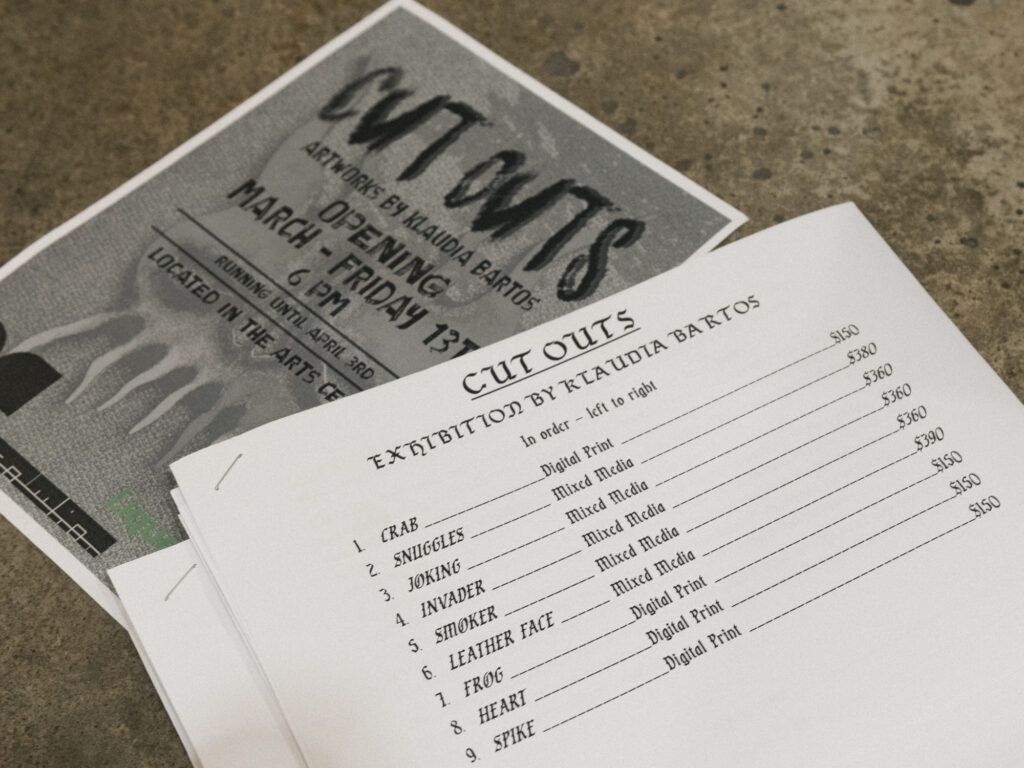
KB: Cut Outs is at Absolution at the Arts Centre until April 3rd – come and see it!