
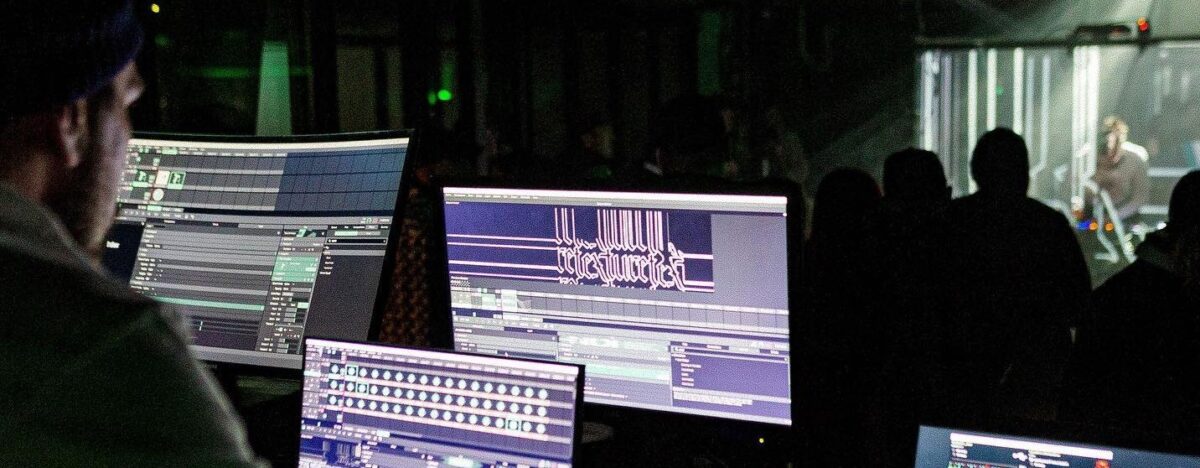
“Your favourite artist’s favourite artists” – it might seem braggadocious as a tagline, but in the case of Sam Emerson of Offline Collective, it reflects the way his work amplifies other creatives – from providing the atmospheric and evocative backdrops for musicians and festival stages, to his collaborations with artists in an increasing number of public projection-based installations. Deeply immersed in his craft and constantly exploring new ideas, Emerson continues to evolve his work technically and thematically, from audio reactivity to expressions of cultural identity. His recent public works, Hurihanga, produced with Flare Ōtautahi Street Art Festival and The Christ Church Cathedral, and Ruruku, produced with graffiti artist Drows for Tīrama Mai 2025, have suggested new possibilities for urban art, transforming architecture with striking sound and moving image, alternately beautiful and fiery. Discussing these works and his career trajectory, our conversation with Sam Emerson was wide-ranging and revealing of art’s ability to transcend defined parameters…
Let’s start by going back – growing up, were music and visual art both constant creative outlets, or did one come first?
Sam Emerson: As a kid I was always very interested in art. I even did extracurricular art classes after school. My mum had picked up my interest in it and then found Pete, I can’t remember his last name, but he was a local artist in Geraldine that was doing caricatures in a magazine. He taught me a lot about the basics of art, like cross hatching, shading and things like that. That interest just kept going throughout my life. I actually did a painting at a school I went to that is still there and sits behind the rector’s desk…
A legacy piece!
Sam Emerson: So, I’ve always wanted to be involved in art, or I guess, to be an artist. Then the music stuff, I liked music, I’d go to gigs and then that eventually turned into DJing and trying to make music. It was actually the first gig that I got booked to play outside of my bedroom where there was a screen there, and I asked how that works. By the end of it, I was running the screen. I never made music again after that.
When did you start to dive into the digital approach?
Sam Emerson: Even as a kid, I remember playing around on MS Paint and drawing things. But it was probably after that very first gig where it was sort of like, right, there’s an outlet to do cool stuff. I was obviously interested in music as well, I probably didn’t even see it at the time, but I just really liked the fact that I could go and make cool images or video art on a screen while listening to music that I liked. It evolved and then I had to learn more of the tools to be able to do more, which then opened up a big can of worms in terms of learning the digital side of it.
Have you learned informally, or did you end up studying somewhere?
Sam Emerson: I went to university to study industrial design. I wanted to work at WETA Workshops. I dropped out of university, but I actually got an internship at WETA, and then right as that was coming to an end and I think I was heading towards a job, I had a relationship breakup. I was in Wellington, and I realized that my entire friend group was actually her friend group and I didn’t know anyone. That’s when I moved to Christchurch, which then kicked off my move into the music side of things.
I guess it’s like they say, things happen for a reason…
Sam Emerson: I almost look at it as fate, or that it directed me to where I was supposed to be going. As much as maybe I thought that I wanted to be at WETA Workshops and making movies, I’ve ended up in a field that truly fulfils my passion. I wanted to build sets and stuff for movies, but building a stage for a festival is just basically building a set with lots of lighting and pretty colours, so it’s kind of similar, but ultimately, I’m far more passionate about…
That juxtaposition of, I guess, the tactility of making and drawing against the screen-based nature of the digital process, how do you balance that? Do you use and write code?
Sam Emerson: I try and use a lot of things. I think it probably helps satisfy my ADHD brain. But I love using mixed media and actual physical media as well. I did an AV set for an artist in the Netherlands last year, where it all started on paper first and then was later scanned and digitized and then run through effects and things like that where needed. I can’t actually code, but now I can use ChatGPT to write code, so I’m learning a lot about that, which has become another tool in the kit.
In that context, how much is the AI revolution impacting what you can do? Do you see it as something that is unlocking possibility rather than being a threat?
Sam Emerson: I think at the moment it’s definitely unlocking potential. It’s more of a tool, and I like to use it, not to create the finished product, but to help me along the way. But I actually do see that the writing might be on the wall for the 3D side of stuff, for a lot of what I’m doing. If we’re at the level of what it’s doing now, I mean, Sora 2 has just been released and it looks like real life. It generates the audio at the same time. What is it going to be able to do five or ten years down the track when you could just upload your song that AI probably made anyway and get a visual made for it on the spot within five minutes? So, I think that might be the death knell for it all. But I also like to hope that people and artists will try to retain a sense of human connection as well.
I think that’s at the crux of that whole dialogue, right? It’s our willingness to celebrate the humanity of creativity that’s going to be key. I want to go back a little bit to you coming down to Ōtautahi. Arriving here, how important was the celebrated drum n bass and dance music scene down here? It’s such a strong presence here and is recognised globally, but lot of people who maybe aren’t part of the culture, myself included as more a band guy, don’t realize how big a reputation Christchurch has…
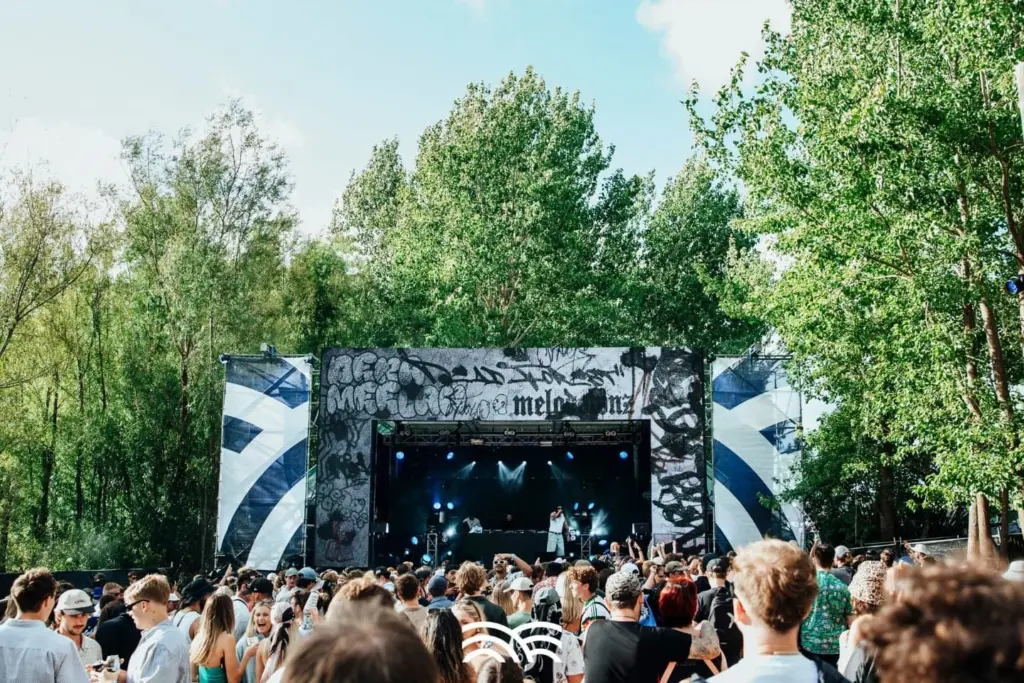
Sam Emerson: Yeah. Christchurch has always had been an outlier in that regard, especially in relation to the music that’s come out of the UK. This was basically the second-best place they could be playing. This goes back pre-earthquake too, there was a legendary club called Ministry here in Christchurch where you could hear almost every international DJ saying that it felt like playing back home, if not better. I moved here in the post-earthquake landscape, I think it was 2013, and I sort of fell into Dux Live, which ended up getting named best music venue in New Zealand two years in a row during that period. I came in there not knowing anyone and by the time I left, we were managing events and running lighting screens for them every weekend. It was very cool to be a part of because there was still a lot of that pre-earthquake community, but also a new generation that hadn’t actually even been to a nightclub that was then a part of it too. Christchurch has come a long way since those post-quake days, maybe not to the former glory of Ministry, but international headliners still note Ōtautahi as being an outlier in their touring calendar.
It’s interesting to take stock, being more removed from the earthquakes, but that more immediate post-quake environment has proven so formative to a lot of the city’s creative output. Whether it’s the spaces that came from it, or as you say, the importance of those places that were active because people had been so restricted, or even just the way you started to see a lot of people playing house parties and they became the next generation of people playing venues and staging gigs. I may think about it all slightly differently, coming from a public space perspective, but what do you think about the way the city’s changing now? The gaps being filled in, the maybe narrowing sense of possibility, is that something that you’ve noticed or is that something that the music scene can avoid because it is utilizing indoor spaces?
Sam Emerson: Yeah, I’d like to think that it can survive that change. I mean, it’s always good to push for and towards a city that accepts spaces that are needed for electronic music. But then, I also believe that even if they are not there, that they will be created by the culture that wants them. Like, if there isn’t a music venue to host a rave, someone will find a warehouse. Those things can then eventually turn into nightclubs or create teams that go and do it. There was a good story about it happening in Wellington a few years back with Club121, which was just a flat, where they used to host big house parties, but then that blossomed into a club and then eventually a festival with the same people running it the whole way through. Two Minds crew have a similar story, from flat parties to now a beautiful festival in Spencer Park (come, you won’t regret it). We’ve obviously just seen Flux close down, which has hosted a lot and been a great space for that community, so there is a hole that is waiting to be filled.
Do you think the right types of spaces are out there? Like post-quake, there were heaps of these slightly broken, or significantly broken, spaces that weren’t being used. There was a sense of possibility. Now, with so many new builds and higher rents, cost and access become prohibitive. But again, just like with AI, it comes down to the desire of the community to make it happen, right?
Sam Emerson: I think there has just been a big, I’m not sure what you’d call it, like a submission to the Council about inner city noise ordinance. I think I saw the report that’s come out about it and that everyone voted very favourably about being able to have higher noise levels in town because it’s such a big part of Christchurch’s culture. I’m not sure of exactly the demographic who voted, but it was good to see an outcome like that. I’m always looking internationally, like at the way that Berlin treats some of their nightclubs, as if they were museums, holding them in the same cultural status. It might be a pipe dream, but I’d love to see the same thing happen here in New Zealand. But at the same time, I think there is a need for an unfettered space that recognises that there is a lot of arts and culture involved in music and it needs a space to grow, whether that’s a smaller Darkroom-sized venue or a suitable nightclub, because it does happen less now. Even some of the bigger gigs are forced to go and just do it in a park, under a tent, or things like that. I mean, the stadium might fill some of those gaps, but a nice big purpose-built music venue would be amazing. A lot of places around New Zealand have multiple venues like that already, but we’re doing them in sports arenas and in marquees on QE2 field or part of the Red Zone. They used to fill up those empty spaces in Christchurch’s inner city, but that was when there were a lot of those empty spaces and the city was crying out for events at the time too. Whereas now, with the progression of the rebuild, there’s not only a lack of those empty lots in the middle of town, but maybe there’s less of a need for the Council to sign off on an inner-city late night noise event as well, with so much else happening.
Changing tack a little bit, how would you describe your aesthetic when it comes to creating visual work for gigs and shows and festivals? How do you approach pairing up moving images with music?
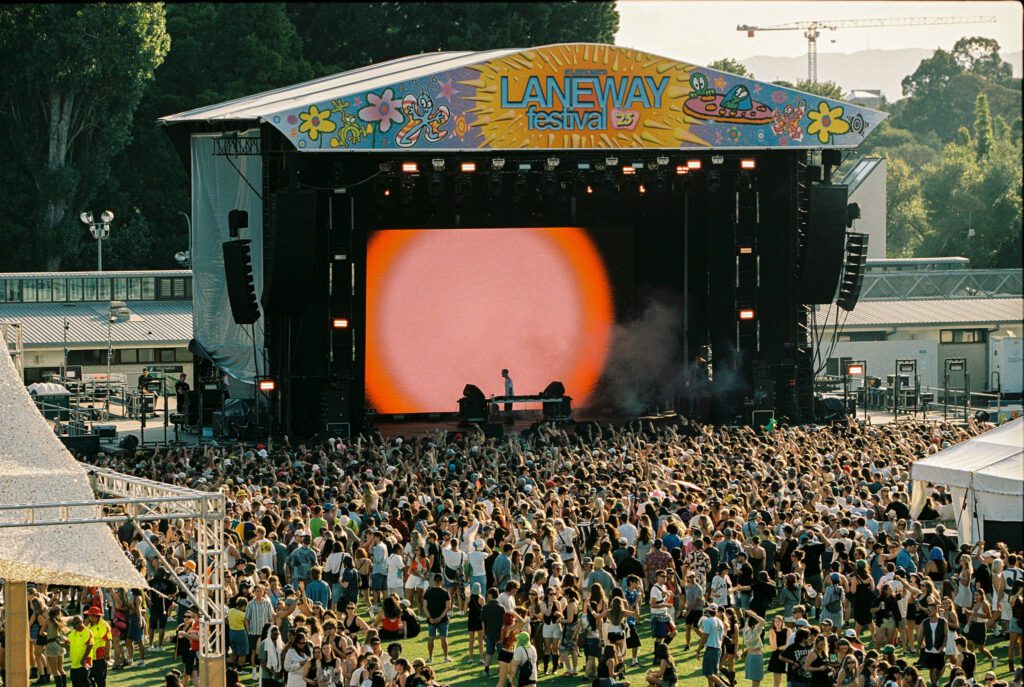
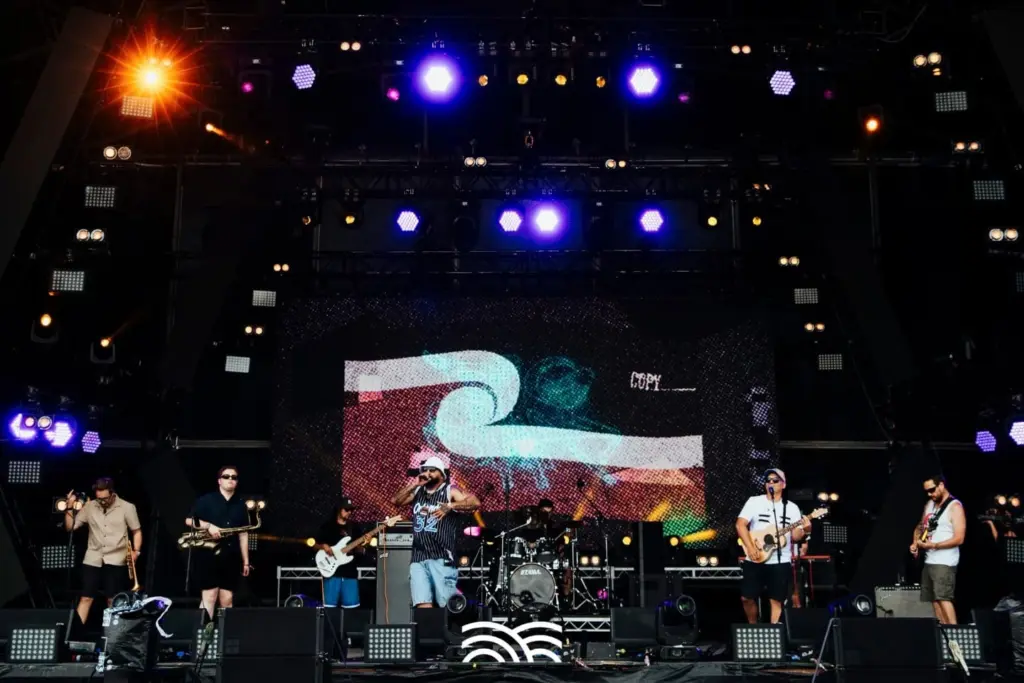
Sam Emerson: There are a few ways that I approach it. There can be times when I’m operating visuals at a gig and I’ve not been given a brief or have only been given a logo and not too much else. That’s often more fun because it allows you to do what you want. In those examples, I often feel that I’m listening to the music first and then creating what I think it should look like in my head. I can turn up very empty handed to a gig but within five minutes of the music being on, I start to build something for the screens that then looks like what the music should be looking like. Then there’s the other side of it which can be very methodical and thought out, because you’re dealing with it for months before the gig and you’re making a lot of content and a lot of the time that is dictated by the artist. Even when they have a brief or a dream of what they want to create, I still enjoy putting a piece of myself in that somehow, something that remains recognisable to my own brand without like blatantly using my own logo on the screen at the same time. In terms of style, I like to create stuff that looks like where it’s come from. Like, if it’s very rave or underground-influenced music, I’ve got folders full of newspaper clippings of illegal rave parties and things like that, and I like to get them dancing around the screen at the same time. I used to have a lot of imagery and videos of broken buildings in Christchurch that you can then go in and effect in different ways. Even if it’s not visibly on the nose on the screen, I’ve always really enjoyed having something in there that has a story to it. Like, I’ve got some of the first actual video footage ever made on early film cameras. Taking that and distorting it a bit and just having something in there that tells a story that not everyone needs to know about, I’ve always really enjoyed that approach.
I remember reading that for a subculture to be fully formed, it needs to have a visual art, a musical form and a form of dance, because these are the bedrocks of our human cultural expression. Your job is to connect those three things. How do you see the visual element extending to the audience and how they move? Obviously, the audience’s movement is often influenced by the music, and is both individual and collective, does the visual part also have some role in encouraging physical responses or is there a way it might work in the other direction?
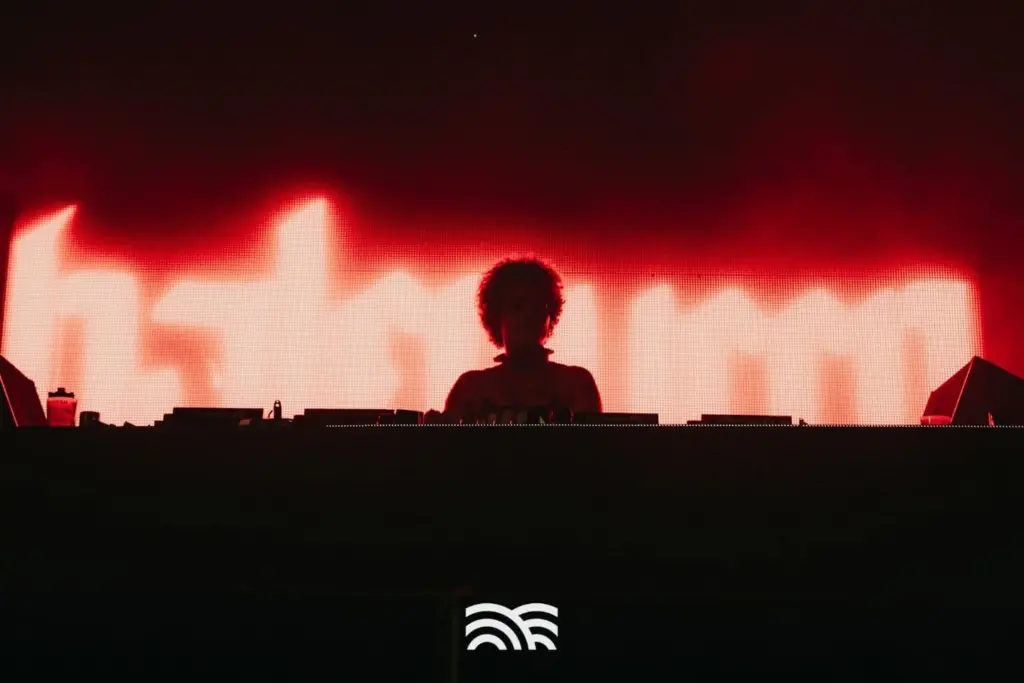
Sam Emerson: I love using audio reactivity. It’s something I don’t see a lot of because often it’s not as controlled and clean as a lot of designers would want it to be, but I kind of enjoy the randomness that it creates. And it doesn’t have to be the entire screen, but you can have certain elements that might be sort of reacting to the bass in the sound, and the other one might be on the snare. So, if you have those two things, they are essentially dancing around the screen because of the audio, like you could have a fisheye sort of bouncing a logo around with the kick of the drum, then other things can be shuffling around with the high end of it. I’ve always sort of considered that a big part of my look. Sometimes I actually feel held back a bit if I don’t have an audio input, because even when you can sync stuff to a BPM or have it tap into the timing of it, to me, it becomes too perfect because it’s doing the exact same thing every time. But audio reactivity can be affected by the yells of a crowd at times or if someone walks past, so it is giving a slight bit of difference every time. I don’t like making loops. I want them to continuously evolve. Like the music, sort of like a DJ set would evolve. There’s also some less serious stuff my mischievous side likes to do, since everyone’s looking at the screens and you have their attention. Last year at a gig before the main act, I spun a camera around on the crowd and put the words KISS CAM on the screen, it had a few people kiss as well, which the rest of the crowd loved.
You make work that is used for shows all over the world, how much do you think about that sense of place? Is there a universality to the experiences or the music, or are you thinking about each specific audience and gig? A gig in Berlin is different from a gig in Ōtautahi, does that influence the type of aesthetic you might deliver?
Sam Emerson: I think to a certain degree, yes. I’m working on a show with this big, wide screen and I’ve used a train in the visual and because of where it is, I’ve modelled trains they’ll recognize, but also threaded a bit of NZ in there, with MEEP graffiti all through the train station. Making some content for Homebrew, with some of their songs about poverty and the treatment of children and things like that, I was able to find actual New Zealand newspaper articles and stuff relating to the lyrical content and then use them throughout the set, bringing that to the fore and really relating where the music has come from and what it’s talking about to what’s happening on the screen at the same time.
Tell me a little bit about the beginnings of Offline Collective and how that has grown and evolved.
Sam Emerson: Well, essentially, I was doing what I’m doing with Offline anyway, but I was also doing a number of things for music festivals, and within my role was taking care of the visuals long before Offline was formed. There was this kid who I’d taught how to VJ a little bit, and he mentioned that he’d made opening videos for Call of Duty montages on YouTube in the past. I started using him to create visuals to buy myself more time to do other stuff at the festivals. In that festival role, I was working for this guy, fuck mentioning his name, who I found out was a bit of a scumbag (recently sentenced for sexual assault) and as soon as I found out what was going on, I left immediately. He had a shot at my career because I’d sort of caused a bit of a stir on my way out, and I lost a lot within about six months. But, basically Offline formed off that. It was when the first lockdowns were happening, I didn’t quite know what I was doing because the last seven or eight years, my whole career was focussed on becoming a creative director at festivals, but I had gained all these skills along the way in the visual side of it. So, with this kid as well, one day we were like, well, should we just start a business doing just that. He had sort of taken over my role actually operating the visuals at those festivals because I was too busy doing all this other stuff. So, we just sort of went for it. We had no idea what we were doing and now we’re five years on. He’s recently gone and started his own studio, heading to the UK with it, but Offline is still a strong team and brand that I’m continuing. We’re working for a lot of festivals in New Zealand and have a lot of international clients. The way it’s grown for a couple of guys that had no idea what we were doing, I guess we did on the visual side, but on the business side we didn’t, it feels quite cool to be honest.
One of our key points of interest is, of course, the work you’ve moved into doing in public space as public art projects. There are a couple of notable ones, working with Flare Ōtautahi Street Art Festival and the Christ Church Cathedral to make Hurihanga for Matariki, and of course for the Tīrama Mai festival, you created Ruruku, working with Drows. Those two works were strikingly different, but both really powerful. Can you talk a little bit about those projects, because I imagine they were quite distinct to develop, working with collaborators, working with different organizations and entities and utilising different spaces…
Sam Emerson: I feel very much the same on the difference between them. While the Cathedral work was a very special project, Ruruku became probably something that’s more in line with my own aesthetic. Not to say that I’m not proud of what we made with the Cathedral, we were making a project to honour Matariki on the side of one of the most prominent cathedrals probably in the southern hemisphere, so there was a lot of respect there. I don’t think I would have got away with putting the same content on there as I put on Ruruku.
Of course.
Sam Emerson: But it was also very cool to push ourselves technically. I worked with a team on the Cathedral. It was cool to push ourselves into making something that was very clean and told a story while still having a bit of wow and punch to it that we were able to deliver with both the soundtrack and the visuals at the same time. We were telling the story of Matariki with light.
Whereas on Ruruku with Tīrama Mai, I was paired up with Drows, a graffiti artist, and they just said, go for it, take what you want from our central theme and turn it into the art on the wall. Not that I’m torn about it, but I probably ended up with a finished product visually that is more in line with my own aesthetic for Ruruku. But then Hurihanga will always be a special one because of what it is, the opportunity to projection map an icon, and what it was for.
Hurihanga had a lovely sense of tranquillity, there was a sense of beauty, whereas with Ruruku there was a fire, an intensity, there was a confrontational element. How did you frame those intentionally challenging aspects in terms of communicating to an audience?
Sam Emerson: Yeah. It wasn’t like, proving a point, but I might have wanted to annoy some people as well with it, in a way. Not to offend, but maybe to just get a story or a conversation started. While I had a good idea of what I wanted to create, and had made a lot of visual content, it was again about leading with the music. Mokotron, a prominent Māori musician that threads te reo into electronica has a tune called Ōtautahi, and I talked to him about licensing it for the project, and it turns out he had an unreleased remix of it, so I worked with both the released and the dubplate to create the soundtrack. Mixing them together, utilizing different parts of each, creating build-ups of intensity, periods of calm, peaks and troughs really. With that in place, the visual elements were then lined up to suit. Big moments of the soundtrack were matched with the video, drops became like a big release where it just went completely across the screen. I had Drows write up a whole bunch of hand-style stuff, words that looked scrawly, like graffiti all over a wall, but were actually talking about honouring your family and your ancestors and where you come from and looking ahead to the future, how to be a better person, things like that, but in a hand-style to make the building look like it was covered with it. I referenced it with the Broken Window theory, where a broken window would cause graffiti and then suddenly a whole place is covered in vandalism and destroyed. It was near the Arts Centre and near a lot of very colonial Canterbury buildings, so to put a temporary broken window effect on the side of a building was part of the statement I wanted to make.

I had a moment on opening night, standing on Worcester Boulevard watching Ruruku and this Uber pulled up and a couple of older gentlemen in tuxedos with bow ties got out, walked into the Canterbury Club directly behind us, and they didn’t even see the work, they were oblivious. It was hilarious because it was glowing and fiery, I don’t know how they didn’t see it, but it felt very much like a fitting juxtaposition…
Sam Emerson: That was definitely one of the buildings I was talking about. Knowing that Ruruku was directly opposite from somewhere that is essentially worlds apart from what I was intending to put on the wall was a big driver. Knowing that if that building actually ended up covered in graffiti, it would get buffed the day after because of where it sits in the city. But this was a city-led art project that couldn’t be denied, and it was also only temporary at the same time. And if you looked deeper, and translated the words on the building, there was a deeper story to be told.
It was striking how the work built up into something, from quiet to intense, with increasingly loud moments, the visuals echoing the audio, it was a progression. But when you’re creating something where you can’t necessarily control how long an audience stays there, which is quite different from a gig or even a film, how do you approach the possibility that someone may only see a part of the narrative you are wanting to present?
Sam Emerson: Yeah, I think throughout Ruruku there were essentially bits for everyone. Like while there were moments where it was absolutely covered in graffiti, there were also times where there was a more traditional 3D-based projection mapping, where you were taking the building and turning it into particles or vines growing over it and things like that. There was also a whole bunch of more traditional Māori-based artwork that Drows put together that I was able to then turn into pou on the columns of the building, or a koruru emerging from it. So, you could watch the whole thing and see essentially like four or five different episodes, or if you were just walking past, you might catch something that if a person walked past five minutes later, they would have seen something completely different. I think that’s the key of not going into a loop, of not having it look too much the same throughout the whole thing, there were other chapters to it in a sense.
WTS: Both Ruruku and Hurihanga draw influence from Te Ao Māori. How impactful has it been for you to be able to connect with your culture and heritage through those works?
Sam Emerson: They’re both probably the first two projects that I’ve really put that thought into, about my sense of identity. But it’s something that I should be putting into my work a lot more. I’ve realised it doesn’t necessarily have to be as blatant or on the nose as something like a tribal carving pattern, there are other ways to express it, down to using a flax weave as texture on minor objects and things like that. Those are some of the little things that I feel I can insert into projects that aren’t even related to New Zealand or myself specifically but can just have a little bit of me in them. I’m planning to chase that a lot more as well.
Speaking of chasing things, I’m not sure if you remember, but we had a conversation, during Tīrama Mai actually, talking about the potential of outdoor projection-based works and the evolving technology. The practical projection side is changing at a pretty quick speed, the size, the power of projectors. How exciting is that for you in terms of the possibilities for public projects? What ideas have you got floating around for future works?
Sam Emerson: I guess it’s probably been just over ten years that I’ve been playing with projectors, but in that time the price and the size of them has come down massively. When I first started, you were dealing with huge suitcase-sized projectors that were essentially only putting out like 6k bright in terms of lumens. Whereas now a 6k bright is just bigger than your hand. It’s making the ability to create art with them far more accessible. Recently, just for my own curiosity, I’ve bought a handful of these tiny little projectors that run on batteries. I’d like to explore projects where I just put them on a wall and leave them. It’s a way I could put a mural on a wall, but I also want to test the bounds of whether it is really vandalism if it’s temporary and things like that. So, with the price and size coming down so much and the technology meaning you can just plug a USB in the back of them and leave them there, battery powered, it’s definitely made it far more accessible.
I’ve always been fascinated by that, there’s so much possibility. You must be coming into a busy period with summer festivals and events. But being that you basically work globally, do you ever get a quiet period?
Sam Emerson: I think I’m my own worst enemy when it comes to that. I live alone. I don’t have a TV. I live in a village with 16 other people who are all about 20 years older than me at least, so there’s not much to do there if I’m not creating. I do love getting outside. I always take daily trips down to the beach with my dog. But even if I’m not working, I will go back in and work on something. Like with Offline, we’ve got, I don’t know, maybe 50 of what I guess are kind of VJ packs that we only use internally, but they’re just things that I’ve hyper fixated on one night and gone and made 20 clips that look kind of similar, but by having all these, now they’re on the crews hard drive as a library of content to pull from. I like to learn, I’m constantly watching YouTube tutorials on new techniques, and I put that into practise creating content for the social media grinder.
What is Sam Emerson’s dream gig or event to create a visual for?
Sam Emerson: I have this underlying dream of running my own festival, so it would probably be the visuals that would be there. That would be it, I think.
And we’ll see that soon?
Sam Emerson: I’m not sure. I’m not sure because I’ve tried being a promoter. I’ve run a few gigs myself, but I actually found it more like gambling. And I’m not a gambler. Like, you’re taking so much of a chance. But throughout all my years, it’s stayed with me as a goal, I even have in my head the team that I would pick to work on it, and then that’s where I’d find the promoter and the right people. It’s still a pipe dream, and I think as I’m growing up, it might be less of a rave and more of a nice day out. I’ve always been a fan of food as well, so being able to mix food, music, and art all together somewhere in a beautiful spot in Canterbury, give me another ten years, maybe…
That sounds pretty good to me. Thanks, Sam!
To see more of Sam’s work, check out his Instagram.